🕒 10-12 min read • Updated: July 2026
Table of Contents
Introduction
Imagine receiving a product recommendation that feels like it was made just for you, seeing an advertisement that matches your interests, or getting a marketing email at exactly the right time. These experiences aren’t random—they’re increasingly powered by artificial intelligence (AI).
From global brands to small businesses, AI is transforming the way companies understand customers, create content, personalize campaigns, and measure marketing performance. Instead of relying solely on guesswork, marketers can now use AI to analyze large amounts of data, identify trends, automate repetitive tasks, and deliver more relevant experiences.
But what exactly is AI in marketing, and how does it work?
In this beginner-friendly guide, you’ll learn what AI in marketing is, how businesses use it, its key benefits and challenges, popular AI marketing tools, and real-world examples across different industries. Whether you’re a student, entrepreneur, marketer, or simply curious about AI, this guide will help you understand how artificial intelligence is shaping the future of marketing.
Key Takeaways
- AI in marketing uses artificial intelligence to automate tasks, analyze customer data, and improve marketing decisions.
- Businesses use AI for content creation, personalized recommendations, email marketing, advertising, customer support, and data analysis.
- AI helps marketers save time, improve customer experiences, and optimize campaigns with data-driven insights.
- Popular AI marketing tools include ChatGPT, Gemini, Claude, Canva AI, Grammarly, and Perplexity AI.
- AI works best when combined with human creativity, strategic thinking, and ethical marketing practices.
What Is AI in Marketing?
Artificial intelligence (AI) in marketing refers to the use of AI technologies to help businesses plan, create, manage, and improve their marketing efforts. Instead of manually analyzing customer behavior or performing repetitive tasks, AI can process large amounts of information, recognize patterns, and recommend actions that help marketers make better decisions.
In simple terms, AI acts as an intelligent assistant that helps marketers understand their audience, create personalized experiences, and automate routine work.
For example, an online store may use AI to recommend products based on a customer’s browsing history, while an email marketing platform may use AI to determine the best time to send newsletters for higher open rates.
Unlike traditional marketing, which often relies on manual analysis and broad audience targeting, AI enables businesses to deliver more relevant and personalized experiences to individual customers.
Example: When Netflix recommends movies based on your viewing history or Amazon suggests products you might like, AI is helping personalize your experience using data and predictive algorithms.
As AI continues to evolve, it is becoming an essential tool for businesses of all sizes—not just large corporations. Even small businesses and individual creators can now use affordable AI tools to improve productivity and connect with their audiences more effectively.
Learn more about the fundamentals of artificial intelligence from IBM.
How Does AI Work in Marketing?
Artificial intelligence works by collecting and analyzing large amounts of customer and marketing data to identify patterns, predict outcomes, and automate tasks. Instead of replacing marketers, AI helps them make faster, more informed decisions and deliver personalized experiences at scale.
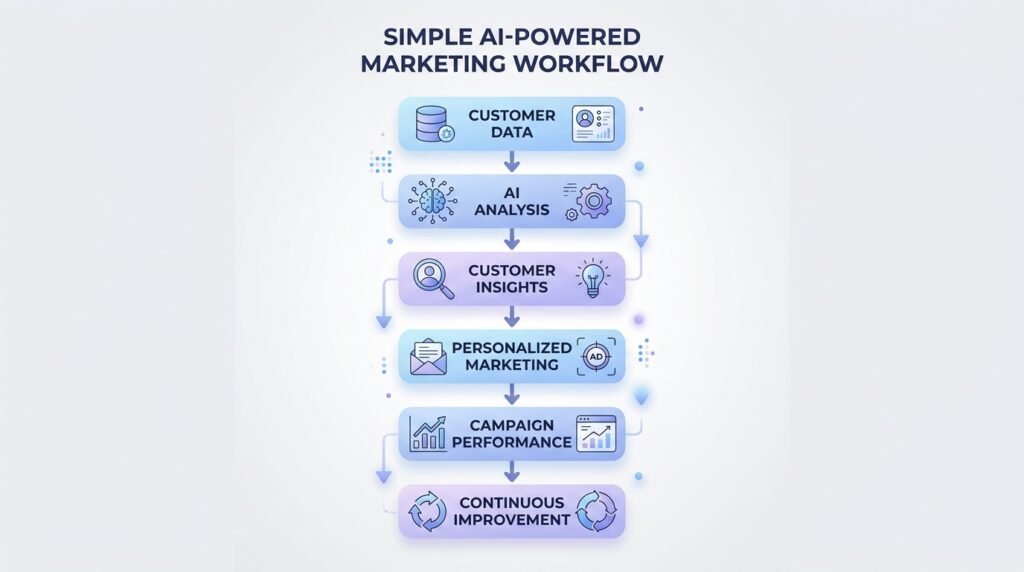
Here’s a simplified view of how AI supports a typical marketing campaign:
Step 1: Collect Customer Data
AI gathers data from various sources, including:
- Website visits
- Search history
- Social media interactions
- Purchase history
- Email engagement
- Customer feedback
This information helps businesses understand who their customers are and how they interact with a brand.
Step 2: Analyze Patterns and Customer Behavior
AI algorithms process the collected data to uncover trends and insights that would be difficult or time-consuming to identify manually.
For example, AI can determine:
- Which products are most popular with a specific audience.
- Which email subject lines generate higher open rates.
- What time customers are most likely to make a purchase.
- Which marketing channels deliver the best return on investment (ROI).
These insights help marketers make more informed decisions instead of relying on guesswork.
Step 3: Personalize Marketing Campaigns
Once AI understands customer preferences, it can deliver personalized experiences to different users.
For example, AI can:
- Recommend products based on browsing history.
- Display personalized advertisements.
- Customize email content for individual subscribers.
- Suggest relevant blog posts or videos.
- Show different website content to different visitors.
This level of personalization improves customer engagement and increases the likelihood of conversions.
Step 4: Automate Repetitive Tasks
Many routine marketing tasks can be automated using AI, allowing marketers to focus on strategy and creativity.
Examples include:
- Writing first drafts of marketing content.
- Scheduling social media posts.
- Responding to common customer questions with chatbots.
- Generating campaign performance reports.
- Organizing customer data.
Automation saves time while maintaining consistency across marketing activities.
Step 5: Learn and Improve Over Time
One of AI’s greatest strengths is its ability to continuously learn from new data.
As customers interact with campaigns, AI evaluates what works and what doesn’t. It then uses those insights to improve future recommendations, optimize advertising campaigns, and deliver increasingly relevant content.
Over time, this creates a cycle of continuous improvement, helping businesses make smarter marketing decisions.
Explore how Google develops and applies artificial intelligence.
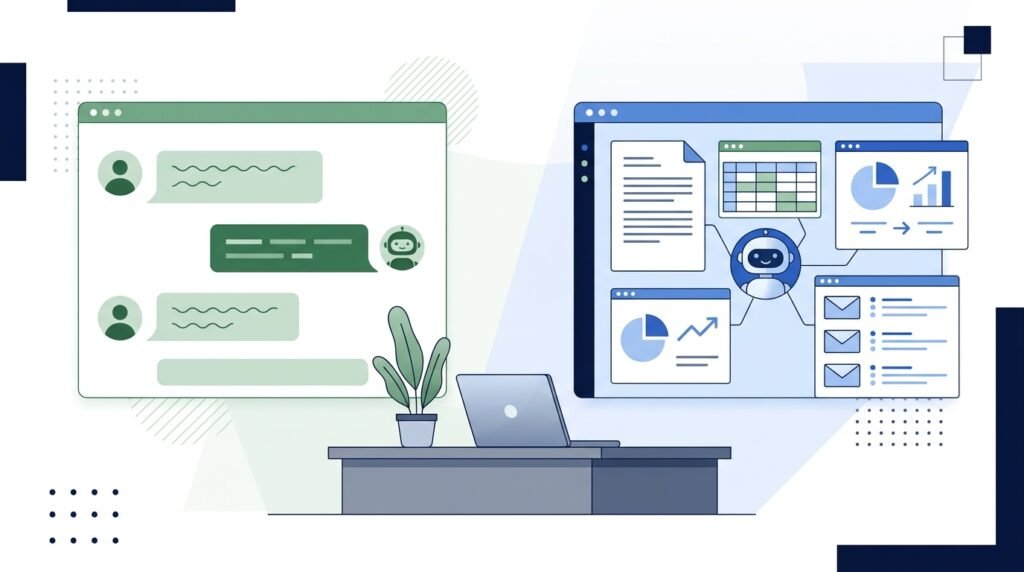
AI Marketing Workflow
Real-World Example
Imagine an online clothing store launching a summer sale.
Instead of sending the same email to every customer, AI analyzes past purchases and browsing behavior. Customers who recently viewed running shoes receive recommendations for sportswear, while those who frequently buy formal clothing see offers on business attire.
At the same time, AI determines the best time to send each email, predicts which products are most likely to sell, and monitors campaign performance in real time. This allows the business to deliver more relevant marketing while reducing manual effort.
Real-World Applications of AI in Marketing
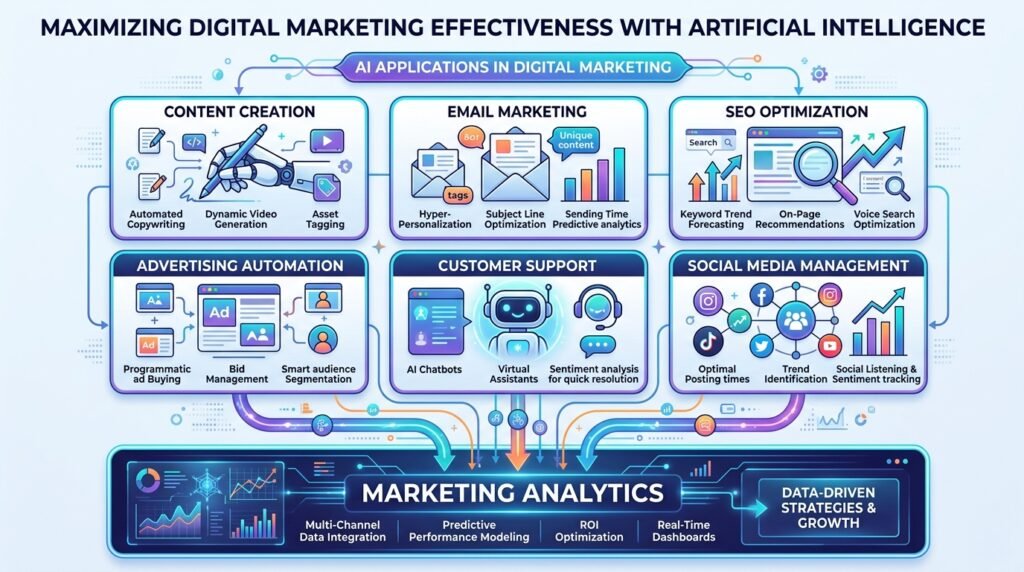
Artificial intelligence is transforming nearly every aspect of modern marketing. From creating content and personalizing customer experiences to optimizing advertising campaigns, AI helps businesses work more efficiently and make smarter decisions.
Here are some of the most common ways AI is used in marketing today.
1. Content Creation
Creating high-quality content consistently can be time-consuming. AI tools help marketers brainstorm ideas, draft articles, write social media posts, generate email copy, and even create images.
While AI can speed up the content creation process, human review is still essential to ensure accuracy, originality, and brand consistency.
Examples:
- Writing blog post outlines
- Creating product descriptions
- Drafting social media captions
- Generating ad copy
- Brainstorming campaign ideas
Example: A small business owner uses ChatGPT to create a first draft of a weekly newsletter, then edits it to match the company’s brand voice before sending it to subscribers.
2. Personalized Customer Experiences
Modern customers expect personalized experiences. AI analyzes customer behavior, preferences, and purchase history to deliver relevant recommendations and tailored marketing messages.
Instead of showing every customer the same content, AI helps businesses present products, offers, and messages that are more likely to match individual interests.
Examples:
- Product recommendations
- Personalized emails
- Customized website content
- Dynamic pricing
- Personalized offers
Example: Amazon recommends products based on your previous purchases and browsing history, making shopping more relevant and convenient.
3. Email Marketing Automation
AI helps marketers create smarter email campaigns by analyzing customer behavior and predicting when recipients are most likely to engage.
Many email marketing platforms use AI to improve open rates, click-through rates, and conversions.
AI can assist with:
- Writing subject lines
- Segmenting audiences
- Scheduling emails
- Personalizing content
- Predicting customer engagement
4. Search Engine Optimization (SEO)
AI has become a valuable assistant for SEO professionals by simplifying research and content optimization.
Rather than replacing SEO expertise, AI helps marketers work more efficiently by analyzing large amounts of information quickly.
Common AI-assisted SEO tasks include:
- Keyword research
- Content optimization
- Competitor analysis
- Search intent analysis
- Content brief generation
Important: AI should support your SEO strategy—not replace human expertise. High-quality, helpful content remains the most important factor for long-term search success.
5. Digital Advertising
Managing online advertising campaigns often requires continuous monitoring and optimization. AI helps automate many of these tasks while improving campaign performance.
AI can:
- Identify the right audience
- Optimize bidding strategies
- Recommend advertising budgets
- Predict campaign performance
- Improve ad targeting
This allows marketers to spend their advertising budget more efficiently while reaching customers who are more likely to convert.
6. Social Media Marketing
AI simplifies social media management by helping marketers create content, schedule posts, analyze engagement, and identify trending topics.
Popular uses include:
- Caption generation
- Content calendars
- Hashtag suggestions
- Audience insights
- Performance analytics
AI reduces repetitive work, allowing marketers to spend more time engaging with their communities and developing creative campaigns.
7. Customer Support and Chatbots
AI-powered chatbots provide instant responses to common customer questions, improving customer service while reducing support workloads.
Businesses use chatbots to:
- Answer frequently asked questions
- Recommend products
- Track orders
- Schedule appointments
- Collect customer information
For more complex issues, conversations can be seamlessly transferred to a human support representative.
8. Marketing Analytics and Decision-Making
One of AI’s greatest strengths is analyzing large datasets to uncover valuable insights.
Instead of manually reviewing reports, marketers can use AI to identify trends, measure campaign performance, and make data-driven decisions.
AI can help answer questions such as:
- Which campaign generated the highest ROI?
- Which audience converted the most?
- Which marketing channel performed best?
- What content resonates with customers?
- Which campaigns need improvement?
These insights help businesses continuously refine their marketing strategies.
Follow Google’s guidance for creating helpful, people-first content.
Comparison Table: Traditional Marketing vs AI-Powered Marketing
| Traditional Marketing | AI-Powered Marketing |
| Manual audience research | AI-driven customer insights |
| Generic campaigns | Personalized experiences |
| Time-consuming reporting | Automated analytics |
| Manual content creation | AI-assisted content generation |
| Broad audience targeting | Precision targeting |
| Reactive decisions | Predictive recommendations |
Popular AI Marketing Tools
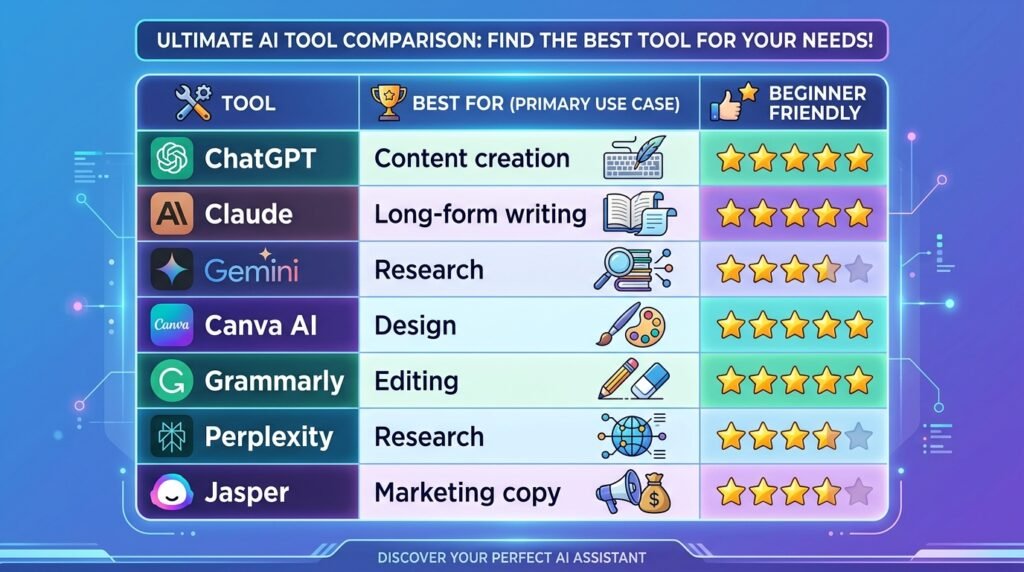
Today, businesses of all sizes use AI-powered tools to create content, automate repetitive tasks, improve customer engagement, and make data-driven marketing decisions. Whether you’re a freelancer, small business owner, or part of a large marketing team, there’s an AI tool designed to simplify your workflow.
Here are some of the most popular AI marketing tools and what they do best.
ChatGPT
Best for: Content writing, brainstorming, email marketing, SEO, and marketing strategy.
ChatGPT helps marketers generate blog post ideas, write email campaigns, create social media captions, draft product descriptions, and brainstorm advertising concepts. It can also assist with keyword research, customer personas, and campaign planning.
Common marketing tasks:
- Blog writing
- Email copy
- Ad copy
- Content ideas
- SEO outlines
Claude
Best for: Long-form writing and document analysis.
Claude is particularly useful for creating detailed marketing plans, editing long-form content, summarizing reports, and improving brand messaging. Many marketers use it for refining content before publication.
Common marketing tasks:
- Marketing strategies
- Content editing
- Brand messaging
- Campaign planning
- Document summarization
Google Gemini
Best for: Research, planning, and Google’s ecosystem.
Gemini helps marketers research industry trends, organize ideas, summarize information, and generate content while integrating with Google’s productivity tools.
Common marketing tasks:
- Market research
- Campaign planning
- Brainstorming
- Productivity
- Content creation
Canva AI
Best for: Visual content creation.
Canva AI enables marketers to create social media graphics, presentations, advertisements, and marketing materials without advanced design skills.
Common marketing tasks:
- Social media graphics
- Presentation design
- Marketing materials
- Advertising creatives
- Brand assets
Grammarly
Best for: Improving writing quality.
Grammarly helps marketers produce clear, professional, and error-free content by checking grammar, spelling, tone, and readability.
Common marketing tasks:
- Editing blog posts
- Proofreading emails
- Improving readability
- Brand consistency
Perplexity AI
Best for: Research and fact-checking.
Perplexity AI combines AI-powered responses with web sources, making it useful for researching competitors, industry trends, and supporting marketing content with reliable information.
Common marketing tasks:
- Competitor research
- Industry research
- Fact verification
- Content research
Jasper
Best for: Marketing copy and advertising.
Jasper is built specifically for marketers and businesses that need to produce marketing content at scale. It includes templates for advertisements, landing pages, product descriptions, and email campaigns.
Common marketing tasks:
- Advertising copy
- Product descriptions
- Landing pages
- Marketing campaigns
- Sales copy
| Tool | Best For | Beginner Friendly |
|---|---|---|
| ChatGPT | Content creation | ⭐⭐⭐⭐⭐ |
| Claude | Long-form writing | ⭐⭐⭐⭐⭐ |
| Gemini | Research | ⭐⭐⭐⭐☆ |
| Canva AI | Design | ⭐⭐⭐⭐⭐ |
| Grammarly | Editing | ⭐⭐⭐⭐⭐ |
| Perplexity | Research | ⭐⭐⭐⭐☆ |
| Jasper | Marketing copy | ⭐⭐⭐⭐☆ |
Which AI Marketing Tool Should You Choose?
The right AI tool depends on your goals and workflow.
| Goal | Recommended Tool |
| Write blog posts and emails | ChatGPT |
| Edit and improve content | Claude, Grammarly |
| Conduct research | Perplexity AI, Gemini |
| Create marketing visuals | Canva AI |
| Write advertising copy | Jasper |
| Brainstorm ideas | ChatGPT, Gemini |
If you’re just getting started, you don’t need to use every AI tool. Begin with one or two tools that match your primary marketing tasks, then gradually expand your toolkit as your needs grow.
Continue Learning: Explore our 25 Best AI Tools for Beginners to discover more AI tools for content creation, productivity, design, and business. You can also visit our Recommended AI Tools page for detailed reviews and beginner-friendly recommendations.
Benefits and Challenges of AI in Marketing
Artificial intelligence has become a valuable tool for marketers because it helps businesses work more efficiently, better understand their customers, and deliver more personalized experiences. However, like any technology, AI also has limitations that require careful planning and human oversight.
HubSpot regularly publishes research on how marketers are adopting AI.
Understanding both the advantages and challenges of AI can help businesses use it responsibly and effectively.
Benefits of AI in Marketing
1. Saves Time Through Automation
Many marketing tasks, such as drafting emails, scheduling social media posts, analyzing campaign performance, and generating reports, can be automated with AI. This allows marketing teams to spend less time on repetitive work and more time on creative strategy and customer engagement.
2. Delivers Personalized Customer Experiences
AI can analyze customer behavior, preferences, and purchase history to recommend relevant products, tailor email campaigns, and customize website experiences.
Personalization helps businesses build stronger customer relationships and improve engagement.
3. Improves Marketing Decisions
AI processes large amounts of data much faster than humans, helping marketers identify trends, predict customer behavior, and measure campaign performance more accurately.
Instead of relying on assumptions, businesses can make data-driven decisions.
4. Increases Productivity
AI assists with content creation, market research, keyword analysis, and campaign planning, allowing marketers to accomplish more in less time.
Rather than replacing human creativity, AI acts as a productivity tool that supports faster execution.
5. Optimizes Advertising Campaigns
AI continuously analyzes advertising performance and can recommend adjustments to audience targeting, bidding strategies, budgets, and ad placements.
This helps businesses improve return on investment (ROI) while reducing wasted advertising spend.
6. Supports Better Customer Service
AI-powered chatbots and virtual assistants can answer common customer questions 24/7, provide instant responses, and guide users through simple tasks.
This improves customer satisfaction while reducing the workload for support teams.
Challenges of AI in Marketing
Although AI offers many benefits, businesses should also understand its limitations.
1. AI Can Make Mistakes
AI-generated content may contain factual inaccuracies, outdated information, or misleading recommendations. It can also misunderstand context or produce generic responses.
For this reason, marketers should always review AI-generated content before publishing it.
2. Privacy and Data Security
Many AI systems rely on customer data to personalize experiences. Businesses must handle this data responsibly and comply with privacy regulations such as GDPR and other applicable laws.
Building customer trust should always be a priority.
3. Limited Human Creativity
AI can generate ideas quickly, but it does not understand emotions, cultural nuances, or brand values in the same way humans do.
The most effective marketing combines AI efficiency with human creativity, storytelling, and strategic thinking.
4. Bias in AI Systems
AI models learn from existing data. If that data contains biases, the AI’s recommendations or outputs may also be biased.
Organizations should regularly review AI-generated content and decisions to ensure they are fair, accurate, and inclusive.
5. Dependence on Technology
Overreliance on AI can reduce critical thinking and creativity within marketing teams. Businesses should view AI as a supportive tool rather than a replacement for human expertise.
The best marketing strategies combine AI-powered insights with human judgment and experience.
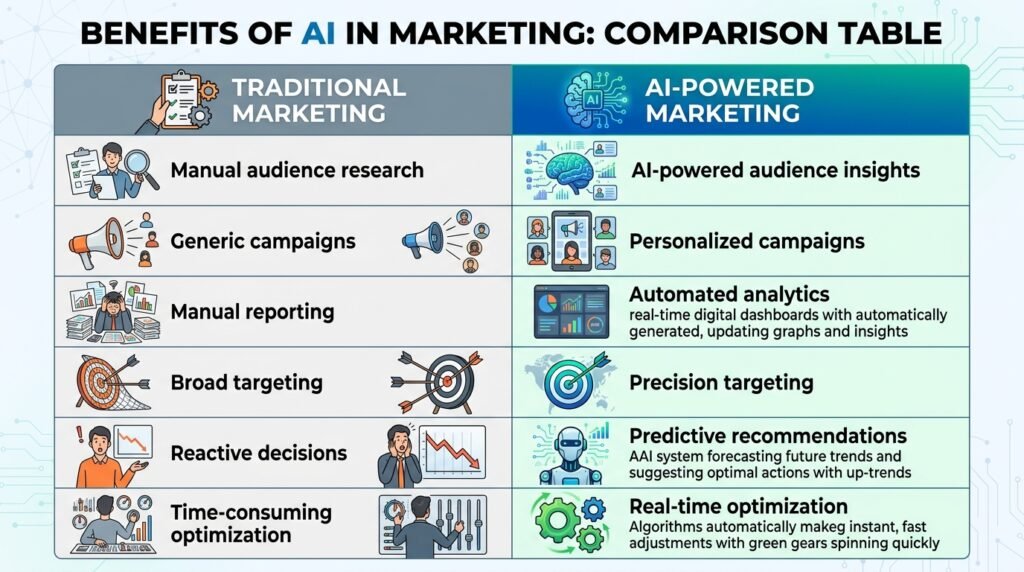
Comparison Table: Benefits vs Challenges of AI in Marketing
| Benefits | Challenges |
| Automates repetitive tasks | AI-generated errors require human review |
| Improves personalization | Privacy and data protection concerns |
| Faster data analysis | May reflect biases in training data |
| Supports better decision-making | Limited creativity and emotional understanding |
| Optimizes advertising performance | Overdependence on AI can reduce strategic thinking |
| Enhances customer support | Requires responsible and ethical use |
Key Takeaway
AI is most effective when it augments human marketers rather than replacing them. Businesses that combine AI’s speed and analytical capabilities with human creativity, empathy, and strategic thinking are better positioned to create meaningful customer experiences and long-term marketing success.
McKinsey’s research explores how organizations are using AI across industries.
Best Practices for Using AI in Marketing
Artificial intelligence can significantly improve marketing efficiency, but achieving the best results requires more than simply using AI tools. Businesses should combine AI with human expertise, clear goals, and ethical practices to create effective and trustworthy marketing campaigns.
Here are some best practices to help you get the most value from AI in marketing.
1. Start with a Specific Marketing Goal
Before using AI, identify what you want to achieve.
For example, you may want to:
- Increase website traffic
- Generate more leads
- Improve email open rates
- Create content faster
- Enhance customer support
- Optimize advertising campaigns
Having a clear objective helps you choose the right AI tool and measure its effectiveness.
2. Use AI to Assist—Not Replace—Human Creativity
AI can generate ideas, draft content, and analyze data, but it cannot fully replace human creativity, emotional intelligence, or strategic thinking.
The most successful marketers use AI as a creative assistant while making the final decisions themselves.
For example, you can use AI to draft a blog post or advertising campaign, then refine the message to match your brand voice and audience.
3. Write Clear and Detailed Prompts
The quality of AI-generated results depends heavily on the instructions you provide.
Instead of asking:
“Write a Facebook ad.”
Try:
“Write a Facebook ad for a small online clothing store promoting a summer sale. Use a friendly tone and include a strong call-to-action.”
Providing clear context helps AI generate more accurate and useful responses.
Continue Learning: Learn how to write better prompts in our Prompt Engineering Techniques guide.
4. Always Review AI-Generated Content
AI can occasionally produce inaccurate, outdated, or misleading information. Before publishing any AI-generated content, review it carefully for:
- Accuracy
- Grammar
- Brand voice
- Tone
- Originality
- Factual correctness
Human review is essential to maintain quality and build trust with your audience.
5. Protect Customer Privacy
Many AI marketing tools analyze customer data to provide personalized experiences. Businesses should collect and use customer information responsibly while complying with applicable privacy regulations.
Being transparent about data collection and respecting customer privacy helps build long-term trust.
6. Monitor Performance and Continuously Improve
AI works best when combined with continuous testing and optimization.
Track key marketing metrics such as:
- Website traffic
- Conversion rates
- Email open rates
- Click-through rates (CTR)
- Customer engagement
- Return on investment (ROI)
Use these insights to refine your campaigns and improve future marketing strategies.
Best Practices Checklist
Use this checklist when implementing AI in your marketing workflow:
✅ Define clear marketing objectives.
✅ Choose AI tools that match your needs.
✅ Write detailed and specific prompts.
✅ Review all AI-generated content before publishing.
✅ Protect customer data and privacy.
✅ Track campaign performance and optimize regularly.
✅ Combine AI efficiency with human creativity and strategic thinking.
Common Mistakes to Avoid
Even experienced marketers can misuse AI if they rely on it too heavily. Avoid these common mistakes:
- Publishing AI-generated content without reviewing it.
- Depending entirely on AI for creative decisions.
- Ignoring customer privacy and data security.
- Using AI without a clear marketing strategy.
- Choosing tools simply because they’re popular instead of selecting those that fit your business needs.
- Expecting AI to deliver perfect results on the first attempt.
Remember, AI is a powerful assistant—not a replacement for thoughtful marketing and genuine customer relationships.
The Future of AI in Marketing
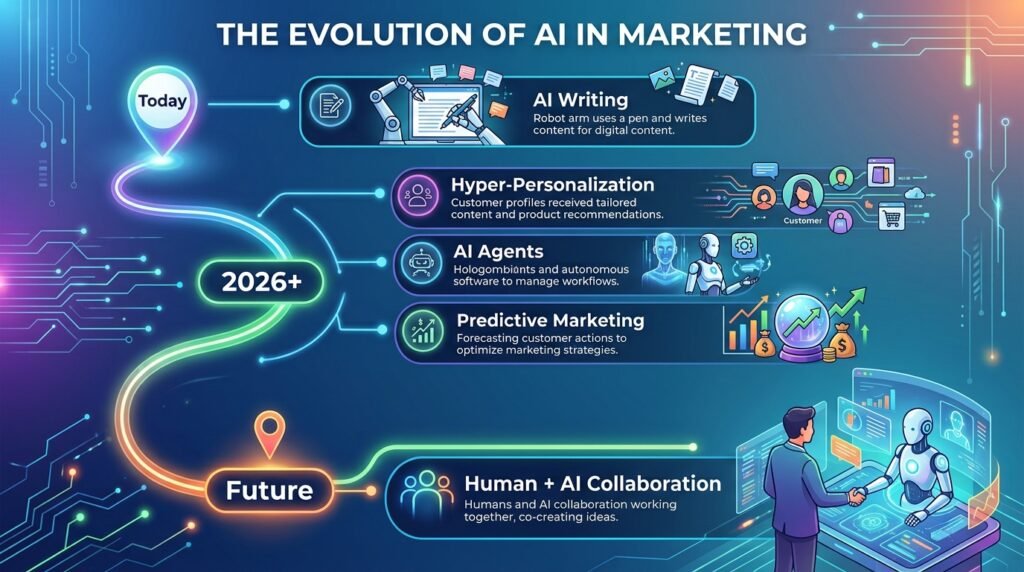
Artificial intelligence is already transforming marketing, but its role is expected to grow even further in the coming years. As AI technologies become more capable and accessible, businesses will be able to create more personalized customer experiences, automate complex workflows, and make faster, data-driven decisions.
However, successful marketing will continue to rely on human creativity, strategic thinking, and ethical decision-making. Rather than replacing marketers, AI is likely to become an essential partner that helps professionals work more efficiently and focus on higher-value tasks.
Here are some trends shaping the future of AI in marketing.
1. Hyper-Personalized Customer Experiences
Future AI systems will deliver even more personalized experiences by analyzing customer preferences, browsing behavior, purchase history, and real-time interactions.
Instead of sending the same message to every customer, businesses will be able to tailor content, product recommendations, and marketing campaigns to individual needs.
This level of personalization can improve customer satisfaction, engagement, and loyalty.
2. Smarter AI Assistants and AI Agents
Today’s AI tools can generate content and answer questions, but the next generation of AI systems is becoming more capable of planning, reasoning, and completing multi-step tasks.
These AI agents may help marketers:
- Plan marketing campaigns
- Monitor campaign performance
- Analyze competitors
- Generate reports
- Recommend improvements automatically
While human oversight will remain essential, AI agents could significantly reduce repetitive administrative work.
3. Predictive Marketing
AI is becoming increasingly effective at forecasting customer behavior.
Businesses can use predictive analytics to estimate:
- Which customers are most likely to make a purchase
- When customers may stop using a product or service
- Which marketing campaigns are likely to perform well
- Future demand for products or services
These insights allow marketers to make proactive decisions instead of reacting after results are available.
4. Voice and Visual Search Optimization
As voice assistants and image-based search continue to grow, marketers will need to optimize their content for more than traditional text searches.
AI can help businesses understand conversational search queries, improve visual content, and adapt marketing strategies for emerging search behaviors.
5. Responsible and Ethical AI
As AI becomes more widely adopted, businesses will face increasing expectations around transparency, fairness, and responsible use of customer data.
Organizations that use AI ethically—while protecting user privacy and maintaining human oversight—are more likely to earn long-term customer trust.
Responsible AI practices will become an important part of successful marketing strategies.
Will AI Replace Marketers?
One of the most common questions about AI is whether it will replace marketing professionals.
The short answer is no.
AI can automate repetitive tasks, analyze large datasets, and generate content quickly. However, it cannot fully replace the creativity, emotional intelligence, critical thinking, and strategic decision-making that experienced marketers bring to their work.
Instead, AI is changing how marketers work. Professionals who learn to use AI effectively can improve productivity, make better decisions, and focus more on building meaningful customer relationships.
The future of marketing is not AI versus humans—it’s AI working alongside humans.
Key Takeaway
Artificial intelligence will continue to reshape marketing, but its greatest value lies in helping people work smarter—not replacing them. Businesses that combine AI-powered efficiency with human creativity, ethical practices, and customer-focused strategies will be better positioned to succeed in an increasingly digital world.
Frequently Asked Questions (FAQs)
What is AI in marketing?
AI in marketing is the use of artificial intelligence technologies to automate marketing tasks, analyze customer data, personalize experiences, and improve decision-making. Businesses use AI for content creation, email marketing, advertising, customer support, market research, and campaign optimization.
How is AI used in digital marketing?
AI supports digital marketing by helping businesses create content, optimize search engine rankings (SEO), personalize email campaigns, manage social media, improve online advertising, analyze customer behavior, and automate repetitive tasks. It enables marketers to make faster, data-driven decisions while improving customer engagement.
What are the benefits of AI in marketing?
Some of the biggest benefits of AI in marketing include:
- Automating repetitive tasks
- Delivering personalized customer experiences
- Improving campaign performance
- Saving time and increasing productivity
- Analyzing customer data more efficiently
- Supporting better business decisions
When combined with human expertise, AI helps businesses create more effective marketing strategies.
Can small businesses use AI for marketing?
Yes. Many AI marketing tools are affordable and easy to use, making them suitable for small businesses, freelancers, startups, and content creators. Businesses can start with simple tasks such as generating marketing copy, creating social media posts, or automating email campaigns before expanding to more advanced use cases.
Will AI replace marketers?
No. AI is designed to assist marketers rather than replace them. While AI can automate repetitive tasks and analyze data quickly, it cannot replicate human creativity, strategic thinking, emotional intelligence, or relationship building. The most successful marketers use AI as a productivity tool while maintaining human oversight.
What are the best AI marketing tools for beginners?
Some beginner-friendly AI marketing tools include:
- ChatGPT for content creation and brainstorming
- Claude for editing and long-form writing
- Google Gemini for research and planning
- Canva AI for graphic design
- Grammarly for improving writing
- Perplexity AI for research and fact-checking
The right tool depends on your goals and workflow.
Is AI marketing suitable for every business?
AI can benefit businesses of all sizes and industries, but its effectiveness depends on how it’s implemented. Organizations should identify their marketing goals, choose appropriate AI tools, and ensure that AI complements—not replaces—their overall marketing strategy.
Conclusion
Artificial intelligence is changing the way businesses connect with customers, create content, analyze data, and optimize marketing campaigns. From automating repetitive tasks to delivering personalized experiences, AI helps marketers work more efficiently and make informed decisions.
However, successful marketing still depends on people. Human creativity, critical thinking, empathy, and ethical decision-making remain essential for building trust and meaningful customer relationships. AI should be viewed as a powerful assistant that enhances marketing efforts—not as a replacement for human expertise.
Whether you’re a student exploring AI, a business owner looking to improve your marketing, or a professional wanting to build future-ready skills, learning how to use AI effectively can provide a valuable advantage in today’s digital landscape.
As AI continues to evolve, staying informed and experimenting with the right tools will help you adapt to new opportunities and create more impactful marketing strategies.
Continue Your AI Journey
Keep building your AI knowledge with these beginner-friendly guides.
-

AI Interview Preparation: How to Use AI Tools to Land Your Next Job
Learn more : AI Interview Preparation: How to Use AI Tools to Land Your Next Job🕒 14-16 min read • Updated: July 2026 AI Interview Preparation: How to Use AI Tools to Ace…
-

7 Ways to Use AI for Research: Faster & Smarter Workflows (2026)
Learn more : 7 Ways to Use AI for Research: Faster & Smarter Workflows (2026)🕒 15 min read • Updated: July 2026 Introduction Research has always been about discovering new information, asking…
-

AI for Teachers: 15 Practical Workflows to Streamline Your Classroom
Learn more : AI for Teachers: 15 Practical Workflows to Streamline Your Classroom🕒 15 min read • Updated: July 2026 Introduction Teaching is one of the most rewarding professions, but…
-

AI for Productivity: 15 Practical Workflows to Work Smarter in 2026
Learn more : AI for Productivity: 15 Practical Workflows to Work Smarter in 2026🕒 12-14 min read • Updated: July 2026 Introduction Imagine completing your daily work in less time while…
-

The 2026 Guide to AI in Sales: Tools & Workflows to Close Deals Faster
Learn more : The 2026 Guide to AI in Sales: Tools & Workflows to Close Deals Faster🕒 12-14 min read • Updated: July 2026 Introduction Artificial intelligence (AI) is transforming the way businesses find…
-

AI for Project Management: 15 Time-Saving Workflows & Prompt Templates
Learn more : AI for Project Management: 15 Time-Saving Workflows & Prompt Templates🕒 12-14 min read • Updated: July 2026 Quick Answer AI for project management uses artificial intelligence to…
Related Articles
Explore more guides and resources related to this topic.
-

ChatGPT Complete Guide for Beginners (2026): Master AI Step-by-Step
Learn more : ChatGPT Complete Guide for Beginners (2026): Master AI Step-by-Step🕒 20-25 min read • Updated: Aug 2026 Introduction Introduction Artificial intelligence is changing how people learn, work,…
-

Master Prompt Engineering in 2026: A Step-by-Step Beginner’s Guide
Learn more : Master Prompt Engineering in 2026: A Step-by-Step Beginner’s Guide🕒 18-20 min read • Updated: Aug 2026 Introduction Artificial intelligence (AI) tools like ChatGPT, Claude, Gemini, and…
-
Large Language Models (LLMs) Explained: The Complete 2026 Beginner’s Guide
Learn more : Large Language Models (LLMs) Explained: The Complete 2026 Beginner’s Guide🕒 14-16 min read • Updated: Aug 2026 Introduction Artificial Intelligence has become part of everyday life. Whether…
-

Best AI Image Generators in 2026: 10 Free & Paid Tools Tested
Learn more : Best AI Image Generators in 2026: 10 Free & Paid Tools Tested🕒 15 min read • Updated: July 2026 introduction Creating stunning images no longer requires years of design…
-
10 Best AI Chatbots in 2026: Tested & Ranked for Every Use Case
Learn more : 10 Best AI Chatbots in 2026: Tested & Ranked for Every Use Case🕒 10-12 min read • Updated: July 2026 introduction Artificial intelligence has made chatbots far more capable than…
-
ChatGPT vs Microsoft Copilot (2026): Tested, Pricing & Workflow Comparison
Learn more : ChatGPT vs Microsoft Copilot (2026): Tested, Pricing & Workflow Comparison🕒 10-12 min read • Updated: July 2026 Introduction Choosing between ChatGPT and Microsoft Copilot can be challenging,…
Recommended AI Tools
Looking for practical AI tools to improve your marketing workflow? Visit our Recommended AI Tools page to discover beginner-friendly solutions for:
- Content writing
- Graphic design
- SEO and research
- Productivity
- Marketing automation
- Business growth
Each recommendation includes an overview of its features, ideal use cases, and guidance to help you choose the right tool for your needs.
Leave a Reply