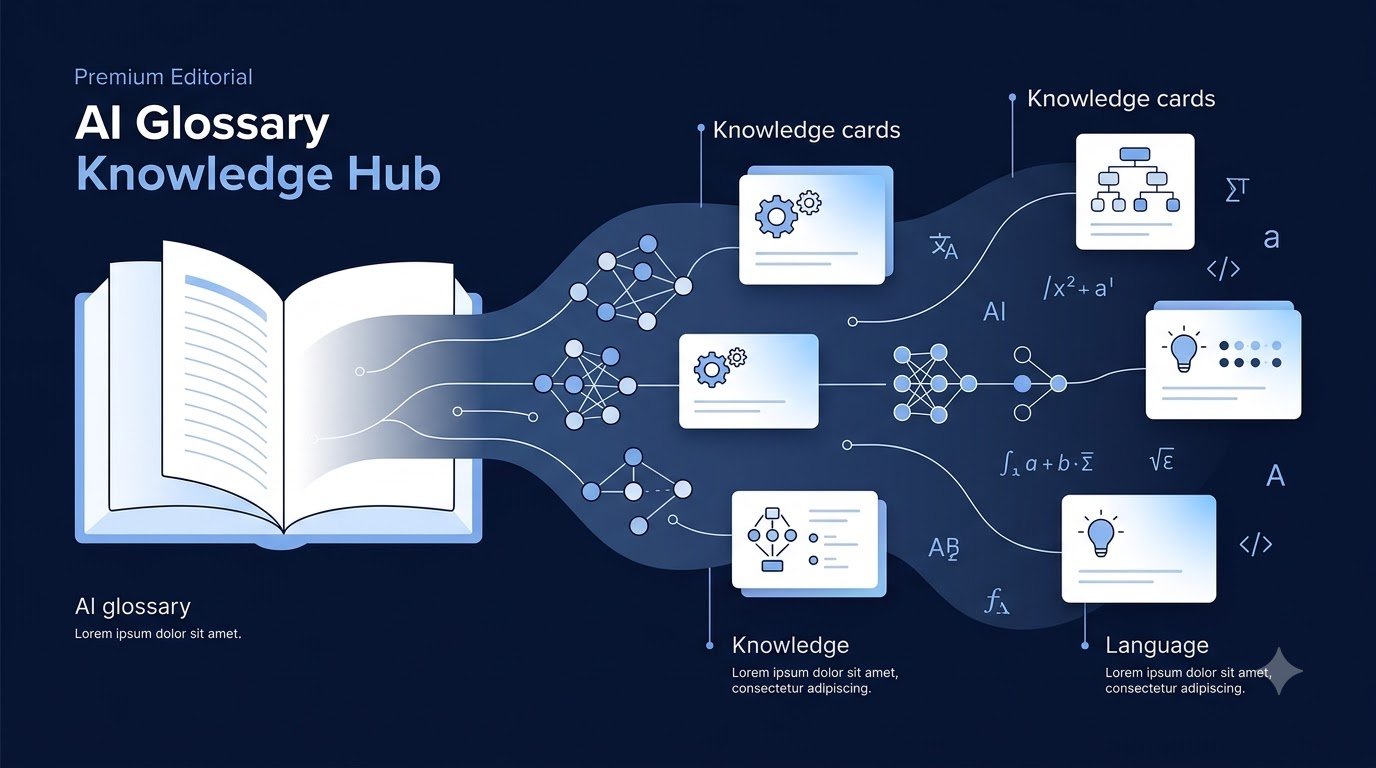
🕒 25-35 min read • Updated: Aug 2026
Table of Contents
Introduction
Artificial Intelligence (AI) is changing how we learn, work, create, and solve problems. As AI becomes more common, you’ll encounter technical terms like LLM, GPT, prompt engineering, embeddings, RAG, and AI agents. For beginners, this vocabulary can feel overwhelming.
This glossary is designed to make AI terminology easy to understand. Instead of complex technical definitions, you’ll find clear explanations, practical examples, and links to in-depth guides where you can learn more.
Whether you’re a student, professional, educator, business owner, or simply curious about AI, this resource will help you build a strong foundation.
Because AI evolves rapidly, this glossary is a living resource. New terms, technologies, and concepts will be added over time to keep it up to date.
Key Takeaways
- Learn over 100 essential AI terms in plain English.
- Understand the meaning behind common AI buzzwords.
- Discover practical examples for every concept.
- Find links to deeper guides throughout the Naeveor AI learning library.
- Use this glossary as a quick reference whenever you encounter unfamiliar AI terminology.
How to Use This Glossary
Each entry includes:
- Definition – A simple explanation.
- Example – A real-world example.
- Why It Matters – Why the term is important.
- Learn More – A link to a dedicated guide (where available).
A
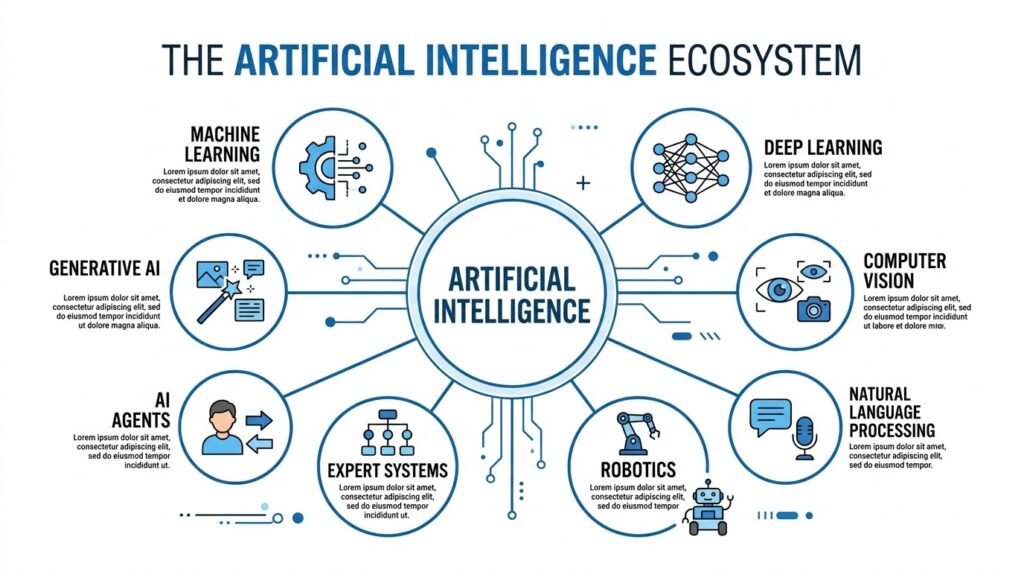
AI (Artificial Intelligence)
Definition
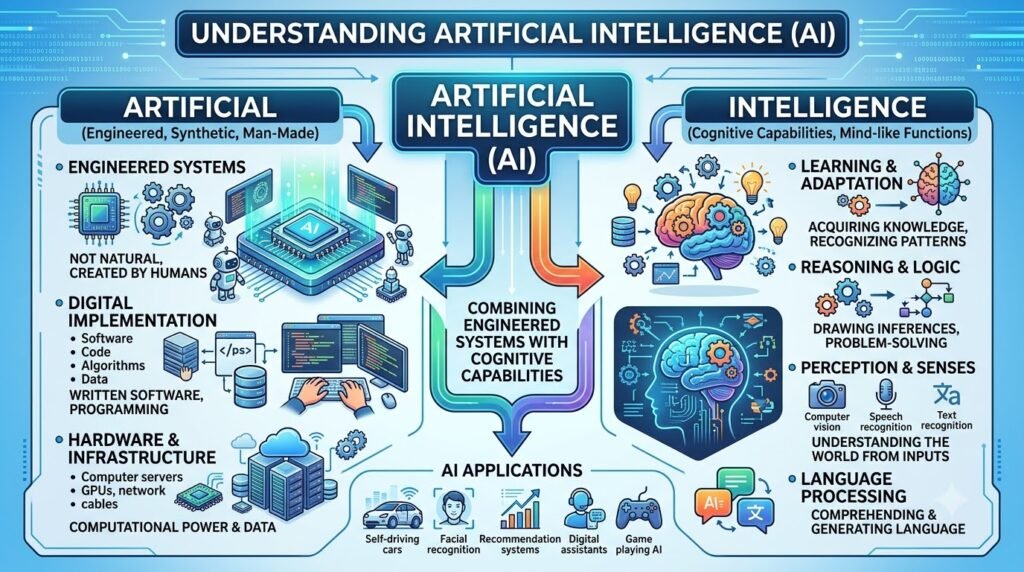
Artificial Intelligence (AI) is the field of computer science focused on creating systems that can perform tasks requiring human intelligence, such as understanding language, recognizing images, making decisions, and solving problems.
Example
When ChatGPT answers your questions or Google Photos recognizes faces in your pictures, AI is being used.
Why It Matters
AI powers many of the technologies we use every day, from recommendation systems to virtual assistants and self-driving vehicle research.
Learn More
→ What Is Artificial Intelligence?
AI Agent
Definition
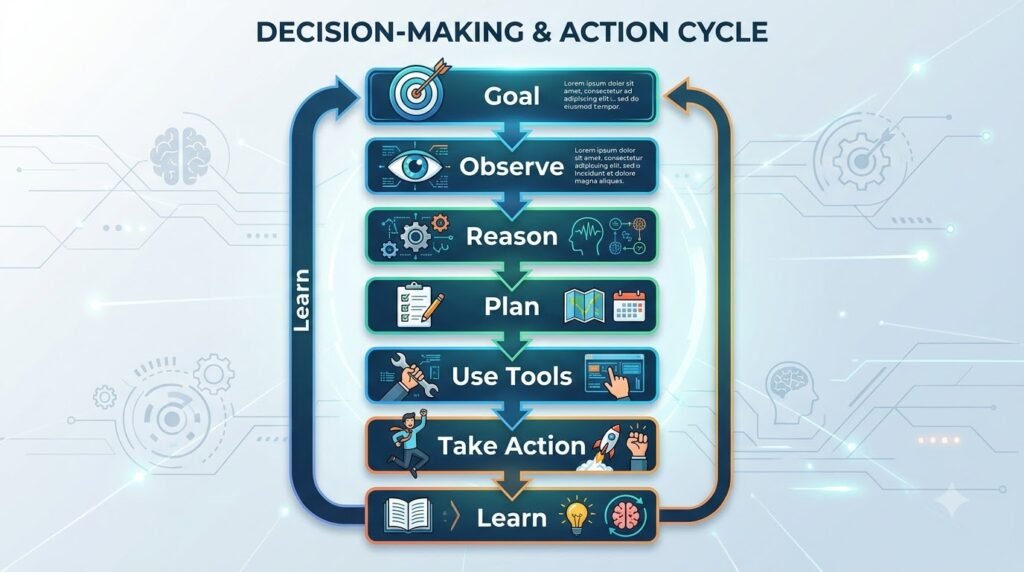
An AI agent is a software system that can observe its environment, make decisions, and take actions to achieve a goal with minimal human intervention.
Unlike a standard chatbot that simply responds to questions, an AI agent can plan, remember, use tools, and complete multi-step tasks.
Example
An AI assistant that reads your emails, schedules meetings, and sends follow-up messages automatically.
Why It Matters
AI agents represent one of the fastest-growing areas of artificial intelligence and are expected to automate increasingly complex workflows.
Learn More
→ What Are AI Agents?
AI Alignment
Definition
AI alignment refers to ensuring that AI systems behave according to human values, goals, and safety requirements.
Example
Preventing an AI chatbot from providing harmful advice.
Why It Matters
Alignment is one of the biggest challenges in developing advanced AI responsibly.
AI Assistant
Definition
An AI assistant is an application that helps users complete tasks using natural language.
Examples include answering questions, writing emails, summarizing documents, and planning schedules.
Examples
- ChatGPT
- Claude
- Gemini
- Microsoft Copilot
Why It Matters
AI assistants are becoming everyday productivity tools for individuals and businesses.
AI Bias
Definition
AI bias occurs when an AI system produces unfair, inaccurate, or discriminatory results because of biases in its training data or design.
Example
An AI hiring system favoring certain applicants because historical hiring data contained bias.
Why It Matters
Reducing bias improves fairness, trust, and reliability in AI systems.
AI Ethics
Definition
AI ethics is the study of how AI should be designed, developed, and used responsibly.
It includes topics such as:
- Fairness
- Privacy
- Transparency
- Accountability
- Human oversight
Example
Creating AI tools that respect user privacy and clearly disclose AI-generated content.
Why It Matters
Ethical AI helps build public trust and reduces potential harm.
AI Hallucination
Definition
An AI hallucination occurs when an AI model generates information that sounds believable but is incorrect, misleading, or entirely fabricated.
Example
An AI inventing a book title or citing a research paper that doesn’t exist.
Why It Matters
Users should verify important information rather than assuming AI outputs are always accurate.
Learn More
→ AI Hallucinations Explained
AI Literacy
Definition
AI literacy is the ability to understand, evaluate, and use AI tools effectively and responsibly.
Example
Knowing when AI can help write a draft and when human judgment is still required.
Why It Matters
As AI becomes part of everyday life, AI literacy is becoming an essential digital skill.
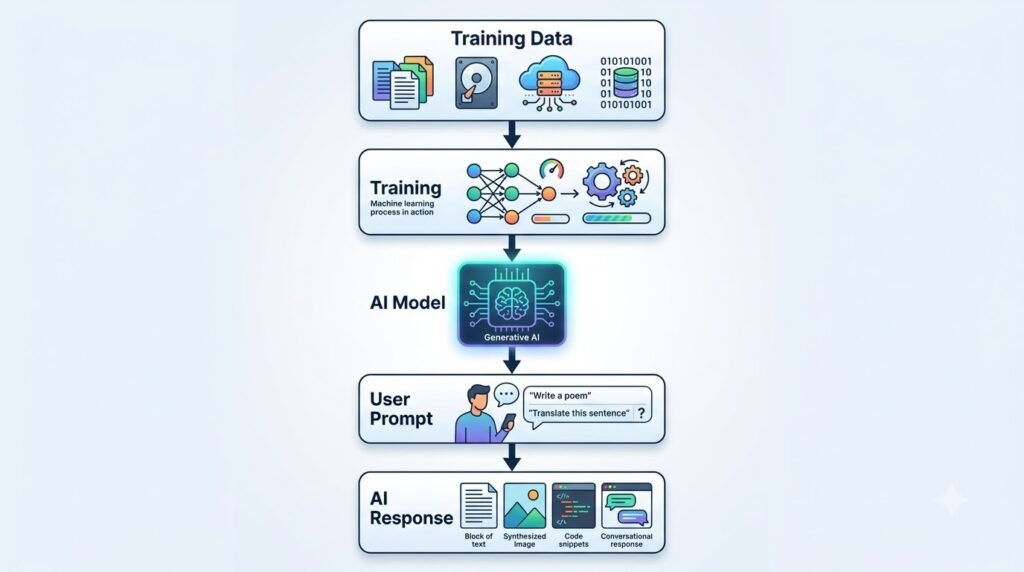
AI Model
Definition
An AI model is the trained system that performs tasks such as generating text, recognizing images, or predicting outcomes.
The model learns patterns from large datasets during training.
Example
GPT-4, Claude, Gemini, and Llama are AI models.
Why It Matters
The quality and capabilities of an AI application depend largely on its underlying model.
AI Safety
Definition
AI safety focuses on designing AI systems that operate reliably and avoid causing unintended harm.
Example
Testing an AI model extensively before using it in healthcare.
Why It Matters
Safe AI is essential as AI systems become more powerful and widely adopted.
B
Benchmark
Definition
A benchmark is a standardized test used to measure and compare the performance of AI models.
Example
Evaluating two language models using the same reasoning test.
Why It Matters
Benchmarks help researchers and users compare AI systems objectively.
Bias (Machine Learning)
Definition
Bias refers to systematic errors introduced during data collection, model design, or training that affect AI outputs.
Example
A facial recognition model performing better on some demographic groups than others.
Why It Matters
Recognizing bias helps developers create fairer AI systems.
Chatbot
Definition
A chatbot is software designed to simulate conversations with users through text or voice.
Modern chatbots often use large language models to generate responses.
Example
Customer support assistants on websites.
Why It Matters
Chatbots improve customer service, education, and productivity.
C
Chain of Thought (CoT)
Definition
Chain of Thought is a prompting technique that encourages an AI model to reason through a problem step by step before producing an answer.
Example
Instead of asking:
Solve this math problem.
You ask:
Explain each step before giving the final answer.
Why It Matters
For suitable tasks, this approach can improve reasoning quality and make the model’s process more understandable. However, users don’t need to request it for every prompt, and some AI systems may not explicitly reveal their internal reasoning.
Learn More
→ Prompt Engineering Techniques
ChatGPT
Definition
ChatGPT is a conversational AI application developed by OpenAI that can answer questions, write content, summarize information, generate ideas, and assist with many everyday tasks using natural language.
Example
Using ChatGPT to draft an email or explain a science concept.
Why It Matters
ChatGPT has helped introduce millions of people to generative AI and conversational interfaces.
Learn More
→ What Is ChatGPT?
Computer Vision
Definition
Computer vision is a branch of AI that enables computers to interpret and understand images and videos.
Example
A smartphone unlocking by recognizing your face.
Why It Matters
Computer vision powers applications in healthcare, manufacturing, autonomous vehicles, security, and retail.
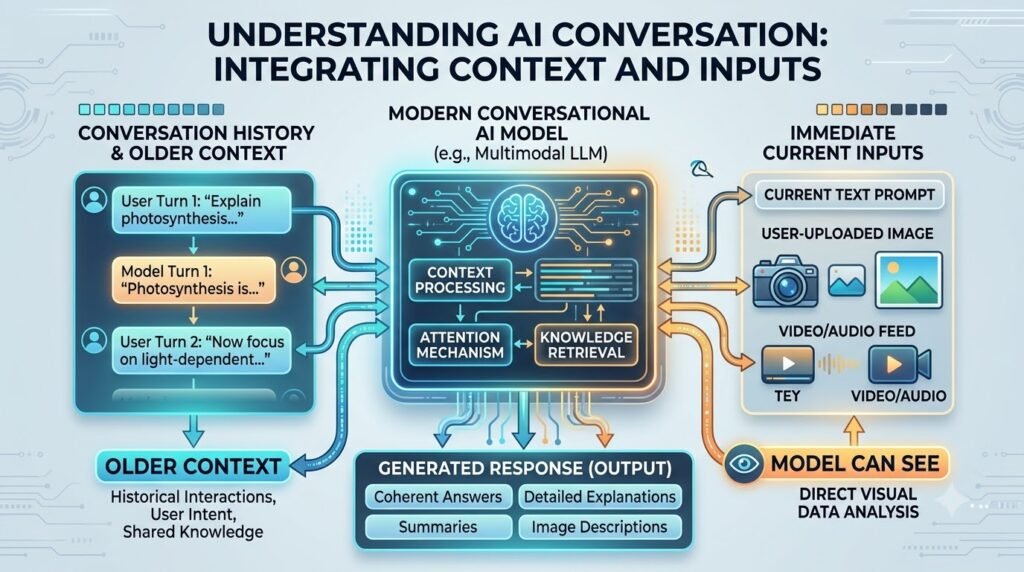
Context Window
Definition
A context window is the maximum amount of information an AI model can consider at one time while generating a response. This includes your prompt, previous messages, uploaded documents, and the model’s own generated text.
Example
If you paste a long report into an AI assistant, only the portion that fits within its context window can be processed together.
Why It Matters
A larger context window allows AI models to analyze longer conversations, books, codebases, or documents without losing important information.
Learn More
→ How Does ChatGPT Work?
Continue Learning
If you’re new to AI, these guides are a great next step:
- What Is Artificial Intelligence?
- What Is Generative AI?
- Types of Artificial Intelligence
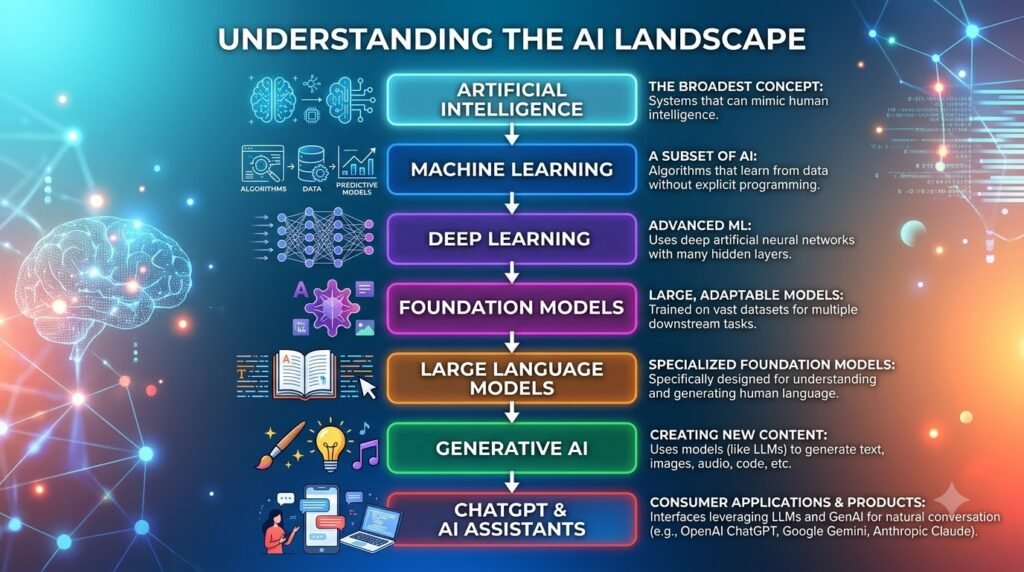
- AI vs Machine Learning vs Deep Learning
- How Does ChatGPT Work?
- What Are AI Agents?
- What Is Prompt Engineering?
D
Data Annotation
Definition
Data annotation is the process of labeling data so an AI model can learn from it during training. Labels tell the model what each piece of data represents.
Example
Drawing boxes around cars in thousands of images so a computer vision model learns to recognize vehicles.
Why It Matters
High-quality annotated data often leads to more accurate AI models.
Dataset
Definition
A dataset is a collection of information used to train, test, or evaluate an AI model. Datasets can include text, images, videos, audio, spreadsheets, or structured databases.
Example
A language model may be trained on billions of words collected from books, articles, websites, and other publicly available sources, along with licensed or human-created data.
Why It Matters
The quality, diversity, and relevance of a dataset directly affect an AI model’s performance.
Decision Tree
Definition
A decision tree is a machine learning algorithm that makes predictions by asking a sequence of yes-or-no questions.
Example
An email spam filter might ask:
- Does the email contain suspicious links?
- Does it come from an unknown sender?
- Does it include certain keywords?
Based on the answers, it predicts whether the email is spam.
Why It Matters
Decision trees are easy to understand and are commonly used in classification and prediction tasks.
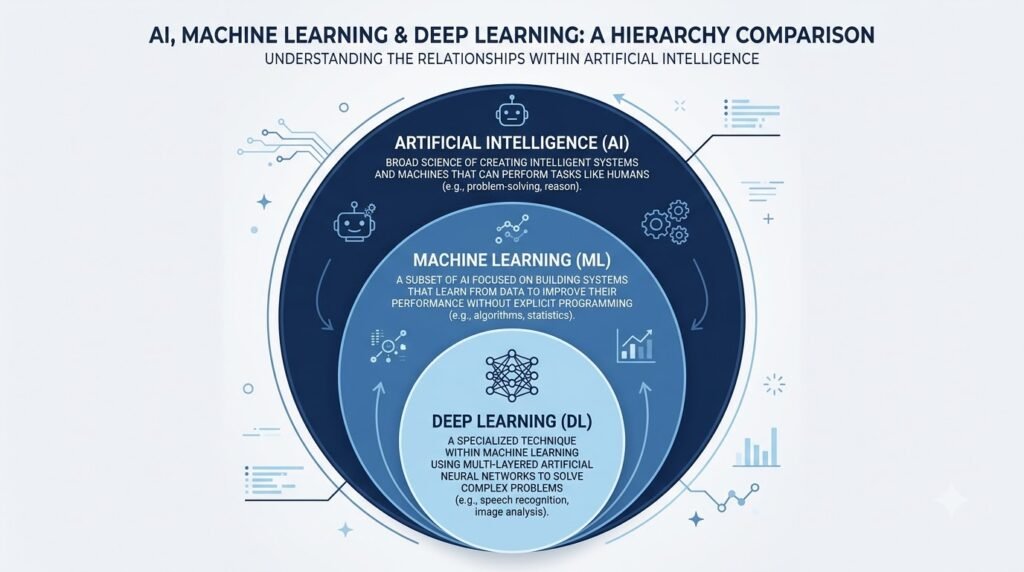
Deep Learning
Definition
Deep learning is a branch of machine learning that uses neural networks with many layers to recognize complex patterns in data.
Example
Deep learning enables AI to:
- Recognize faces
- Translate languages
- Generate images
- Understand speech
- Write text
Why It Matters
Many of today’s most advanced AI systems—including large language models and image generators—are built using deep learning.
Learn More
→ AI vs Machine Learning vs Deep Learning
Diffusion Model
Definition
A diffusion model is a type of AI model that generates images by gradually removing random noise until a realistic image is created.
Example
Image generators such as Stable Diffusion create artwork using diffusion models.
Why It Matters
Diffusion models have significantly improved AI-generated image quality.
Digital Twin
Definition
A digital twin is a virtual representation of a real-world object, machine, or system that updates using real-time data.
Example
A factory may use a digital twin to monitor equipment and predict maintenance needs.
Why It Matters
Digital twins help businesses optimize performance and reduce downtime.
E
Embedding
Definition
An embedding is a numerical representation of text, images, or other data that captures its meaning. AI models use embeddings to understand relationships between different pieces of information.
Example
The words dog, puppy, and canine have similar embeddings because they are closely related in meaning.
Why It Matters
Embeddings power semantic search, recommendation systems, document retrieval, and Retrieval-Augmented Generation (RAG).
Learn More
→ Embeddings Explained
Encoder
Definition
An encoder is a component of some AI models that converts input data into a meaningful numerical representation.
Example
A translation model encodes an English sentence before generating its French translation.
Why It Matters
Encoders help AI understand the meaning and context of input data.
Explainable AI (XAI)
Definition
Explainable AI refers to techniques that make AI decisions easier for humans to understand.
Example
Instead of simply predicting that a loan should be denied, an explainable AI system identifies the factors that influenced its decision.
Why It Matters
Explainability builds trust, supports accountability, and is especially important in industries like healthcare and finance.
F
Few-Shot Learning
Definition
Few-shot learning enables an AI model to perform a task after seeing only a small number of examples.
Example
You show an AI three examples of how you want product descriptions written, and it follows the same style for future descriptions.
Why It Matters
Few-shot prompting helps users guide AI without extensive training.
Learn More
→ Zero-Shot vs Few-Shot Prompting
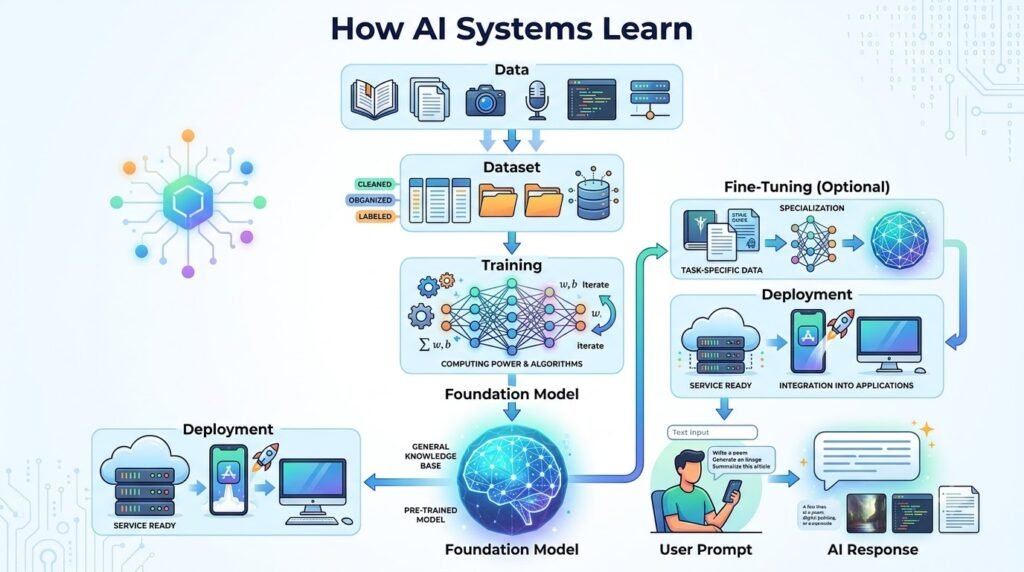
Fine-Tuning
Definition
Fine-tuning is the process of taking an existing AI model and training it further on a specialized dataset so it performs better on specific tasks.
Example
A healthcare company fine-tunes a language model using medical documents.
Why It Matters
Fine-tuning allows organizations to create AI systems tailored to their industry or workflow.
Foundation Model
Definition
A foundation model is a large AI model trained on broad datasets that can be adapted for many different tasks.
Examples
- GPT models
- Claude models
- Gemini models
- Llama models
Why It Matters
Foundation models are the backbone of many modern AI applications.
G
Generative AI
Definition
Generative AI is a type of artificial intelligence that creates new content, such as text, images, videos, music, code, or audio, based on user prompts.
Example
Using an AI tool to generate an illustration from a written description.
Why It Matters
Generative AI is transforming content creation, education, software development, and business productivity.
Learn More
→ What Is Generative AI?
Generative Pre-trained Transformer (GPT)
Definition
GPT stands for Generative Pre-trained Transformer, a family of language models designed to understand and generate human-like text.
- Generative – Creates new content.
- Pre-trained – Learns from large datasets before being used.
- Transformer – Uses a neural network architecture optimized for language tasks.
Example
ChatGPT is powered by GPT models.
Why It Matters
GPT models are among the most widely used large language models today.
GPU (Graphics Processing Unit)
Definition
A GPU is a specialized processor designed to perform many calculations simultaneously. While originally created for graphics, GPUs are now essential for training and running AI models.
Example
Companies use thousands of GPUs to train large language models.
Why It Matters
Without GPUs, training advanced AI systems would take much longer.
Guardrails
Definition
Guardrails are rules, policies, or technical safeguards that help AI systems produce safer and more reliable outputs.
Example
Preventing an AI assistant from generating dangerous or harmful instructions.
Why It Matters
Guardrails improve user safety, reduce misuse, and increase trust in AI systems.
H
Hallucination
Definition
A hallucination occurs when an AI system generates information that appears convincing but is incorrect, misleading, or unsupported by reliable evidence.
Example
An AI invents a scientific study or incorrectly attributes a quote to a famous person.
Why It Matters
Always verify AI-generated information, especially for healthcare, legal, financial, or academic use.
Best Practice
Use trusted sources and ask AI to cite references whenever possible.
Learn More
→ AI Hallucinations Explained
Human-in-the-Loop (HITL)
Definition
Human-in-the-loop is an approach where humans review, guide, or approve AI-generated decisions before they are finalized.
Example
An AI drafts a legal document, but a lawyer reviews and edits it before it is submitted.
Why It Matters
Combining AI with human expertise improves accuracy, accountability, and decision-making.
Hyperparameter
Definition
A hyperparameter is a setting chosen before training an AI model that influences how the model learns.
Common hyperparameters include:
- Learning rate
- Batch size
- Number of training iterations
- Model size
Example
Adjusting the learning rate to help a model train more efficiently.
Why It Matters
Selecting appropriate hyperparameters can significantly improve model performance.
Hugging Face
Definition
Hugging Face is a popular platform and open-source community that provides AI models, datasets, libraries, and tools for building machine learning applications.
Example
Developers download pre-trained language models from Hugging Face to build chatbots, translation tools, or text classifiers.
Why It Matters
Hugging Face has become one of the largest ecosystems for open-source AI development.
I
Inference
Definition
Inference is the process of using a trained AI model to generate predictions, answers, or outputs from new input data. In simple terms, inference is when AI “uses what it has learned.”
Example
When you ask ChatGPT a question and receive an answer, the model is performing inference—not learning something new.
Why It Matters
Every interaction with an AI chatbot, image generator, or recommendation system involves inference. Faster inference leads to quicker responses and a better user experience.
Learn More
→ How Does ChatGPT Work?
Input
Definition
Input is the information you provide to an AI system. It can be text, images, audio, video, code, or structured data.
Example
Typing “Explain quantum computing in simple terms” into ChatGPT is providing text input.
Why It Matters
The quality and clarity of your input directly influence the quality of the AI’s output.
Intelligent Agent
Definition
An intelligent agent is a system that can perceive its environment, make decisions, and take actions to achieve specific goals. AI agents are a modern example of intelligent agents.
Example
A robot vacuum that maps your home and decides the most efficient cleaning path.
Why It Matters
Intelligent agents form the foundation of many autonomous AI systems.
K
Knowledge Base
Definition
A knowledge base is a collection of organized information that an AI system can search or reference when answering questions.
Example
A company’s internal documentation used by an AI customer support assistant.
Why It Matters
Knowledge bases help AI provide accurate, organization-specific answers without relying only on its original training.
Knowledge Graph
Definition
A knowledge graph is a structured network of connected information that represents relationships between people, places, concepts, and objects.
Example
Google’s Knowledge Graph connects information about famous people, companies, books, and locations.
Why It Matters
Knowledge graphs improve search engines, recommendation systems, and question-answering AI.
L
Large Language Model (LLM)
Definition
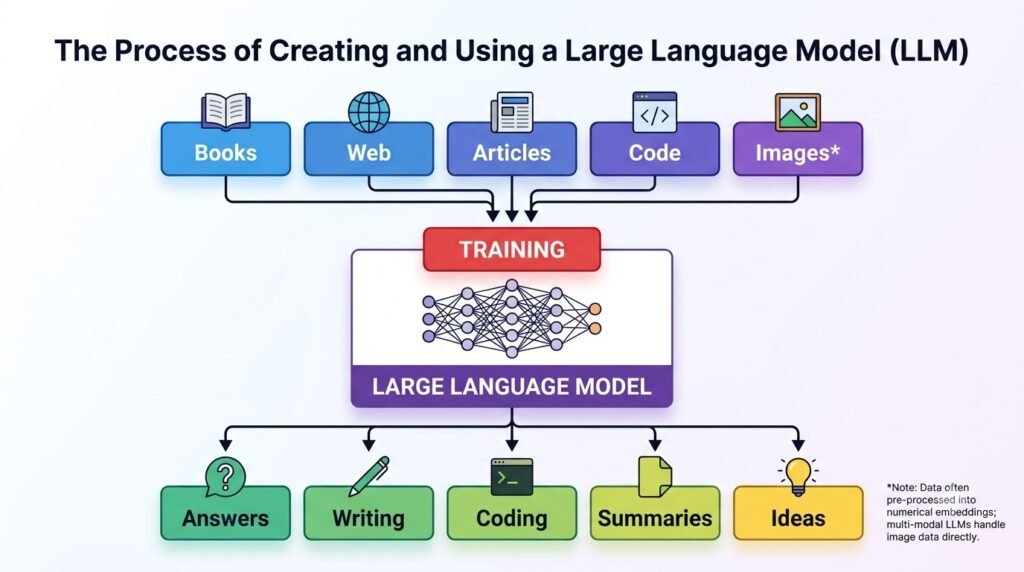
A Large Language Model (LLM) is an AI model trained on vast amounts of text to understand and generate human language.
LLMs can:
- Answer questions
- Write articles
- Summarize documents
- Translate languages
- Generate code
- Brainstorm ideas
Examples
- GPT
- Claude
- Gemini
- Llama
- Mistral
Why It Matters
Large Language Models are the technology behind many modern AI assistants.
Learn More
→ Large Language Models (LLMs) Explained (Future Guide)
Latency
Definition
Latency is the time it takes an AI system to respond after receiving a request.
Example
If an AI chatbot answers in two seconds, its latency is approximately two seconds.
Why It Matters
Lower latency creates a smoother and more responsive user experience.
Learning Rate
Definition
The learning rate is a training setting that determines how much an AI model adjusts itself after processing new data.
Example
A learning rate that is too high may prevent a model from learning accurately, while one that is too low can make training very slow.
Why It Matters
Choosing the right learning rate is essential for effective model training.
Llama
Definition
Llama is a family of open-weight large language models developed by Meta. Developers can use these models to build AI applications, assistants, and research projects.
Example
Many businesses build private AI assistants using Llama models.
Why It Matters
Llama has helped expand access to high-quality AI models beyond proprietary platforms.
M
Machine Learning (ML)
Definition
Machine Learning is a branch of artificial intelligence that enables computers to learn patterns from data instead of following fixed programming rules.
Rather than being explicitly programmed for every task, machine learning systems improve by analyzing examples.
Example
Netflix recommending movies based on your viewing history.
Why It Matters
Machine learning powers many everyday AI applications, including recommendation systems, fraud detection, speech recognition, and predictive analytics.
Learn More
→ AI vs Machine Learning vs Deep Learning
Model
Definition
A model is a trained AI system that performs specific tasks, such as generating text, recognizing images, or making predictions.
Example
GPT-4 is a language model. Stable Diffusion is an image generation model.
Why It Matters
The capabilities of an AI application depend on the model it uses.
Model Training
Definition
Model training is the process of teaching an AI model by exposing it to large amounts of data so it can identify patterns and improve its predictions.
Example
Training a language model on billions of sentences to learn grammar, vocabulary, and reasoning patterns.
Why It Matters
Training is one of the most computationally intensive stages of AI development.
Multimodal AI
Definition
Multimodal AI can understand and generate multiple types of information, such as text, images, audio, video, and documents, within a single system.
Example
Uploading a photo to an AI assistant and asking it to describe the image or answer questions about it.
Why It Matters
Multimodal AI enables more natural and versatile interactions, making AI useful across a wider range of real-world tasks.
Multimodal Model
Definition
A multimodal model is an AI model designed to process and combine different types of input and output, such as text, images, and audio.
Example
An AI that can analyze a chart, explain it in text, and generate a presentation based on its findings.
Why It Matters
These models are becoming increasingly common in AI assistants and productivity tools.
Model Parameters
Definition
Parameters are the internal numerical values that an AI model learns during training. They store the patterns and relationships the model has discovered from its training data.
Example
Modern large language models may contain billions or even trillions of parameters.
Why It Matters
While more parameters can increase a model’s capacity, they do not automatically make it better. Training quality, data, architecture, and optimization also play major roles.
Memory (AI Context)
Definition
In conversational AI, memory refers to a system’s ability to retain relevant information across interactions or within a conversation, depending on how it is designed.
Example
An AI assistant remembering your preferred writing style during an ongoing project.
Why It Matters
Memory enables more personalized, consistent, and context-aware interactions.
Mixture of Experts (MoE)
Definition
Mixture of Experts (MoE) is an AI architecture where specialized sub-models, called “experts,” handle different parts of a task. Instead of activating the entire model for every request, only the most relevant experts are used.
Example
One expert may specialize in coding, another in mathematics, and another in creative writing.
Why It Matters
MoE architectures can improve efficiency while maintaining strong performance on diverse tasks.
Machine Vision
Definition
Machine vision is the use of AI and computer vision to inspect, analyze, and interpret visual information, especially in industrial and manufacturing settings.
Example
A factory camera automatically detecting defects on a production line.
Why It Matters
Machine vision improves quality control, automation, and operational efficiency.
Quick Comparison
| Term | Simple Meaning | Everyday Example |
| AI | Machines performing intelligent tasks | Voice assistants |
| Machine Learning | AI learns from data | Netflix recommendations |
| Deep Learning | ML using layered neural networks | Face recognition |
| LLM | AI specialized in language | ChatGPT |
| Multimodal AI | AI works with multiple data types | Analyzing images and text together |
| Inference | AI generating an answer | Chatbot response |
| Model | Trained AI system | GPT, Gemini, Claude |
Continue Learning
After understanding these concepts, explore:
- What Is Artificial Intelligence?
- AI vs Machine Learning vs Deep Learning
- What Is Generative AI?
- What Are AI Agents?
- How Does ChatGPT Work?
- Prompt Engineering Techniques
- Zero-Shot vs Few-Shot Prompting
N
Natural Language Processing (NLP)
Definition
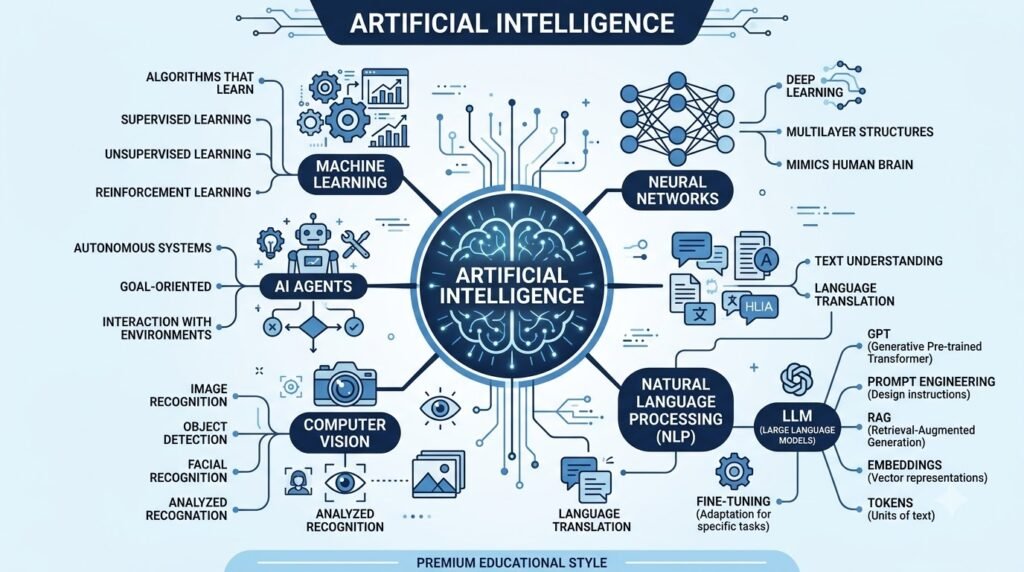
Natural Language Processing (NLP) is a branch of artificial intelligence that enables computers to understand, interpret, generate, and respond to human language.
NLP combines machine learning, linguistics, and computer science to help computers work with text and speech.
Example
Everyday NLP applications include:
- ChatGPT answering questions
- Google Translate translating languages
- Gmail suggesting replies
- Voice assistants understanding spoken commands
Why It Matters
NLP makes AI systems easier to interact with because people can communicate naturally instead of using programming languages or complex commands.
Learn More
→ Natural Language Processing (NLP) Explained (Future Guide)
Neural Network
Definition
A neural network is a machine learning model inspired by the structure of the human brain. It consists of interconnected nodes (called neurons) that learn patterns from data.
Despite the name, neural networks do not function like the human brain—they are mathematical models designed to recognize relationships in data.
Example
Neural networks power:
- Image recognition
- Speech recognition
- AI chatbots
- Language translation
- Recommendation systems
Why It Matters
Modern AI breakthroughs, including large language models and image generators, are built using deep neural networks.
Learn More
→ How Neural Networks Work (Future Guide)
Node
Definition
A node is an individual processing unit within a neural network. Each node receives information, performs calculations, and passes the result to other nodes.
Example
Thousands or even millions of nodes work together to help an AI recognize a handwritten number.
Why It Matters
Nodes are the basic building blocks of neural networks.
No-Code AI
Definition
No-Code AI refers to platforms that allow people to build or use AI applications without writing code.
Example
Creating an AI-powered chatbot using a drag-and-drop interface.
Why It Matters
No-Code AI makes artificial intelligence accessible to educators, marketers, entrepreneurs, and small businesses.
O
Open Source AI
Definition
Open-source AI refers to AI software, models, or tools whose source code or model weights are publicly available for developers to inspect, modify, and build upon, subject to their licenses.
Examples
- Llama (open-weight models)
- Mistral AI models
- Stable Diffusion
- Hugging Face libraries
Why It Matters
Open-source AI encourages collaboration, innovation, and wider access to AI technology.
Output
Definition
Output is the result produced by an AI system after processing your input.
Example
You ask:
“Summarize this article.”
The summary generated by the AI is the output.
Why It Matters
Evaluating AI output helps users determine whether the response is accurate, useful, and complete.
Overfitting
Definition
Overfitting occurs when an AI model learns its training data too closely, including noise and irrelevant details, making it perform poorly on new, unseen data.
Example
A model scores nearly 100% on its training data but performs poorly when tested with new examples.
Why It Matters
Developers work to avoid overfitting so AI systems generalize well to real-world situations.
Optimization
Definition
Optimization is the process of improving an AI model’s performance by adjusting how it learns, trains, or generates outputs.
Example
Changing training settings or improving the quality of training data to increase model accuracy.
Why It Matters
Optimization helps create AI systems that are faster, more accurate, and more efficient.
P
Parameter
Definition
A parameter is a value learned by an AI model during training. Parameters store the relationships and patterns the model has discovered in its training data.
Example
Modern language models contain billions of learned parameters.
Why It Matters
Parameters are a measure of a model’s capacity, but they are only one factor influencing performance.
Predictive AI
Definition
Predictive AI uses historical data to estimate or forecast future outcomes.
Example
Predicting customer demand for a product next month.
Why It Matters
Businesses use predictive AI for forecasting, risk analysis, inventory planning, and decision-making.
Pre-training
Definition
Pre-training is the initial stage of training an AI model on a very large and diverse dataset before adapting it to specific tasks.
Example
A language model learns grammar, vocabulary, and general knowledge during pre-training.
Why It Matters
Pre-training gives foundation models broad capabilities that can later be refined through prompting or fine-tuning.
Prompt
Definition
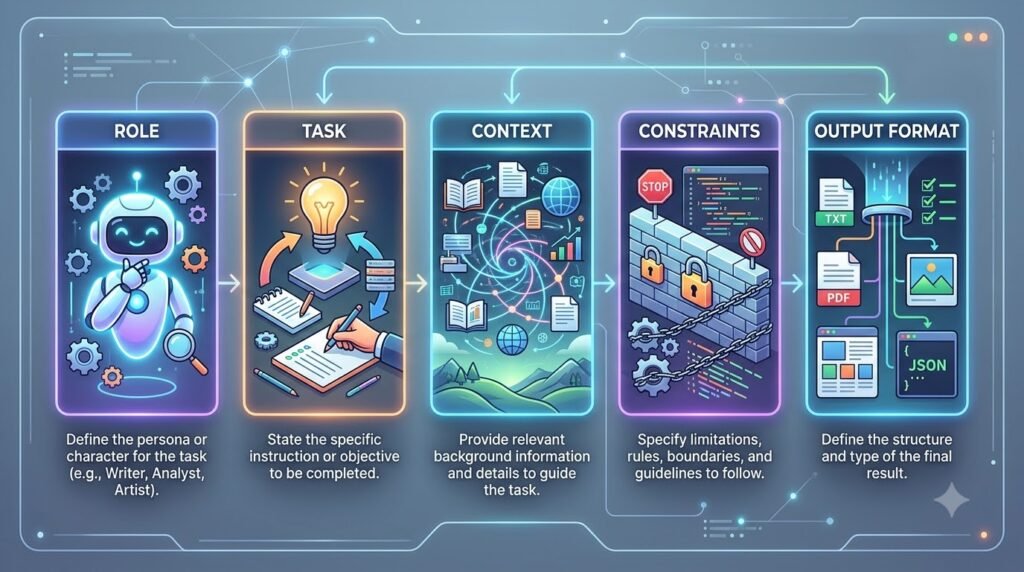
A prompt is the instruction, question, or input you provide to an AI system to guide its response.
A prompt can include:
- Questions
- Instructions
- Context
- Examples
- Constraints
- Desired output format
Example
Explain blockchain to a 12-year-old using simple language.
Why It Matters
The quality of your prompt has a significant impact on the quality of the AI’s response.
Learn More
→ How to Write Better AI Prompts
Prompt Engineering
Definition
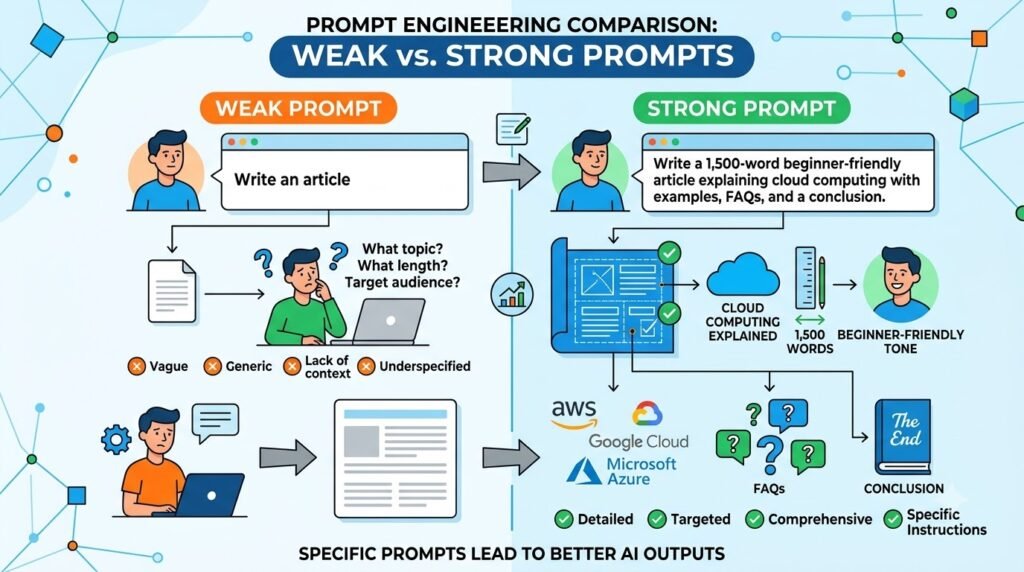
Prompt engineering is the practice of designing clear and effective prompts to help AI systems generate better results.
It involves providing context, setting goals, specifying formats, and refining instructions.
Example
Instead of asking:
Write an email.
You ask:
Write a professional follow-up email after a job interview in under 150 words.
Why It Matters
Prompt engineering improves the accuracy, relevance, and usefulness of AI-generated content.
Learn More
→ What Is Prompt Engineering?
Prompt Template
Definition
A prompt template is a reusable prompt structure that can be adapted for similar tasks.
Example
Act as a [ROLE].
Your task is to [OBJECTIVE].
Audience:
[TARGET AUDIENCE]
Requirements:
– Requirement 1
– Requirement 2
Output Format:
[FORMAT]
Why It Matters
Prompt templates save time and help produce more consistent AI outputs.
Learn More
→ Prompt Templates
Q
Query
Definition
A query is a request submitted to an AI system or search engine.
Example
“What is reinforcement learning?”
is an AI query.
Why It Matters
Understanding user queries helps AI systems deliver more relevant responses.
R
RAG (Retrieval-Augmented Generation)
Definition
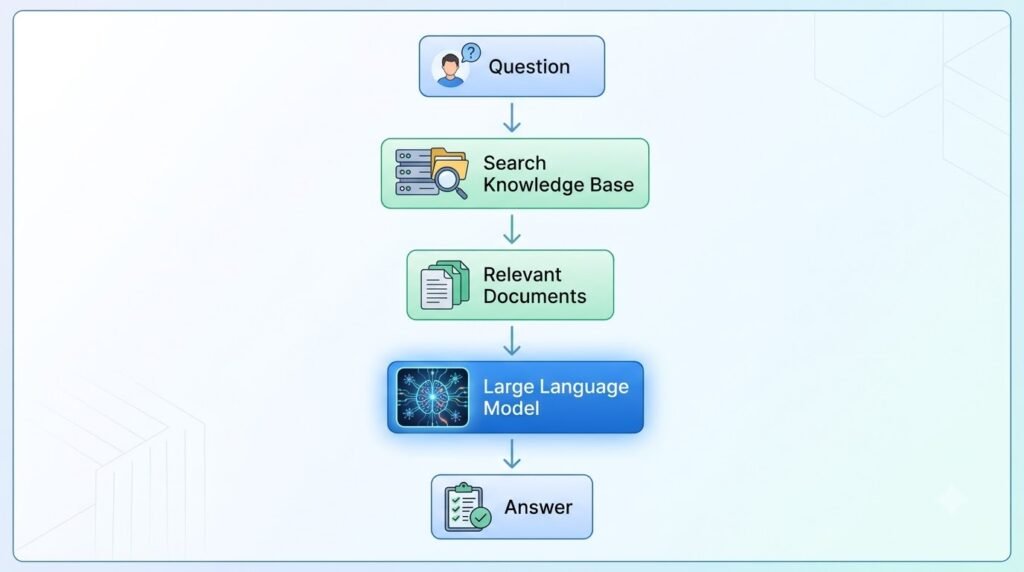
Retrieval-Augmented Generation (RAG) is an AI technique that combines a language model with an external knowledge source. Instead of relying only on what the model learned during training, it first retrieves relevant information and then uses that information to generate a response.
Example
A company chatbot searches its internal documentation before answering an employee’s question about company policies.
Why It Matters
RAG can improve accuracy, reduce hallucinations, and provide responses based on up-to-date or organization-specific information.
Learn More
→ What Is Retrieval-Augmented Generation (RAG)? (Future Guide)
Reinforcement Learning
Definition
Reinforcement learning is a type of machine learning in which an AI system learns by interacting with an environment and receiving rewards or penalties based on its actions.
Example
An AI learning to play a video game by earning points for successful moves and losing points for mistakes.
Why It Matters
Reinforcement learning is widely used in robotics, game-playing AI, recommendation systems, and autonomous decision-making.
Reinforcement Learning from Human Feedback (RLHF)
Definition
Reinforcement Learning from Human Feedback (RLHF) is a training technique where human evaluators rate AI responses, helping the model learn which outputs are more helpful, accurate, and appropriate.
Example
Human reviewers compare two AI-generated answers and indicate which one better satisfies the user’s request.
Why It Matters
RLHF has played an important role in improving the helpfulness and safety of modern conversational AI systems.
Retrieval
Definition
Retrieval is the process of finding relevant information from a database, document collection, or knowledge base before generating a response.
Example
An AI assistant searches a company’s policy documents to answer a question about employee benefits.
Why It Matters
Effective retrieval enables AI systems to provide more accurate, current, and context-specific answers.
Responsible AI
Definition
Responsible AI is the practice of designing, deploying, and using AI systems in ways that are ethical, fair, transparent, secure, and accountable.
Key principles often include:
- Fairness
- Privacy
- Safety
- Transparency
- Human oversight
- Accountability
Example
A healthcare AI system that explains its recommendations and protects patient privacy.
Why It Matters
Responsible AI helps organizations build trustworthy systems that serve people while reducing risks and unintended harm.
Recommendation System
Definition
A recommendation system is an AI-powered system that suggests products, content, or services based on user preferences, behavior, or similarities with other users.
Example
Recommendations on Netflix, YouTube, Spotify, Amazon, and online shopping platforms.
Why It Matters
Recommendation systems personalize digital experiences and help users discover relevant content more efficiently.
Quick Comparison
| Term | What It Does | Real-World Example |
| NLP | Understands human language | ChatGPT |
| Neural Network | Learns patterns | Image recognition |
| Prompt | User instruction | Asking ChatGPT a question |
| Prompt Engineering | Improves prompts | Better AI responses |
| RAG | Retrieves information before answering | Company knowledge chatbot |
| RLHF | Learns from human preferences | Improving chatbot responses |
| Recommendation System | Suggests relevant content | Netflix recommendations |
S
Semantic Search
Definition
Semantic search is a search technique that focuses on understanding the meaning and intent behind a query rather than simply matching exact keywords.
Example
Searching for:
“How can I write better AI prompts?”
may return articles about prompt engineering, even if they don’t contain that exact phrase.
Why It Matters
Semantic search helps AI and search engines provide more relevant and useful results.
Small Language Model (SLM)
Definition
A Small Language Model (SLM) is a compact AI language model designed to perform language tasks using fewer parameters and less computing power than a Large Language Model (LLM).
Example
An AI assistant running locally on a smartphone instead of relying on a cloud-based model.
Why It Matters
SLMs can offer faster responses, lower costs, and better privacy for certain applications.
Speech Recognition
Definition
Speech recognition is AI technology that converts spoken language into text.
Example
Voice typing on your smartphone or generating captions during a video meeting.
Why It Matters
Speech recognition powers virtual assistants, accessibility tools, transcription services, and voice-controlled devices.
Stable Diffusion
Definition
Stable Diffusion is an open-source AI image generation model that creates images from text descriptions using diffusion techniques.
Example
Generating artwork from the prompt:
“A watercolor painting of a mountain village at sunrise.”
Why It Matters
Stable Diffusion has made AI image generation widely accessible to developers, designers, and creators.
Structured Prompt
Definition
A structured prompt is a prompt that clearly defines the task, context, constraints, audience, and desired output.
Example
Instead of writing:
Write a blog.
You write:
Write a 1,500-word beginner-friendly blog post explaining cloud computing. Include headings, examples, FAQs, and a conclusion.
Why It Matters
Structured prompts generally produce more accurate and consistent AI responses.
Supervised Learning
Definition
Supervised learning is a machine learning method where an AI model learns from labeled training data.
Example
Teaching an AI to identify cats and dogs using thousands of labeled images.
Why It Matters
Supervised learning is widely used in image classification, fraud detection, and spam filtering.
Synthetic Data
Definition
Synthetic data is artificially generated data that resembles real-world data but is created by algorithms rather than collected from actual users or events.
Example
Generating realistic medical images for research without exposing patient information.
Why It Matters
Synthetic data can improve privacy, expand training datasets, and reduce data collection costs.
T
Temperature
Definition
Temperature is a model setting that influences how predictable or creative an AI model’s responses are.
- Lower temperature produces more consistent and focused responses.
- Higher temperature encourages more varied and creative outputs.
Example
A low temperature may be suitable for factual explanations, while a higher temperature may help generate story ideas.
Why It Matters
Understanding temperature helps users choose outputs that match their goals.
Token
Definition
A token is a small unit of text processed by an AI model. Tokens may represent entire words, parts of words, punctuation, or symbols.
For example:
Artificial Intelligence is amazing.
may be split into several tokens before being processed by the model.
Why It Matters
Most AI models have token limits, which determine how much information they can process in a single interaction.
Learn More
→ What Are AI Tokens? (Future Guide)
Tokenization
Definition
Tokenization is the process of breaking text into tokens before an AI model processes it.
Example
The sentence:
“AI is transforming education.”
is divided into smaller pieces that the model can understand.
Why It Matters
Tokenization is a fundamental step in how language models process text.
Training Data
Definition
Training data is the collection of examples used to teach an AI model.
Training data may include:
- Articles
- Books
- Images
- Audio
- Videos
- Code
- Scientific papers
depending on the model’s purpose.
Why It Matters
The quality, diversity, and relevance of training data strongly influence how well an AI model performs.
Transformer
Definition
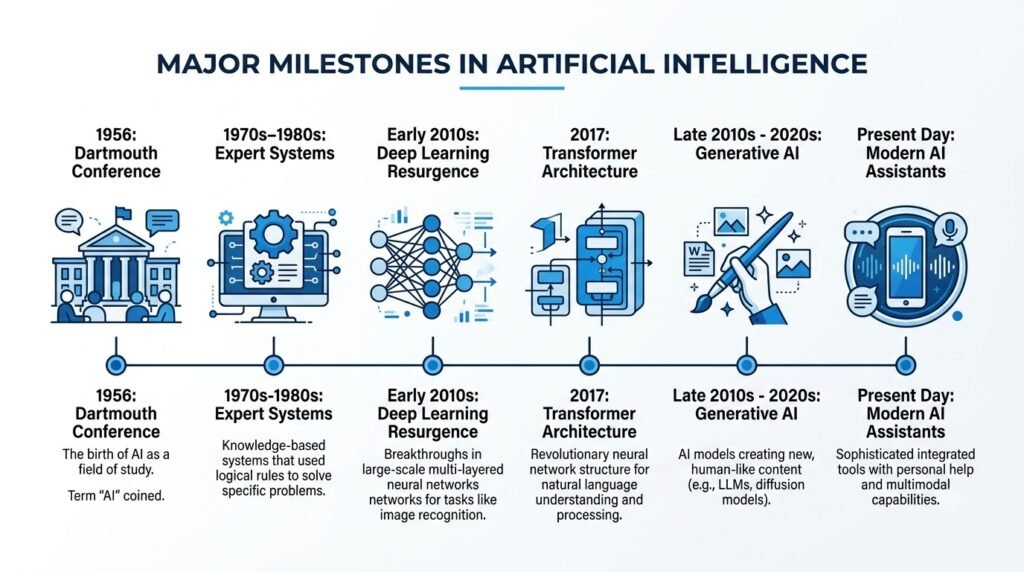
A Transformer is a neural network architecture introduced in 2017 that revolutionized natural language processing by enabling models to understand relationships between words more efficiently.
Most modern language models—including GPT, Claude, Gemini, and Llama—are built on transformer-based architectures.
Example
ChatGPT uses transformer technology to generate coherent responses to user prompts.
Why It Matters
The transformer architecture made today’s large language models possible.
Learn More
→ How Transformers Work (Future Guide)
Transfer Learning
Definition
Transfer learning is the practice of using knowledge gained from one task to improve performance on another related task.
Example
A language model trained on general text is adapted for legal document analysis.
Why It Matters
Transfer learning reduces the amount of data and computing required for specialized AI applications.
U
Unstructured Data
Definition
Unstructured data is information that does not follow a predefined format or database structure.
Examples include:
- Emails
- Images
- Videos
- Audio recordings
- Social media posts
- PDF documents
Why It Matters
Most of the world’s digital information is unstructured, making AI especially valuable for organizing and analyzing it.
Unsupervised Learning
Definition
Unsupervised learning is a machine learning technique where an AI model discovers patterns in unlabeled data without predefined answers.
Example
Grouping customers with similar purchasing behavior without knowing the groups in advance.
Why It Matters
Unsupervised learning is useful for clustering, anomaly detection, and data exploration.
V
Vector
Definition
A vector is a numerical representation of information used by AI models to compare meaning and relationships.
Vectors allow AI systems to determine how similar two pieces of information are.
Example
The words “doctor” and “physician” have vectors that are close together because they have similar meanings.
Why It Matters
Vectors are essential for semantic search, recommendation systems, and Retrieval-Augmented Generation (RAG).
Vector Database
Definition
A vector database is a specialized database designed to store and search vectors efficiently.
Instead of matching exact keywords, it finds information based on semantic similarity.
Example
An AI assistant retrieves the most relevant company documents using vector search before answering a question.
Why It Matters
Vector databases are a core component of many RAG systems and modern AI search applications.
Vision Language Model (VLM)
Definition
A Vision Language Model (VLM) is an AI model that can understand both images and text, allowing it to answer questions about visual content.
Example
Uploading a photo of a chart and asking the AI to explain its trends.
Why It Matters
VLMs are expanding AI’s ability to work across multiple types of information.
W
Weights
Definition
Weights are the numerical values inside an AI model that determine how strongly different inputs influence its predictions.
During training, the model adjusts these weights to improve performance.
Example
As an AI learns to recognize handwritten numbers, it updates its weights to make more accurate predictions.
Why It Matters
Weights represent much of what an AI model has learned from its training data.
Workflow Automation
Definition
Workflow automation uses AI and software tools to complete repetitive tasks with minimal human intervention.
Example
Automatically summarizing customer support emails and assigning them to the appropriate team.
Why It Matters
AI-powered automation increases productivity and reduces manual work.
X
Explainable AI (XAI)
Definition
Explainable AI (XAI) refers to methods that help humans understand how AI systems make decisions.
Example
A medical AI highlighting the factors that contributed to a diagnosis.
Why It Matters
Explainability is important for trust, accountability, and regulatory compliance.
Editor’s Note: This term was introduced earlier under E. Keep one primary entry there and add an alphabetical cross-reference under X:
XAI → See Explainable AI.
Y
Yield (AI Inference)
Definition
Yield refers to the amount of useful output generated relative to the computing resources used. While not a common beginner term, it is sometimes used when discussing AI infrastructure and efficiency.
Example
Improving hardware utilization so more AI requests can be processed per second.
Why It Matters
Higher yield helps reduce infrastructure costs and improve scalability.
Z
Zero-Shot Learning
Definition
Zero-shot learning enables an AI model to perform a task it has not been specifically trained on by relying on its existing knowledge.
Example
Asking an AI to summarize a type of document it has never seen before.
Why It Matters
Zero-shot capabilities make foundation models flexible and useful across many tasks.
Zero-Shot Prompting
Definition
Zero-shot prompting is the practice of asking an AI to complete a task without providing examples.
Example
Summarize this article in five bullet points.
No examples are included—the AI relies on its general training.
Why It Matters
Zero-shot prompting is quick, simple, and effective for many everyday AI tasks.
Learn More
→ Zero-Shot vs Few-Shot Prompting
Frequently Asked Questions
What is the most important AI term to understand first?
Start with Artificial Intelligence (AI), then learn Machine Learning, Deep Learning, Large Language Models (LLMs), and Generative AI. These concepts provide the foundation for understanding most modern AI tools.
What is the difference between AI and machine learning?
Artificial Intelligence is the broader field of creating systems that perform tasks requiring human intelligence. Machine Learning is a subset of AI that enables systems to learn patterns from data instead of relying solely on explicit programming.
What is an LLM?
A Large Language Model (LLM) is an AI model trained on vast amounts of text to understand and generate human language. Examples include GPT, Claude, Gemini, and Llama.
What is a token in AI?
A token is a unit of text processed by an AI model. Models have token limits that affect how much information they can consider in a single interaction.
What is RAG?
Retrieval-Augmented Generation (RAG) combines a language model with an external knowledge source to produce responses based on relevant, up-to-date information rather than relying only on the model’s training.
Why is prompt engineering important?
Prompt engineering helps users communicate more effectively with AI systems, often leading to more accurate, relevant, and useful responses.
Continue Your AI Journey
Keep building your AI knowledge with these beginner-friendly guides.
-
AI Glossary: 100+ Artificial Intelligence Terms Explained
Learn more : AI Glossary: 100+ Artificial Intelligence Terms Explained🕒 25-35 min read • Updated: Aug 2026 Introduction Artificial Intelligence (AI) is changing how we learn, work,…
-

Large Language Models (LLMs) Explained: The Complete 2026 Beginner’s Guide
Learn more : Large Language Models (LLMs) Explained: The Complete 2026 Beginner’s Guide🕒 14-16 min read • Updated: Aug 2026 Introduction Artificial Intelligence has become part of everyday life. Whether…
-
How Artificial Intelligence Works: 5 Core Concepts Explained Simply (2026 Guide)
Learn more : How Artificial Intelligence Works: 5 Core Concepts Explained Simply (2026 Guide)🕒 14-16 min read • Updated: Aug 2026 Introduction What Is Machine Learning? If Artificial Intelligence is the…
-

Artificial Intelligence Explained: The Complete Beginner’s Guide (2026)
Learn more : Artificial Intelligence Explained: The Complete Beginner’s Guide (2026)🕒 14-18 min read • Updated: Aug 2026 introduction Artificial intelligence (AI) has quickly become one of the…
-

How to Use AI in Content Creation: The Complete 2026 Blueprint
Learn more : How to Use AI in Content Creation: The Complete 2026 Blueprint🕒 10-12 min read • Updated: July 2026 Introduction Creating high-quality content consistently can be challenging, whether you’re…
-

7 Ways AI Is Transforming Software Development in 2026 (Real Workflows & Case Studies)
Learn more : 7 Ways AI Is Transforming Software Development in 2026 (Real Workflows & Case Studies)🕒 12-15 min read • Updated: July 2026 Introduction Artificial intelligence (AI) is transforming software development by helping…
References
- https://platform.openai.com/docs
- https://docs.anthropic.com/
- https://ai.google.dev/
- https://huggingface.co/docs
- https://developers.google.com/machine-learning/crash-course
- https://www.deeplearning.ai/
- https://www.nist.gov/itl/ai-risk-management-framework
- https://hai.stanford.edu/
- https://arxiv.org/abs/1706.03762
- https://arxiv.org/abs/2005.11401
- https://arxiv.org/abs/2201.11903
- https://learn.microsoft.com/ai/
Leave a Reply