
🕒 12-14 min read • Updated: July 2026
Table of Contents
Introduction
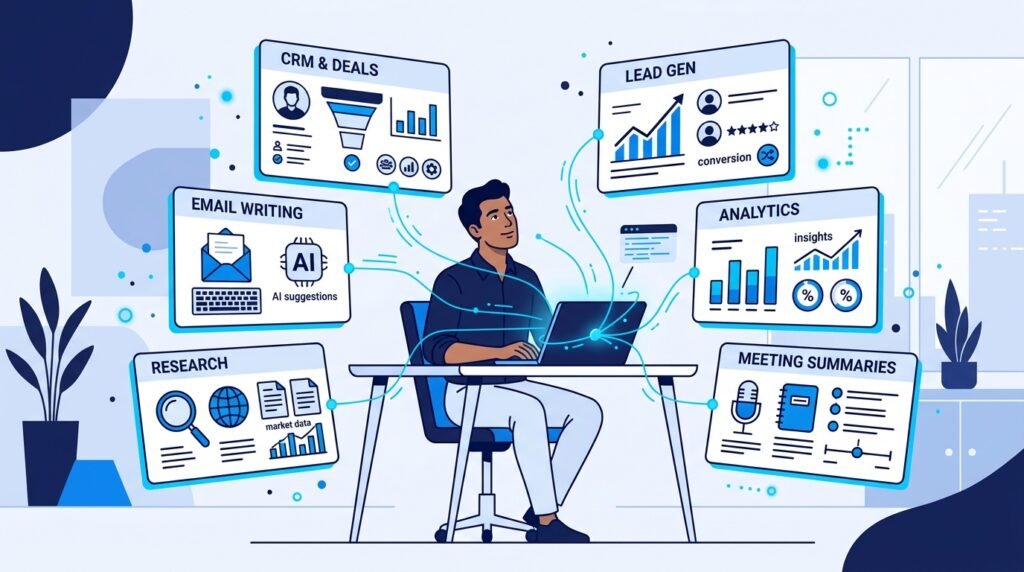
Artificial intelligence (AI) is transforming the way businesses find customers, build relationships, and close deals. Tasks that once required hours of manual effort—such as researching leads, writing personalized emails, updating customer records, and forecasting sales—can now be completed in minutes with the help of AI.
The best part? AI in sales is no longer limited to large enterprises with massive budgets. Today, startups, small businesses, freelancers, and individual sales professionals can access powerful AI tools that improve productivity, personalize customer interactions, and help teams make smarter decisions.
Whether you’re new to artificial intelligence or looking for practical ways to improve your sales process, this guide explains everything you need to know. You’ll learn what AI in sales is, how it works, its benefits and challenges, real-world examples, and the best AI tools to help you get started.
Key Takeaways
- AI in sales helps automate repetitive tasks like lead research, follow-up emails, CRM updates, and meeting summaries.
- It analyzes customer data to identify high-quality leads and predict buying behavior.
- AI enables sales teams to personalize outreach at scale without sacrificing efficiency.
- Businesses of all sizes can benefit from AI, thanks to many beginner-friendly and free tools.
- AI enhances human sales professionals—it doesn’t replace the need for relationship-building and strategic thinking.
What Is AI in Sales?
AI in sales refers to the use of artificial intelligence technologies to help sales professionals work more efficiently, make better decisions, and improve customer engagement throughout the sales process.
Instead of manually searching for prospects or spending hours updating spreadsheets, AI can analyze large amounts of customer data, identify promising opportunities, recommend the next best action, and automate repetitive tasks.
Think of AI as a smart sales assistant that works alongside your team. It doesn’t replace human expertise—instead, it handles repetitive work so sales professionals can spend more time building relationships and closing deals.
Example
Imagine a sales representative who receives hundreds of new leads each week.
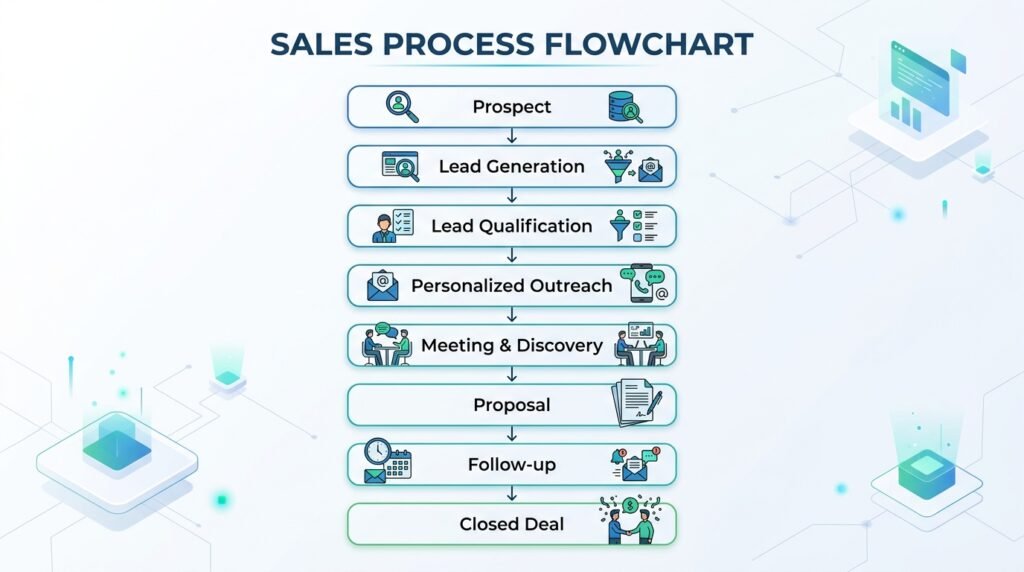
Without AI, they might:
- Review each lead manually.
- Research the company.
- Write personalized emails.
- Update the CRM after every conversation.
- Decide which prospects deserve follow-up.
With AI, much of this work can be automated. The system can score leads, summarize customer information, draft personalized emails, schedule follow-ups, and even recommend the best time to contact a prospect.
As a result, the salesperson spends less time on administrative work and more time having meaningful conversations with potential customers.
How Does AI Work in Sales?
AI in sales combines several technologies to help businesses make smarter decisions and automate everyday tasks.
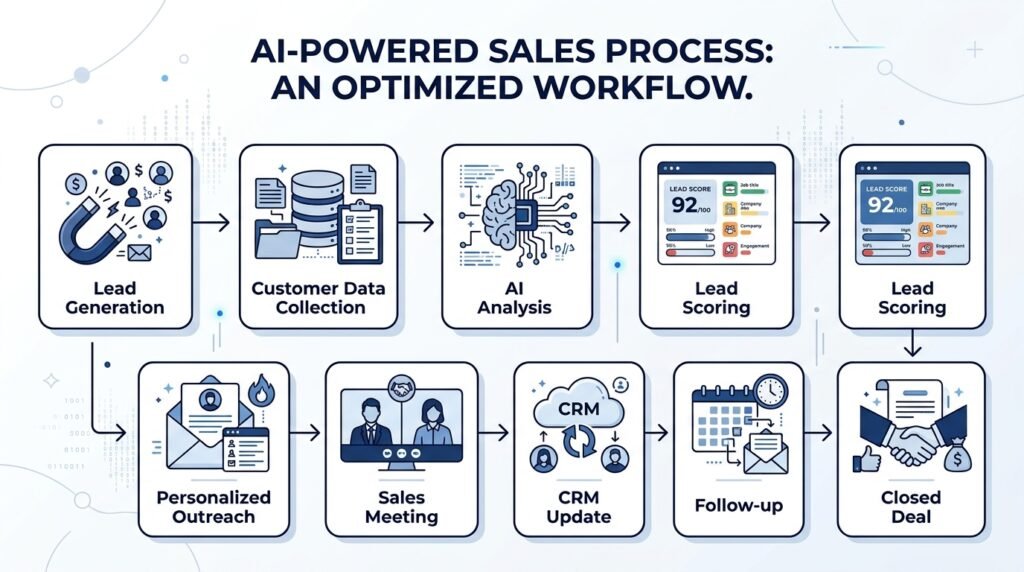
Here’s a simplified workflow:
Customer Data → AI Analysis → Recommendations → Automation → Better Sales Decisions
Let’s look at the key components.
Machine Learning
Machine learning analyzes historical sales data to identify patterns.
For example, AI might discover that prospects from a particular industry are more likely to convert after attending a product demo.
Sales teams can use these insights to prioritize similar opportunities.
Predictive Analytics
Predictive analytics estimates the likelihood of future outcomes.
For example, AI can predict:
- Which leads are most likely to convert.
- Which customers may stop buying.
- Expected monthly revenue.
- Products customers are likely to purchase next.
This helps sales managers make better decisions based on data rather than guesswork.
Natural Language Processing (NLP)
Natural Language Processing enables AI to understand and generate human language.
In sales, NLP powers features such as:
- Email writing assistance
- Meeting summaries
- Chatbots
- Sentiment analysis
- Conversation insights
These capabilities help teams communicate more effectively while reducing manual effort.
Sales Automation
AI also automates repetitive workflows, including:
- Scheduling follow-up reminders
- Updating CRM records
- Logging sales activities
- Creating meeting notes
- Drafting outreach emails
Automation reduces administrative work and allows sales professionals to focus on customer relationships.
Why AI Is Transforming Sales
Modern buyers expect quick responses, personalized communication, and helpful recommendations. Meeting these expectations manually becomes increasingly difficult as businesses grow.
AI helps organizations scale their sales efforts without sacrificing quality.
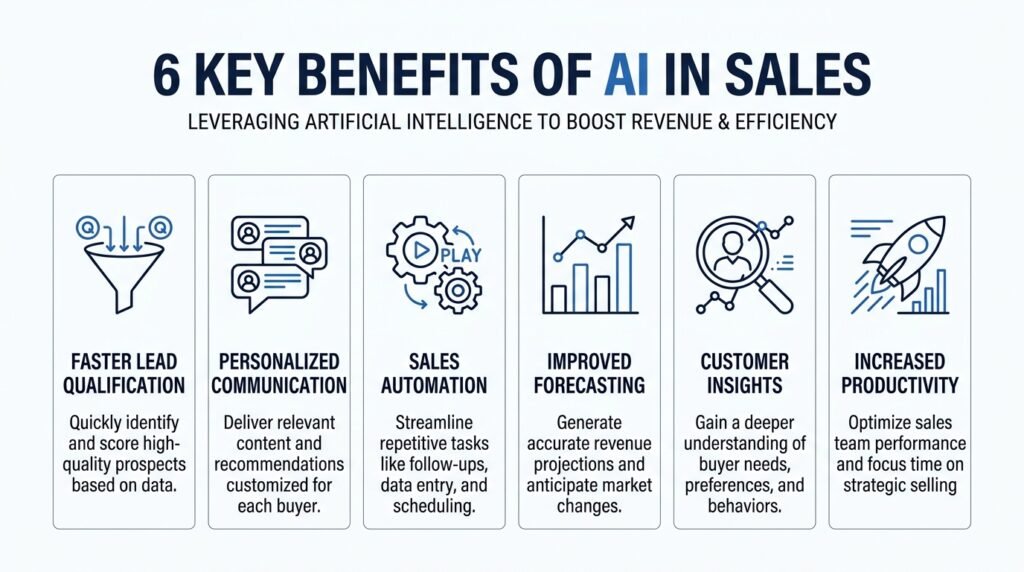
Some of the biggest reasons companies are adopting AI include:
- Faster lead qualification
- Personalized customer experiences
- Improved sales forecasting
- Higher productivity
- Better customer insights
- Reduced manual data entry
- More consistent follow-up
By combining automation with data-driven decision-making, AI enables sales teams to spend more time selling and less time managing repetitive tasks.
Benefits of AI in Sales
Artificial intelligence is changing sales by helping teams work smarter, respond faster, and make better decisions. While AI can’t replace human relationships or negotiation skills, it can automate repetitive tasks and uncover insights that would otherwise take hours to find.
Whether you’re a solo entrepreneur or part of a large sales team, AI can improve efficiency across the entire sales process.
| Benefit | How AI Helps |
| Faster Lead Qualification | Identifies high-potential prospects based on customer data and behavior. |
| Personalized Outreach | Creates tailored emails, messages, and recommendations for each prospect. |
| Higher Productivity | Automates repetitive administrative tasks, allowing more time for selling. |
| Better Sales Forecasting | Uses historical data to predict revenue and future sales trends. |
| Improved Customer Experience | Responds faster and provides more relevant interactions. |
| Smarter Decision-Making | Analyzes customer data to recommend the next best action. |
| Reduced Manual Work | Automatically updates CRM systems, meeting notes, and follow-up reminders. |
Let’s explore these benefits in more detail.
1. Better Lead Qualification
Not every lead is equally likely to become a customer. Manually reviewing hundreds of prospects can consume valuable time and often leads to missed opportunities.
AI analyzes information such as:
- Company size
- Industry
- Website activity
- Previous interactions
- Purchase history
- Email engagement
Based on this data, AI assigns lead scores that help sales teams prioritize the prospects most likely to convert.
Instead of contacting every lead in the same way, sales representatives can focus their efforts where they are most likely to achieve results.
2. Personalized Customer Communication
Modern buyers expect businesses to understand their needs.
AI helps personalize communication by analyzing customer behavior and generating tailored recommendations.
For example, AI can:
- Draft personalized sales emails.
- Recommend products based on customer interests.
- Suggest follow-up messages.
- Adjust messaging for different industries.
Personalization improves engagement while allowing sales teams to communicate with more prospects efficiently.
3. Increased Productivity
Many sales professionals spend a significant portion of their day on administrative work instead of selling.
AI reduces this burden by automating tasks such as:
- Scheduling meetings
- Updating CRM records
- Writing meeting summaries
- Sending follow-up reminders
- Organizing customer information
As a result, sales teams can dedicate more time to conversations, relationship building, and closing deals.
4. More Accurate Sales Forecasting
Predicting future revenue has traditionally relied on experience and manual analysis.
AI improves forecasting by analyzing historical sales data, customer behavior, seasonal trends, and market patterns.
This helps businesses answer questions such as:
- How much revenue can we expect next quarter?
- Which deals are most likely to close?
- Which customers may need additional attention?
More accurate forecasts help organizations allocate resources and plan growth more effectively.
5. Improved Customer Experience
Customers appreciate quick responses and relevant information.
AI helps businesses provide both.
For example, AI-powered systems can:
- Answer common questions through chatbots.
- Route inquiries to the right salesperson.
- Recommend helpful resources.
- Notify representatives when customers need follow-up.
This creates a smoother buying experience while reducing response times.
6. Smarter Sales Decisions
Sales professionals make dozens of decisions every day.
AI provides data-driven insights that support those decisions.
Instead of relying only on intuition, AI can recommend:
- Which prospect to contact first.
- The best time to send an email.
- Which products to recommend.
- When a deal may be at risk.
These recommendations help teams work more strategically.
Common Applications of AI in Sales
AI supports nearly every stage of the sales process, from identifying potential customers to maintaining long-term relationships after a purchase.
Here are some of the most common ways businesses use AI today.
AI Lead Generation
Finding qualified leads is one of the most time-consuming aspects of sales.
AI simplifies this process by analyzing customer data and identifying businesses or individuals who match your ideal customer profile.
Instead of manually searching for prospects, sales teams receive a prioritized list of potential customers based on factors such as industry, company size, purchasing behavior, and online activity.
This allows representatives to focus on high-quality opportunities rather than spending hours researching.
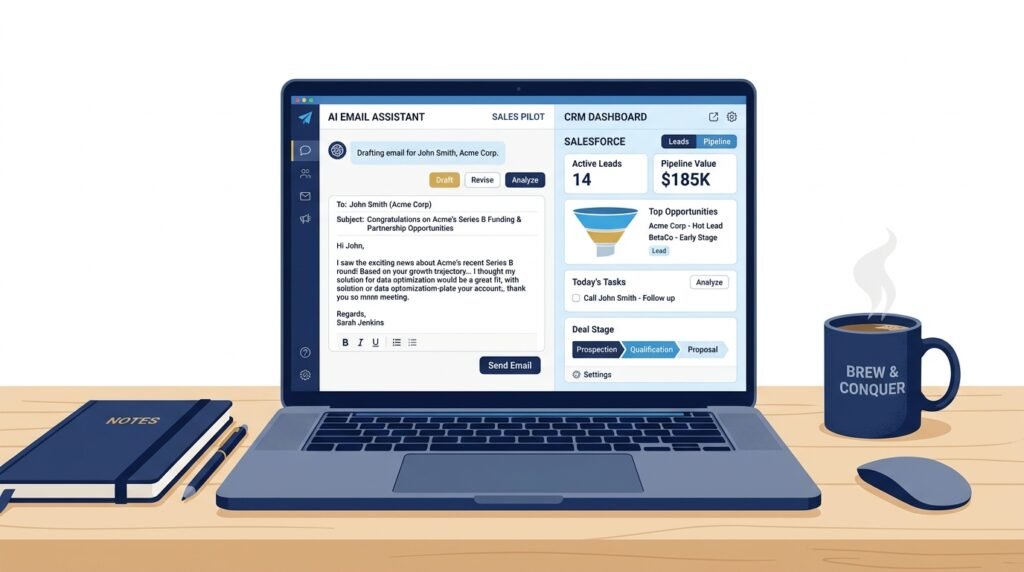
AI Email Writing
Writing personalized emails for every prospect can be challenging, especially when managing dozens of conversations simultaneously.
AI writing assistants can help by:
- Drafting first-contact emails.
- Creating follow-up sequences.
- Suggesting subject lines.
- Improving grammar and tone.
- Personalizing messages using customer information.
Sales professionals should always review AI-generated content before sending it to ensure accuracy and maintain a genuine human voice.
AI-Powered CRM Systems
Customer Relationship Management (CRM) software becomes significantly more powerful when combined with AI.
Modern AI-enabled CRMs can:
- Automatically update customer records.
- Recommend follow-up actions.
- Summarize customer interactions.
- Predict deal outcomes.
- Identify inactive opportunities.
This reduces manual data entry while keeping customer information organized and up to date.
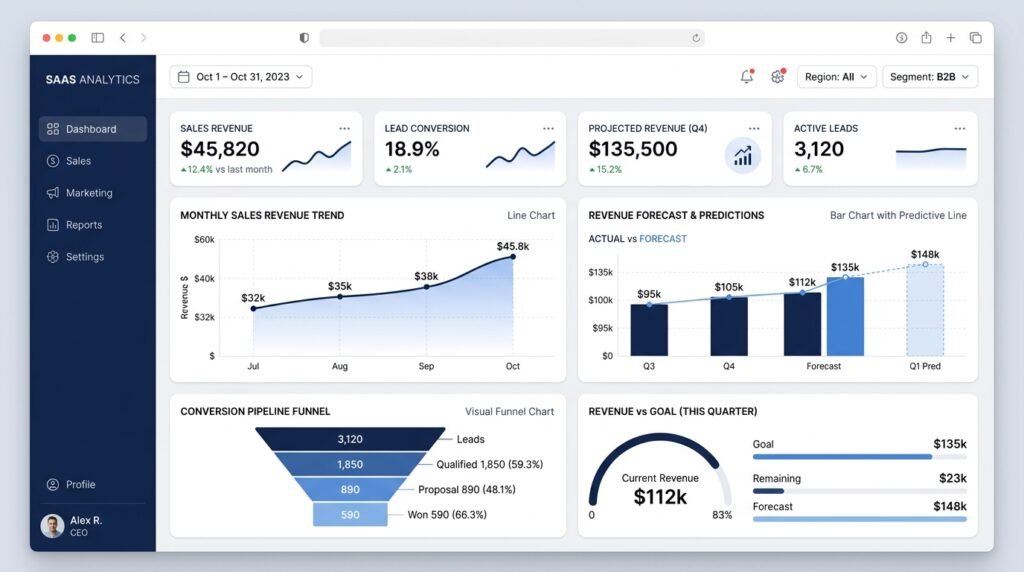
Sales Forecasting
Sales forecasting is no longer limited to spreadsheets and manual calculations.
AI continuously analyzes:
- Historical sales performance
- Customer engagement
- Market trends
- Deal progression
- Seasonal patterns
This helps managers make informed decisions about hiring, budgeting, inventory, and future sales strategies.
Meeting Summaries
Taking notes during client meetings often distracts representatives from active listening.
AI meeting assistants automatically generate summaries that include:
- Key discussion points
- Action items
- Customer questions
- Follow-up reminders
- Next steps
These summaries can also be synchronized with CRM systems, reducing administrative work.

Customer Support Chatbots
Many businesses use AI chatbots to answer frequently asked questions before connecting customers with a sales representative.
Chatbots can:
- Respond instantly.
- Collect customer information.
- Recommend products.
- Schedule meetings.
- Qualify leads.
When implemented effectively, chatbots improve response times while allowing human representatives to focus on more complex conversations.
Quick Tip
Start small. You don’t need to automate your entire sales process on day one. Begin with one repetitive task—such as drafting follow-up emails or summarizing meetings—and gradually introduce AI into other workflows as your team becomes comfortable with the technology.
Real-World Examples of AI in Sales
AI is no longer an experimental technology used only by large corporations. Businesses of all sizes—from startups and small businesses to global enterprises—are using AI to improve sales performance and customer experiences.
Here are some practical examples of how AI is being used in sales today.
Example 1: Writing Personalized Sales Emails
Imagine a sales representative who needs to contact 50 potential customers.
Instead of writing each email from scratch, they can use an AI writing assistant to generate a personalized first draft based on:
- The prospect’s company
- Industry
- Job role
- Recent company news
- Previous interactions
The representative then reviews and customizes the email before sending it.
This approach significantly reduces writing time while maintaining a personal touch.
Example 2: Prioritizing High-Quality Leads
A software company receives hundreds of new leads every week through its website.
Instead of contacting every lead equally, AI analyzes information such as:
- Company size
- Website activity
- Email engagement
- Previous purchases
- Industry
The system then ranks leads based on their likelihood of becoming customers.
Sales representatives can focus on the highest-priority opportunities first, improving efficiency and conversion rates.
Example 3: Meeting Summaries
After a customer meeting, representatives often spend valuable time writing notes and updating CRM records.
AI meeting assistants can automatically generate:
- Meeting summaries
- Key decisions
- Customer questions
- Action items
- Follow-up reminders
This allows sales professionals to stay focused during conversations instead of taking detailed notes.
Example 4: Predicting Customer Churn
AI can analyze customer behavior to identify early warning signs that someone may stop using a product or service.
For example, AI may detect:
- Reduced product usage
- Fewer website visits
- Missed renewals
- Declining engagement
Sales or customer success teams can then proactively reach out before the customer leaves.
Example 5: Intelligent Product Recommendations
Many e-commerce businesses use AI to recommend products based on previous purchases and browsing behavior.
Instead of showing the same products to every customer, AI personalizes recommendations, increasing both customer satisfaction and average order value.
Best AI Tools for Sales
Choosing the right AI tool depends on your goals. Some tools focus on writing sales emails, while others specialize in CRM automation, meeting intelligence, or lead generation.
The following tools are among the most beginner-friendly and widely used by sales professionals.
| Tool | Best For | Free Plan | Ideal For |
| ChatGPT | Email writing, brainstorming, proposal drafts | ✅ | Individuals & teams |
| HubSpot AI | CRM automation & customer management | ✅ | Small businesses |
| Microsoft Copilot | Productivity & meeting summaries | Limited | Microsoft 365 users |
| Salesforce Einstein | Enterprise sales intelligence | ❌ | Large organizations |
| Apollo.io | Lead generation & outreach | ✅ | B2B sales teams |
| Grammarly | Sales emails & communication | ✅ | All professionals |
| Perplexity AI | Prospect research | ✅ | Sales research |
| Notion AI | Sales documentation & knowledge management | ✅ | Teams |
ChatGPT
Best for: Writing sales emails, follow-ups, proposals, objection handling, brainstorming, and customer communication.
ChatGPT can help sales professionals:
- Draft personalized cold emails
- Rewrite sales messages
- Prepare meeting agendas
- Summarize customer conversations
- Generate follow-up emails
- Brainstorm sales strategies
It works especially well when combined with strong prompting techniques.
HubSpot AI
HubSpot combines CRM functionality with AI-powered features that help businesses manage customer relationships more efficiently.
Key capabilities include:
- AI-generated email suggestions
- Lead scoring
- CRM automation
- Customer insights
- Workflow automation
It’s an excellent choice for growing businesses that want an all-in-one sales platform.
Microsoft Copilot
For organizations already using Microsoft 365, Copilot integrates with familiar applications such as Outlook, Teams, Excel, and Word.
It can:
- Summarize meetings
- Draft emails
- Analyze spreadsheets
- Generate reports
- Prepare presentations
This helps sales teams save time on routine office tasks.
Salesforce Einstein
Salesforce Einstein is designed for larger organizations that require advanced AI capabilities.
Features include:
- Predictive lead scoring
- Opportunity insights
- Sales forecasting
- Automated workflows
- Customer recommendations
While powerful, it may be more complex than necessary for beginners or small businesses.
Apollo.io
Apollo combines lead generation with AI-powered outreach tools.
Sales teams can:
- Find potential customers
- Build prospect lists
- Automate outreach
- Track engagement
- Improve prospecting efficiency
It’s particularly popular among B2B sales professionals.
AI in Sales vs Traditional Sales
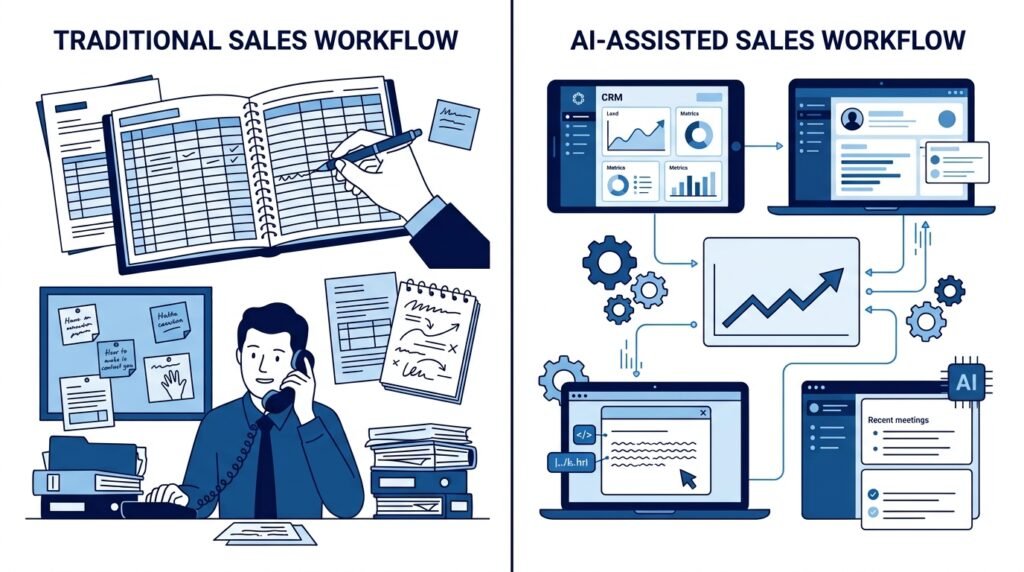
AI doesn’t replace traditional selling—it enhances it.
The biggest difference is that AI automates repetitive work while humans continue to build trust, understand customer needs, and negotiate deals.
| Traditional Sales | AI-Assisted Sales |
| Manual lead research | AI identifies high-quality prospects |
| Generic outreach | Personalized communication at scale |
| Manual CRM updates | Automatic CRM synchronization |
| Time-consuming forecasting | Data-driven predictions |
| Manual meeting notes | AI-generated summaries |
| Guess-based prioritization | Predictive lead scoring |
| Hours spent on administration | More time spent selling |
The most successful sales teams combine human expertise with AI-powered efficiency.
Challenges and Limitations of AI in Sales
Although AI offers many advantages, it isn’t a perfect solution.
Understanding its limitations helps businesses use AI responsibly and effectively.
1. AI Cannot Replace Human Relationships
Sales is built on trust.
While AI can automate research and communication, customers still value genuine conversations, empathy, and relationship-building.
Human judgment remains essential during negotiations and complex decision-making.
2. AI Can Make Mistakes
AI-generated emails, summaries, and recommendations are not always accurate.
Always review AI-generated content before sharing it with customers.
3. Data Privacy Matters
AI systems often process sensitive customer information.
Businesses should ensure they comply with privacy regulations and use trusted platforms that protect customer data.
4. Learning Curve
Introducing AI into existing workflows takes time.
Sales teams should begin with one or two use cases before expanding to more advanced automation.
Best Practices for Using AI in Sales
To get the best results, follow these practical guidelines:
- Use AI to assist—not replace—human decision-making.
- Review AI-generated emails before sending them.
- Keep customer data secure.
- Automate repetitive tasks first.
- Measure results and refine your workflows over time.
- Continue developing your communication and relationship-building skills.
Remember: The most effective sales professionals use AI to become more productive, not less personal.

Frequently Asked Questions (FAQs)
Can AI replace salespeople?
No. AI is designed to assist sales professionals, not replace them. It excels at automating repetitive tasks such as lead research, CRM updates, email drafting, and meeting summaries. However, building trust, understanding customer needs, negotiating deals, and maintaining long-term relationships still require human skills.
What are the best AI tools for sales?
The best AI sales tools depend on your needs, but some of the most popular options include:
- ChatGPT – Writing emails, proposals, and brainstorming.
- HubSpot AI – CRM automation and customer management.
- Salesforce Einstein – Predictive analytics and enterprise sales.
- Apollo.io – Lead generation and outreach.
- Microsoft Copilot – Productivity and meeting assistance.
- Grammarly – Improving sales communication.
Many of these tools offer free plans or trials, making them suitable for beginners.
Is AI in sales only for large businesses?
No. AI has become much more accessible in recent years. Freelancers, startups, and small businesses can use affordable or free AI tools to automate routine tasks, improve communication, and manage customer relationships more efficiently.
How does AI help generate sales leads?
AI analyzes customer data, website activity, demographics, buying behavior, and engagement history to identify prospects who are most likely to become customers. This helps sales teams focus their efforts on higher-quality leads.
Can AI write effective sales emails?
Yes. AI can generate personalized email drafts, suggest subject lines, improve grammar, and adapt tone based on your audience. However, it’s always recommended to review and personalize AI-generated content before sending it.
What are the risks of using AI in sales?
Some potential challenges include:
- AI-generated inaccuracies
- Over-reliance on automation
- Data privacy concerns
- Poor personalization if prompts are too generic
Businesses should combine AI with human oversight to ensure accurate, ethical, and customer-focused communication.
How can beginners start using AI in sales?
Start with one simple workflow rather than trying to automate everything at once.
For example:
- Use ChatGPT to draft sales emails.
- Organize customer information in an AI-powered CRM.
- Use an AI meeting assistant for summaries.
- Experiment with lead generation tools.
- Measure the results and gradually expand your AI workflows.

Conclusion
Artificial intelligence is reshaping the way businesses sell, but its greatest value isn’t replacing sales professionals—it’s helping them work more efficiently and make better decisions.
From identifying promising leads and writing personalized emails to forecasting revenue and automating administrative tasks, AI enables sales teams to focus on what matters most: building meaningful customer relationships.
The key to success isn’t adopting every AI tool available. Instead, begin with one or two practical use cases that solve your biggest challenges. As your confidence grows, you can gradually expand AI into other areas of your sales process.
Whether you’re a student exploring a career in sales, a freelancer looking to improve client outreach, or a business owner seeking greater efficiency, learning how to use AI effectively can become a valuable competitive advantage.
As AI technology continues to evolve, the most successful sales professionals will be those who combine data-driven insights with empathy, creativity, and strong communication skills.
Continue Your AI Journey
Keep building your AI knowledge with these beginner-friendly guides.
-

AI Interview Preparation: How to Use AI Tools to Land Your Next Job
Learn more : AI Interview Preparation: How to Use AI Tools to Land Your Next Job🕒 14-16 min read • Updated: July 2026 AI Interview Preparation: How to Use AI Tools to Ace…
-

7 Ways to Use AI for Research: Faster & Smarter Workflows (2026)
Learn more : 7 Ways to Use AI for Research: Faster & Smarter Workflows (2026)🕒 15 min read • Updated: July 2026 Introduction Research has always been about discovering new information, asking…
-

AI for Teachers: 15 Practical Workflows to Streamline Your Classroom
Learn more : AI for Teachers: 15 Practical Workflows to Streamline Your Classroom🕒 15 min read • Updated: July 2026 Introduction Teaching is one of the most rewarding professions, but…
-

AI for Productivity: 15 Practical Workflows to Work Smarter in 2026
Learn more : AI for Productivity: 15 Practical Workflows to Work Smarter in 2026🕒 12-14 min read • Updated: July 2026 Introduction Imagine completing your daily work in less time while…
-

The 2026 Guide to AI in Sales: Tools & Workflows to Close Deals Faster
Learn more : The 2026 Guide to AI in Sales: Tools & Workflows to Close Deals Faster🕒 12-14 min read • Updated: July 2026 Introduction Artificial intelligence (AI) is transforming the way businesses find…
-

AI for Project Management: 15 Time-Saving Workflows & Prompt Templates
Learn more : AI for Project Management: 15 Time-Saving Workflows & Prompt Templates🕒 12-14 min read • Updated: July 2026 Quick Answer AI for project management uses artificial intelligence to…
Related Articles
Explore more guides and resources related to this topic.
-

ChatGPT Complete Guide for Beginners (2026): Master AI Step-by-Step
Learn more : ChatGPT Complete Guide for Beginners (2026): Master AI Step-by-Step🕒 20-25 min read • Updated: Aug 2026 Introduction Introduction Artificial intelligence is changing how people learn, work,…
-

Master Prompt Engineering in 2026: A Step-by-Step Beginner’s Guide
Learn more : Master Prompt Engineering in 2026: A Step-by-Step Beginner’s Guide🕒 18-20 min read • Updated: Aug 2026 Introduction Artificial intelligence (AI) tools like ChatGPT, Claude, Gemini, and…
-
Large Language Models (LLMs) Explained: The Complete 2026 Beginner’s Guide
Learn more : Large Language Models (LLMs) Explained: The Complete 2026 Beginner’s Guide🕒 14-16 min read • Updated: Aug 2026 Introduction Artificial Intelligence has become part of everyday life. Whether…
-

Best AI Image Generators in 2026: 10 Free & Paid Tools Tested
Learn more : Best AI Image Generators in 2026: 10 Free & Paid Tools Tested🕒 15 min read • Updated: July 2026 introduction Creating stunning images no longer requires years of design…
-
10 Best AI Chatbots in 2026: Tested & Ranked for Every Use Case
Learn more : 10 Best AI Chatbots in 2026: Tested & Ranked for Every Use Case🕒 10-12 min read • Updated: July 2026 introduction Artificial intelligence has made chatbots far more capable than…
-
ChatGPT vs Microsoft Copilot (2026): Tested, Pricing & Workflow Comparison
Learn more : ChatGPT vs Microsoft Copilot (2026): Tested, Pricing & Workflow Comparison🕒 10-12 min read • Updated: July 2026 Introduction Choosing between ChatGPT and Microsoft Copilot can be challenging,…
References
To ensure accuracy and provide trustworthy information, this guide was informed by publicly available documentation, educational resources, and industry best practices, including:
- Official documentation from leading AI platform providers.
- CRM and sales automation platform resources.
- Research on artificial intelligence in sales and customer relationship management.
- Industry reports on AI adoption in business and sales.
Because AI tools evolve rapidly, features, pricing, and availability may change over time. We recommend checking each provider’s official website for the latest information.
Recommended AI Tools
If you’re just getting started with AI in sales, these beginner-friendly tools are worth exploring:
| Tool | Best For |
| ChatGPT | Writing emails, brainstorming, and sales communication |
| HubSpot AI | CRM automation and customer management |
| Perplexity AI | Customer and market research |
| Grammarly | Improving sales emails and proposals |
| Notion AI | Sales documentation and knowledge management |
Ready to Use AI More Effectively?
Learning what AI can do is only the first step. The real advantage comes from knowing how to apply it in everyday work.
Continue your AI learning journey with Naeveor’s beginner-friendly guides, where you’ll discover practical tutorials, AI tools, prompt engineering techniques, and real-world applications designed to help you work smarter with confidence.
Next recommended read: Best AI Tools for Beginners → Find the right AI tools to support your sales, productivity, writing, research, and business workflows.
References
- OpenAI. ChatGPT. https://openai.com/chatgpt
- Salesforce. Artificial Intelligence Solutions. https://www.salesforce.com/artificial-intelligence/
- HubSpot. Artificial Intelligence. https://www.hubspot.com/artificial-intelligence
- Microsoft. Microsoft 365 Copilot. https://www.microsoft.com/en-us/microsoft-365/copilot
- IBM. Artificial Intelligence. https://www.ibm.com/artificial-intelligence
- Google Cloud. Artificial Intelligence Solutions. https://cloud.google.com/ai
- McKinsey & Company. The State of AI. https://www.mckinsey.com/capabilities/quantumblack/our-insights/the-state-of-ai
- National Institute of Standards and Technology (NIST). AI Risk Management Framework (AI RMF 1.0). https://www.nist.gov/itl/ai-risk-management-framework
Leave a Reply