
🕒 18-20 min read • Updated: Aug 2026
Table of Contents
Introduction
Artificial intelligence (AI) tools like ChatGPT, Claude, Gemini, and Perplexity have changed how people learn, write, code, research, and solve problems. But using these tools effectively depends on one important skill: prompt engineering.
If you’ve ever received an inaccurate, incomplete, or confusing response from an AI chatbot, the issue often isn’t the AI itself—it’s the prompt you gave it.
Prompt engineering is the process of designing clear, structured instructions that help AI models understand exactly what you want. It doesn’t require programming experience or advanced technical knowledge. Whether you’re a student, professional, creator, or business owner, learning how to write better prompts can dramatically improve the quality of AI-generated responses.
In this guide, you’ll learn what prompt engineering is, why it matters, how prompts work, practical prompting techniques, common mistakes to avoid, and how to start building this valuable AI skill.
Key Takeaways
- Prompt engineering is the practice of writing effective instructions for AI models.
- Well-written prompts produce more accurate, relevant, and useful responses.
- Anyone can learn prompt engineering—no coding skills are required for most everyday use cases.
- Effective prompts provide context, define goals, specify formats, and set clear expectations.
- Prompt engineering is becoming an essential digital skill across education, business, marketing, software development, and content creation.
What Is Prompt Engineering?
Prompt engineering is the process of creating, refining, and optimizing instructions (called prompts) that guide artificial intelligence systems toward generating the desired output.
A prompt can be as simple as a question:
“Explain photosynthesis.”
Or it can be much more detailed:
“Explain photosynthesis to a 12-year-old using simple language, include a real-world example, and summarize the explanation in five bullet points.”
Although both prompts ask about the same topic, the second prompt provides more guidance, helping the AI produce a response that better matches the user’s needs.
In simple terms:
Prompt engineering is the art and science of communicating effectively with AI.
Instead of learning a programming language, you’re learning how to communicate clearly with an AI model.
Why Prompt Engineering Matters
Large language models are designed to predict the most appropriate response based on the information you provide. They do not automatically know your goals, preferences, audience, or desired format unless you tell them.
A vague prompt leaves room for interpretation, while a detailed prompt reduces ambiguity and improves the quality of the response.
For example:
Basic Prompt
“Write about artificial intelligence.”
Possible outcome:
- Too broad
- Generic information
- Missing important details
Improved Prompt
“Write a 500-word beginner-friendly article explaining artificial intelligence. Use simple language, include three real-world examples, and end with a summary.”
Possible outcome:
- Clear structure
- Appropriate reading level
- Relevant examples
- Better organization
The more clearly you communicate your expectations, the more useful the AI’s response is likely to be.
How AI Understands Prompts
AI models don’t “think” like humans. Instead, they analyze the words in your prompt, identify patterns from their training data, and generate the most probable next words based on context.
When you write a prompt, the AI attempts to understand several things:
- What task you’re asking it to perform
- The topic or subject
- The intended audience
- The desired format
- Any constraints or preferences you’ve provided
For example, consider this prompt:
“Create a one-week vegetarian meal plan for a college student with a limited budget.”
From this single sentence, the AI identifies multiple requirements:
- Task: Create a meal plan
- Duration: One week
- Diet: Vegetarian
- Audience: College student
- Constraint: Limited budget
Because the prompt includes specific context, the AI can generate a more relevant response.
What Makes a Good Prompt?
Effective prompts share several common characteristics.
1. They Have a Clear Goal
Start by defining exactly what you want.
Instead of:
“Tell me about climate change.”
Try:
“Explain the main causes of climate change in simple language suitable for high school students.”
A clear objective reduces confusion and improves accuracy.
2. They Provide Context
Context helps the AI understand the situation and tailor its response.
Example:
Instead of:
“Write an email.”
Try:
“Write a professional email to a client explaining that the project deadline has been extended by one week due to unexpected technical issues.”
The additional context results in a more relevant and appropriate response.
3. They Specify the Audience
Different audiences require different explanations.
For example:
- Explain blockchain to a child.
- Explain blockchain to an investor.
- Explain blockchain to a software developer.
Although the topic is the same, the responses should differ significantly based on the audience.
4. They Define the Output Format
AI can generate information in many formats, including:
- Bullet points
- Tables
- Emails
- Reports
- Articles
- Checklists
- JSON
- Code
- Lesson plans
- Social media posts
If you need a specific format, include it in your prompt.
Example:
“Summarize this article into five bullet points.”
or
“Present the information in a comparison table.”
5. They Include Constraints
Constraints tell the AI what to include—or avoid.
Examples include:
- Word count
- Reading level
- Tone
- Language
- Number of examples
- Output length
- Formatting requirements
Example:
“Write a 300-word introduction using a friendly, professional tone and avoid technical jargon.”
These constraints help the AI produce content that aligns with your requirements.
Anatomy of an Effective Prompt
Most high-quality prompts include several key components.
| Component | Purpose | Example |
| Task | What should the AI do? | Write a blog post |
| Context | Background information | For beginners learning AI |
| Audience | Who is it for? | College students |
| Format | Desired structure | Bullet points |
| Tone | Writing style | Friendly and professional |
| Constraints | Specific requirements | Under 500 words |
Think of these components as building blocks. You don’t need every element for every prompt, but including more relevant details often leads to better results.

A Simple Prompt Framework for Beginners
One easy framework to remember is:
Task → Context → Format → Constraints
For example:
Task: Explain prompt engineering.
Context: For someone new to AI.
Format: Use headings and bullet points.
Constraints: Keep it under 600 words and include two examples.
Final prompt:
“Explain prompt engineering for someone new to AI. Use headings and bullet points, keep the explanation under 600 words, and include two real-world examples.”
This structured approach is simple yet effective for most everyday AI tasks.
Real-World Examples of Prompt Engineering
Prompt engineering isn’t limited to AI researchers. People across industries use it to improve productivity and creativity.
Students
Students can ask AI to:
- Explain difficult concepts
- Summarize research papers
- Create study guides
- Generate quiz questions
- Practice interview questions
Example Prompt
“Explain Newton’s Laws of Motion using simple language and everyday examples suitable for a high school student.”
Professionals
Professionals use AI to:
- Draft emails
- Summarize meetings
- Create presentations
- Brainstorm ideas
- Analyze documents
Example Prompt
“Summarize these meeting notes into action items with owners and deadlines.”
Content Creators
Creators use prompts to:
- Generate content ideas
- Create outlines
- Improve headlines
- Draft scripts
- Repurpose content for different platforms
Example Prompt
“Turn this 1,500-word article into a LinkedIn post, an X thread, and a YouTube video outline.”
How Prompt Engineering Works
To write better prompts, it helps to understand—at a high level—how AI models process them.
Large Language Models (LLMs) such as ChatGPT, Claude, Gemini, and other conversational AI systems are trained on massive amounts of text. During training, they learn patterns in language, relationships between words, and common ways people communicate.
When you enter a prompt, the AI doesn’t search the internet or think like a human. Instead, it analyzes your prompt, identifies patterns from its training, and predicts the most appropriate response based on the context you’ve provided.
Think of it like giving instructions to a highly knowledgeable assistant:
- If your instructions are vague, the assistant has to make assumptions.
- If your instructions are detailed and specific, the assistant can deliver a much more useful result.
Prompt engineering is about reducing unnecessary assumptions by providing clear guidance.
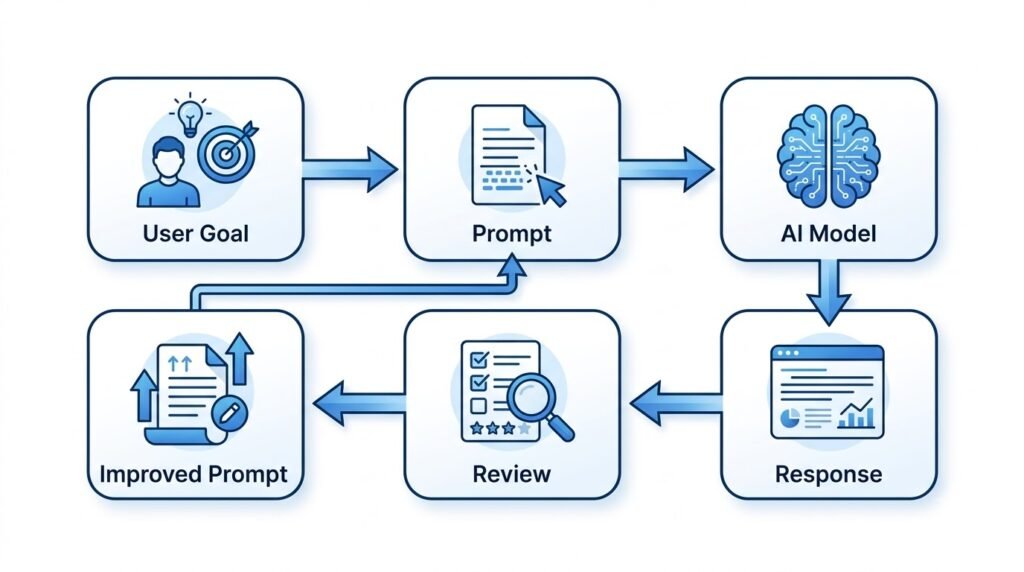
The Prompt-Response Cycle
Every interaction with an AI model follows a simple cycle.
Your Goal
↓
Write a Prompt
↓
AI Interprets Instructions
↓
Generates Response
↓
Review Output
↓
Refine Prompt (if needed)
↓
Improved Response
The first response doesn’t have to be perfect. Prompt engineering is often an iterative process where you refine your instructions until the output matches your needs.

Types of Prompts
Not all prompts are the same. Depending on your objective, you can use different styles of prompting.
1. Informational Prompts
Used when you want to learn something.
Example
Explain quantum computing in simple language.
2. Creative Prompts
Used for brainstorming or generating original content.
Example
Write a short science fiction story about a city powered entirely by AI.
3. Instructional Prompts
Used to ask AI to complete a specific task.
Example
Rewrite this paragraph in plain English.
4. Analytical Prompts
Used for evaluating or comparing information.
Example
Compare remote work and office work. Include advantages, disadvantages, and ideal use cases.
5. Conversational Prompts
Used to simulate discussion or tutoring.
Example
Act as a personal finance coach and help me create a monthly budget.
Essential Prompt Engineering Techniques
As you become more comfortable using AI, you’ll discover that certain prompting methods consistently produce better results.
Zero-Shot Prompting
Zero-shot prompting means asking the AI to complete a task without providing any examples.
Example
Translate this paragraph into Spanish.
The AI relies entirely on its existing knowledge.
Best for
- General questions
- Summaries
- Definitions
- Basic writing tasks
Few-Shot Prompting
Few-shot prompting involves giving the AI a few examples before asking it to complete a similar task.
Example:
Positive → Happy
Negative → Sad
Fast → Quick
Large →
The AI recognizes the pattern and responds with:
Big
Few-shot prompting helps the model understand the style, format, or logic you expect.
Best for
- Classification
- Formatting
- Consistent writing
- Data extraction
- Custom outputs
Role Prompting
One of the simplest and most effective techniques is assigning the AI a role.
Instead of asking:
Explain investing.
Try:
You are a certified financial educator. Explain investing to someone who has never invested before.
Giving the AI a role encourages it to adopt an appropriate tone, depth, and perspective.
Examples:
- Teacher
- Career coach
- Software engineer
- Marketing consultant
- Editor
- Interviewer
- Nutritionist
Structured Prompting
Instead of writing one vague sentence, organize your prompt into sections.
Example:
Role
You are a professional copywriter.
Task
Write a product description.
Audience
Small business owners.
Tone
Professional and friendly.
Length
150 words.
Structured prompts reduce ambiguity and are especially useful for complex tasks.
Step-by-Step Prompting
Breaking a task into smaller steps often produces better results than asking for everything at once.
Instead of:
Write an entire business plan.
Try:
- Generate business ideas.
- Evaluate the best idea.
- Create a business model.
- Write a marketing strategy.
- Build a financial projection.
This approach is easier to review and refine.
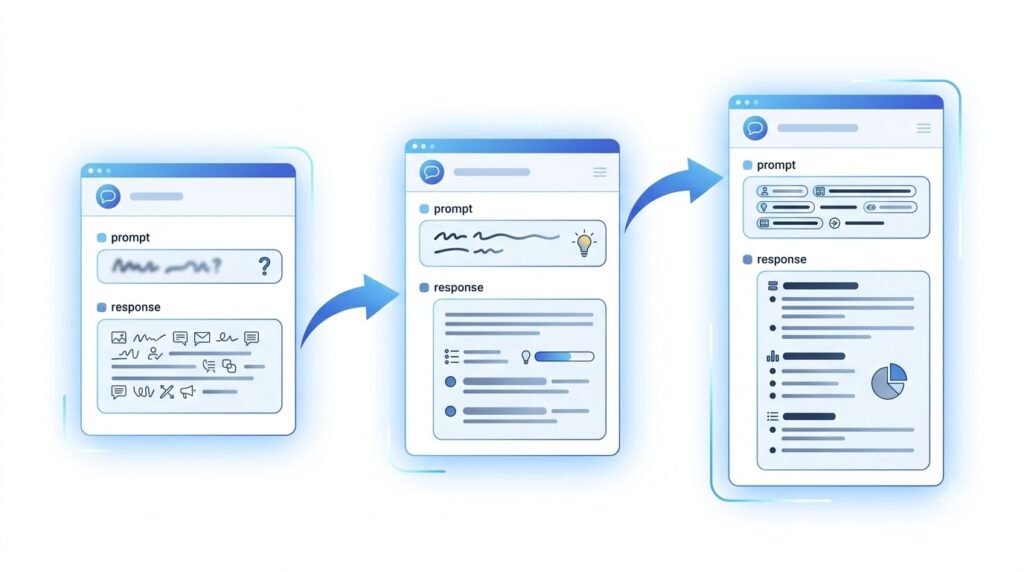
Iterative Prompting
Prompt engineering is rarely about writing one perfect prompt. Most successful users improve results through iteration.
For example:
First Prompt
Write a blog introduction.
Response is too generic.
Second Prompt
Make it more engaging.
Better.
Third Prompt
Add a surprising statistic and end with a question.
Even better.
Each prompt builds on the previous response.
A Practical Prompt Template
One of the easiest frameworks for beginners is:
Role
Task
Context
Audience
Format
Tone
Constraints
Example:
Role:
You are an experienced teacher.
Task:
Explain artificial intelligence.
Audience:
A 12-year-old student.
Format:
Bullet points.
Tone:
Simple and friendly.
Constraints:
Keep it under 300 words.
This framework works well for educational content, business writing, research, coding assistance, and creative projects.
Prompt Engineering Across Different AI Tools
Although the core principles remain the same, different AI tools have unique strengths.
| AI Tool | Best For | Prompt Tips |
| ChatGPT | Writing, coding, brainstorming | Be specific and provide context |
| Claude | Long documents, analysis | Give clear structure and objectives |
| Gemini | Research and Google ecosystem tasks | Include detailed questions and comparisons |
| Perplexity | Research with cited sources | Ask focused factual questions |
| Midjourney | Image generation | Use descriptive visual language |
Understanding each tool’s strengths helps you choose the right AI for the task.

Real-World Applications of Prompt Engineering
Prompt engineering has become valuable across many industries.
Education
Teachers use prompts to:
- Create lesson plans
- Generate quizzes
- Explain difficult concepts
- Design classroom activities
Students use prompts to:
- Summarize textbooks
- Practice interviews
- Learn programming
- Create revision notes
Business
Businesses use prompt engineering for:
- Customer support
- Marketing campaigns
- Proposal writing
- Data analysis
- Internal documentation
Software Development
Developers use AI to:
- Generate code
- Debug programs
- Explain technical concepts
- Write documentation
- Review code quality
Marketing
Marketing teams use prompts to create:
- Blog posts
- Email campaigns
- Social media content
- Product descriptions
- SEO outlines
Research
Researchers use AI to:
- Summarize papers
- Compare studies
- Identify trends
- Generate literature reviews
- Organize findings
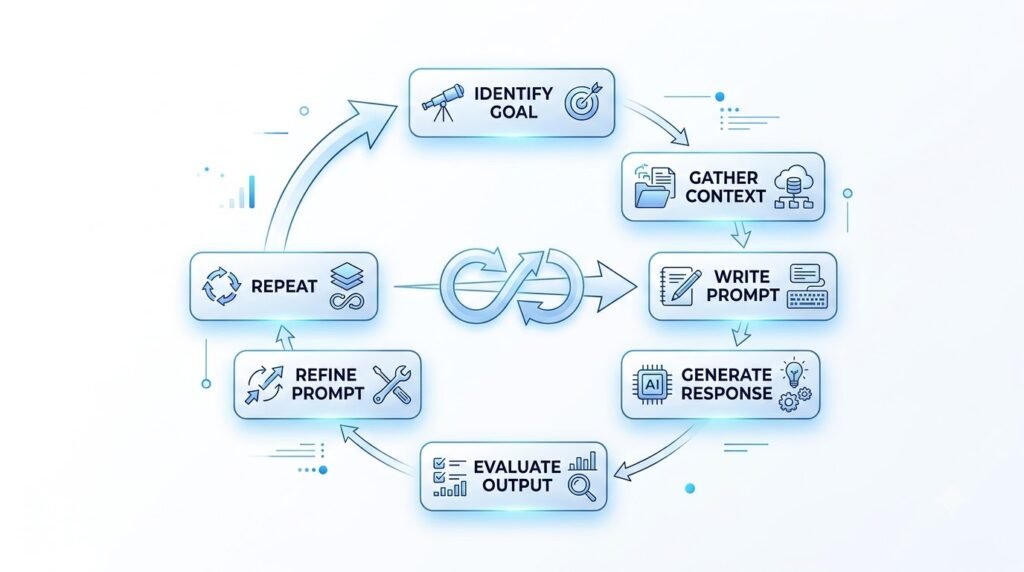
Prompt Engineering Workflow
A simple workflow can help you consistently create effective prompts.
Identify Your Goal
↓
Gather Context
↓
Choose Output Format
↓
Write First Prompt
↓
Review AI Response
↓
Improve Prompt
↓
Repeat Until Satisfied
Over time, you’ll develop a library of prompts that you can reuse and adapt for different tasks.
Best Practices for Writing Better Prompts
Following a few best practices can significantly improve AI responses.
- Start with a clear objective.
- Include relevant background information.
- Specify your intended audience.
- Request a specific format.
- Set constraints such as word count or tone.
- Break complex tasks into smaller steps.
- Review and refine your prompts.
- Experiment with different wording to see what works best.
- Save effective prompts for future use.
Common Prompt Engineering Mistakes
Even experienced users occasionally make mistakes. Here are some of the most common ones to avoid.
| Mistake | Better Approach |
| Being too vague | Clearly describe the task |
| Asking multiple unrelated questions | Focus on one objective at a time |
| Providing no context | Explain the background |
| Forgetting the audience | Specify who the content is for |
| Not requesting a format | Ask for bullets, tables, or sections |
| Expecting perfection in one attempt | Refine prompts iteratively |
| Blindly trusting AI output | Verify important facts and sources |
Beginner Tips to Improve Faster
As you practice, you’ll notice patterns in what works well. Keep these tips in mind:
- Treat AI like a collaborator, not a mind reader.
- Experiment with different prompt structures.
- Reuse successful prompts by turning them into templates.
- Ask follow-up questions to refine responses.
- Always review AI-generated content for accuracy, especially when using it for work, education, or publishing.
Is Prompt Engineering Still Important?
As AI models become more capable, you may hear claims that prompt engineering is becoming obsolete because newer AI systems understand natural language better than ever.
The reality is more nuanced.
Modern AI models can often produce useful responses from simple prompts. However, when you need accurate, consistent, structured, or professional-quality outputs, prompt engineering remains a valuable skill.
Think of it like using a search engine. Anyone can type a few words into Google, but people who know how to refine their searches often find better information more quickly. The same principle applies to AI.
Prompt engineering today is less about learning complex tricks and more about communicating your intent clearly.
Whether you’re creating content, analyzing data, writing code, or brainstorming ideas, well-crafted prompts help you:
- Save time
- Reduce revisions
- Improve response quality
- Get more consistent results
- Use AI more effectively across different tasks
As AI continues to evolve, the emphasis will likely shift from memorizing prompting techniques to developing strong communication, critical thinking, and problem-solving skills.
Prompt Engineering Best Practices
Whether you’re using AI for learning, work, or creative projects, these best practices can help you get better results.
Start Simple
Begin with a straightforward prompt. If the response isn’t quite right, gradually add more details rather than writing an overly complex prompt from the start.
Be Specific
The more clearly you define your objective, the better the AI can help.
Instead of:
“Write something about marketing.”
Try:
“Write a 700-word beginner-friendly article explaining email marketing for small business owners. Include examples and actionable tips.”
Provide Relevant Context
Background information helps the AI understand your situation.
For example:
“I’m preparing for a software engineering interview and have two years of Python experience.”
This context enables more relevant suggestions than simply asking for interview questions.
Ask for a Format
If you need information presented in a particular way, mention it explicitly.
Examples:
- Bullet points
- Comparison table
- Checklist
- Step-by-step guide
- JSON
- Markdown
- Email draft
Iterate and Refine
The first response is rarely the final one.
You can improve the output with follow-up prompts such as:
- “Make it shorter.”
- “Add more examples.”
- “Use simpler language.”
- “Include a comparison table.”
- “Explain this to a beginner.”
Prompt engineering is an interactive process.
Verify Important Information
AI can make mistakes or generate outdated or inaccurate information.
Always verify:
- Statistics
- Medical information
- Legal advice
- Financial guidance
- Scientific claims
- Citations
AI should assist your work—not replace critical thinking.
Common Mistakes to Avoid
Many beginners experience inconsistent AI responses because of avoidable prompting mistakes.
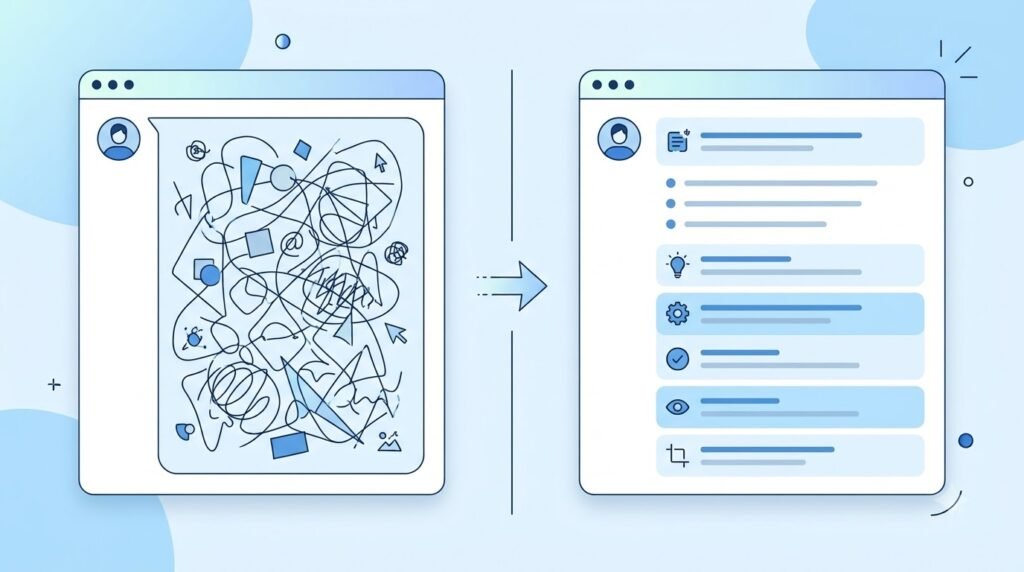
Being Too Vague
❌ Bad Prompt
Tell me about AI.
✅ Better Prompt
Explain artificial intelligence to someone with no technical background. Include three everyday examples and a short summary.
Asking Too Many Things at Once
Instead of requesting a complete website, business strategy, marketing plan, and social media campaign in a single prompt, break the work into smaller tasks.
Smaller requests usually produce higher-quality results.
Forgetting the Audience
The same explanation shouldn’t be used for:
- Children
- College students
- Executives
- Developers
- Customers
Always tell the AI who the content is for.
Accepting the First Response
Treat AI as a collaborator.
Ask follow-up questions, request revisions, and refine the output until it meets your needs.

Practical Prompt Templates
You don’t need to write every prompt from scratch. Templates can save time and improve consistency.
Learning Template
Explain [topic] to a beginner. Use simple language, provide three real-world examples, and summarize the key points in bullet form.
Writing Template
Write a [article/email/report] about [topic] for [audience]. Use a [tone] tone, include headings, and keep the length under [word count] words.
Research Template
Summarize the latest information about [topic], explain the key concepts, compare different viewpoints, and present the findings in a table.
Brainstorming Template
Generate 20 creative ideas for [goal]. Group similar ideas together and rank them from easiest to most challenging.
Coding Template
Explain the following code, identify any errors, suggest improvements, and rewrite it using best practices.
Frequently Asked Questions
What is prompt engineering in simple terms?
Prompt engineering is the practice of writing clear and effective instructions that help AI systems generate better responses.
Do I need programming skills to learn prompt engineering?
No. Most everyday prompt engineering tasks only require good communication skills. Technical knowledge becomes more useful when working with AI development, APIs, or automation.
Which AI tools use prompt engineering?
Many generative AI tools rely on prompts, including ChatGPT, Claude, Gemini, Perplexity, Microsoft Copilot, Midjourney, and other large language or image-generation models.
Is prompt engineering a good career skill?
Yes. Understanding how to work effectively with AI is becoming valuable across industries such as education, marketing, software development, research, customer support, and business operations.
Can prompt engineering improve AI accuracy?
It can improve the relevance, clarity, and usefulness of responses by providing better context and instructions. However, it cannot guarantee factual accuracy. Always verify important information.
How can I become better at prompt engineering?
Practice regularly, experiment with different prompt structures, review the AI’s responses critically, and build a library of prompts that work well for your common tasks.

Conclusion
Prompt engineering is one of the most practical AI skills you can learn today. While modern AI models are increasingly capable of understanding natural language, the quality of your instructions still plays a major role in the quality of the results.
By learning to define clear goals, provide context, specify formats, and refine your prompts, you can make AI tools more useful for learning, work, creativity, and problem-solving.
The best way to improve is through practice. Start with simple prompts, observe the responses, make small adjustments, and gradually build a collection of effective prompt templates. Over time, prompt engineering becomes less about memorizing techniques and more about developing a clear, structured way of communicating with AI.
As AI continues to evolve, the ability to work alongside these tools thoughtfully and responsibly will remain an important digital skill.
Continue Your AI Journey
Keep building your AI knowledge with these beginner-friendly guides.
-

Master Prompt Engineering in 2026: A Step-by-Step Beginner’s Guide
Learn more : Master Prompt Engineering in 2026: A Step-by-Step Beginner’s Guide🕒 18-20 min read • Updated: Aug 2026 Introduction Artificial intelligence (AI) tools like ChatGPT, Claude, Gemini, and…
-

12 Common Prompt Engineering Mistakes and How to Fix Them
Learn more : 12 Common Prompt Engineering Mistakes and How to Fix Them🕒 10-12 min read • Updated: July 2026 Prompt engineering is one of the most valuable skills for…
-

Prompt Templates: A Beginner’s Guide to Writing Better AI Prompts
Learn more : Prompt Templates: A Beginner’s Guide to Writing Better AI Prompts🕒 10-12 min read • Updated: July 2026 Introduction If you’ve ever found yourself rewriting the same AI…
-

10 Prompt Engineering Techniques to Get Better AI Results (With Examples)
Learn more : 10 Prompt Engineering Techniques to Get Better AI Results (With Examples)🕒 10-12 min read • Updated: July 2026 Have you ever asked an AI chatbot a question and…
-

Zero-Shot vs Few-Shot Prompting Made Simple (With Examples)
Learn more : Zero-Shot vs Few-Shot Prompting Made Simple (With Examples)🕒 12-14 min read • Updated: July 2026 Introduction Artificial intelligence tools like ChatGPT, Claude, and Gemini can…
-

How to Write Better AI Prompts: 15 Practical Tips for Better Results (2026)
Learn more : How to Write Better AI Prompts: 15 Practical Tips for Better Results (2026)🕒 15-18 min read • Updated: July 2026 Introduction Have you ever asked an AI a question and…
Related Articles
Explore more guides and resources related to this topic.
-

ChatGPT Complete Guide for Beginners (2026): Master AI Step-by-Step
Learn more : ChatGPT Complete Guide for Beginners (2026): Master AI Step-by-Step🕒 20-25 min read • Updated: Aug 2026 Introduction Introduction Artificial intelligence is changing how people learn, work,…
-
Master Prompt Engineering in 2026: A Step-by-Step Beginner’s Guide
Learn more : Master Prompt Engineering in 2026: A Step-by-Step Beginner’s Guide🕒 18-20 min read • Updated: Aug 2026 Introduction Artificial intelligence (AI) tools like ChatGPT, Claude, Gemini, and…
-

Large Language Models (LLMs) Explained: The Complete 2026 Beginner’s Guide
Learn more : Large Language Models (LLMs) Explained: The Complete 2026 Beginner’s Guide🕒 14-16 min read • Updated: Aug 2026 Introduction Artificial Intelligence has become part of everyday life. Whether…
-

Best AI Image Generators in 2026: 10 Free & Paid Tools Tested
Learn more : Best AI Image Generators in 2026: 10 Free & Paid Tools Tested🕒 15 min read • Updated: July 2026 introduction Creating stunning images no longer requires years of design…
-

10 Best AI Chatbots in 2026: Tested & Ranked for Every Use Case
Learn more : 10 Best AI Chatbots in 2026: Tested & Ranked for Every Use Case🕒 10-12 min read • Updated: July 2026 introduction Artificial intelligence has made chatbots far more capable than…
-

ChatGPT vs Microsoft Copilot (2026): Tested, Pricing & Workflow Comparison
Learn more : ChatGPT vs Microsoft Copilot (2026): Tested, Pricing & Workflow Comparison🕒 10-12 min read • Updated: July 2026 Introduction Choosing between ChatGPT and Microsoft Copilot can be challenging,…
Recommended AI Tools
If you’re ready to put prompt engineering into practice, these beginner-friendly AI tools are worth exploring:
| Tool | Best For |
| ChatGPT | Writing, brainstorming, coding, learning |
| Claude | Long-form writing and document analysis |
| Gemini | Research and productivity |
| Perplexity AI | Research with cited sources |
| Microsoft Copilot | Productivity within Microsoft 365 |
References
OpenAI. Prompt Engineering Documentation
https://platform.openai.com/docs/guides/prompt-engineering
Anthropic. Prompt Engineering Overview
https://docs.anthropic.com/en/docs/build-with-claude/prompt-engineering/overview
Google AI for Developers. Prompting Strategies
https://ai.google.dev/gemini-api/docs/prompting-strategies
Microsoft Learn. Introduction to Prompt Engineering
https://learn.microsoft.com/en-us/azure/ai-services/openai/concepts/prompt-engineering
IBM. What is Prompt Engineering?
https://www.ibm.com/think/topics/prompt-engineering
Brown, T. B., et al. (2020). Language Models are Few-Shot Learners.
https://arxiv.org/abs/2005.14165
Wei, J., et al. (2022). Chain-of-Thought Prompting Elicits Reasoning in Large Language Models.
https://arxiv.org/abs/2201.11903
Liu, P., et al. (2023). Pre-train, Prompt, and Predict: A Systematic Survey of Prompting Methods in Natural Language Processing.
https://arxiv.org/abs/2107.13586
Leave a Reply