
🕒 10-12 min read • Updated: July 2026
Table of Contents
Introduction
Artificial intelligence (AI) is changing how businesses operate, make decisions, and serve customers. From automating repetitive tasks to analyzing large amounts of data, AI is helping organizations improve efficiency, reduce costs, and unlock new opportunities for growth.
Today, businesses of all sizes—from startups to global enterprises—use AI to streamline operations, personalize customer experiences, forecast demand, and support better decision-making. Rather than replacing employees, AI is increasingly being used as a powerful tool that helps teams work smarter and focus on higher-value tasks.
Whether you’re a business owner, student, or simply curious about AI, understanding how organizations use this technology is becoming an essential skill in today’s digital world.
In this beginner-friendly guide, you’ll learn what AI in business is, why companies are adopting it, its most common applications, benefits, challenges, and real-world examples.
Key Takeaways
- AI helps businesses automate tasks, analyze data, and improve decision-making.
- Common applications include customer service, marketing, finance, human resources, cybersecurity, and supply chain management.
- AI improves productivity and efficiency while supporting employees rather than replacing them.
- Successful AI adoption requires quality data, human oversight, and responsible implementation.
What Is AI in Business?
AI in business refers to the use of artificial intelligence technologies to improve business processes, support decision-making, enhance customer experiences, and automate repetitive tasks.
Instead of relying entirely on manual work, businesses use AI to process large amounts of information, identify patterns, generate insights, and perform routine activities more efficiently.
For example, an online retailer may use AI to recommend products based on a customer’s browsing history, while a customer support team may use an AI-powered chatbot to answer common questions 24/7.
These systems don’t replace human expertise. Instead, they assist employees by handling repetitive tasks, allowing teams to focus on strategy, creativity, and problem-solving.
Continue Learning: If you’re new to artificial intelligence, start with our What Is Artificial Intelligence? guide to understand the core concepts before exploring business applications.
Why Businesses Are Adopting AI
Businesses operate in an increasingly competitive and data-driven environment. Every day, organizations generate massive amounts of information through customer interactions, sales, operations, and digital platforms.
AI helps businesses make better use of this data by identifying trends, predicting outcomes, and automating time-consuming processes.
Some of the key reasons businesses are investing in AI include:
- Increasing productivity
- Reducing operational costs
- Improving customer experiences
- Supporting data-driven decisions
- Automating repetitive tasks
- Identifying business opportunities
- Improving efficiency across departments
Rather than replacing employees, AI often acts as a digital assistant that helps people complete their work faster and more effectively.
How AI Is Transforming Businesses
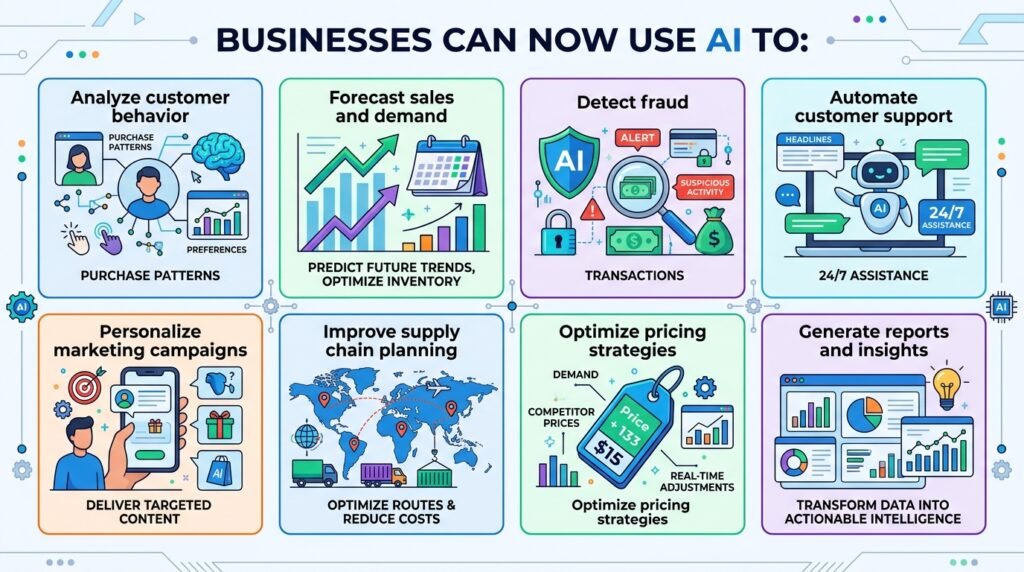
AI is changing nearly every aspect of modern business by helping organizations become more efficient, responsive, and customer-focused.
Instead of relying solely on manual processes, businesses can now use AI to:
- Analyze customer behavior
- Forecast sales and demand
- Detect fraud
- Automate customer support
- Personalize marketing campaigns
- Improve supply chain planning
- Optimize pricing strategies
- Generate reports and insights
As AI technology continues to improve, businesses are finding new ways to integrate it into everyday operations.
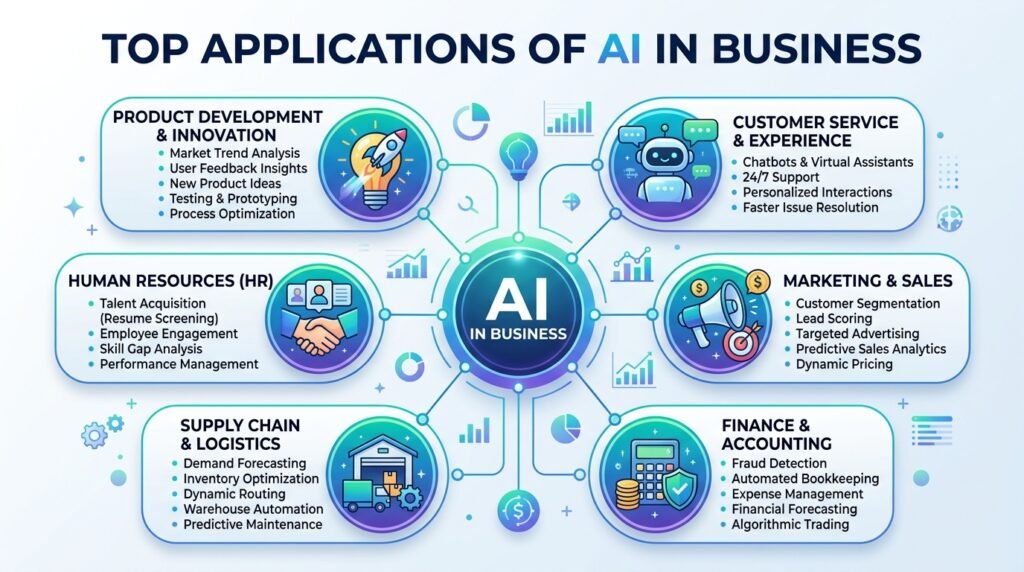
Top Applications of AI in Business
1. Customer Service
One of the most common business applications of AI is customer service.
AI-powered chatbots and virtual assistants can:
- Answer frequently asked questions
- Provide order updates
- Help customers find products
- Route complex issues to human agents
- Offer support outside business hours
This improves response times while allowing customer service teams to focus on more complex requests.
2. Marketing
Marketing teams use AI to better understand customer behavior and create more personalized campaigns.
AI can help businesses:
- Analyze customer preferences
- Segment audiences
- Recommend content
- Optimize email campaigns
- Generate marketing copy
- Measure campaign performance
These insights enable businesses to deliver more relevant experiences to their customers.
3. Sales
Sales teams use AI to identify potential customers, prioritize leads, and forecast future sales.
Common uses include:
- Lead scoring
- Sales forecasting
- Customer relationship analysis
- Personalized recommendations
- Automated follow-ups
AI helps sales professionals spend more time building relationships and less time on repetitive administrative work.
4. Human Resources
Human resources (HR) departments use AI to streamline recruitment and employee management.
Applications include:
- Resume screening
- Interview scheduling
- Employee onboarding
- Skills assessment
- Workforce planning
- Employee engagement analysis
Human judgment remains essential throughout the hiring process, especially for evaluating candidates and making final decisions.
5. Finance and Accounting
AI helps finance teams process information more efficiently and identify unusual patterns in financial data.
Examples include:
- Fraud detection
- Expense management
- Invoice processing
- Financial forecasting
- Risk assessment
- Budget planning
These tools support finance professionals by improving accuracy and reducing manual work.
6. Data Analysis
Businesses collect data from websites, mobile apps, customer feedback, sales systems, and operations.
AI helps transform this information into actionable insights by:
- Identifying trends
- Detecting anomalies
- Predicting future demand
- Creating dashboards
- Supporting business decisions
This allows leaders to make more informed decisions based on data rather than assumptions.
7. Supply Chain Management
Supply chain operations involve forecasting demand, managing inventory, and coordinating logistics.
AI can support these processes by:
- Predicting product demand
- Optimizing inventory levels
- Improving delivery routes
- Identifying supply chain risks
- Supporting warehouse operations
This helps businesses improve efficiency while reducing waste and delays.
8. Cybersecurity
Businesses use AI to strengthen cybersecurity by monitoring networks and identifying suspicious activity.
AI systems can help:
- Detect unusual login attempts
- Identify potential cyber threats
- Monitor network activity
- Respond to security incidents more quickly
Since cyber threats continue to evolve, AI provides an additional layer of protection alongside human security teams.
9. Product Development
AI supports product development by analyzing customer feedback, identifying market trends, and helping teams make data-driven decisions.
Businesses can use AI to:
- Analyze customer reviews
- Discover unmet customer needs
- Test product concepts
- Improve design processes
- Predict market demand
These insights help organizations create products that better meet customer expectations.
10. Document Automation
Many businesses process thousands of documents every month.
AI helps automate tasks such as:
- Contract analysis
- Invoice processing
- Data extraction
- Document classification
- Report generation
Automating these repetitive tasks reduces errors and allows employees to focus on higher-value work.
AI in Business Workflow
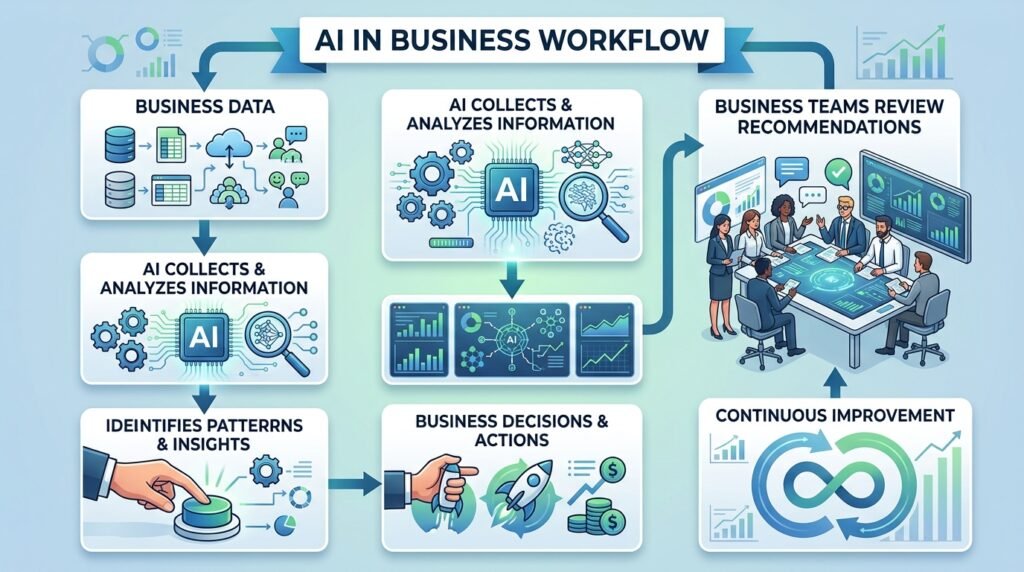
This workflow demonstrates that AI supports business decision-making by providing insights, while people remain responsible for strategic decisions.
Benefits of AI in Business
Artificial intelligence offers businesses more than just automation. When implemented responsibly, it helps organizations improve productivity, make smarter decisions, and deliver better customer experiences. While AI cannot replace human creativity, judgment, or leadership, it can significantly enhance how businesses operate.
1. Increased Productivity
AI automates repetitive and time-consuming tasks, allowing employees to focus on strategic work that requires creativity, problem-solving, and collaboration.
For example, AI can automate data entry, schedule meetings, generate reports, and organize documents, helping teams accomplish more in less time.
2. Better Decision-Making
Businesses generate vast amounts of data every day. AI helps analyze this information quickly, uncovering patterns and trends that support informed decision-making.
Instead of relying solely on intuition, business leaders can use AI-generated insights alongside their expertise to make smarter strategic decisions.
3. Improved Customer Experience
Modern customers expect personalized experiences and quick responses.
AI enables businesses to:
- Recommend relevant products or services
- Provide instant customer support
- Personalize marketing campaigns
- Predict customer preferences
These capabilities help businesses build stronger customer relationships and improve satisfaction.
4. Cost Savings
By automating routine processes and optimizing operations, AI can help businesses reduce operational costs.
Examples include:
- Automated customer support
- Smarter inventory management
- Reduced manual data processing
- Improved resource allocation
However, businesses should also consider the initial investment required for implementing AI solutions.
5. Increased Efficiency
AI helps streamline workflows by handling repetitive administrative tasks and processing large datasets more efficiently than manual methods.
This allows employees to spend more time on innovation, collaboration, and customer engagement.
6. Competitive Advantage
Organizations that effectively adopt AI can respond faster to market changes, better understand customer needs, and improve operational performance.
Responsible AI adoption can become a long-term competitive advantage in an increasingly digital economy.
Traditional Business vs AI-Powered Business
| Feature | Traditional Business | AI-Powered Business |
| Data Analysis | Manual reports and spreadsheets | Automated analysis of large datasets |
| Customer Support | Limited business hours | AI-assisted support available 24/7 |
| Marketing | Broad campaigns | Personalized customer experiences |
| Sales Forecasting | Historical estimates | Predictive analytics and forecasting |
| Administrative Tasks | Manual processes | Automated workflows |
| Decision Support | Experience and historical data | Data-driven insights with human oversight |
Key Point: AI enhances business operations by supporting employees with data-driven insights and automation. Strategic decisions and customer relationships still depend on human expertise.
Challenges and Limitations of AI in Business
While AI offers many benefits, successful implementation requires careful planning and responsible use.
Data Privacy and Security
Businesses often handle sensitive customer and company information.
Organizations must implement strong security measures and comply with relevant privacy regulations when using AI systems.
High Implementation Costs
Introducing AI may require investment in software, infrastructure, employee training, and ongoing maintenance.
Although AI can reduce long-term costs, the initial investment may be challenging for some businesses.
AI Bias
AI systems learn from historical data.
If that data contains biases or inaccuracies, AI may produce unfair or unreliable results.
Regular monitoring and high-quality training data are essential for improving fairness and accuracy.
Employee Training
Employees need training to effectively use AI tools and understand their capabilities and limitations.
Organizations that invest in AI education often achieve better adoption and more successful outcomes.
Human Oversight
AI should support—not replace—human decision-making.
Business leaders remain responsible for evaluating AI recommendations, considering ethical implications, and making final strategic decisions.
Real-World Examples of AI in Business
AI is already being used across industries to improve efficiency and support business operations.
Customer Support
Many businesses use AI-powered chatbots to answer common customer questions, provide order updates, and route complex issues to human representatives.
Marketing
AI helps marketers analyze customer behavior, personalize content, optimize advertising campaigns, and improve engagement.
Fraud Detection
Banks and financial institutions use AI to identify unusual transaction patterns that may indicate fraudulent activity.
Inventory Management
Retailers use AI to forecast product demand and optimize inventory levels, reducing both shortages and excess stock.
Business Intelligence
Organizations use AI-powered analytics platforms to transform large datasets into dashboards and actionable insights for business leaders.
The Future of AI in Business
Artificial intelligence is expected to play an even greater role in the future of business.
Emerging trends include:
- AI-powered business assistants
- Intelligent workflow automation
- Predictive analytics for strategic planning
- AI agents capable of managing multi-step business tasks
- Enhanced collaboration between humans and AI
Rather than replacing employees, the future workplace is likely to combine human creativity, leadership, and critical thinking with AI’s speed, automation, and analytical capabilities.
Businesses that embrace responsible AI adoption while investing in employee skills will be better positioned to adapt to future technological changes.
Frequently Asked Questions
What is AI in business?
AI in business refers to the use of artificial intelligence technologies to automate tasks, analyze data, improve decision-making, and enhance customer experiences across different business functions.
How do businesses use AI?
Businesses use AI in customer service, marketing, sales, finance, cybersecurity, supply chain management, human resources, and business analytics.
What are the benefits of AI in business?
Some of the main benefits include improved productivity, better decision-making, personalized customer experiences, cost savings, and increased operational efficiency.
Can AI replace employees?
No. AI is designed to assist employees by automating repetitive tasks and providing insights. Human judgment, creativity, leadership, and relationship-building remain essential.
Which industries use AI?
AI is used across many industries, including healthcare, finance, retail, manufacturing, education, transportation, logistics, entertainment, and technology.
Conclusion
Artificial intelligence is reshaping the way businesses operate by helping organizations automate routine tasks, analyze data, improve customer experiences, and make more informed decisions. From small businesses to multinational companies, AI is becoming an essential tool for increasing productivity and driving innovation.
However, AI is most effective when used as a complement to human expertise rather than a replacement. Successful businesses combine AI’s ability to process information quickly with the creativity, judgment, and ethical decision-making that only people can provide.
As AI technology continues to evolve, understanding its applications, benefits, and limitations will become increasingly valuable for business owners, professionals, students, and future leaders.
Continue Your AI Journey
Keep building your AI knowledge with these beginner-friendly guides.
-
AI Glossary: 100+ Artificial Intelligence Terms Explained
Learn more : AI Glossary: 100+ Artificial Intelligence Terms Explained🕒 25-35 min read • Updated: Aug 2026 Introduction Artificial Intelligence (AI) is changing how we learn, work,…
-
Large Language Models (LLMs) Explained: The Complete 2026 Beginner’s Guide
Learn more : Large Language Models (LLMs) Explained: The Complete 2026 Beginner’s Guide🕒 14-16 min read • Updated: Aug 2026 Introduction Artificial Intelligence has become part of everyday life. Whether…
-
How Artificial Intelligence Works: 5 Core Concepts Explained Simply (2026 Guide)
Learn more : How Artificial Intelligence Works: 5 Core Concepts Explained Simply (2026 Guide)🕒 14-16 min read • Updated: Aug 2026 Introduction What Is Machine Learning? If Artificial Intelligence is the…
-
Artificial Intelligence Explained: The Complete Beginner’s Guide (2026)
Learn more : Artificial Intelligence Explained: The Complete Beginner’s Guide (2026)🕒 14-18 min read • Updated: Aug 2026 introduction Artificial intelligence (AI) has quickly become one of the…
-
How to Use AI in Content Creation: The Complete 2026 Blueprint
Learn more : How to Use AI in Content Creation: The Complete 2026 Blueprint🕒 10-12 min read • Updated: July 2026 Introduction Creating high-quality content consistently can be challenging, whether you’re…
-

7 Ways AI Is Transforming Software Development in 2026 (Real Workflows & Case Studies)
Learn more : 7 Ways AI Is Transforming Software Development in 2026 (Real Workflows & Case Studies)🕒 12-15 min read • Updated: July 2026 Introduction Artificial intelligence (AI) is transforming software development by helping…
Related Articles
Explore more guides and resources related to this topic.
-

ChatGPT Complete Guide for Beginners (2026): Master AI Step-by-Step
Learn more : ChatGPT Complete Guide for Beginners (2026): Master AI Step-by-Step🕒 20-25 min read • Updated: Aug 2026 Introduction Introduction Artificial intelligence is changing how people learn, work,…
-
Master Prompt Engineering in 2026: A Step-by-Step Beginner’s Guide
Learn more : Master Prompt Engineering in 2026: A Step-by-Step Beginner’s Guide🕒 18-20 min read • Updated: Aug 2026 Introduction Artificial intelligence (AI) tools like ChatGPT, Claude, Gemini, and…
-
Large Language Models (LLMs) Explained: The Complete 2026 Beginner’s Guide
Learn more : Large Language Models (LLMs) Explained: The Complete 2026 Beginner’s Guide🕒 14-16 min read • Updated: Aug 2026 Introduction Artificial Intelligence has become part of everyday life. Whether…
-

Best AI Image Generators in 2026: 10 Free & Paid Tools Tested
Learn more : Best AI Image Generators in 2026: 10 Free & Paid Tools Tested🕒 15 min read • Updated: July 2026 introduction Creating stunning images no longer requires years of design…
-
10 Best AI Chatbots in 2026: Tested & Ranked for Every Use Case
Learn more : 10 Best AI Chatbots in 2026: Tested & Ranked for Every Use Case🕒 10-12 min read • Updated: July 2026 introduction Artificial intelligence has made chatbots far more capable than…
-
ChatGPT vs Microsoft Copilot (2026): Tested, Pricing & Workflow Comparison
Learn more : ChatGPT vs Microsoft Copilot (2026): Tested, Pricing & Workflow Comparison🕒 10-12 min read • Updated: July 2026 Introduction Choosing between ChatGPT and Microsoft Copilot can be challenging,…
Recommended AI Tools
If you’re interested in using AI for work or business, explore these beginner-friendly tools:
You can also visit our Recommended AI Tools page to compare popular AI tools, explore their features, and find the right solution for your needs.
External References
- National Institute of Standards and Technology (NIST) – AI Risk Management Framework
- Organisation for Economic Co-operation and Development (OECD) – OECD AI Principles
- World Economic Forum (WEF) – AI and the Future of Business
- McKinsey & Company – The State of AI Reports
Editor’s Note: AI adoption varies across organizations based on their goals, industry, available resources, and regulatory requirements. The examples in this article are intended to illustrate common business applications and should not be interpreted as endorsements of any specific AI platform or vendor.
Leave a Reply