🕒 12- 15 min read • Updated: July 2026
Table of Contents
AI Applications: 25 Real-World Uses of Artificial Intelligence in 2026
Introduction
Artificial intelligence (AI) is no longer a futuristic concept—it’s already shaping the way we live, work, learn, and communicate. From receiving personalized recommendations on Netflix and Spotify to using ChatGPT for writing assistance or Google Maps for navigation, AI has become an integral part of everyday life.
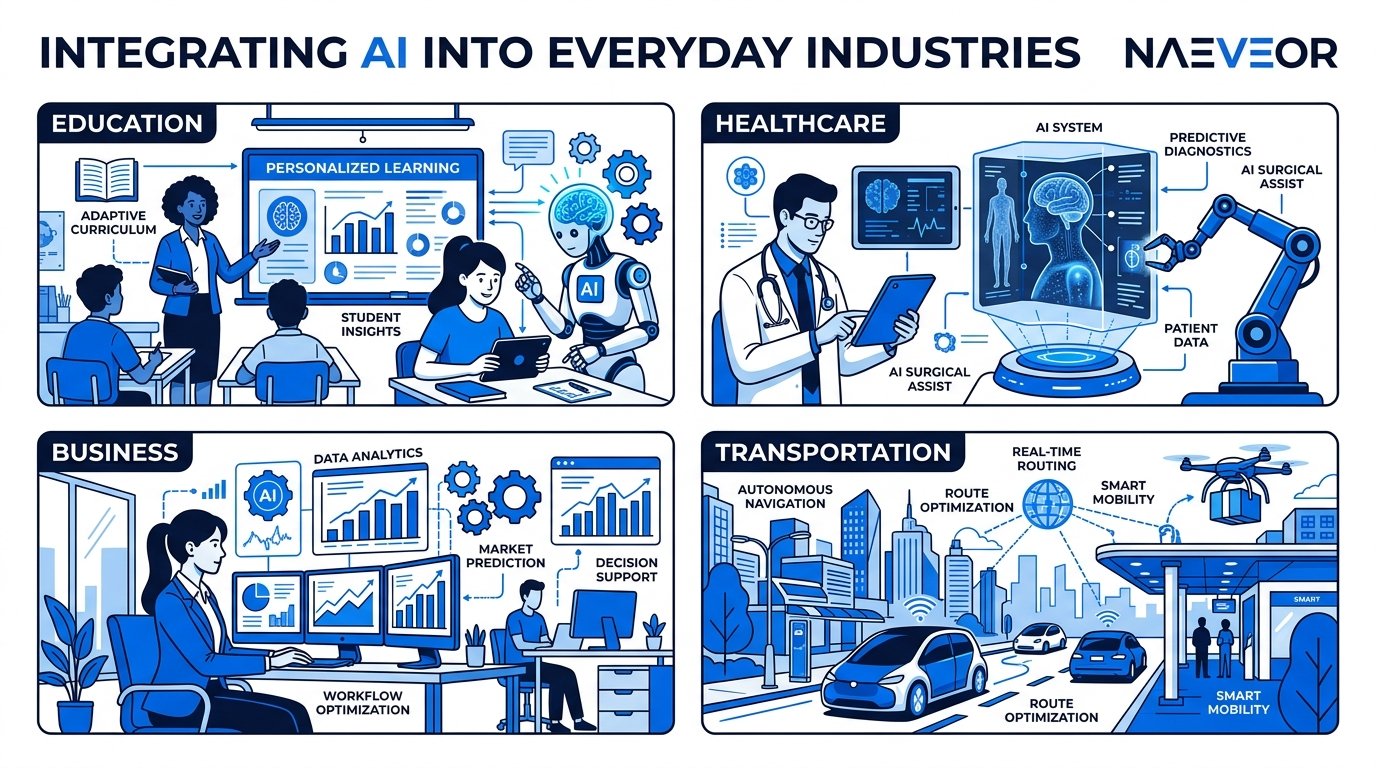
Businesses are using AI to automate repetitive tasks, doctors rely on it to assist with medical diagnoses, educators use it to create personalized learning experiences, and financial institutions leverage it to detect fraudulent transactions. As AI continues to evolve, its influence is expanding across nearly every industry.
According to the Stanford AI Index Report, AI adoption continues to expand across industries, with organizations increasingly integrating AI into products, services, and business operations.
But what exactly are AI applications, and how are they changing the world around us?
In this beginner-friendly guide, you’ll discover 25 real-world applications of artificial intelligence, learn how AI is transforming different industries, explore its key benefits and challenges, and understand why AI skills are becoming increasingly valuable in today’s digital economy.
Whether you’re a student, professional, entrepreneur, or simply curious about artificial intelligence, this guide will help you understand where AI is used today and what its future could look like.
Key Takeaways
- Artificial intelligence is already integrated into many everyday products and services.
- AI applications span industries including healthcare, education, finance, business, marketing, transportation, and cybersecurity.
- Organizations use AI to improve efficiency, automate repetitive tasks, enhance decision-making, and deliver personalized experiences.
- Understanding AI applications helps individuals and businesses prepare for a rapidly evolving digital future.
- As AI technology advances, new opportunities and challenges will continue to emerge across almost every sector.
What Are AI Applications?
AI applications are the practical ways artificial intelligence is used to solve real-world problems or perform tasks that typically require human intelligence. Instead of being limited to research laboratories, AI now powers countless tools, services, and systems that people interact with every day.
An AI application combines data, algorithms, and computing power to perform functions such as recognizing images, understanding language, making predictions, generating content, or automating decisions. Depending on the task, AI can analyze massive amounts of information in seconds, identify patterns, and continuously improve its performance through learning.
For example:
- When Netflix recommends a movie you might enjoy, AI analyzes your viewing history and preferences.
- When Google Maps suggests the fastest route, AI processes real-time traffic data to calculate the quickest path.
- When ChatGPT answers your questions or helps draft an email, generative AI creates human-like text based on your prompt.
- When your email filters spam messages, AI identifies suspicious patterns to protect your inbox.
These examples show that AI applications are not limited to one industry or profession. They are becoming essential tools that help individuals make better decisions, save time, improve productivity, and deliver more personalized experiences.
As technology continues to advance, AI applications are expected to become even more capable, supporting everything from scientific research and healthcare to creative work and business operations.
Continue Learning: If you’re new to artificial intelligence, start with our What Is Artificial Intelligence? guide to understand the core concepts before exploring its real-world applications.
How AI Is Transforming Everyday Life
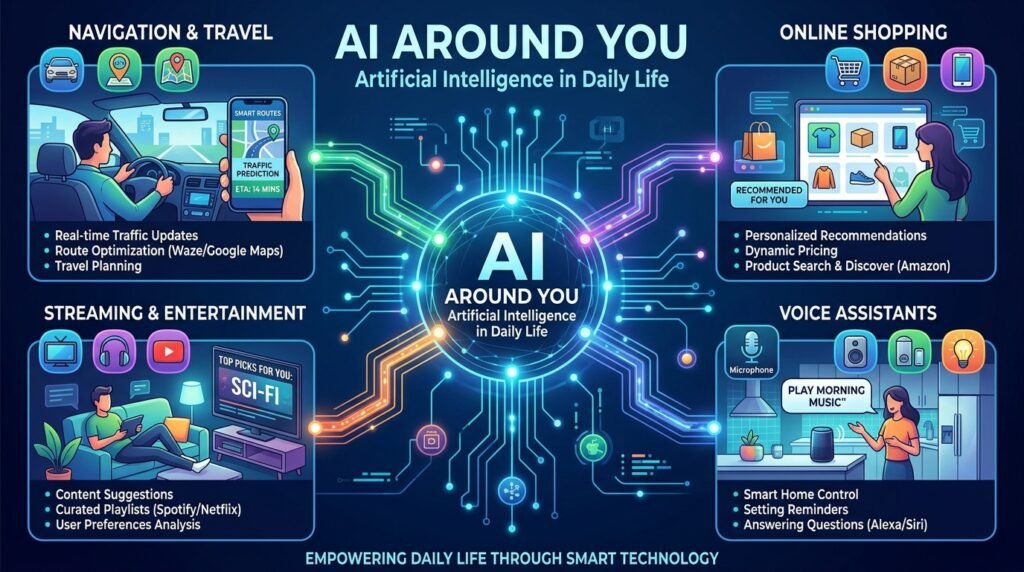
Artificial intelligence isn’t just used by technology companies or large businesses—it’s already part of many everyday activities. Whether you’re shopping online, watching a movie, navigating traffic, or asking a virtual assistant a question, there’s a good chance AI is working behind the scenes.
Here are some of the most common ways people interact with AI every day:
Personalized Recommendations
Streaming platforms like Netflix and Spotify use AI to analyze your viewing and listening habits. Based on your preferences, AI recommends movies, TV shows, songs, and playlists that you’re more likely to enjoy.
Similarly, online stores like Amazon use AI to suggest products based on your browsing history, previous purchases, and shopping behavior.
Smart Search Engines
Modern search engines use AI to better understand what you’re looking for instead of simply matching keywords. They analyze the meaning behind your query to deliver more relevant search results, featured snippets, and personalized recommendations.
Navigation and Maps
Applications like Google Maps and Waze rely on AI to process real-time traffic conditions, road closures, and historical travel data. This allows them to recommend the fastest routes, estimate arrival times, and suggest alternate paths during heavy traffic.
Virtual Assistants
Voice assistants such as Google Assistant, Siri, and Alexa use artificial intelligence to understand spoken language, answer questions, set reminders, play music, and control smart home devices.
As natural language processing continues to improve, these assistants are becoming increasingly conversational and capable of handling more complex tasks.
Email and Spam Protection
Email services use AI to automatically detect spam, phishing attempts, and potentially harmful messages. Instead of relying solely on predefined rules, AI learns from billions of emails to recognize suspicious patterns and improve its accuracy over time.
Social Media Feeds
Social media platforms use AI to personalize your feed by analyzing your interests, interactions, and viewing behavior. This helps determine which posts, videos, and advertisements are most relevant to you.
Online Shopping
AI enhances the online shopping experience by recommending products, predicting delivery times, providing personalized discounts, and powering customer support chatbots that can answer questions instantly.
Content Creation
Generative AI tools have made it easier than ever to create written content, images, presentations, videos, and even computer code. Students, professionals, marketers, and businesses increasingly use these tools to save time, generate ideas, and improve productivity.
If you’ve ever used ChatGPT to write an email, brainstorm ideas, summarize a document, or answer a question, you’ve already experienced one of the most popular AI applications available today
Everyday AI at a Glance
| Everyday Activity | How AI Helps |
| Watching movies or TV shows | Recommends content based on your preferences |
| Online shopping | Suggests products and personalizes offers |
| Navigation | Finds the fastest route using real-time traffic data |
| Detects spam and phishing attempts | |
| Social media | Personalizes your news feed and recommendations |
| Virtual assistants | Understands voice commands and answers questions |
| Banking | Detects suspicious transactions and fraud |
| Content creation | Generates text, images, presentations, and code |
Did You Know?
Many people use artificial intelligence dozens of times each day without realizing it. From unlocking a smartphone with facial recognition to receiving personalized recommendations online, AI has quietly become an essential part of modern digital life.
25 Real-World AI Applications
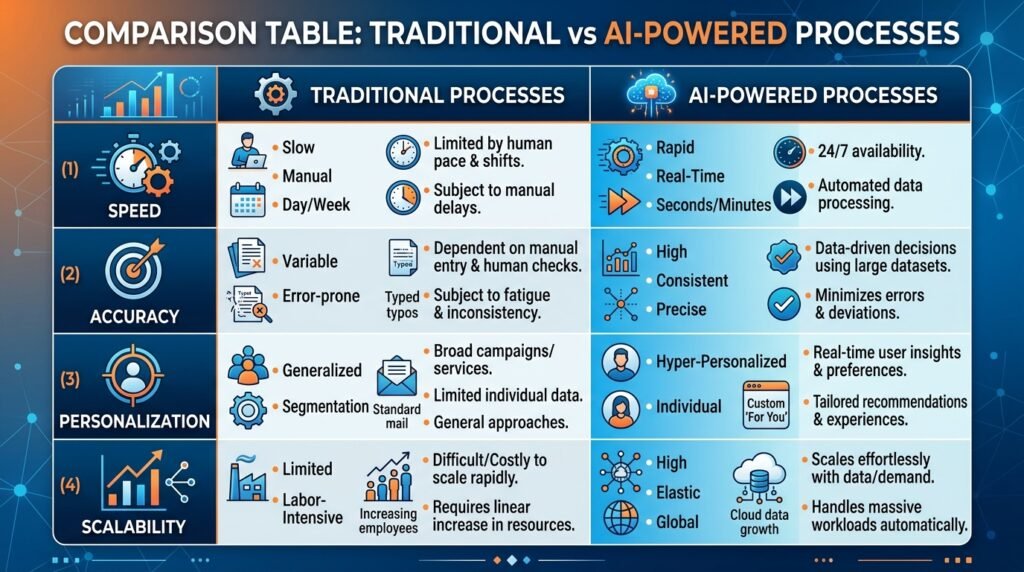
Artificial intelligence is transforming nearly every industry by automating repetitive tasks, analyzing large amounts of data, and helping people make faster, more informed decisions. While the underlying technology may vary, the goal remains the same: to improve efficiency, accuracy, and user experiences.
Below are 25 practical examples of how AI is being used across different sectors today.
AI in Education
Education is becoming more personalized and accessible thanks to artificial intelligence. AI helps students learn at their own pace while allowing teachers to automate administrative tasks and focus more on instruction.
1. Personalized Learning
AI-powered learning platforms analyze a student’s progress, strengths, and weaknesses to recommend customized lessons and learning paths. This helps learners receive content tailored to their individual needs instead of following a one-size-fits-all approach.
Example: An online learning platform suggests additional practice exercises when a student struggles with a particular topic.
Benefits
- Personalized study plans
- Better learning outcomes
- Improved student engagement
2. AI Tutors and Virtual Learning Assistants
AI tutors can answer questions, explain complex concepts, generate quizzes, and provide instant feedback at any time of the day. These tools act as learning companions rather than replacements for teachers.
Example: A student uses ChatGPT to understand algebra concepts before an exam.
Benefits
- 24/7 learning support
- Instant explanations
- Interactive learning experience
Related Article: Learn more about popular AI learning tools in our 25 Best AI Tools for Beginners guide.
AI in Healthcare
Healthcare organizations use AI to improve patient care, assist medical professionals, and accelerate research. While doctors remain responsible for clinical decisions, AI serves as a powerful decision-support tool.
3. Medical Image Analysis
AI can analyze X-rays, CT scans, MRIs, and other medical images to help identify abnormalities such as fractures, tumors, or signs of disease more quickly and accurately.
Example: Radiologists use AI-assisted software to detect early signs of breast cancer in mammograms.
Benefits
- Faster diagnosis
- Improved accuracy
- Early disease detection
4. Drug Discovery and Research
Developing new medicines traditionally takes years of research. AI helps researchers analyze biological data, predict how different compounds may behave, and identify promising drug candidates much faster.
Example: Pharmaceutical companies use AI to accelerate the discovery of treatments for complex diseases.
Benefits
- Faster research
- Lower development costs
- Improved treatment innovation
The World Health Organization (WHO) emphasizes that AI can improve healthcare delivery when developed and deployed responsibly with appropriate human oversight.
AI in Business
Businesses of all sizes use AI to improve productivity, reduce operational costs, and make smarter decisions. From automating repetitive work to analyzing customer behavior, AI has become an essential business tool.
5. Workflow Automation
AI automates repetitive administrative tasks such as scheduling meetings, processing documents, organizing emails, and generating reports. This allows employees to focus on higher-value work.
Example: A company uses AI to automatically categorize customer emails and assign them to the appropriate support team.
Benefits
- Increased productivity
- Reduced manual work
- Faster business operations
6. Business Intelligence and Data Analysis
Organizations generate massive amounts of data every day. AI helps analyze this information to identify trends, predict future outcomes, and support better decision-making.
Example: A retail company uses AI to forecast product demand and optimize inventory levels.
Benefits
- Better forecasting
- Data-driven decisions
- Improved operational efficiency
Research from McKinsey shows that organizations are increasingly adopting AI to improve efficiency, decision-making, and innovation across business functions.
AI in Marketing
Marketing teams use AI to better understand customer behavior, personalize campaigns, and create content more efficiently.
7. Personalized Recommendations
AI analyzes browsing history, purchase behavior, and user preferences to recommend products or services that customers are more likely to buy.
Example: Amazon recommends products based on previous purchases and browsing activity.
Benefits
- Higher customer satisfaction
- Increased sales
- Better user experience
8. AI Content Creation
Generative AI helps marketers create blog posts, social media captions, emails, product descriptions, and advertising copy more efficiently.
Example: A small business owner uses AI to generate social media content ideas for the upcoming month.
Benefits
- Faster content production
- Improved creativity
- Consistent marketing output
Continue Learning: Curious about how AI generates content? Read our guide on What Is Generative AI?
AI in Finance
Artificial intelligence is helping financial institutions improve security, automate processes, and make better lending and investment decisions.
9. Fraud Detection
Banks and payment providers use AI to monitor millions of transactions in real time. By identifying unusual spending patterns, AI can quickly detect and flag potentially fraudulent activities before significant losses occur.
Example: Your bank temporarily blocks a transaction because it detects unusual spending in another country.
Benefits
- Improved financial security
- Faster fraud detection
- Reduced financial losses
10. Credit Scoring and Risk Assessment
AI analyzes financial history, spending habits, and other relevant data to help lenders assess creditworthiness and make informed lending decisions.
Example: A digital lending platform uses AI to evaluate loan applications within minutes.
Benefits
- Faster loan approvals
- More accurate risk assessment
- Better customer experience
AI in Customer Service
Businesses use AI to provide faster, more efficient support while reducing operational costs.
11. AI Chatbots
AI-powered chatbots can answer common customer questions, guide users through processes, and resolve simple issues without human intervention.
Example: An online retailer’s chatbot helps customers track orders and process returns.
Benefits
- 24/7 customer support
- Faster response times
- Lower support costs
12. Intelligent Virtual Assistants
Unlike basic chatbots, AI virtual assistants can understand context, manage conversations, and perform multiple tasks such as scheduling appointments or processing service requests.
Example: A telecommunications company uses an AI assistant to troubleshoot internet connectivity issues before transferring customers to a human representative.
Benefits
- Personalized customer interactions
- Reduced waiting times
- Improved service quality
AI in Manufacturing
Manufacturers rely on AI to improve production efficiency, reduce downtime, and maintain consistent product quality.
13. Predictive Maintenance
AI monitors equipment performance using sensor data to predict when machines may require maintenance before a failure occurs.
Example: A factory replaces a machine component before it breaks, preventing costly production delays.
Benefits
- Reduced downtime
- Lower maintenance costs
- Increased equipment lifespan
14. Quality Inspection
Computer vision systems powered by AI inspect products for defects more quickly and consistently than manual inspection.
Example: An electronics manufacturer uses AI cameras to identify damaged components on production lines.
Benefits
- Higher product quality
- Faster inspections
- Reduced manufacturing waste
AI in Transportation
AI is making transportation safer, more efficient, and better optimized.
15. Route Optimization
AI analyzes traffic conditions, weather, and road closures to recommend the most efficient routes.
Example: Delivery companies optimize daily delivery schedules using AI-powered route planning.
Benefits
- Shorter travel times
- Lower fuel consumption
- Improved logistics efficiency
16. Autonomous Vehicles
Self-driving vehicles combine AI with sensors, cameras, and machine learning to understand their surroundings and make driving decisions.
Although fully autonomous vehicles are still evolving, AI already powers features such as adaptive cruise control, lane-keeping assistance, and automatic emergency braking.
Benefits
- Improved road safety
- Reduced driver workload
- Smarter transportation systems
AI in Cybersecurity
As cyber threats become more sophisticated, AI helps organizations identify and respond to security risks more quickly.
17. Threat Detection
AI continuously monitors network activity to detect unusual behavior that may indicate malware, hacking attempts, or unauthorized access.
Example: A company’s cybersecurity system automatically isolates suspicious activity before it spreads across the network.
Benefits
- Faster threat identification
- Enhanced security
- Reduced response time
18. Spam and Phishing Detection
Email providers use AI to recognize malicious messages by analyzing patterns, language, and sender behavior.
Benefits
- Safer email communication
- Reduced phishing attacks
- Better user protection
AI in Software Development
Software developers increasingly use AI to write code, improve software quality, and speed up development.
19. Code Generation
Generative AI can assist developers by suggesting code, generating functions, explaining programming concepts, and reducing repetitive coding tasks.
Example: A developer uses an AI coding assistant to generate boilerplate code for a web application.
Benefits
- Faster development
- Improved productivity
- Reduced repetitive work
20. Bug Detection and Testing
AI helps identify software bugs, recommend fixes, and automate testing before applications are released.
Benefits
- Improved software quality
- Faster testing cycles
- More reliable applications
AI in Agriculture
Artificial intelligence is helping farmers improve productivity while using resources more efficiently.
21. Precision Farming
AI analyzes satellite imagery, soil conditions, and weather data to help farmers determine the best times for planting, irrigation, and harvesting.
Benefits
- Higher crop yields
- Better resource management
- Reduced environmental impact
22. Crop and Disease Monitoring
Computer vision systems can detect plant diseases, pest infestations, and nutrient deficiencies before they become widespread.
Benefits
- Early problem detection
- Healthier crops
- Lower agricultural losses
AI in Entertainment
Entertainment companies use AI to personalize experiences and streamline content creation.
23. Personalized Content Recommendations
Streaming platforms recommend movies, music, podcasts, and videos based on users’ viewing and listening preferences.
Benefits
- Better user experience
- Increased engagement
- More relevant recommendations
24. AI-Powered Game Development
Game developers use AI to create realistic non-player characters (NPCs), adaptive gameplay, and personalized gaming experiences.
Benefits
- Smarter game characters
- Dynamic gameplay
- More immersive experiences
AI in Content Creation
Generative AI has transformed how individuals and businesses create digital content.
25. Writing, Image, and Video Generation
AI-powered tools can generate blog posts, presentations, marketing copy, images, videos, and even music from simple prompts. These tools help creators save time, overcome creative blocks, and produce content more efficiently.
Example: A marketing team uses AI to draft campaign copy, design promotional graphics, and create presentation slides for a product launch.
Benefits
- Faster content production
- Increased creativity
- Improved productivity
Recommended Reading: Explore our 25 Best AI Tools for Beginners to discover practical AI tools you can start using today.
Benefits of AI Applications
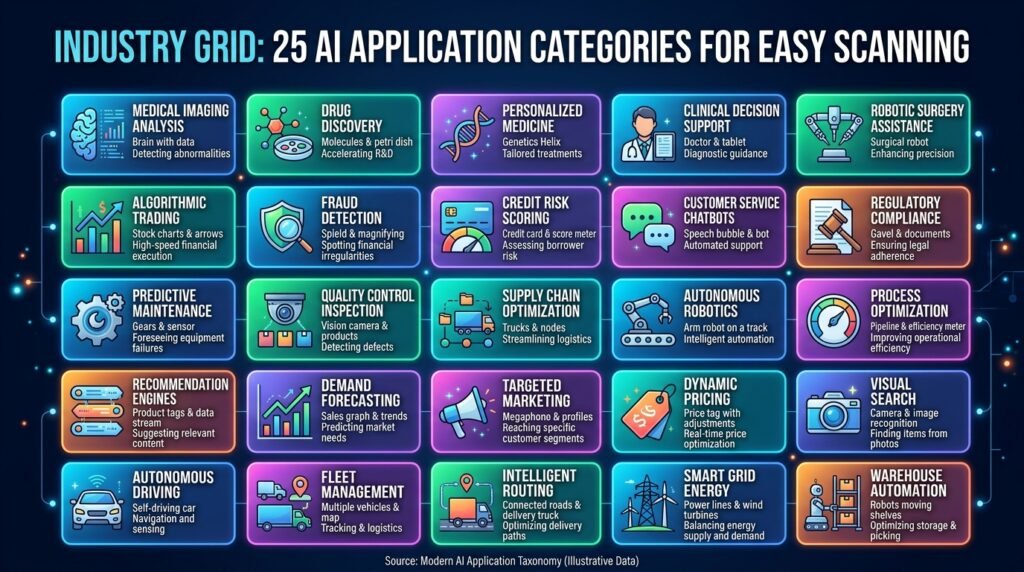
Artificial intelligence offers significant advantages for individuals, businesses, and society. By automating routine tasks, analyzing large volumes of data, and supporting better decision-making, AI helps organizations work more efficiently while creating better experiences for customers and employees.
Here are some of the key benefits of AI applications:
Increased Efficiency and Productivity
AI can automate repetitive and time-consuming tasks such as data entry, scheduling, document processing, and customer support. This allows employees to focus on strategic, creative, and high-value work.
Example: Businesses use AI assistants to summarize meetings, organize emails, and automate workflows, saving hours of manual effort each week.
Better Decision-Making
AI can analyze vast amounts of structured and unstructured data much faster than humans. By identifying trends and patterns, it provides valuable insights that support more informed decision-making.
Example: Retail companies use AI to forecast product demand and optimize inventory based on customer purchasing patterns.
Personalized User Experiences
Many digital services use AI to tailor recommendations and experiences to individual users. Personalization improves customer satisfaction and helps users find relevant content, products, or services more quickly.
Example: Streaming platforms recommend movies and TV shows based on your viewing history.
Improved Accuracy
AI systems can reduce human error in tasks such as medical image analysis, quality inspection, and fraud detection. While human oversight remains essential, AI often improves consistency and precision.
Cost Savings
By automating repetitive processes and improving operational efficiency, AI helps organizations reduce costs and make better use of their resources.
Innovation and New Opportunities
AI enables organizations to develop new products, improve existing services, and solve problems that were previously difficult or impossible to address. It is driving innovation across industries, from healthcare and education to finance and scientific research.
Challenges and Limitations of AI Applications
Despite its many advantages, artificial intelligence also presents important challenges. Understanding these limitations helps individuals and organizations use AI responsibly and effectively.
Privacy and Data Security
Many AI systems rely on large amounts of data to function effectively. Organizations must ensure that personal information is collected, stored, and processed securely while respecting user privacy.
Bias and Fairness
AI systems learn from the data they are trained on. If that data contains biases, the AI may produce unfair or inaccurate outcomes. Developers must continuously evaluate and improve AI systems to reduce bias and promote fairness.
Lack of Human Judgment
AI can identify patterns and make predictions, but it does not possess human emotions, ethics, or common sense. Important decisions—especially in healthcare, law, and finance—should always involve human oversight.
High Development Costs
Building and maintaining advanced AI systems often requires significant investment in computing infrastructure, skilled professionals, and high-quality data.
Job Transformation
AI is changing the nature of work by automating certain tasks. While some roles may become less common, AI is also creating new career opportunities in areas such as AI development, data science, cybersecurity, and prompt engineering.
The future of work is likely to involve collaboration between humans and AI rather than complete replacement.
The Future of AI Applications
Artificial intelligence continues to evolve rapidly, and its applications are expected to become even more widespread in the coming years. Advances in computing power, machine learning, and generative AI are enabling systems that are more capable, accessible, and useful across industries.
Some of the key trends shaping the future of AI include:
AI Agents
AI agents can plan, reason, remember information, and complete multi-step tasks with minimal human guidance. These systems are expected to play an increasingly important role in business operations, research, and personal productivity.
Multimodal AI
Modern AI models can understand and generate multiple types of content—including text, images, audio, and video—within a single system. This enables more natural and versatile human-computer interactions.
Industry-Specific AI Solutions
Rather than relying solely on general-purpose AI, organizations are increasingly adopting specialized AI systems designed for industries such as healthcare, education, manufacturing, finance, and law.
Responsible AI Development
Governments, researchers, and technology companies are working to develop AI systems that are transparent, secure, fair, and aligned with ethical principles. Responsible AI practices will play a critical role in building public trust as adoption continues to grow.
While it’s impossible to predict exactly how AI will evolve, one thing is clear: artificial intelligence will continue to reshape the way we live and work. Understanding its applications today is an important step toward preparing for the opportunities and challenges of tomorrow.
International organizations such as OECD and UNESCO have published principles to promote trustworthy, transparent, and human-centered AI development.
Frequently Asked Questions (FAQs)
What are AI applications?
AI applications are software systems or tools that use artificial intelligence to perform tasks that typically require human intelligence. These tasks include recognizing speech, understanding language, analyzing data, making predictions, generating content, and automating repetitive processes.
What are some examples of AI applications?
Some common examples include:
- ChatGPT for writing and brainstorming
- Google Maps for route optimization
- Netflix for personalized recommendations
- Gmail for spam detection
- Siri and Google Assistant for voice assistance
- AI-powered chatbots for customer support
- Medical AI for disease detection
- AI coding assistants for software development
Which industries use artificial intelligence?
Artificial intelligence is used across many industries, including:
- Healthcare
- Education
- Finance
- Marketing
- Manufacturing
- Transportation
- Agriculture
- Retail
- Entertainment
- Cybersecurity
- Software Development
- Customer Service
As AI technology continues to evolve, adoption is expected to expand into even more sectors.
How does AI improve businesses?
Businesses use AI to automate repetitive tasks, analyze large datasets, improve customer service, personalize marketing campaigns, detect fraud, optimize operations, and support better decision-making. These capabilities help organizations increase productivity while reducing costs.
Will AI replace human jobs?
AI is changing how work is done, but it is more likely to transform jobs than replace them entirely. While AI can automate repetitive tasks, human creativity, critical thinking, emotional intelligence, and decision-making remain essential in many professions.
Many experts expect AI to create new career opportunities while changing the skills required for existing roles.
How can beginners start learning about AI?
The best way to begin is by understanding the fundamentals of artificial intelligence before exploring AI tools and practical applications. Experimenting with beginner-friendly AI tools and practicing prompt writing can also help you build confidence.
Continue Learning
Ready to deepen your understanding of artificial intelligence? Explore these beginner-friendly guides:
- What Is Artificial Intelligence? – Learn the fundamentals of AI and how it works.
- What Is Generative AI? – Discover how AI creates text, images, code, and more.
- AI vs Machine Learning vs Deep Learning – Understand the key differences between these closely related concepts.
- Types of Artificial Intelligence – Explore Narrow AI, General AI, and Super AI.
- How Does ChatGPT Work? – Learn how one of today’s most popular AI assistants generates responses.
Recommended AI Tools
If you’d like to experience artificial intelligence firsthand, these beginner-friendly tools are a great place to start:
| Tool | Best For |
| ChatGPT | Writing, brainstorming, learning, coding |
| Claude | Long-form writing and document analysis |
| Gemini | Research, productivity, and Google Workspace |
| Perplexity AI | AI-powered search and research |
| Canva AI | Creating presentations, graphics, and social media content |
👉 Explore our Recommended AI Tools page for in-depth reviews, comparisons, and beginner-friendly recommendations.
Related Articles
If you found this guide helpful, you may also enjoy:
- 25 Best AI Tools for Beginners
- AI Skills Development: A Beginner’s Roadmap
- What Is Prompt Engineering?
- How to Write Better AI Prompts
- Prompt Engineering Techniques
Conclusion
Artificial intelligence is no longer a technology of the future—it’s already transforming the way we live, work, learn, and interact with the digital world. From personalized recommendations and virtual assistants to medical diagnosis, fraud detection, and content creation, AI applications are becoming an essential part of everyday life across virtually every industry.
As AI continues to evolve, understanding its practical applications will become increasingly valuable for students, professionals, entrepreneurs, and businesses alike. While AI presents exciting opportunities to improve productivity and innovation, it also requires responsible development, ethical considerations, and ongoing human oversight.
Whether you’re just beginning your AI journey or looking to expand your knowledge, learning how artificial intelligence is applied in the real world is an excellent first step. By understanding today’s AI applications, you’ll be better prepared to adapt to tomorrow’s technologies and opportunities.
References
- National Institute of Standards and Technology (NIST). Artificial Intelligence Resource Center.
- Stanford University. AI Index Report 2026.
- World Health Organization. Ethics and Governance of Artificial Intelligence for Health.
- OECD. OECD AI Principles.
- McKinsey & Company. The State of AI.
- Dartmouth College. Dartmouth Summer Research Project on Artificial Intelligence (1956).
Leave a Reply