🕒 15-18 min read • Updated: July 2026
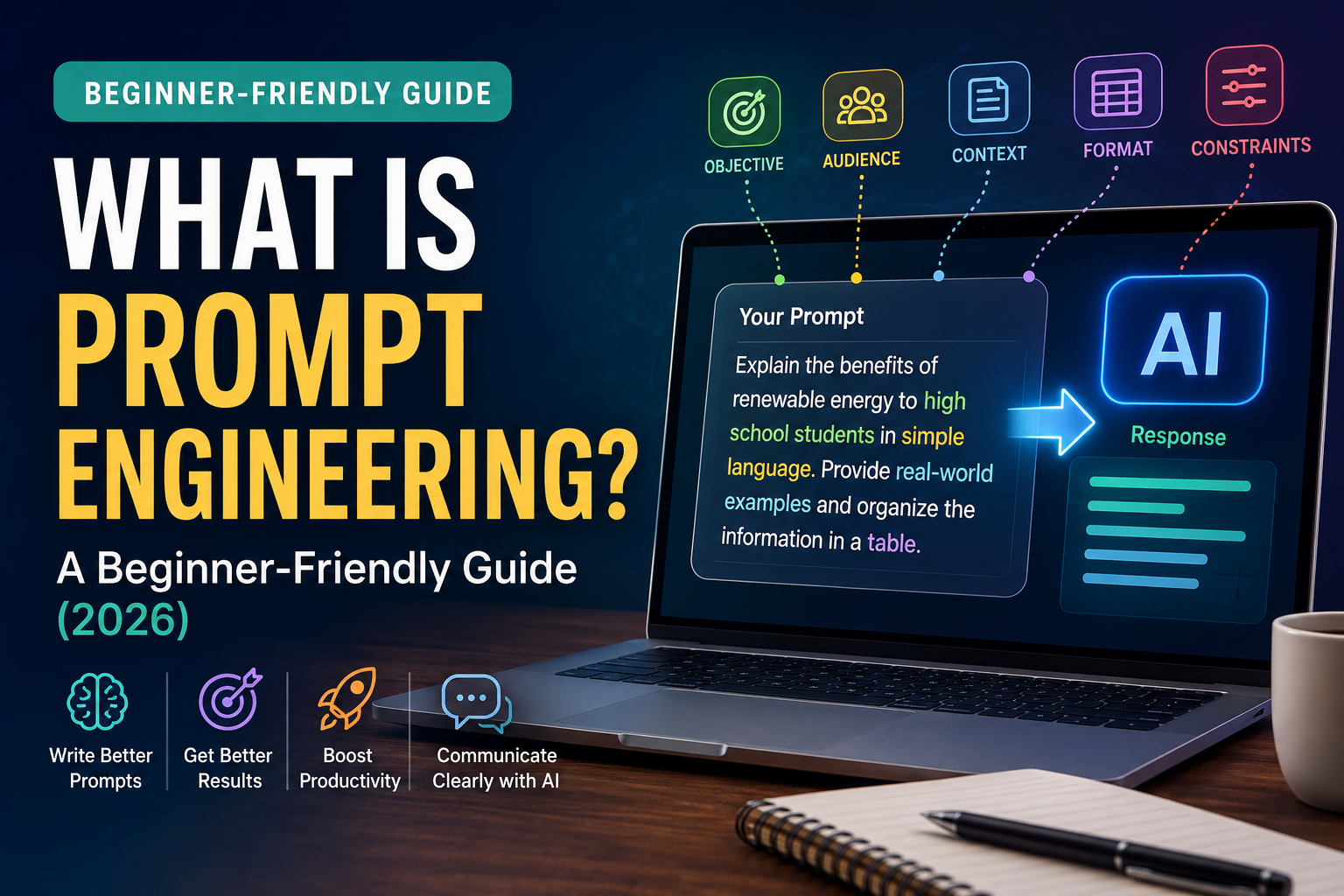
Prompt engineering is the practice of designing clear and effective instructions (called prompts) that help artificial intelligence (AI) systems generate accurate, relevant, and useful responses. By providing the right context, goals, and constraints, users can significantly improve the quality of AI-generated outputs.
Table of Contents
Introduction
Imagine asking someone for directions by simply saying, “Take me somewhere nice.” You might end up at a park, a restaurant, or even a museum because your request is too vague. Now imagine saying, “Recommend a quiet café within walking distance that’s suitable for remote work and serves vegetarian food.” The second request is far more likely to produce the result you actually want.
Artificial intelligence works in much the same way.
Whether you’re using ChatGPT to draft an email, generate images, or explore modern Generative AI applications, the quality of the output depends heavily on the quality of your instructions. If you’re new to the field, you may also want to start with our guide on What Is Artificial Intelligence? before learning how to write effective prompts.
Prompt engineering isn’t about learning a secret language or memorizing complicated formulas. It’s about communicating with AI in a structured and thoughtful way. A well-crafted prompt helps the AI understand your intent, while a vague or incomplete prompt can lead to responses that are confusing, inaccurate, or simply unhelpful.
As AI becomes an everyday tool for learning, work, creativity, and business, prompt engineering is evolving into a valuable digital skill for people across many professions—not just software developers or AI researchers.
In this guide, you’ll learn what prompt engineering is, how it works, why it matters, and practical techniques you can use immediately to get better results from AI tools.
Key Takeaways
- Prompt engineering is the practice of writing effective instructions for AI systems.
- Clear, specific prompts usually produce more accurate and useful responses.
- Good prompts include context, goals, and expected output.
- Prompt engineering is useful for students, professionals, creators, and businesses alike.
- Anyone can learn prompt engineering without programming knowledge.
What Is Prompt Engineering?
Prompt engineering is the process of designing clear, detailed, and purposeful instructions that guide an artificial intelligence system toward producing the most relevant and helpful response.
A prompt is simply the input you provide to an AI model. It can be a question, a command, a description, or a combination of instructions. Prompt engineering focuses on improving that input so the AI better understands what you’re trying to achieve.
For example, consider these two prompts:
Prompt 1
Explain climate change.
Prompt 2
Explain climate change to a 12-year-old using simple language, everyday examples, and no scientific jargon. Keep the explanation under 250 words.
Both prompts ask about the same topic, but the second provides much more guidance. It specifies the audience, writing style, and desired length, making it easier for the AI to generate a response that meets the user’s expectations.
This illustrates an important principle:
The quality of an AI’s response often depends on the clarity and completeness of the prompt it receives.
Prompt engineering doesn’t guarantee perfect answers. AI systems can still make mistakes, misunderstand context, or provide outdated information. However, well-designed prompts can significantly improve the usefulness and consistency of AI-generated content.
Why Prompt Engineering Matters
Artificial intelligence is becoming part of everyday life. People use AI to write emails, brainstorm ideas, analyze information, generate images, create code, translate languages, and automate repetitive tasks.
Despite these impressive capabilities, AI doesn’t truly “understand” requests in the same way humans do. Instead, it identifies patterns in language and predicts the most likely response based on the prompt it receives.
This means that even powerful AI models can produce disappointing results if the instructions are unclear.
Prompt engineering helps bridge this gap by enabling users to communicate their intentions more effectively. If you’re curious about what happens behind the scenes when you enter a prompt, our guide on How Does ChatGPT Work? explains how AI models process instructions and generate responses.
Here are some of the key benefits:
Better Accuracy
Specific prompts reduce ambiguity and help AI focus on the information that matters most.
For instance, instead of asking:
Write about electric vehicles.
You could ask:
Write a beginner-friendly comparison between electric and petrol cars for first-time buyers. Include purchase cost, maintenance, charging, and environmental impact in a table.
The second prompt gives the AI a much clearer direction.
Higher Productivity
A well-written prompt often eliminates the need for multiple follow-up questions, saving time and reducing repetitive editing.
More Relevant Responses
Providing context allows AI to tailor its output to your needs, whether you’re writing for children, professionals, or social media audiences.
Improved Creativity
Prompt engineering isn’t just about precision. Thoughtfully designed prompts can inspire creative ideas, generate alternative perspectives, and help overcome writer’s block.
Better Learning Experience
Students and lifelong learners can use prompt engineering to receive explanations that match their current level of understanding, making complex topics easier to grasp.
How Prompt Engineering Works
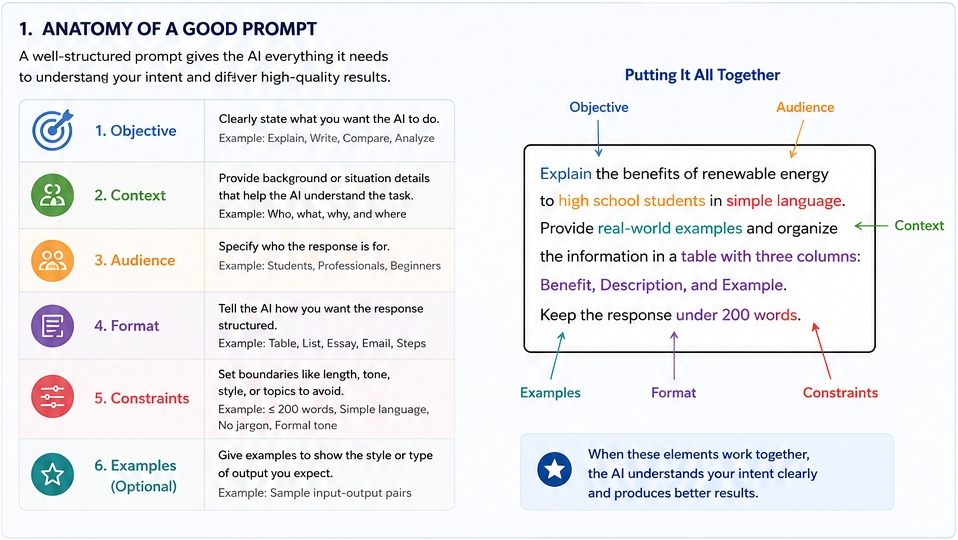
Although AI can seem almost conversational, it doesn’t think or reason like a human. Instead, it processes your prompt, identifies patterns from the data it was trained on, and generates the most probable response based on those patterns.
A simplified view of the process looks like this:
User Writes a Prompt
↓
AI Interprets the Instructions
↓
Considers Context and Patterns
↓
Generates a Response
↓
User Reviews and Refines the Prompt (if needed)
This process highlights why prompt engineering is often iterative. If the first response isn’t quite right, you don’t need to start over—you can refine the prompt by adding more context, clarifying your goal, or specifying the desired format.
For example, if an AI-generated article feels too technical, you might revise your prompt to ask for simpler language, real-world examples, or shorter paragraphs.
Over time, this cycle of prompting, reviewing, and refining helps users consistently achieve better results.
Think of a prompt as a set of instructions. Just as you would give clear directions to a person to complete a task, an AI model performs best when it receives enough information to understand exactly what you want.
Components of an Effective Prompt
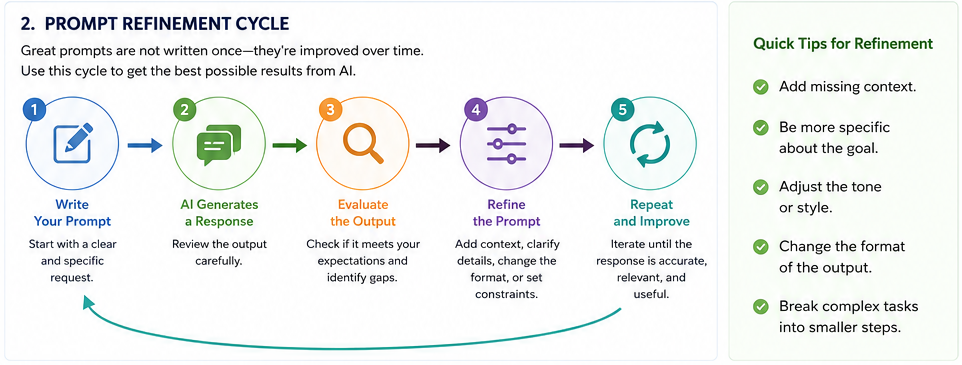
While not every prompt needs to include every detail, the most effective prompts often contain the following components.
1. A Clear Objective
Start by telling the AI exactly what you want it to do.
Instead of writing:
Tell me about renewable energy.
Try:
Explain how solar panels generate electricity in simple language for high school students.
The second prompt gives the AI a specific goal, making it easier to produce a focused response.
2. Relevant Context
Context helps the AI understand the background of your request.
For example, if you’re asking the AI to write an email, explain who the recipient is and why you’re writing.
Instead of:
Write an email.
Try:
Write a professional email to a client explaining that a software update has been delayed by two days due to additional security testing.
The additional information helps the AI generate a response that matches the situation.
3. Specify the Audience
The same topic can be explained in different ways depending on who will read it.
For example:
- Children
- College students
- Business executives
- Developers
- General readers
A prompt that identifies the intended audience usually produces more appropriate language and examples.
4. Define the Desired Format
AI can organize information in many different ways.
Examples include:
- Bullet points
- Tables
- Step-by-step guides
- Emails
- Reports
- Blog articles
- FAQs
- Social media captions
For example:
Compare electric cars and petrol cars in a table with five comparison points.
This tells the AI not only what information to provide but also how to present it.
5. Add Constraints
Constraints define the boundaries of the response.
Examples include:
- Maximum word count
- Reading level
- Writing style
- Tone of voice
- Topics to avoid
For example:
Explain blockchain in less than 200 words without using technical jargon.
Constraints help the AI stay focused and reduce unnecessary information.
6. Request Examples (When Helpful)
Examples often make complex topics easier to understand.
Instead of asking:
Explain APIs.
You might ask:
Explain APIs using a real-world analogy and provide two everyday examples.
This encourages the AI to create a more engaging and practical explanation.
Weak Prompt vs. Strong Prompt
The difference between a vague and a well-structured prompt can significantly affect the quality of the response.
| Weak Prompt | Improved Prompt |
| Explain AI. | Explain artificial intelligence to someone with no technical background using simple language and real-world examples. |
| Write an email. | Write a polite follow-up email to a job interviewer after a first-round interview. Keep it under 150 words. |
| Create a workout plan. | Create a beginner-friendly four-week home workout plan that requires no equipment and includes rest days. |
| Summarize this article. | Summarize the following article in five bullet points and highlight the three most important takeaways. |
| Help me study biology. | Create ten multiple-choice biology questions about human cells with answers and short explanations. |
Notice how the stronger prompts provide clear objectives, context, audience, and formatting instructions. These details help the AI generate responses that require fewer revisions.
Types of Prompt Engineering
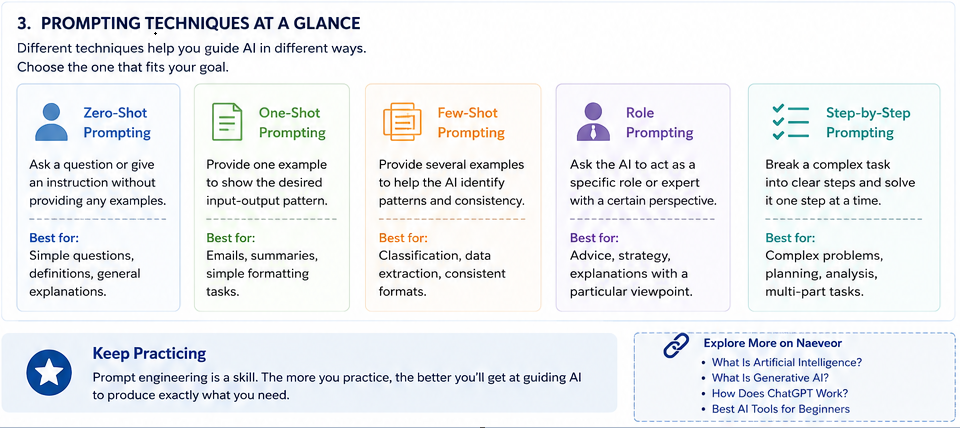
Prompt engineering includes several techniques that help users guide AI models more effectively. While some of these methods originated in AI research, they can also be useful for everyday users.
Zero-Shot Prompting
Zero-shot prompting means asking the AI to perform a task without providing any examples.
For instance:
Explain photosynthesis in simple language.
The AI relies on its existing knowledge to generate the response.
This is one of the most common prompting techniques because it’s quick and works well for straightforward tasks.
Best for:
- General questions
- Definitions
- Brainstorming
- Simple explanations
One-Shot Prompting
One-shot prompting provides the AI with a single example before asking it to complete a similar task.
Example:
Example:
Input:
Customer: “The package arrived late.”
Response:
“We’re sorry your order was delayed. We appreciate your patience.”
Now respond to:
Customer: “The wrong product was delivered.”
The example helps the AI understand the expected style and format.
Best for:
- Customer support
- Email writing
- Content formatting
- Consistent responses
Few-Shot Prompting
Few-shot prompting extends the same idea by providing several examples.
This allows the AI to identify patterns and produce responses that more closely match your expectations.
It’s especially useful when you want consistency across multiple outputs.
Examples include:
- Product descriptions
- Classification tasks
- Data formatting
- Review analysis
Role Prompting
Role prompting asks the AI to respond from a particular perspective or assume a specific role.
For example:
Act as an experienced financial advisor and explain the basics of investing to someone opening their first investment account.
Or:
Act as a high school science teacher and explain gravity using everyday examples.
Assigning a role helps the AI adopt an appropriate tone, vocabulary, and style.
Step-by-Step Prompting
Some tasks become easier when broken into smaller steps.
Instead of asking:
Build a business plan.
You could ask:
- Identify the target audience.
- Suggest three business ideas.
- Compare the ideas.
- Create a business model.
- Develop a marketing strategy.
Breaking a complex request into stages often results in more organized and accurate responses.
Structured Prompting
Structured prompting organizes information using headings or labels.
Example:
Task: Write a blog introduction
Audience: Beginners
Tone: Friendly
Length: 200 words
Goal: Encourage readers to continue reading
Providing information in a structured format reduces ambiguity and makes it easier for the AI to understand your requirements.
Choosing the Right Prompting Technique
You don’t need to memorize every prompting method. The best approach depends on what you’re trying to accomplish.
| Your Goal | Recommended Technique |
| Ask a simple question | Zero-shot prompting |
| Match a specific style | One-shot prompting |
| Generate consistent results | Few-shot prompting |
| Change the AI’s perspective | Role prompting |
| Solve a complex problem | Step-by-step prompting |
| Control the output format | Structured prompting |
For most everyday tasks, combining a clear objective, relevant context, and a structured format is enough to produce high-quality responses.
Real-World Prompt Engineering Examples
Prompt engineering isn’t limited to AI experts or software developers. Whether you’re studying for an exam, managing a business, or creating content online, writing better prompts can help you work more efficiently and get more relevant AI-generated responses.
If you’re just getting started, explore our curated list of the Best AI Tools for Beginners to discover platforms that support writing, coding, research, image generation, and productivity.
Here are some practical examples across different use cases.
For Students
Instead of asking:
Explain the water cycle.
Try:
Explain the water cycle to a Class 8 student using simple language, everyday examples, and a short summary at the end.
This tells the AI who the explanation is for, how detailed it should be, and how to structure the response.
For Content Writers
Instead of:
Write a blog post about remote work.
Try:
Write a 1,200-word beginner-friendly blog post about the benefits of remote work. Use clear headings, practical examples, and a professional but conversational tone.
Adding details about length, audience, and tone produces a more useful first draft.
For Business Professionals
Instead of:
Write an email.
Try:
Write a professional email informing customers about scheduled website maintenance on Saturday from 10 PM to 2 AM. Keep the tone reassuring and include an apology for any inconvenience.
Providing context helps the AI generate a message that fits the situation.
For Developers
Instead of:
Fix my code.
Try:
Review the following Python function for readability and potential bugs. Explain each issue you find and suggest improvements without changing the overall functionality.
This encourages a more structured and educational response rather than simply rewriting the code.
For Job Seekers
Instead of:
Improve my resume.
Try:
Rewrite the following resume summary for a digital marketing role. Highlight measurable achievements and keep it under 100 words.
The AI now understands the target role and the desired outcome.
For Small Business Owners
Instead of:
Give me marketing ideas.
Try:
Suggest ten low-cost marketing ideas for a newly opened local bakery. Prioritize ideas that can be implemented within one month and require minimal advertising budget.
Specific constraints often lead to more practical recommendations.
Best Practices for Writing Better AI Prompts
You don’t need to master every prompting technique to use AI effectively. Following a few simple principles can dramatically improve the quality of the responses you receive.
Be Specific
Avoid vague requests whenever possible.
Instead of:
Tell me about cybersecurity.
Try:
Explain the most common cybersecurity risks faced by small businesses and suggest practical ways to reduce them.
Specific prompts help the AI focus on the information that matters most.
Provide Relevant Context
Context helps AI understand the purpose behind your request.
If you’re writing an article, mention the intended audience. If you’re preparing a presentation, explain who will be attending. If you’re solving a problem, describe the situation clearly.
The more relevant information you provide, the better the AI can tailor its response.
Define the Output Format
Tell the AI how you’d like the information presented.
Examples include:
- Bullet points
- Tables
- Checklists
- Email drafts
- Step-by-step instructions
- Blog outlines
- Frequently asked questions
Specifying the format reduces the amount of editing needed later.
Break Complex Tasks into Smaller Steps
Large or complicated requests are often easier to manage when divided into smaller parts.
For example, instead of asking:
Help me launch a business.
You could ask the AI to:
- Identify potential business ideas.
- Compare the options.
- Create a simple business plan.
- Suggest a marketing strategy.
- Outline the first month’s priorities.
This approach often produces more organized and actionable results.
Review and Refine
Prompt engineering is an iterative process.
If the first response isn’t quite what you expected, refine your prompt instead of abandoning the task.
You might:
- Add more context.
- Clarify your objective.
- Specify the audience.
- Adjust the tone.
- Request a different format.
Small changes can lead to significantly better results.
Verify Important Information
AI can occasionally produce inaccurate, outdated, or incomplete information. For decisions involving health, finance, law, safety, or other high-impact topics, always verify important facts using reliable and authoritative sources.
Think of AI as a helpful assistant—not a replacement for expert advice or independent verification.
Common Prompt Engineering Mistakes
Even experienced AI users sometimes receive disappointing results because of avoidable prompting mistakes.
Being Too Vague
Short prompts often leave too much room for interpretation.
Instead of asking:
Write something about climate change.
Specify the audience, purpose, and desired format.
Asking Too Many Things at Once
Trying to solve multiple unrelated tasks in one prompt can confuse the AI.
For example:
Write a blog post, create social media captions, design a logo idea, and prepare an email campaign.
Instead, complete one task at a time or break the project into separate prompts.
Leaving Out Important Context
AI cannot infer information that hasn’t been provided.
If you’re asking the AI to continue an article, summarize a meeting, or review a document, include the necessary background.
Expecting Perfect Results on the First Attempt
Prompt engineering is often a process of refinement.
Many professionals improve AI-generated outputs through several iterations rather than expecting a flawless response immediately.
Assuming AI Always Has the Latest Information
Depending on the AI tool you’re using, responses may not always reflect the most recent developments or real-time events.
If you’re researching current news, product releases, or changing regulations, confirm the information using up-to-date sources.
Myth vs. Reality
Many misconceptions surround prompt engineering. Understanding what it is—and what it isn’t—can help you use AI more effectively.
| Myth | Reality |
| Prompt engineering is only for programmers. | Anyone who uses AI can benefit from writing clearer prompts. |
| There is one perfect prompt for every task. | Different tasks often require different approaches and refinements. |
| Longer prompts are always better. | Clarity and relevance matter more than length. |
| AI always understands exactly what you mean. | AI responds based on the information you provide, so unclear prompts can lead to unexpected results. |
| Prompt engineering guarantees correct answers. | Well-crafted prompts improve results but do not eliminate errors or inaccuracies. |
Will Prompt Engineering Still Matter?
As AI systems continue to evolve, they are becoming better at understanding natural language and handling less detailed instructions. This has led some people to wonder whether prompt engineering will eventually become unnecessary.
While AI models are improving, the ability to communicate clearly with AI remains valuable.
Rather than disappearing, prompt engineering is evolving from a highly technical discipline into a practical communication skill. Users who can define objectives, provide context, and describe the desired outcome are likely to achieve more reliable and useful results.
In the future, prompt engineering may become less about memorizing specific techniques and more about understanding how to collaborate effectively with AI systems.
Frequently Asked Questions
Do I need coding skills to learn prompt engineering?
No. Most prompt engineering techniques rely on clear communication rather than programming knowledge. Anyone who can describe a task clearly can learn the basics.
Is prompt engineering only useful for ChatGPT?
No. Many AI tools—including writing assistants, image generators, coding assistants, and research tools—respond to prompts. The same principles generally apply across different AI systems, although features and capabilities may vary.
Can prompt engineering improve AI accuracy?
Writing clearer prompts often leads to more relevant and focused responses. However, prompt engineering cannot guarantee that every answer will be factually correct, so important information should always be verified.
Is prompt engineering difficult to learn?
Not at all. Most beginners improve quickly by practicing with everyday tasks and refining their prompts based on the AI’s responses.
Will prompt engineering remain an important skill?
Yes. As AI becomes more common in education, business, and everyday life, the ability to communicate effectively with AI is likely to remain valuable—even as the technology becomes easier to use.
Conclusion
Prompt engineering builds on the foundational concepts of AI. To deepen your understanding, you can also read our comparison of AI vs Machine Learning vs Deep Learning, which explains how these related technologies work together.
Prompt engineering is more than learning how to ask better questions. It’s the skill of communicating your goals clearly so that AI can generate responses that are more accurate, relevant, and useful.
Whether you’re a student studying for exams, a professional writing reports, a creator developing content, or a business owner exploring AI-powered tools, effective prompting can help you save time and improve the quality of your work.
The good news is that prompt engineering isn’t about finding a single “perfect” prompt. It’s about experimenting, learning from the results, and refining your instructions over time. The more you practice, the more naturally you’ll be able to guide AI toward the outcomes you want.
As artificial intelligence continues to become part of everyday life, clear communication will remain one of the most valuable skills you can develop. Learning the fundamentals of prompt engineering today will help you make better use of AI tools both now and in the future.
Leave a Reply