
🕒 10-12 min read • Updated: July 2026
Table of Contents

Have you ever asked an AI chatbot a question and received a vague, inaccurate, or unhelpful response? In many cases, the problem isn’t the AI—it’s the prompt.
Prompt engineering techniques help you communicate with AI more effectively by structuring your instructions in a way that produces clearer, more accurate, and more useful responses. Whether you’re using ChatGPT, Claude, Gemini, or another AI assistant, knowing a few proven prompting methods can dramatically improve the quality of the answers you receive.
In this beginner-friendly guide, you’ll learn 10 essential prompt engineering techniques, understand when to use each one, and see practical examples that you can apply immediately. By the end of this article, you’ll have a toolkit of prompting strategies to help you work more efficiently and get better results from AI.
What You’ll Learn
By the end of this guide, you’ll understand:
- ✔ What prompt engineering techniques are
- ✔ Why they improve AI responses
- ✔ 10 practical techniques with examples
- ✔ Common mistakes to avoid
- ✔ How to choose the right technique for different tasks
Quick Answer: Prompt engineering techniques are structured methods for writing AI prompts that improve the quality, accuracy, and relevance of AI-generated responses. Common techniques include zero-shot prompting, few-shot prompting, role prompting, chain-of-thought prompting, and iterative prompting.
What Are Prompt Engineering Techniques?
Prompt engineering techniques are structured methods for writing effective AI instructions that help AI models generate more accurate, relevant, and useful responses.
Instead of typing a short request like:
“Write an article about AI.”
you can provide additional guidance:
“Write a 1,000-word beginner-friendly article explaining artificial intelligence using simple language, practical examples, and clear headings.”
Although both prompts ask for the same topic, the second provides the AI with much more information about the expected outcome. As a result, the response is usually better organized and more closely aligned with your goals.
Think of prompt engineering like giving directions to a new employee. If you simply say, “Complete this project,” they may not know where to start. However, if you explain the objective, audience, deadline, and expected format, they’re much more likely to deliver exactly what you need.
AI models work in a similar way. The clearer your instructions, the easier it is for the model to understand your intent.
Prompt engineering techniques provide practical frameworks that make those instructions more effective.
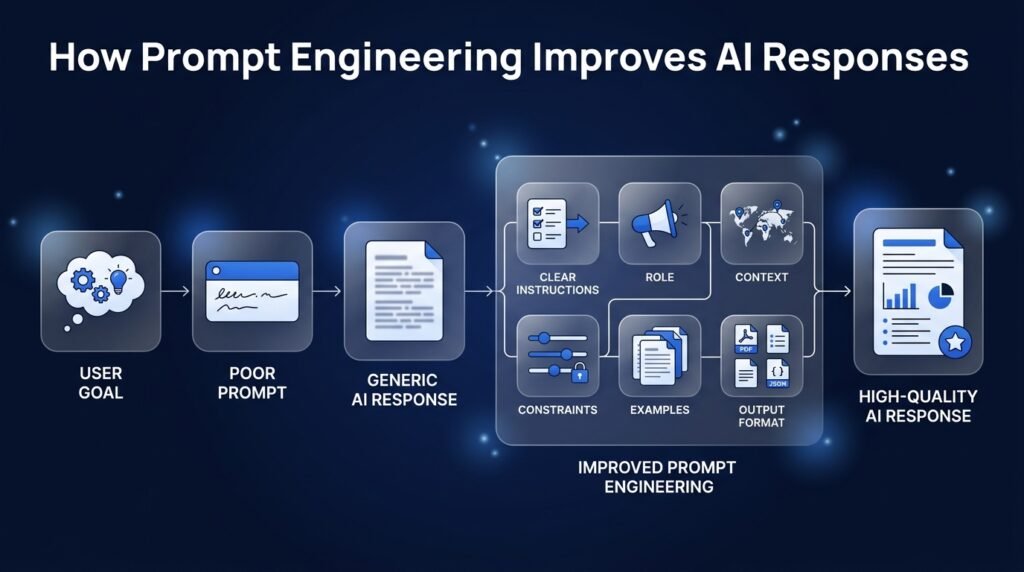
Why Prompt Engineering Techniques Matter
Large language models can perform an impressive range of tasks, but they don’t automatically know your expectations.
A vague prompt often leads to a vague answer.
For example:
Prompt
Explain machine learning.
The response may be technically correct, but it could be too brief, too advanced, or not relevant to your intended audience.
Now compare it with this:
Prompt
Explain machine learning to someone with no technical background. Use simple language, include three real-world examples, and keep the explanation under 500 words.
The second prompt gives the AI clear guidance about:
- the audience,
- the level of detail,
- the writing style,
- the format, and
- the desired length.
As a result, the response is much more likely to match your needs.
Effective prompt engineering offers several benefits:
- Improves response quality and accuracy.
- Reduces the need for repeated revisions.
- Produces more consistent outputs across similar tasks.
- Saves time by minimizing trial and error.
- Makes AI more useful for writing, learning, coding, research, business, and creative work.
Rather than treating AI as a search engine, prompt engineering helps you collaborate with it more effectively.
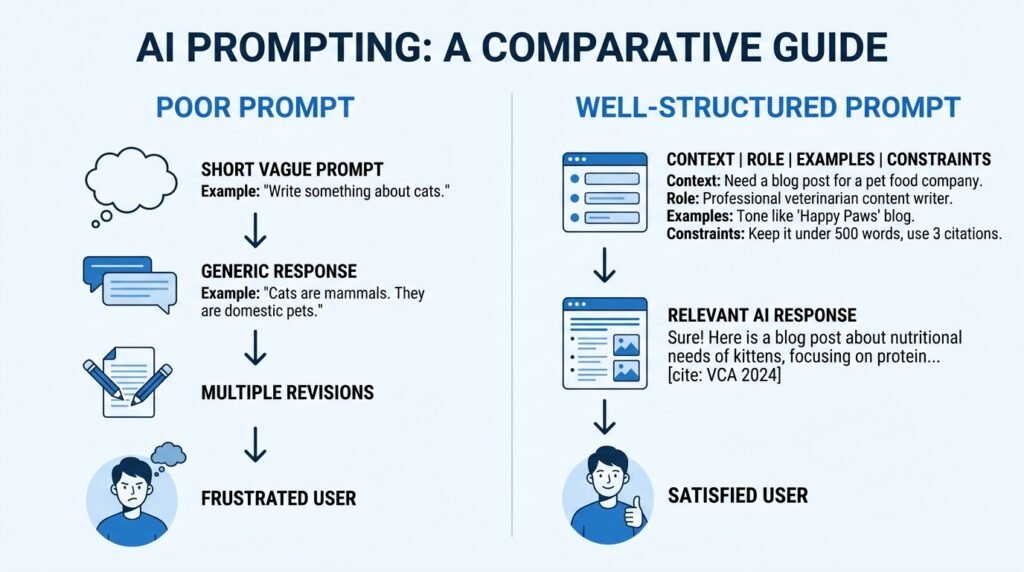
10 Essential Prompt Engineering Techniques
No single prompting technique works best for every situation. Different tasks require different approaches depending on your goal, the AI model you’re using, and the level of detail you need.
The techniques below form a practical toolkit. You can use them individually or combine multiple techniques to create prompts that produce more accurate and useful results.
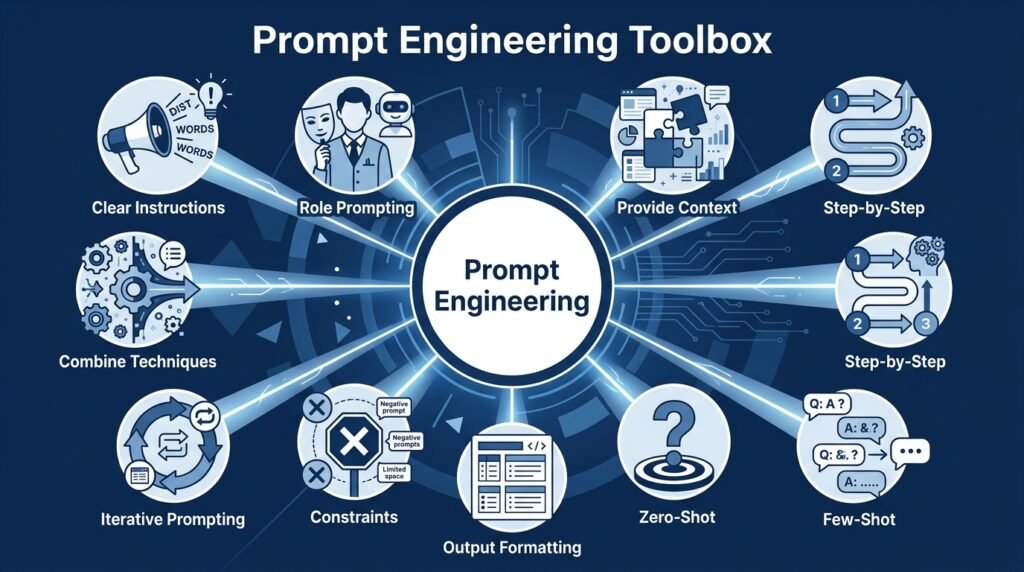
1. Give Clear and Specific Instructions
One of the simplest ways to improve AI responses is to be specific about what you want.
Vague prompts force the AI to guess your intent, while clear instructions reduce ambiguity and lead to more relevant outputs.
Poor Prompt
Write about artificial intelligence.
Better Prompt
Write a beginner-friendly 800-word article explaining artificial intelligence using simple language, real-world examples, and short paragraphs.
The second prompt clearly defines:
- Topic
- Audience
- Length
- Writing style
- Structure
This gives the AI a much clearer objective.
Best For
- Blog writing
- Emails
- Reports
- Research summaries
- Educational content
Tip: Before submitting your prompt, ask yourself, “Would another person understand exactly what I’m asking?” If not, add more detail.
2. Assign a Role to the AI (Role Prompting)
AI can adapt its tone and style when you tell it who it should act as.
This technique, known as role prompting, provides context by assigning the AI a specific perspective or profession.
Similar prompting principles are also recommended by Anthropic, demonstrating that techniques such as role prompting, context setting, and structured instructions are effective across different AI models—not just ChatGPT.
Example Prompt
You are an experienced career coach. Help me improve my resume for an entry-level software engineering position.
Instead of producing a generic response, the AI is more likely to adopt the tone and priorities of a career coach.
You can assign many different roles, such as:
- Teacher
- Software developer
- Marketing consultant
- Financial analyst
- Travel planner
- Copywriter
- Interviewer
Best For
- Professional advice
- Educational explanations
- Business planning
- Resume reviews
- Content writing
Tip: Assign realistic roles that match the expertise you’re looking for. Avoid overly broad instructions like “Act as the smartest person in the world.”
3. Provide Context
Context tells the AI why you’re asking and who the output is for.
Without context, AI generates a general response. With context, it can tailor its answer to your specific needs.
Poor Prompt
Write a product description.
Better Prompt
Write a product description for a wireless mechanical keyboard aimed at remote software developers. Keep the tone professional and highlight comfort, battery life, and portability.
The additional information helps the AI focus on what matters to your audience.
Best For
- Marketing
- Business communication
- Customer support
- Lesson planning
- Personalized recommendations
Tip: Include relevant background information, target audience, objectives, or constraints whenever possible.
4. Use Step-by-Step Instructions
Complex tasks become easier when you divide them into smaller steps.
Instead of asking AI to solve everything at once, guide it through a structured process.
Example Prompt
Help me write a business plan by completing these steps:
- Identify the target audience.
- Suggest a value proposition.
- Outline revenue streams.
- Create a marketing strategy.
- Summarize the final plan.
Breaking the task into stages often produces clearer and more organized responses.
Best For
- Business planning
- Learning new topics
- Research
- Project management
- Workflow creation
Tip: Numbered instructions make it easier for both you and the AI to follow the process.
5. Use Examples (Few-Shot Prompting)
Sometimes the best way to explain your expectations is to show the AI an example.
This technique is known as few-shot prompting because you provide one or more sample inputs and outputs before asking the AI to complete a similar task.
Example Prompt
Example 1
Customer Review:
The delivery was quick and the packaging was excellent.
Sentiment:
Positive
Example 2
Customer Review:
The product stopped working after two days.
Sentiment:
Negative
Now classify the following review:
The design is attractive, but the battery life is disappointing.
By learning from the examples, the AI can often produce more consistent results.
Best For
- Classification tasks
- Content formatting
- Data labeling
- Customer support
- Repetitive workflows
Learn more: Read our guide on Zero-Shot vs Few-Shot Prompting for a detailed comparison.
Try It Yourself: Few-Shot Prompting
Give AI examples before asking it to continue.
Prompt:
Product: Wireless Mouse
Description: A comfortable wireless mouse with a long-lasting battery.Product: Bluetooth Keyboard
Description: A compact keyboard designed for productivity on the go.Now write a similar description for:
Product: USB-C Hub
Observe: Notice how the AI follows the writing style of your examples.
6. Use Zero-Shot Prompting
Zero-shot prompting involves asking an AI model to complete a task without providing any examples. Instead, you rely on the model’s existing knowledge and give clear instructions about what you want.
Because today’s large language models are trained on vast amounts of information, they can often perform many tasks successfully without needing sample inputs.
Example Prompt
Summarize the following article in five bullet points using simple language suitable for beginners.
In this example, the AI receives only the task description and formatting instructions—no examples are provided.
When to Use Zero-Shot Prompting
Zero-shot prompting works well for:
- General questions
- Summarization
- Brainstorming ideas
- Translation
- Basic writing tasks
- Simple explanations
For more specialized tasks where consistency is important, providing examples (few-shot prompting) often produces better results.
Learn more: Our guide on Zero-Shot vs Few-Shot Prompting explains when each approach is most effective.
Tip: Start with zero-shot prompting for straightforward tasks. If the results aren’t consistent, add examples to guide the model.
Try It Yourself: Zero-Shot Prompting
Prompt:
Explain quantum computing.
Now improve it:
Explain quantum computing to a beginner using simple language and a real-world analogy.
Observe: Which response is easier to understand?
7. Specify the Desired Output Format
Even when AI understands your request, it may present the information in a format that isn’t useful.
One simple way to improve responses is to specify exactly how you want the output to be organized.
Example Prompt
Explain the benefits of artificial intelligence using the following format:
- A short introduction
- A comparison table
- Five bullet points
- A brief conclusion
Instead of deciding its own structure, the AI follows the format you’ve requested.
You can ask for outputs such as:
- Bullet lists
- Tables
- Markdown
- JSON
- CSV
- HTML
- Step-by-step instructions
- FAQs
- Checklists
Best For
- Content creation
- Data organization
- Documentation
- Reports
- Tutorials
Tip: When creating content for blogs or presentations, defining the structure first often saves significant editing time.
8. Add Constraints
Constraints define the boundaries within which the AI should generate its response.
They help prevent outputs from becoming too long, too technical, or off-topic.
Common constraints include:
- Word count
- Tone
- Reading level
- Audience
- Language
- Number of examples
- Output length
- Formatting rules
Example Prompt
Explain blockchain technology in fewer than 300 words using simple language suitable for high school students. Include one real-world example and avoid technical jargon.
Here, the AI knows exactly what limitations it should follow.
Best For
- Educational content
- Business communication
- Social media posts
- Marketing copy
- Executive summaries
Tip: Think about the final reader before writing your prompt. The more clearly you define the audience, the more relevant the response is likely to be.
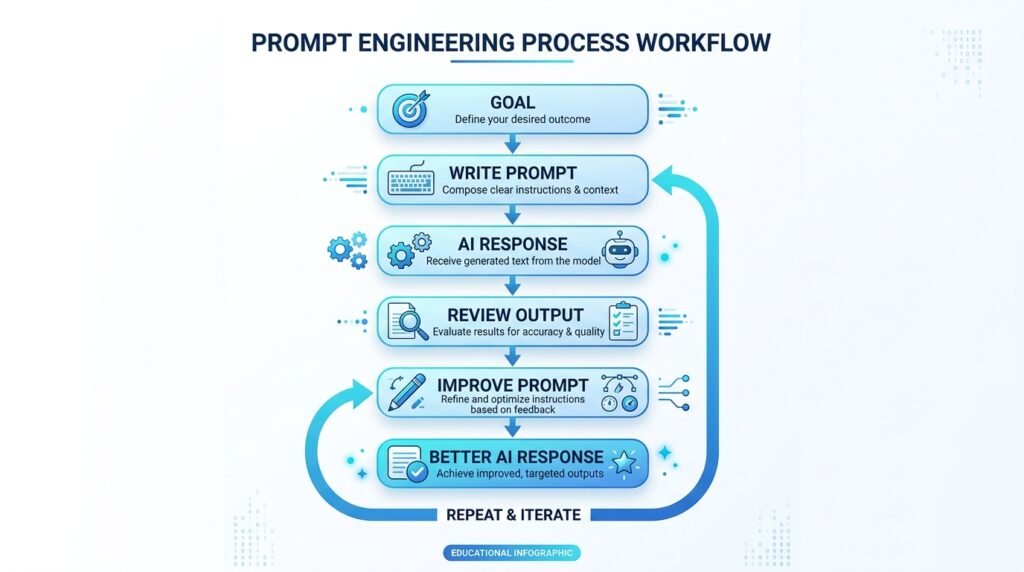
9. Refine Your Prompt Through Iteration
Prompt engineering is rarely about writing the perfect prompt on the first attempt.
Instead, treat AI as a collaborative assistant. Review the response, identify what could be improved, and refine your prompt accordingly.
This process is known as iterative prompting.
Example Workflow
First Prompt
Write an article about renewable energy.
↓
Second Prompt
Rewrite the article for beginners using simple language and include three real-world examples.
↓
Third Prompt
Add comparison tables, FAQs, and practical tips to improve readability.
Each refinement helps the AI move closer to your ideal result.
Best For
- Long-form writing
- Research
- Coding
- Business planning
- Educational content
- Creative projects
Tip: Instead of starting over, build on previous responses by asking the AI to revise, expand, simplify, or reorganize its output.
10. Combine Multiple Techniques
Experienced prompt engineers rarely rely on a single technique.
Instead, they combine several methods to create prompts that are clear, structured, and tailored to the task.
For example, a single prompt might include:
- A defined role
- Background context
- Clear instructions
- Formatting requirements
- Constraints
- Step-by-step guidance
Example Prompt
You are an experienced technology educator.
Write a beginner-friendly article explaining prompt engineering.
The audience has no prior AI experience.
Use clear headings, practical examples, a comparison table, and conclude with five key takeaways.
Keep the article between 1,200 and 1,500 words and maintain a professional yet approachable tone.
This prompt combines multiple techniques to communicate expectations clearly.
Why It Works
Rather than leaving the AI to interpret your request, you’re providing a complete set of instructions that define:
- Who the AI should be
- What it should create
- Who the audience is
- How the information should be presented
- What limitations it should follow
This approach consistently produces higher-quality results across many different AI models.
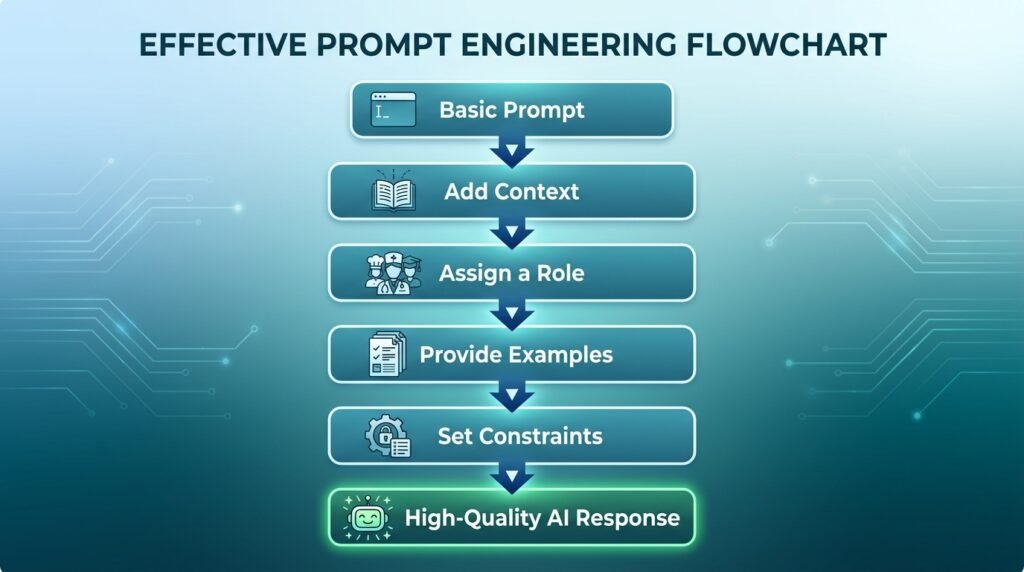
Comparison Table: Prompt Engineering Techniques
| Technique | Best For | Difficulty |
|---|---|---|
| Zero-shot | Simple questions | ⭐ |
| Few-shot | Teaching AI patterns | ⭐⭐ |
| Chain-of-Thought | Complex reasoning | ⭐⭐⭐ |
| Role Prompting | Expert responses | ⭐ |
| Step-by-Step Prompting | Multi-step tasks | ⭐⭐ |
| Constraint Prompting | Precise outputs | ⭐⭐ |
| Contextual Prompting | Personalized responses | ⭐⭐ |
| Iterative Prompting | Refining outputs | ⭐ |
| Delimiter Prompting | Structured inputs | ⭐⭐ |
| Self-Reflection Prompting | Reviewing responses | ⭐⭐⭐ |
Best Practices for Using Prompt Engineering Techniques
Learning individual prompt engineering techniques is valuable, but applying them consistently is what leads to better AI interactions. The following best practices can help you get more accurate, reliable, and useful responses across different AI models.
Many of these best practices align with recommendations from the OpenAI Prompting Guide, which emphasizes providing clear instructions, relevant context, and well-defined tasks when interacting with AI models.
1. Start with a Clear Objective
Before writing a prompt, define exactly what you want the AI to accomplish.
Ask yourself:
- What is the goal?
- Who is the intended audience?
- What should the final output look like?
Having a clear objective makes it easier to write prompts that produce relevant results.
2. Provide Sufficient Context
AI performs better when it understands the background of your request.
Instead of assuming the model knows your situation, include relevant details such as:
- Target audience
- Purpose
- Industry
- Experience level
- Desired outcome
The more relevant context you provide, the more tailored the response is likely to be.
3. Be Specific About the Format
Don’t leave the structure to chance.
If you need:
- Bullet points
- Tables
- Markdown
- JSON
- FAQs
- Step-by-step instructions
say so explicitly in your prompt.
4. Experiment and Refine
Rarely does the first prompt produce the perfect response.
Instead:
Prompt
↓
Review
↓
Improve
↓
Repeat
Small adjustments often lead to significant improvements.
5. Verify Important Information
While AI models can generate helpful content, they can also make mistakes or present outdated information.
Always verify:
- Statistics
- Legal information
- Medical advice
- Financial guidance
- Technical specifications
- Scientific claims
Prompt engineering improves communication with AI, but it doesn’t replace critical thinking or fact-checking.
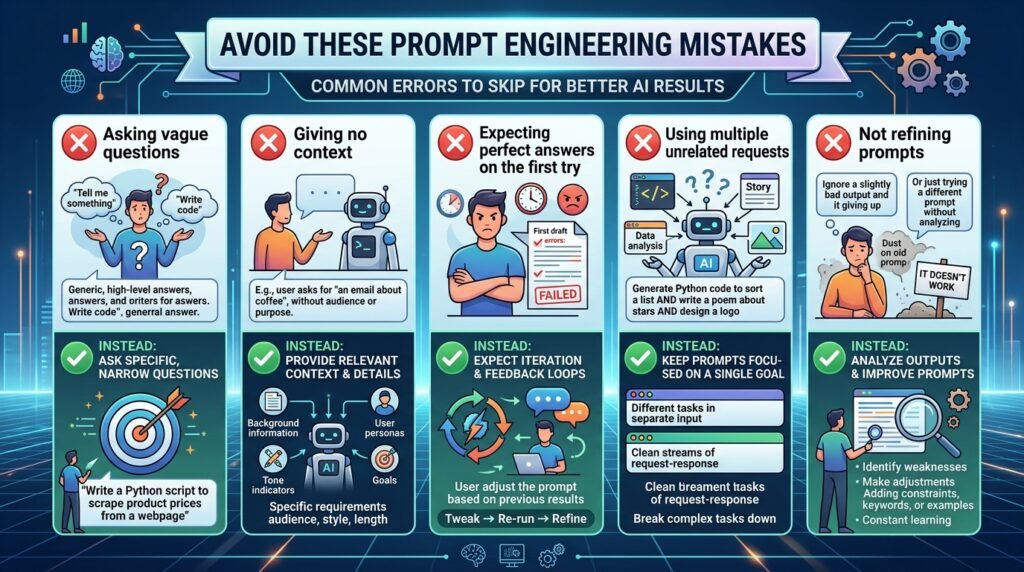
Common Mistakes to Avoid
Even experienced users occasionally write prompts that are too vague or incomplete. Avoiding these common mistakes can improve the quality of AI-generated responses.
Being Too Vague
Instead of:
Explain AI.
Try:
Explain artificial intelligence to a high school student using simple language and three real-world examples.
Asking Multiple Unrelated Questions
Instead of combining several unrelated requests into one prompt, break them into separate tasks.
This helps the AI focus and often produces more accurate responses.
Ignoring the Target Audience
The same explanation won’t work equally well for a child, a business executive, and a software engineer.
Always specify who the content is intended for.
Forgetting Output Requirements
If you need a table, checklist, or bullet list, mention it directly in your prompt.
Otherwise, the AI may choose a format that doesn’t meet your needs.
Expecting Perfect Results Immediately
Prompt engineering is an iterative process.
Treat the AI like a collaborative assistant rather than expecting flawless answers from a single prompt.
Continue Learning: Read our guide on Common Prompt Engineering Mistakes to explore these pitfalls in greater detail.
Real-World Applications of Prompt Engineering Techniques
Prompt engineering isn’t limited to developers or AI researchers. These techniques are useful in many everyday situations.
Students
Students can use prompt engineering to:
- Simplify difficult concepts
- Create study notes
- Generate quiz questions
- Practice interviews
- Summarize textbooks
Content Creators
Writers, bloggers, and marketers can:
- Generate article ideas
- Create content outlines
- Rewrite paragraphs
- Draft social media posts
- Improve headlines
Software Developers
Developers often use AI to:
- Explain code
- Generate functions
- Debug errors
- Write documentation
- Learn new programming concepts
Business Professionals
Businesses use prompt engineering for:
- Email drafting
- Meeting summaries
- Market research
- Customer support
- Workflow automation
Researchers
Researchers can use AI to:
- Summarize academic papers
- Compare concepts
- Organize information
- Generate research questions
- Brainstorm new ideas
As AI tools continue to evolve, prompt engineering is becoming a valuable skill across many professions.
Frequently Asked Questions (FAQ)
What is the most effective prompt engineering technique?
There isn’t a single technique that works best for every situation. Clear instructions, providing context, assigning roles, and refining prompts iteratively are among the most widely applicable methods. Combining several techniques often produces the best results.
Do prompt engineering techniques work with all AI models?
Most modern AI assistants—including ChatGPT, Claude, Gemini, Perplexity, and Microsoft Copilot—respond well to clear instructions, context, examples, and formatting requests. However, the quality and style of responses may vary depending on the model.
Is prompt engineering only for ChatGPT?
No. Prompt engineering principles apply to many generative AI systems, including text, image, coding, and multimodal AI models. While each tool has unique capabilities, the core techniques remain broadly useful.
What’s the difference between zero-shot and few-shot prompting?
Zero-shot prompting asks the AI to complete a task without providing examples, while few-shot prompting includes one or more examples to demonstrate the desired output. Few-shot prompting is often helpful for tasks requiring consistency or a specific format.
Can beginners learn prompt engineering?
Absolutely. Most prompt engineering techniques are based on clear communication rather than programming. With practice, anyone can learn to write better prompts and improve the quality of AI-generated responses.
Conclusion
Prompt engineering is less about finding a single “perfect” prompt and more about learning how to communicate effectively with AI. By using techniques such as giving clear instructions, providing context, assigning roles, specifying output formats, and refining your prompts over time, you can consistently achieve more accurate and useful results.
Like any skill, prompt engineering improves with practice. Start with simple techniques, experiment with different approaches, and observe how small changes influence the AI’s responses. As you become more comfortable, you’ll naturally combine multiple techniques to tackle more complex tasks.
Whether you’re using AI for learning, writing, coding, research, or business, these methods provide a strong foundation for working more effectively with today’s AI tools—and they’ll remain valuable as new models and capabilities continue to emerge.
Continue Your Learning Journey
If you’re just getting started with prompt engineering, these guides are a great next step:
- What Is Prompt Engineering? — Learn the fundamentals of communicating with AI effectively.
- How to Write Better AI Prompts — Practical tips for creating clearer and more effective prompts.
- Zero-Shot vs Few-Shot Prompting — Understand when to use examples and when they’re unnecessary.
- Prompt Templates — Reusable prompts for common AI tasks.
- Common Prompt Engineering Mistakes — Avoid the most frequent errors and improve your results.
Leave a Reply