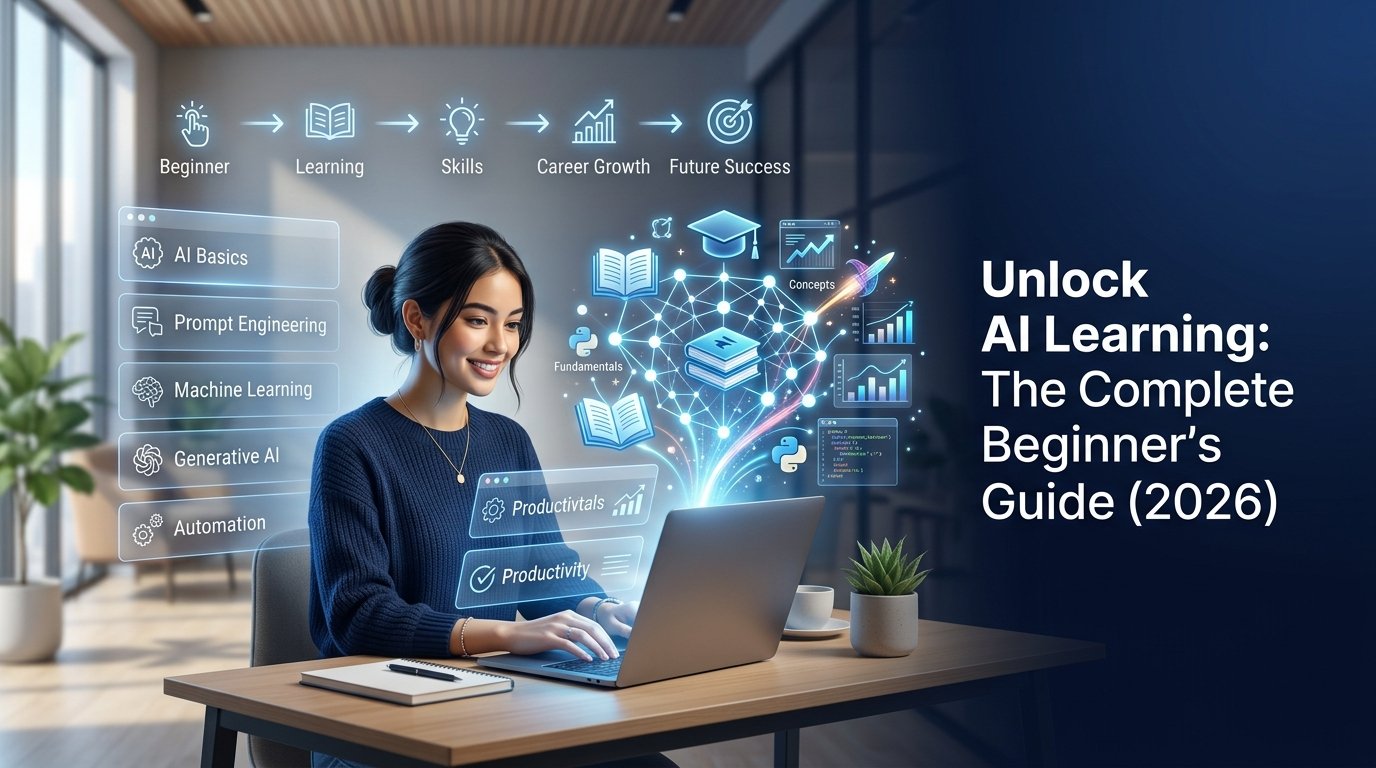
Published: July 4, 2026 | Reading Time: 13 min read
Table of Contents
Introduction
Artificial intelligence (AI) is transforming the way people work, learn, and solve everyday problems. From writing emails and analyzing data to creating images and automating repetitive tasks, AI is becoming an essential skill across industries.
The good news is that you don’t need to be a programmer or data scientist to start learning AI. Today’s AI tools are designed for beginners, making it easier than ever to build practical skills that can improve productivity, support career growth, and open new opportunities.
In this guide, you’ll learn what AI learning means, why it’s becoming an essential skill, the best ways to start learning AI, common mistakes to avoid, and practical tips to build confidence as you continue your AI journey.
If you’re new to AI, explore our AI Learning resources to build a strong foundation before moving on to advanced topics.
Key Takeaways
- AI learning is about understanding and using artificial intelligence effectively.
- You don’t need programming knowledge to begin learning AI.
- AI skills can improve productivity, creativity, decision-making, and career opportunities.
- Learning AI is an ongoing process that combines theory with practical experience.
- Responsible AI use includes verifying important information and understanding the technology’s limitations.
What Is AI Learning?
AI learning is the process of developing the knowledge and practical skills needed to understand, use, and work effectively with artificial intelligence technologies.
It goes beyond simply knowing what AI is. AI learning involves understanding how AI systems solve problems, recognizing their strengths and limitations, and learning how to apply AI tools responsibly in real-world situations.
For some people, AI learning may involve exploring concepts such as machine learning or prompt engineering. For others, it may simply mean learning how to use AI-powered applications to write documents, analyze data, create presentations, or organize daily tasks.
Think of AI learning in the same way you would learn to drive a car.
You don’t need to understand every mechanical component of the engine before you can become a safe and confident driver. Similarly, you don’t need to become an AI researcher before you can benefit from AI in your studies, career, or personal projects.
Learning AI begins with understanding the basics and gradually building confidence through regular practice.
Comparison Table
A comparison table is much more valuable than another long paragraph.
AI Learning Methods Comparison
| Learning Method | Best For | Difficulty | Cost |
|---|---|---|---|
| Reading Beginner Guides | Understanding AI concepts | Easy | Free |
| Watching Video Tutorials | Visual learners | Easy | Free/Paid |
| Using ChatGPT Daily | Practical experience | Easy | Mostly Free |
| Online AI Courses | Structured learning | Medium | Free/Paid |
| Building Small Projects | Skill development | Medium | Free |
Why AI Learning Matters Today
Artificial intelligence is reshaping many aspects of modern life, from how we communicate and learn to how businesses operate and innovate.
Organizations across industries are adopting AI-powered tools to improve efficiency, automate repetitive work, support decision-making, and enhance customer experiences. At the same time, educational institutions are introducing AI literacy into classrooms, and professionals in many fields are discovering new ways to integrate AI into their daily workflows.
This growing adoption means that AI is becoming an important digital skill rather than a niche technical subject.
Learning AI today can help you:
Improve Productivity
AI can assist with drafting emails, summarizing lengthy documents, organizing information, brainstorming ideas, and automating repetitive tasks. Learning how to use these tools effectively can save time and allow you to focus on higher-value work.
Make Better Decisions
Many Generative AI tools can analyze information, identify patterns, and present insights that support informed decision-making. While AI should not replace human judgment, it can serve as a valuable assistant when evaluating options or exploring complex topics.
Strengthen Problem-Solving Skills
Using AI effectively often involves breaking problems into smaller parts, asking clear questions, and evaluating different solutions. These habits can improve critical thinking and structured problem-solving beyond AI itself.
Prepare for Future Careers
Many employers now expect candidates to be comfortable using digital tools, including AI-powered applications. Understanding how AI fits into your profession can help you stay adaptable as workplaces continue to evolve.
Importantly, learning AI doesn’t mean replacing human expertise. Instead, it allows individuals to combine their own knowledge, creativity, and judgment with AI-assisted capabilities.
AI Learning vs. Learning to Build AI
One of the biggest misconceptions is that learning AI automatically means becoming an AI engineer.
In reality, there are different ways to engage with AI depending on your interests and goals.
| AI Learning | Learning to Build AI |
| Focuses on using AI tools effectively | Focuses on developing AI systems |
| Suitable for most people | Typically requires programming and mathematics |
| Improves productivity and digital skills | Involves machine learning, data science, and software engineering |
| Can begin with no coding experience | Often requires technical knowledge |
Most beginners benefit from learning how to use AI effectively before deciding whether they want to explore the technical side of AI development.
Who Should Learn AI?
One of the greatest strengths of AI is its broad applicability. People from many backgrounds can benefit from understanding and using AI in ways that match their personal or professional goals.
Students
AI can help explain difficult concepts, generate practice questions, summarize study materials, and support research. Used responsibly, it can complement—not replace—independent learning.
Professionals
Many workplace tasks, such as drafting reports, organizing information, preparing presentations, and brainstorming ideas, can be completed more efficiently with AI assistance.
Entrepreneurs and Small Business Owners
AI can support content creation, customer communication, marketing ideas, data analysis, and workflow automation, helping businesses save time and operate more efficiently.
Creators
Writers, designers, educators, and content creators can use AI as a collaborative tool to generate ideas, refine drafts, create visuals, and explore creative directions while maintaining their own originality and editorial judgment.
Core AI Skills Worth Learning
Learning AI isn’t about mastering everything at once. Like learning any new skill, it’s more effective to build a strong foundation before exploring advanced topics.
The following skills form a practical roadmap for beginners.
1. Understanding AI Fundamentals
Before using AI tools, it’s helpful to understand the basic concepts behind them.
Focus on learning:
- What artificial intelligence is
- How AI differs from machine learning and deep learning
- What generative AI can do
- Common AI terminology
- AI capabilities and limitations
Understanding these fundamentals makes it easier to evaluate new AI tools and recognize when they are appropriate for a particular task.
Suggested Reading:
➡ What Is Artificial Intelligence?
➡ What Is Generative AI?
➡ AI vs Machine Learning vs Deep Learning
2. Learning to Communicate with AI
Learning to communicate effectively with AI is one of the most valuable practical skills. Our Prompt Engineering Guide explains how to write clearer prompts that produce better AI responses.
Knowing how to communicate effectively with AI is one of the most valuable practical skills.
Instead of giving vague instructions, learn to:
- Define clear objectives
- Provide relevant context
- Specify your desired format
- Break complex tasks into smaller steps
- Refine prompts based on the results
These habits help AI generate responses that are more useful and relevant.
Suggested Reading:
➡ What Is Prompt Engineering?
3. Becoming Familiar with AI Tools
If you’re looking for beginner-friendly platforms, explore our curated list of the Best AI Tools for Beginners to find writing assistants, research tools, image generators, and productivity applications.
Rather than trying every tool, start with a small collection that supports common tasks.
Examples include tools for:
- Writing
- Research
- Presentations
- Coding
- Image generation
- Productivity
- Translation
- Meeting notes
Learning when—and when not—to use these tools is just as important as learning their features.
4. Evaluating AI Responses
AI can produce impressive results, but it isn’t always correct.
Develop the habit of asking:
- Is this information accurate?
- Is the source trustworthy?
- Does the answer make sense?
- Could important context be missing?
Critical thinking remains one of the most valuable skills in an AI-assisted world.
5. Using AI Responsibly
Responsible AI use includes respecting privacy, avoiding plagiarism, verifying important information, and understanding the ethical implications of AI-generated content.
Responsible users don’t simply accept AI outputs—they review, refine, and validate them before relying on them.
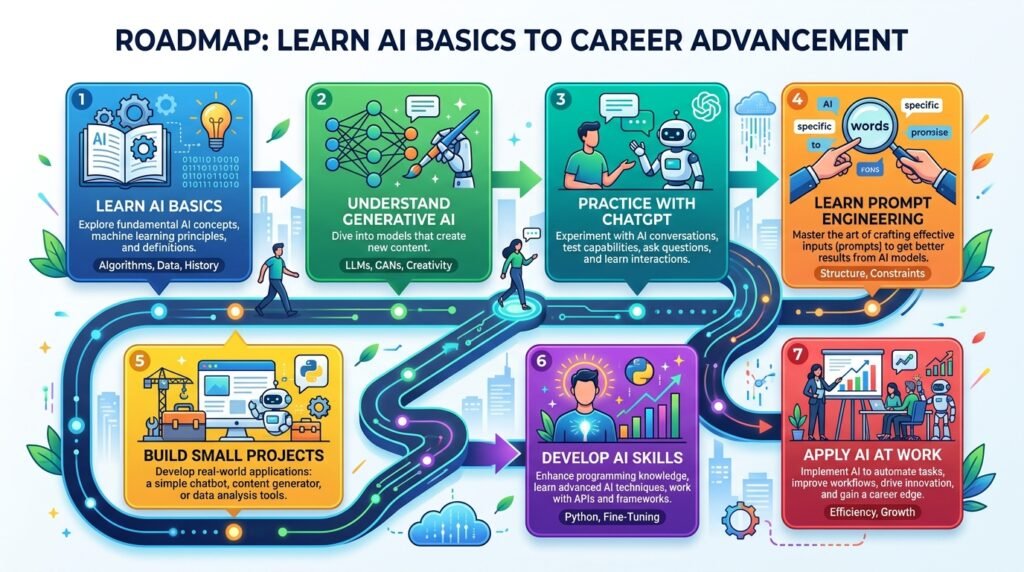
A Practical AI Learning Roadmap
Many beginners wonder where to start. While there isn’t a single correct path, the following roadmap provides a balanced progression from basic knowledge to practical application.
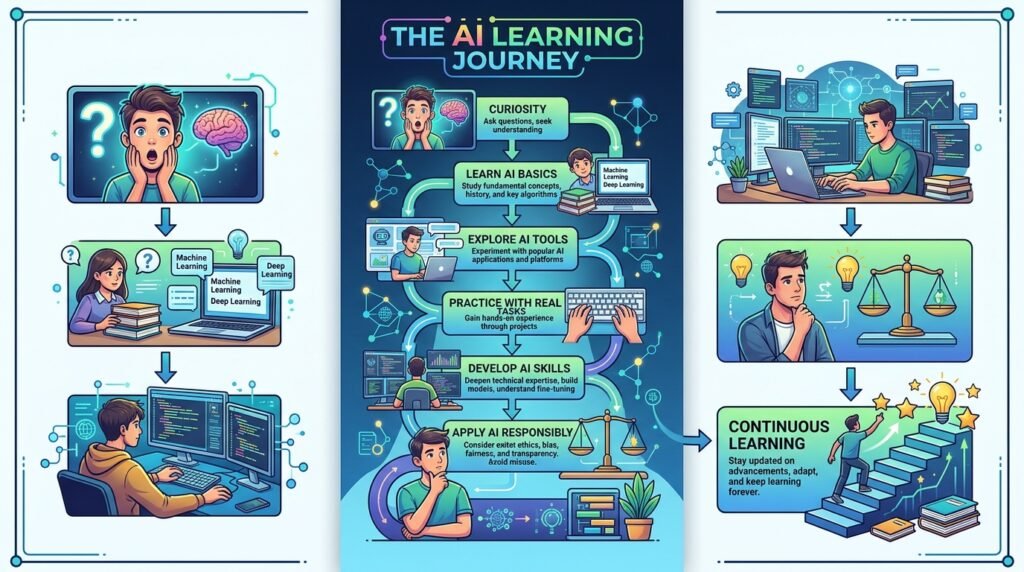
Rather than rushing through these stages, focus on building confidence at each step. AI is changing rapidly, but the ability to learn continuously is more valuable than memorizing every new feature.
Organizations such as UNESCO encourage the responsible use of AI and emphasize the importance of developing AI literacy alongside ethical awareness. Learn more through UNESCO’s AI and Education resources
The AI Skills Pyramid
Not every learner needs advanced technical knowledge. Think of AI skills as a pyramid, where each level builds on the one below it.
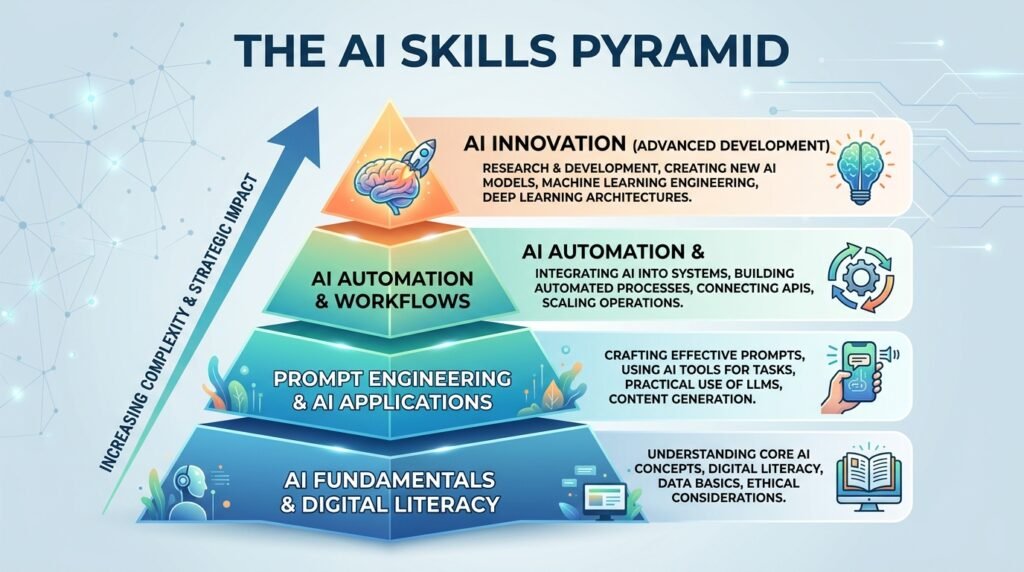
Most people gain the greatest immediate value from the lower and middle levels of the pyramid. These skills improve productivity and digital confidence without requiring programming or advanced mathematics.
How AI Supports Personal Growth
AI learning isn’t just about career advancement. It can also enhance everyday learning, creativity, and personal development.
Lifelong Learning
AI can explain complex topics in simpler language, generate quizzes, summarize books, and suggest additional learning resources.
For example, someone learning photography can ask AI to explain camera settings, recommend practice exercises, or review a shooting plan.
Creative Thinking
AI can help overcome creative blocks by generating ideas, alternative perspectives, and starting points for projects.
Writers might use AI to brainstorm article topics, while designers could explore color palettes or layout ideas.
The key is to treat AI as a creative collaborator rather than a replacement for original thinking.
Better Organization
AI-powered productivity tools can help organize notes, create schedules, summarize meetings, and prioritize tasks.
This allows individuals to spend less time on repetitive administrative work and more time on meaningful activities.
Building Confidence
As people become more comfortable using AI, they often gain confidence in experimenting with new technologies and adapting to digital change.
This mindset can make future learning easier across many fields—not just AI.
How AI Supports Professional Growth
Across many industries, AI is becoming a practical workplace assistant rather than a replacement for human expertise.
Professionals who understand how to use AI effectively can often complete routine tasks more efficiently while focusing their attention on higher-value work.
Improving Productivity
AI can assist with:
- Drafting reports
- Summarizing documents
- Creating presentations
- Organizing research
- Brainstorming ideas
- Preparing meeting notes
Used thoughtfully, these tools can reduce repetitive work without replacing human judgment.
Enhancing Communication
AI can help improve writing by suggesting clearer wording, correcting grammar, adjusting tone, and tailoring content for different audiences.
Professionals should still review and edit AI-generated text to ensure it reflects their own expertise and intent.
Supporting Better Decision-Making
Some AI tools can organize data, identify patterns, and highlight trends that might otherwise take longer to recognize.
However, important business decisions should continue to involve human oversight, experience, and domain knowledge.
Encouraging Continuous Learning
AI can act as an on-demand learning assistant by explaining unfamiliar concepts, creating personalized study plans, and recommending additional resources.
This makes professional development more accessible and flexible.
Common Challenges When Learning AI
Like any new skill, AI learning comes with challenges. Understanding these obstacles can help you overcome them more effectively.
Feeling Overwhelmed
The AI landscape evolves quickly, and new tools appear regularly.
Instead of trying to learn everything, focus on mastering a few reliable tools and building strong foundational knowledge.
Fear of Being “Too Late”
Many beginners worry that they’ve missed the opportunity to learn AI.
In reality, AI is still developing rapidly, and new applications continue to emerge. Consistent learning matters more than starting early.
Information Overload
The internet contains countless tutorials, opinions, and tool recommendations.
Choose a small number of trustworthy learning resources and build your understanding gradually instead of jumping between unrelated topics.
Expecting Instant Expertise
Learning AI is an ongoing journey rather than a one-time achievement.
Regular practice, curiosity, and continuous improvement are far more valuable than trying to become an expert overnight.
Learning AI Responsibly and Ethically
Artificial intelligence is a powerful technology, but like any tool, its impact depends on how it is used. Learning AI responsibly means understanding not only what AI can do but also where its limitations lie.
Developing responsible AI habits from the beginning will help you make better decisions and build trust in both personal and professional settings.
Protect Your Privacy
Many AI tools process information that users provide through prompts. Before sharing sensitive data, consider whether it contains personal, financial, medical, or confidential business information.
As a general rule:
- Avoid sharing passwords or authentication codes.
- Don’t upload confidential company documents without permission.
- Be cautious when entering personally identifiable information.
Understanding the privacy policies of the AI tools you use is an important part of responsible AI use.
Verify Important Information
AI systems can occasionally generate inaccurate or outdated information. This phenomenon is sometimes referred to as an AI hallucination, where the model produces content that sounds convincing but is factually incorrect.
For important topics—such as health, legal matters, finance, or safety—always verify information using reliable and authoritative sources.
Think of AI as an assistant that helps you work more efficiently, not as the final authority on every subject.
Respect Copyright and Originality
AI can assist with brainstorming, outlining, and drafting ideas, but it should not replace your own creativity or critical thinking.
Whenever you publish content, create designs, or produce professional work, review and refine AI-generated material so that the final result reflects your own knowledge, experience, and perspective.
Original work builds trust with your audience and helps maintain high-quality standards.
Continue Developing Human Skills
As AI becomes more capable, uniquely human abilities remain just as valuable.
These include:
- Critical thinking
- Creativity
- Emotional intelligence
- Ethical decision-making
- Communication
- Collaboration
- Leadership
Learning AI should complement these skills—not replace them.
Myth vs. Reality
Artificial intelligence is surrounded by excitement, but also by misconceptions. Understanding the difference between perception and reality can help you approach AI with realistic expectations.
| Myth | Reality |
| AI will replace every job. | AI is more likely to automate specific tasks while creating new roles and changing existing workflows. |
| You must learn programming before learning AI. | Many people begin by using AI tools without writing any code. |
| AI always provides correct answers. | AI can make mistakes and should be used alongside human judgment and fact-checking. |
| Learning AI is only for technology professionals. | Students, educators, creators, business owners, and professionals across industries can all benefit from AI literacy. |
| AI learning ends after completing a course. | AI evolves continuously, making lifelong learning an important part of staying up to date. |
The Future of AI Learning
According to the World Economic Forum, AI-related skills are expected to play an increasingly important role in the future workforce. The Future of Jobs Report provides a broader perspective on emerging workplace trends.
Artificial intelligence is evolving rapidly, and the way people learn AI is evolving with it.
In the coming years, AI learning is likely to become more personalized, interactive, and integrated into everyday education and work. Instead of studying AI as a separate subject, people may use AI-powered assistants to learn languages, analyze data, improve writing, develop software, and solve real-world problems as part of their daily routines.
This doesn’t mean everyone needs to become an AI engineer.
For most individuals, success will come from understanding how to collaborate effectively with AI while continuing to develop the uniquely human skills that technology cannot replace.
The ability to adapt, ask thoughtful questions, evaluate information critically, and learn continuously will become increasingly valuable in an AI-driven world.
Recommended AI Tools
Want to put your AI skills into practice?
Explore our curated collection of beginner-friendly AI tools to discover platforms for writing, research, design, coding, and productivity.
Frequently Asked Questions
Is AI learning difficult for beginners?
Not necessarily. Many AI tools are designed for everyday users and require no programming knowledge. Starting with the fundamentals and practicing with beginner-friendly tools can make the learning process approachable and enjoyable.
Do I need coding skills to learn AI?
No. While programming is useful for building AI systems, many people learn AI by understanding the concepts and using AI-powered applications in their studies, work, or personal projects.
How long does it take to learn AI?
The answer depends on your goals. Learning the basics may take a few weeks of consistent practice, while developing advanced technical skills can take months or years. Focus on steady progress rather than trying to learn everything at once.
Which AI tools should beginners start with?
Many beginners start with conversational AI assistants, writing tools, productivity applications, and research assistants. Choose a few reliable tools that match your goals and spend time learning how to use them effectively instead of trying every new platform.
Can AI help with career growth?
Yes. AI can improve productivity, support learning, streamline routine tasks, and help professionals develop valuable digital skills. While AI is unlikely to replace the need for human expertise, understanding how to use AI effectively is becoming increasingly valuable across many industries.
Will AI replace the need to learn new skills?
No. AI can accelerate learning and assist with many tasks, but human judgment, creativity, communication, and problem-solving remain essential. AI works best when combined with strong foundational skills and continuous learning.
Conclusion
Artificial intelligence is changing the way we learn, work, create, and solve problems. Yet the greatest advantage doesn’t come from simply having access to AI—it comes from knowing how to use it thoughtfully and effectively.
AI learning is not about becoming an expert overnight or mastering every new tool that appears. It’s about building a solid understanding of AI fundamentals, developing practical skills through regular use, and learning how to evaluate AI-generated information responsibly.
Whether you’re a student preparing for future opportunities, a professional looking to improve productivity, an entrepreneur exploring innovation, or someone who simply enjoys learning new technologies, AI literacy is becoming an increasingly valuable skill.
The journey doesn’t end after reading one guide or experimenting with a few tools. Like any meaningful skill, AI learning grows through curiosity, practice, and continuous improvement.
Start with the basics, apply what you learn to real-world tasks, ask better questions, and stay open to new developments. Over time, you’ll gain the confidence to use AI not just as a tool, but as a practical partner that supports your personal and professional growth.
Key Takeaways
AI learning is a journey, not a destination. By understanding the fundamentals, practicing with purpose, and using AI responsibly, you can develop future-ready skills that enhance productivity, creativity, and lifelong learning.
Continue Learning
If you’re just starting your AI journey, these beginner-friendly guides can help you build a stronger foundation:
- What Is Artificial Intelligence?
- What Is Generative AI?
- What Is ChatGPT?
- What Is Prompt Engineering?
- AI Skills Development
Related Articles
You may also enjoy:
- AI vs Machine Learning vs Deep Learning
- Types of Artificial Intelligence
- What Are AI Agents?
- Prompt Engineering Techniques
Keep Learning” note:
AI is evolving quickly, so treat learning as an ongoing process rather than a one-time goal. Regularly practicing with trusted AI tools, experimenting with new techniques, and following reputable educational resources will help you build lasting confidence and stay current as the technology advances.

Leave a Reply