
🕒 12-14 min read • Updated: July 2026
Table of Contents
introduction
Artificial Intelligence (AI) is transforming Human Resources (HR) by helping organizations hire faster, improve employee experiences, automate repetitive tasks, and make smarter workforce decisions. From resume screening and interview scheduling to personalized employee training and predictive workforce analytics, AI is becoming an essential part of modern HR.
Whether you’re an HR professional, business owner, student, or simply curious about how AI is changing the workplace, understanding AI’s role in Human Resources is becoming increasingly valuable.
In this beginner-friendly guide, you’ll learn what AI in Human Resources is, how it works, its biggest benefits and challenges, real-world examples, and the best practices organizations use to implement AI responsibly.
Quick Answer
AI in Human Resources (AI in HR) is the use of artificial intelligence to automate and improve HR tasks such as recruitment, resume screening, interview scheduling, employee onboarding, performance management, workforce planning, and employee engagement. Rather than replacing HR professionals, AI helps them make faster, more informed decisions while reducing repetitive administrative work.
Key Takeaways
- AI helps HR teams automate repetitive administrative tasks.
- Recruiters can identify qualified candidates faster using AI-powered screening.
- AI improves employee onboarding, learning, and engagement through personalized experiences.
- Workforce analytics help organizations make data-driven HR decisions.
- Human judgment remains essential for hiring, leadership, and ethical decision-making.
What Is AI in Human Resources?
Artificial Intelligence in Human Resources refers to the use of AI technologies to support and improve the way organizations recruit, manage, develop, and retain employees.
Traditional HR software stores employee information and automates routine processes. AI-powered HR systems go a step further by analyzing data, recognizing patterns, making predictions, and recommending actions that help HR professionals work more efficiently.
For example, instead of manually reviewing hundreds of resumes, an AI system can identify candidates whose skills and experience closely match the job requirements, allowing recruiters to focus on interviewing the most promising applicants.
AI also assists with employee onboarding, learning recommendations, workforce planning, performance insights, and answering common employee questions through AI-powered chatbots.
Ultimately, AI acts as a decision-support tool rather than a replacement for HR professionals.
Why Is AI Becoming Important in Human Resources?
Modern HR departments face several challenges:
- Increasing numbers of job applications
- Growing administrative workloads
- Skills shortages
- Employee retention
- Personalized learning needs
- Remote and hybrid work environments
AI helps organizations address these challenges by reducing manual work and providing faster, data-driven insights.
Instead of spending hours on repetitive administrative tasks, HR professionals can dedicate more time to strategic initiatives such as employee development, culture building, and leadership.
How AI Works in Human Resources
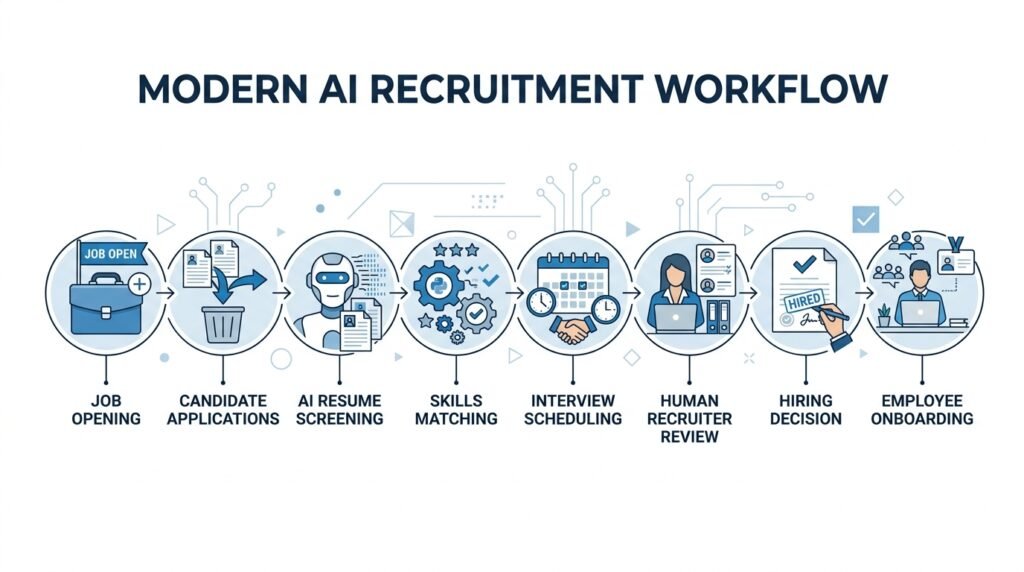
A simplified AI-powered HR workflow looks like this:
- A company publishes a job opening.
- Candidates submit applications.
- AI analyzes resumes based on predefined criteria.
- Qualified candidates are shortlisted.
- Interviews are scheduled automatically.
- HR professionals evaluate candidates and make hiring decisions.
- AI supports onboarding and training.
- Workforce analytics help improve long-term HR strategies.
Although AI assists throughout the process, final decisions remain the responsibility of human HR professionals.
Benefits of AI in Human Resources
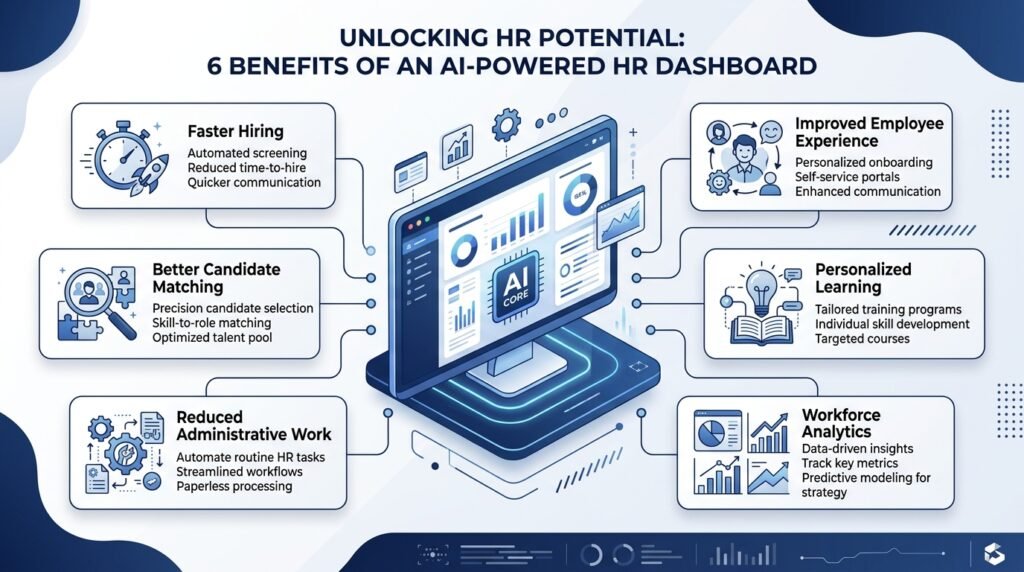
Faster Recruitment
Hiring is one of the most time-consuming responsibilities for HR teams. AI significantly speeds up the recruitment process by automatically reviewing applications, identifying qualified candidates, and reducing the time required for initial screening.
Instead of manually reading hundreds of resumes, recruiters can quickly focus on candidates who best match the job requirements.
Improved Candidate Matching
AI systems can compare a candidate’s qualifications, skills, certifications, and experience with job descriptions to identify strong matches.
This allows recruiters to spend less time filtering applications and more time evaluating candidates through interviews and assessments.
Reduced Administrative Work
Many routine HR tasks can be automated using AI, including:
- Resume screening
- Interview scheduling
- Document processing
- Leave requests
- Employee FAQs
- HR reporting
This reduces repetitive work and allows HR professionals to focus on higher-value activities.
Better Employee Onboarding
Starting a new job often involves paperwork, training, and answering common questions.
AI-powered assistants can guide new employees through onboarding by providing instant answers, recommending training resources, and helping them complete required documentation.
A smoother onboarding experience helps employees become productive more quickly.
Personalized Learning and Development
Every employee learns differently.
AI can recommend personalized training programs based on an employee’s role, current skills, career goals, and previous learning history.
This creates more effective learning experiences while supporting continuous professional development.
Workforce Analytics
AI can analyze large amounts of workforce data to identify trends that would be difficult to detect manually.
For example, organizations can use AI to:
- Predict employee turnover
- Identify skill gaps
- Measure employee engagement
- Forecast hiring needs
- Support succession planning
These insights help HR leaders make better strategic decisions.
Traditional HR vs AI-Powered HR
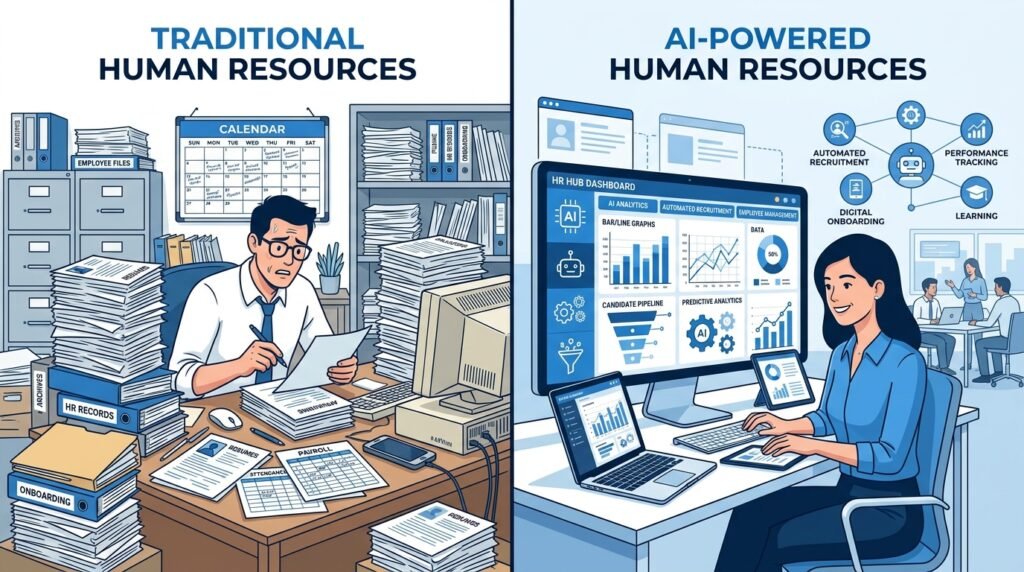
| Traditional HR | AI-Powered HR |
| Manual resume screening | Automated candidate screening |
| Manual interview scheduling | AI-assisted scheduling |
| Generic employee training | Personalized learning recommendations |
| Reactive workforce planning | Predictive workforce analytics |
| Time-consuming reporting | Real-time dashboards and insights |
| Repetitive administrative tasks | Automated workflows |
Real-World Applications of AI in Human Resources
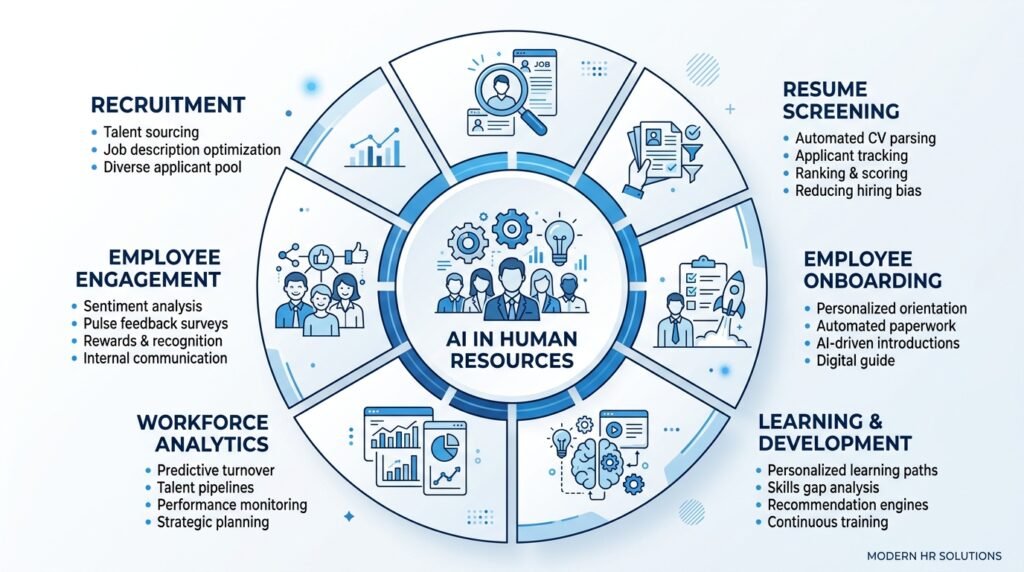
AI Recruitment
Recruiters use AI to analyze resumes, identify qualified candidates, rank applicants, and reduce hiring time.
Example:
A company receives 2,000 applications for a software engineering position. AI identifies the candidates who meet the required qualifications, allowing recruiters to review a much smaller shortlist.
Employee Onboarding
AI-powered chatbots help new employees complete onboarding tasks by answering questions about company policies, benefits, training, and required documents.
This improves the onboarding experience while reducing repetitive work for HR teams.
Employee Performance Management
Organizations use AI to analyze employee performance trends, identify strengths, and recommend personalized development opportunities.
Managers can use these insights to support employee growth rather than relying solely on annual performance reviews.
Learning and Development
AI recommends learning resources based on an employee’s skills, career goals, and previous training.
For example, an employee interested in project management may receive recommendations for leadership courses and relevant certifications.
Employee Engagement
AI can analyze employee surveys and feedback to identify workplace trends, helping HR teams improve employee satisfaction and retention.
Rather than waiting until employees resign, organizations can proactively identify areas that need attention.
Workforce Planning
AI helps organizations forecast hiring needs, identify future skill shortages, and plan workforce development strategies based on business goals.
This enables more informed long-term planning.
Real-World Examples of AI in Human Resources
Many organizations already use AI to streamline HR operations, improve hiring, and create better employee experiences. Here are a few well-known examples.
LinkedIn uses AI to recommend jobs to job seekers and suggest suitable candidates to recruiters based on skills, experience, location, and career interests.
Its AI-powered recommendations help recruiters discover qualified talent more efficiently while helping candidates find relevant opportunities.
Workday
Workday integrates AI into its Human Capital Management (HCM) platform to assist with workforce planning, talent management, skills analysis, and employee development.
Organizations use Workday’s AI capabilities to identify workforce trends and make data-driven HR decisions.
SAP SuccessFactors
SAP SuccessFactors uses AI to personalize employee learning, improve recruiting, and provide intelligent recommendations throughout the employee lifecycle.
The platform helps HR teams automate repetitive processes while supporting employee growth and engagement.
Microsoft
Microsoft incorporates AI across its workplace productivity ecosystem through tools like Microsoft Copilot.
These AI assistants help employees summarize meetings, draft documents, organize information, and improve productivity, reducing the administrative burden across departments, including HR.
Unilever
Unilever has adopted AI in parts of its recruitment process to assess applications, support candidate screening, and improve hiring efficiency. Human recruiters remain responsible for final hiring decisions, while AI helps reduce manual workload and accelerate early-stage evaluations.
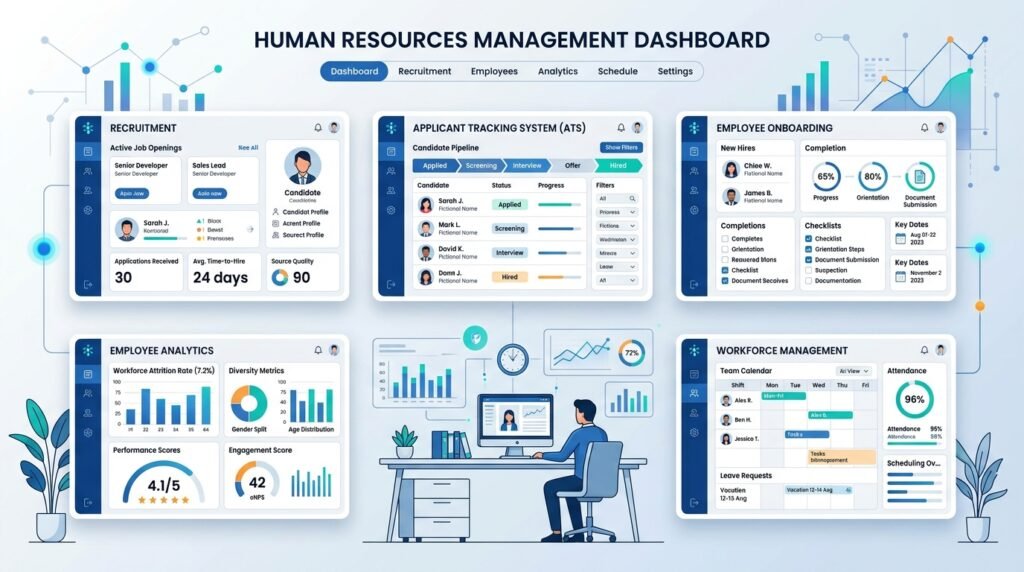
Best AI Tools for Human Resources
Choosing the right AI tool depends on your organization’s size, hiring needs, and HR processes. Here are some widely used AI-powered HR platforms.
| AI Tool | Best For | Key Features |
| LinkedIn Recruiter | Talent Acquisition | Candidate recommendations, recruiter search |
| Workday | Enterprise HR | Workforce analytics, HR management |
| SAP SuccessFactors | Talent Management | Learning, recruiting, employee experience |
| BambooHR | Small & Medium Businesses | Employee records, onboarding, HR workflows |
| HireVue | Recruitment | AI-assisted interviews and assessments |
| Eightfold AI | Talent Intelligence | Skills matching, internal mobility |
| Paradox (Olivia) | HR Chatbot | Candidate communication, interview scheduling |
Recommended Reading: If you’re new to AI software, explore our guide to the 25 Best AI Tools for Beginners to discover beginner-friendly tools beyond HR.
Challenges of AI in Human Resources
Although AI offers many advantages, it also presents challenges that organizations should address carefully.
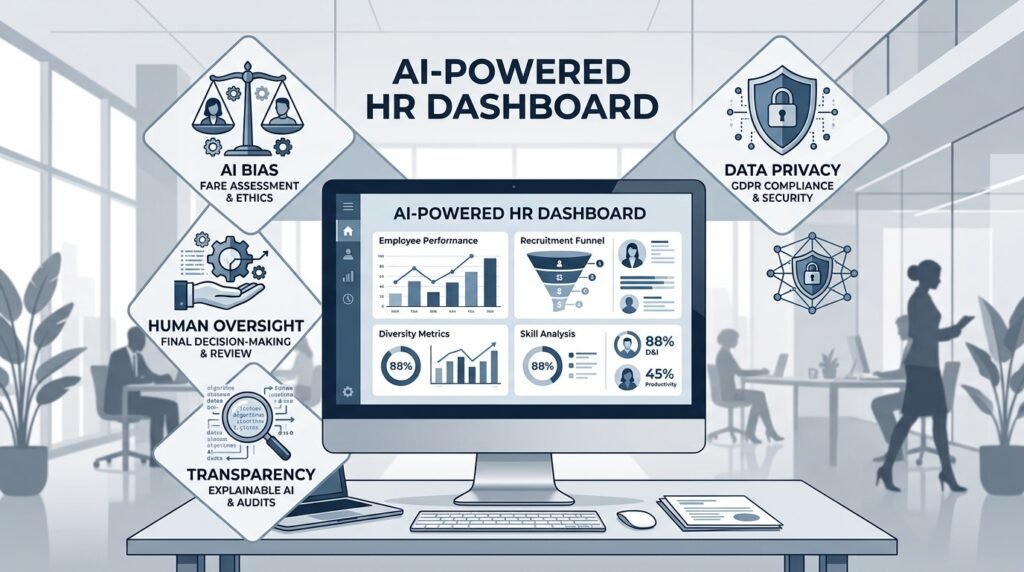
Bias in AI Models
AI systems learn from historical data. If that data contains bias, AI recommendations may unintentionally reflect those patterns.
Organizations should regularly audit AI systems to ensure hiring decisions remain fair and inclusive.
Data Privacy
HR departments manage highly sensitive employee information.
Organizations must protect personal data, follow privacy regulations, and ensure AI systems use employee information responsibly.
Lack of Human Judgment
AI can analyze data quickly, but it cannot fully understand qualities such as empathy, cultural fit, leadership potential, or emotional intelligence.
Human oversight remains essential for hiring and employee management decisions.
Over-Reliance on Automation
AI should support HR professionals—not replace critical thinking.
Blindly accepting AI recommendations without review may lead to poor hiring decisions or unintended consequences.
Employee Trust
Employees may feel uncomfortable if AI systems are used without transparency.
Organizations should clearly communicate how AI is used, what data is collected, and how decisions are made.
Best Practices for Using AI in Human Resources
Organizations can maximize the benefits of AI by following these best practices:
Use AI as a Decision Support Tool
Allow AI to automate repetitive tasks while keeping final decisions in the hands of experienced HR professionals.
Review AI Recommendations Regularly
Monitor AI-generated recommendations to identify potential inaccuracies or unintended bias.
Regular reviews help maintain fairness and improve long-term performance.
Protect Employee Data
Implement strong cybersecurity measures and comply with applicable privacy regulations to safeguard employee information.
Train HR Teams
HR professionals should understand both the capabilities and limitations of AI.
Training helps teams use AI effectively while maintaining ethical standards.
Maintain Transparency
Explain to employees and job applicants when AI is used during recruitment or workforce management.
Transparency builds trust and supports responsible AI adoption.
The Future of AI in Human Resources
AI is expected to play an even greater role in HR over the coming years.
Future developments may include:
- Skills-based hiring powered by AI
- Predictive workforce planning
- Personalized career development recommendations
- AI-powered internal career coaching
- Smarter employee engagement analysis
- More advanced HR assistants capable of handling routine employee requests
Rather than replacing HR professionals, these technologies are likely to help them focus on leadership, strategic planning, employee well-being, and organizational culture.
As AI continues to evolve, organizations that combine intelligent automation with human expertise will be better positioned to attract, develop, and retain top talent.
Frequently Asked Questions (FAQs)
Will AI replace Human Resources professionals?
No. AI is designed to assist HR professionals by automating repetitive administrative tasks and providing useful insights. Human judgment remains essential for hiring decisions, employee relations, conflict resolution, and organizational leadership.
How is AI used in recruitment?
AI helps recruiters screen resumes, match candidates to job descriptions, schedule interviews, communicate with applicants, and identify hiring trends more efficiently.
Is AI in HR safe?
AI can be used responsibly when organizations protect employee data, monitor AI systems for bias, maintain transparency, and ensure that important decisions involve human oversight.
What are the biggest benefits of AI in Human Resources?
Some of the most significant benefits include faster recruitment, reduced administrative workload, personalized employee learning, improved workforce planning, better employee engagement, and data-driven decision-making.
Can small businesses use AI for HR?
Yes. Many modern HR platforms offer AI-powered features suitable for startups and small businesses, including applicant tracking, onboarding automation, employee record management, and AI-assisted recruitment.
Conclusion
Artificial Intelligence is reshaping Human Resources by helping organizations recruit more efficiently, improve employee experiences, and make better workforce decisions. From resume screening and onboarding to workforce analytics and personalized learning, AI enables HR teams to automate repetitive tasks while focusing on the human aspects of their role.
However, successful HR will never rely on technology alone. The most effective organizations combine AI’s speed and analytical capabilities with human empathy, ethical judgment, and strategic thinking. By using AI responsibly and transparently, businesses can create workplaces that are more productive, inclusive, and prepared for the future of work.
Continue Learning
Expand your understanding of AI with these beginner-friendly guides:
- What Is Artificial Intelligence?
- What Is Generative AI?
- How Does ChatGPT Work?
- AI in Business
- AI in Education
Related Articles
- 25 Best AI Tools for Beginners
- What Is Prompt Engineering?
- How to Write Better AI Prompts
- AI Skills Development
- AI in Finance
References
- https://www.shrm.org/
- https://www.weforum.org/topics/artificial-intelligence/
- https://www.mckinsey.com/capabilities/quantumblack/our-insights/the-state-of-ai
- https://www.ibm.com/think/topics/artificial-intelligence-hr
- https://business.linkedin.com/talent-solutions
- https://www.workday.com/
- https://www.sap.com/products/hcm.html
- https://www.microsoft.com/ai
Leave a Reply