
🕒 15 min read • Updated: July 2026
Table of Contents
Introduction
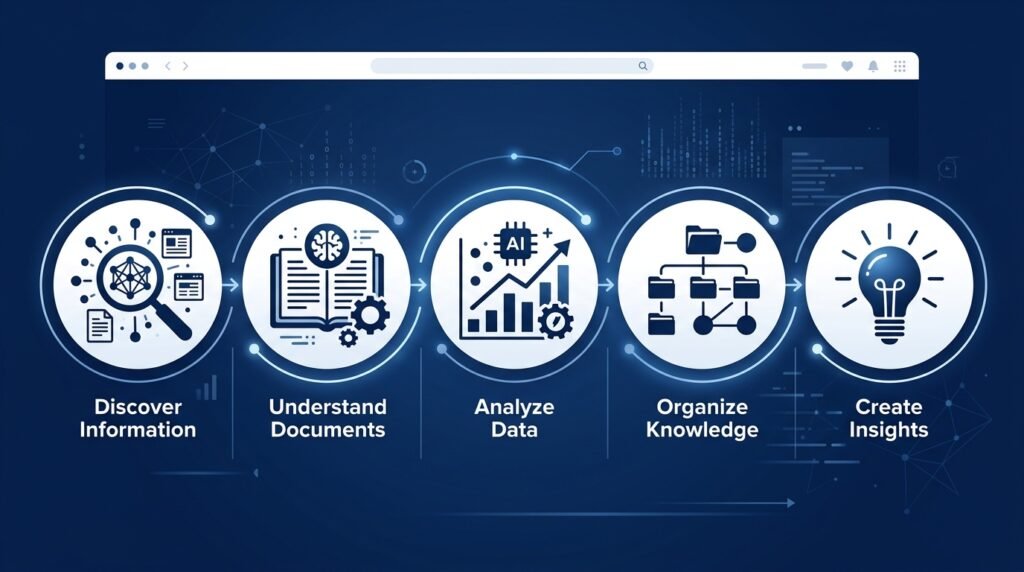
Research has always been about discovering new information, asking better questions, and transforming knowledge into meaningful insights.
Whether you are a student writing an assignment, a professional preparing a report, or a researcher exploring a complex topic, the process usually follows the same pattern:
Find information.
Understand it.
Analyze it.
Create something valuable from it.
However, research today has become increasingly difficult.
The amount of available information is growing faster than humans can manually process. Millions of academic papers, articles, datasets, reports, and online resources are published every year.
The challenge is no longer only finding information.
The challenge is finding the right information, understanding it quickly, and using it effectively.
This is where AI for research is transforming the way people learn and work.
Artificial intelligence tools can now help researchers:
- discover relevant sources faster
- summarize complex information
- analyze documents
- organize research notes
- identify patterns
- generate new ideas
- improve research workflows
But AI does not replace the researcher.
The most effective approach is to use AI as an intelligent research assistant — a tool that enhances human thinking rather than replacing it.
A researcher who knows how to use AI effectively can spend less time on repetitive tasks and more time on what matters most:
- asking better questions
- evaluating information
- developing insights
- creating new knowledge
In this guide, you will learn what AI for research means, how AI tools can support different stages of research, the best practices for using AI responsibly, and how beginners can build an AI-powered research workflow.
Key Takeaways
- AI for research helps people find, understand, organize, and analyze information faster.
- AI research tools can assist with literature reviews, summaries, brainstorming, and data analysis.
- AI should support human reasoning, not replace critical thinking.
- The quality of AI results depends heavily on the quality of instructions and questions.
- Researchers who combine AI skills with domain expertise will have a significant advantage in the future.
What Is AI for Research?
AI for research refers to using artificial intelligence technologies to support and improve different stages of the research process.
Traditionally, research required significant manual effort:
- searching through databases
- reading large amounts of information
- organizing notes
- comparing different sources
- identifying patterns
- writing summaries
AI changes this process by helping automate repetitive tasks and assisting with information processing.
A simple way to understand AI-assisted research is:
AI helps researchers move faster from information collection to meaningful understanding.
For example, imagine a student researching:
“How is artificial intelligence changing education?”
Without AI, the student might:
- Search dozens of websites.
- Read multiple articles.
- Take notes manually.
- Compare different viewpoints.
- Create an outline.
With AI assistance, the student can:
- Ask AI to explain the topic.
- Identify important concepts.
- Summarize research papers.
- Organize themes.
- Create a research structure.
However, the student still needs to:
- verify sources
- evaluate arguments
- form conclusions
AI accelerates the process, but humans provide understanding.
How AI Is Changing the Research Process
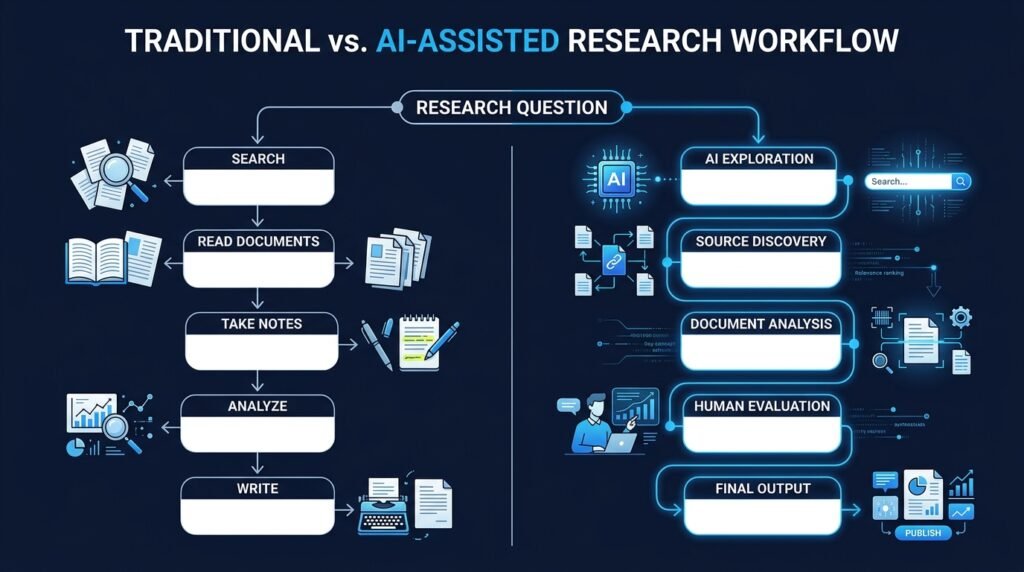
The traditional research workflow looks like this:
Research Question
↓
Information Search
↓
Reading Sources
↓
Taking Notes
↓
Analysis
↓
Writing
↓
Final Output
An AI-enhanced research workflow looks like this:
Research Question
↓
AI-Assisted Exploration
↓
Source Discovery
↓
Document Analysis
↓
Knowledge Organization
↓
Human Evaluation
↓
Final Output
The difference is not that AI replaces research.
The difference is that AI reduces friction.
Researchers can spend more time thinking and less time performing repetitive information-processing tasks.
1. AI Helps Researchers Discover Information Faster
One of the most time-consuming parts of research is finding relevant information.
A researcher often begins with a broad question:
“How does AI impact healthcare?”
This simple question can lead to thousands of possible directions:
- medical diagnosis
- drug discovery
- patient monitoring
- healthcare automation
- ethical concerns
- data privacy
Finding the right information requires narrowing the topic.
AI tools can help researchers explore a subject by:
- explaining important concepts
- suggesting related topics
- identifying keywords
- highlighting major themes
- creating research directions
For example:
Instead of searching:
“AI healthcare”
A researcher can ask:
“Explain the major applications of artificial intelligence in healthcare, including examples, benefits, challenges, and current research areas.”
The AI response can provide a starting map of the field.
This helps researchers understand:
- where to begin
- which questions matter
- what information they need next
Example: Using AI for Topic Exploration
Imagine a beginner wants to research renewable energy.
A traditional search approach:
Search:
“renewable energy”
The results may include:
- solar energy
- wind power
- batteries
- government policies
- climate science
- economics
The researcher may feel overwhelmed.
An AI-assisted approach:
Prompt:
“I am a beginner researching renewable energy. Explain the major areas of study, important concepts, and questions researchers are currently exploring.”
The AI can create a structured overview:
Renewable Energy Research Areas
Technology
- Solar panels
- Wind turbines
- Energy storage
Economics
- Cost reduction
- Market adoption
- Investment
Policy
- Government incentives
- Regulations
Environmental Impact
- Carbon reduction
- Sustainability
The researcher now has a clearer roadmap.
2. AI Makes Understanding Complex Information Easier
Modern research often involves highly technical information.
Academic papers, scientific studies, and industry reports can contain:
- complex terminology
- statistical analysis
- specialized concepts
AI tools can help simplify difficult material.
For example, a researcher reading a technical paper can ask:
“Explain this research paper as if I am a beginner.”
or:
“Summarize the main findings, methodology, and limitations of this study.”
AI can help transform complex information into easier explanations.
This is especially useful for:
- students learning new subjects
- professionals entering new industries
- researchers exploring unfamiliar fields
Important: AI Summaries Should Not Replace Original Sources
While AI summaries are useful, researchers should not depend on them blindly.
A summary may miss:
- important details
- limitations
- context
- conflicting viewpoints
A strong research process uses AI as the first layer of understanding.
The original source remains the final authority.
A good approach:
AI Summary
↓
Read Original Source
↓
Verify Information
↓
Develop Your Own Analysis
3. AI Can Support Literature Reviews
A literature review is one of the most important parts of academic research.
It involves studying existing knowledge about a topic.
Researchers usually need to:
- find previous studies
- identify common themes
- compare different findings
- understand research gaps
For beginners, literature reviews can feel overwhelming because they require analyzing many sources together.
AI can assist by helping organize information.
For example, a researcher studying:
“The impact of AI on education”
may collect dozens of papers.
AI can help categorize them into themes:
| Research Theme | Example Questions |
| Student Learning | Does AI improve learning outcomes? |
| Teacher Support | How can educators use AI tools? |
| Accessibility | Can AI improve educational access? |
| Ethics | What risks should schools consider? |
This does not replace the researcher’s interpretation.
Instead, it creates a clearer structure for deeper analysis.
4. AI Can Assist With Data Analysis
Research is not only about collecting information.
The real value comes from analyzing information and discovering meaningful patterns.
Traditionally, researchers spend significant time working with:
- spreadsheets
- survey responses
- datasets
- interview transcripts
- experimental results
AI can help researchers process and understand large amounts of information more efficiently.
AI in Qualitative Research
Qualitative research focuses on understanding ideas, experiences, and opinions.
Examples include:
- interviews
- surveys with open-ended responses
- customer feedback
- historical documents
- social research
AI tools can help identify:
- recurring themes
- common opinions
- important statements
- relationships between ideas
For example, a researcher analyzing 500 customer reviews might ask AI:
“Analyze these reviews and identify the five most common customer complaints and satisfaction drivers.”
The AI can help organize responses into categories such as:
| Theme | Examples |
| Product Quality | Durability, reliability, performance |
| Customer Service | Response time, support experience |
| Pricing | Value perception, affordability |
| User Experience | Ease of use, design |
The researcher can then investigate these themes more deeply.
AI in Quantitative Research
Quantitative research involves numerical data.
Examples:
- surveys
- financial data
- experiments
- statistical studies
AI can assist researchers by helping:
- explain datasets
- identify trends
- suggest possible relationships
- generate analytical questions
For example:
A business researcher analyzing sales data may ask:
“What patterns should I investigate in this dataset?”
AI might suggest exploring:
- seasonal trends
- customer segments
- purchasing behavior
- regional differences
However, researchers must remember:
AI can identify patterns, but identifying whether those patterns are meaningful requires human expertise.
5. AI Helps Researchers Generate Better Ideas
Research begins with curiosity.
But sometimes the hardest part is deciding:
- What should I study?
- What questions should I ask?
- What perspective should I explore?
AI can act as a brainstorming partner.
It can help researchers:
- explore possibilities
- challenge assumptions
- create research questions
- identify unexplored areas
For example:
A student interested in artificial intelligence might ask:
“Suggest 15 research questions about the impact of AI on workplace productivity. Include possible research methods.”
AI may generate ideas such as:
- How does AI adoption affect employee efficiency?
- What skills do workers need in AI-assisted workplaces?
- Does AI improve decision-making quality?
The researcher can then evaluate which questions are worth exploring.
6. AI Improves Research Writing and Communication
Research is not complete until ideas can be communicated clearly.
Even strong research can lose impact if it is poorly presented.
AI can support researchers with:
- improving sentence clarity
- organizing arguments
- creating outlines
- simplifying explanations
- improving readability
For example:
A researcher may write:
“The implementation of artificial intelligence technologies demonstrates significant implications regarding organizational operational efficiencies.”
AI can help make it clearer:
“Using artificial intelligence can significantly improve how organizations operate.”
The goal is not to make writing sound artificial.
The goal is to make complex ideas easier for people to understand.
Best AI Tools for Research
Different AI tools support different parts of the research process.
There is no single “best” AI research tool.
The right choice depends on the research goal.
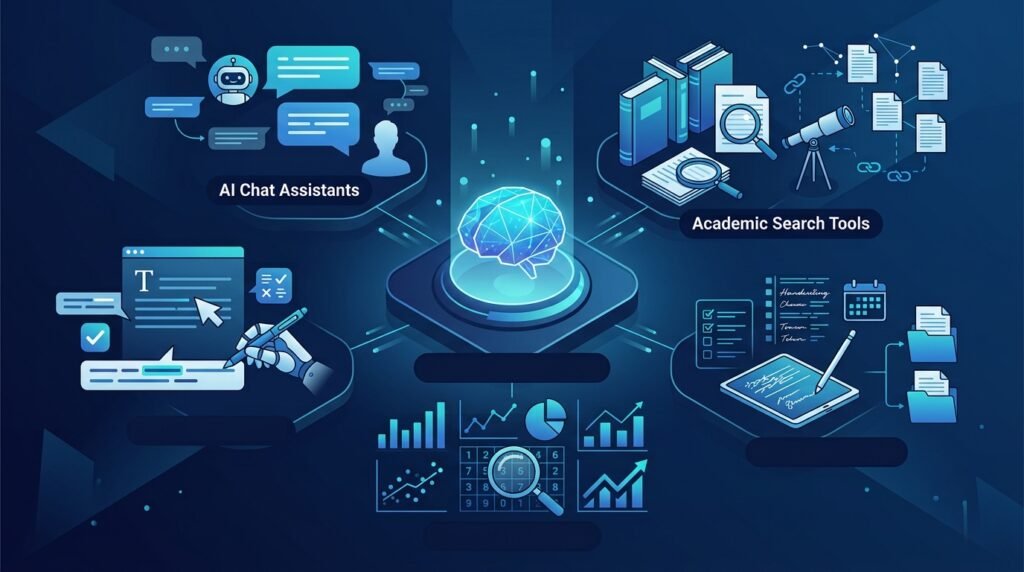
1. AI Assistants
Best for:
- brainstorming
- explanations
- summaries
- writing assistance
- research planning
Examples:
ChatGPT
Useful for:
- understanding concepts
- creating research outlines
- analyzing information
- improving writing
Internal Link:
→ What Is ChatGPT?
Claude
Useful for:
- analyzing long documents
- summarizing complex material
- working with large amounts of text
Internal Link:
→ Claude AI Explained
Gemini
Useful for:
- general research assistance
- information exploration
- working across Google’s ecosystem
Internal Link:
→ Google Gemini Explained
2. AI Search and Discovery Tools
Traditional search engines provide links.
AI-powered search tools provide:
- direct answers
- summaries
- source references
- conversational exploration
Useful for:
- discovering information quickly
- exploring unfamiliar topics
- finding relevant sources
Examples:
- Perplexity AI
- Semantic Scholar
- Consensus
3. AI Note-Taking and Knowledge Management Tools
Research creates a large amount of information.
Without organization, valuable insights can get lost.
AI-powered note-taking tools help researchers:
- organize ideas
- connect concepts
- summarize notes
- build knowledge systems
Examples:
- Notion AI
- Obsidian with AI integrations
These tools are especially useful for:
- students
- writers
- researchers
- professionals managing complex information
AI Research Workflow: A Practical Step-by-Step System
A good AI research workflow combines artificial intelligence with human judgment.
Here is a simple five-step process.
Step 1: Define Your Research Question
Before using AI, clarify what you want to understand.
Weak question:
“Tell me about AI.”
This is too broad.
Better question:
“How is generative AI changing content creation workflows for small businesses?”
A clear question creates better research outcomes.
Step 2: Use AI for Exploration
At the beginning stage, use AI as a learning assistant.
Ask questions like:
“Explain this topic from beginner to advanced level.”
“What are the main concepts I need to understand?”
“What are the biggest debates around this topic?”
The goal is not to collect final answers.
The goal is to build understanding.
Step 3: Find and Evaluate Sources
AI can help discover sources, but researchers must evaluate them.
Check:
Source Authority
Who created the information?
Look for:
- experts
- universities
- research organizations
- established publications
Accuracy
Ask:
- Is the information supported by evidence?
- Are there citations?
- Do other sources agree?
Recency
Some topics change quickly.
For example:
- AI tools
- technology trends
- scientific discoveries
Always check whether information is current.
Step 4: Organize Knowledge
Research becomes valuable when information connects together.
Use AI to create:
- summaries
- comparison tables
- research outlines
- concept maps
Example:
Instead of storing 20 research papers separately:
Create a structure:
AI in Education
├── Benefits
│ ├── Personalized learning
│ ├── Accessibility
│
├── Challenges
│ ├── Privacy
│ ├── Bias
│
└── Future Trends
├── AI tutors
└── Adaptive learning
This makes future writing and analysis easier.
Step 5: Create Original Insights
The final stage is where human intelligence matters most.
AI can help you:
- collect information
- organize ideas
- improve clarity
But your contribution comes from:
- interpretation
- reasoning
- experience
- creativity
Great research is not about collecting more information.
It is about understanding information better.

Common Mistakes When Using AI for Research
Mistake 1: Treating AI as a Search Engine
Many beginners ask AI questions and immediately accept the response.
This creates risks.
AI systems can:
- misunderstand questions
- provide outdated information
- generate incorrect details
Better approach:
Use AI for exploration, then verify important information.
Mistake 2: Accepting AI-Generated Citations Without Checking
One common AI mistake is generating incorrect references.
Researchers should verify:
- paper titles
- authors
- publication details
- URLs
- citations
Never include a reference simply because AI provided it.
Mistake 3: Using AI Without Clear Instructions
AI output quality depends heavily on input quality.
Poor prompt:
“Research climate change.”
Better prompt:
“Create a beginner-friendly overview of climate change research. Explain major causes, current scientific debates, key studies, and areas requiring further research.”
A better question produces better results.
Mistake 4: Letting AI Replace Critical Thinking
The purpose of research is not just collecting answers.
The purpose is developing understanding.
If AI does all the thinking, researchers lose the most valuable part of the process:
learning.

Best Practices for Using AI in Research
1. Use AI as a Research Partner
The best researchers treat AI like a collaborator.
Ask AI to:
- explain concepts
- challenge ideas
- suggest alternatives
- identify gaps
Do not ask AI to replace your judgment.
2. Verify Important Information
Always confirm:
- statistics
- scientific claims
- historical facts
- research conclusions
Especially when information affects:
- academic work
- business decisions
- professional recommendations
3. Keep Human Judgment at the Center
A strong AI-assisted research process looks like:
Human Question
↓
AI Exploration
↓
Source Verification
↓
Human Analysis
↓
Knowledge Creation
The human remains responsible for the final outcome.
The Future of AI for Research
Artificial intelligence is changing research from a process focused mainly on information retrieval into a process focused on deeper understanding and discovery.
In the past, researchers spent a significant amount of time on repetitive activities:
- searching through databases
- organizing documents
- summarizing information
- formatting reports
- reviewing large amounts of text
AI will increasingly automate many of these tasks.
This does not mean research will become less human.
Instead, the role of researchers will evolve.
Future researchers will spend more time on:
- asking meaningful questions
- evaluating evidence
- designing experiments
- connecting ideas
- creating new knowledge
The competitive advantage will belong to people who can combine:
Domain expertise + AI skills + Critical thinking
How AI May Transform Research in the Coming Years
1. AI Research Assistants Will Become More Specialized
Today, many people use general AI assistants.
In the future, we will likely see more specialized AI systems designed for specific fields:
Examples:
Medical Research AI
Helping researchers:
- analyze clinical studies
- discover drug candidates
- identify medical patterns
Legal Research AI
Helping professionals:
- analyze regulations
- review documents
- compare legal cases
Scientific Research AI
Helping scientists:
- process experiments
- analyze datasets
- generate hypotheses
Business Research AI
Helping organizations:
- analyze markets
- understand customers
- identify opportunities
The future of research will likely involve AI systems that understand specific industries and domains.
2. AI Will Improve Knowledge Discovery
One of the most exciting possibilities of AI is discovering connections humans may overlook.
Researchers often work with massive amounts of information.
AI can analyze:
- thousands of papers
- millions of data points
- complex relationships
and identify possible connections.
For example:
A researcher studying medicine may discover relationships between:
- different treatments
- patient outcomes
- biological patterns
AI does not replace scientific discovery.
Instead, it expands the ability of humans to explore complex problems.
3. Research Will Become More Accessible
Historically, advanced research often required:
- expensive databases
- specialized training
- years of experience
AI tools are lowering some of these barriers.
A beginner can now:
- understand complex concepts
- explore new fields
- learn from expert-level information
This creates opportunities for:
- students
- independent researchers
- entrepreneurs
- lifelong learners
AI has the potential to make knowledge more accessible globally.

Responsible Use of AI in Research
While AI offers significant benefits, responsible use is essential.
Researchers must consider:
- accuracy
- transparency
- privacy
- bias
- academic integrity
1. AI Can Produce Incorrect Information
AI systems generate responses based on patterns learned from data.
They do not “know” information in the same way humans do.
Sometimes AI may:
- misunderstand context
- create inaccurate explanations
- provide incorrect references
This is why verification remains critical.
A responsible researcher asks:
- Where did this information come from?
- Can I confirm it?
- Does evidence support it?
2. AI Can Reflect Bias
AI systems learn from existing information.
If training data contains biases, AI outputs may also contain biases.
Researchers should be aware of:
- missing perspectives
- unfair assumptions
- incomplete information
Critical thinking remains essential.
3. Protect Sensitive Research Information
Researchers should be careful when sharing information with AI tools.
Avoid uploading confidential:
- personal data
- unpublished research
- private documents
- sensitive business information
Always understand the privacy policies of the tools you use.
4. Maintain Academic Integrity
AI can support learning, but it should not replace genuine work.
Responsible uses include:
✅ Explaining difficult concepts
✅ Brainstorming ideas
✅ Improving clarity
✅ Organizing research notes
Problematic uses include:
❌ Submitting AI-generated work as original research
❌ Creating fake citations
❌ Misrepresenting AI output as personal analysis
The goal of AI is to improve human capability, not remove human contribution.

How Students Can Use AI for Research
Students are among the biggest beneficiaries of AI research tools.
AI can help students:
- understand difficult subjects
- organize assignments
- prepare presentations
- explore new topics
- improve writing skills
A simple student research workflow:
Step 1: Understand the Topic
Ask:
“Explain this topic in simple terms and identify the most important concepts.”
Step 2: Explore Different Perspectives
Ask:
“What are the main arguments and viewpoints about this topic?”
Step 3: Organize Research
Ask:
“Create a structured outline for a research paper about this topic.”
Step 4: Improve Your Work
Ask:
“Review my writing and suggest improvements in clarity and structure.”
The student remains the creator.
AI becomes the learning assistant.
How Professionals Can Use AI for Research
Research is not limited to academics.
Professionals research every day.
Examples:
Marketing Professionals
AI can help:
- analyze customer trends
- study competitors
- generate content ideas
Entrepreneurs
AI can help:
- research markets
- evaluate opportunities
- understand customers
Managers
AI can help:
- summarize reports
- analyze feedback
- prepare decisions
Writers and Creators
AI can help:
- research topics
- organize ideas
- verify information
Frequently Asked Questions
What is AI for research?
AI for research means using artificial intelligence tools to support research activities such as information discovery, summarization, analysis, organization, and writing.
Can AI replace researchers?
No. AI can automate repetitive tasks and improve productivity, but human judgment, creativity, and critical thinking remain essential.
What are the best AI tools for research?
Popular AI research tools include ChatGPT, Claude, Gemini, Perplexity, Semantic Scholar, Consensus, and AI-powered note-taking platforms.
The best tool depends on the research goal.
Is AI reliable for academic research?
AI can be useful for exploring and organizing information, but important claims should always be verified using trusted sources.
Can students use AI for research?
Yes. Students can use AI responsibly for learning, brainstorming, understanding concepts, organizing ideas, and improving writing.
Does using AI in research count as cheating?
It depends on how it is used.
Using AI as a learning assistant is different from submitting AI-generated work as your own.
Students and researchers should follow their institution’s AI guidelines.
How do I start using AI for research?
A simple starting workflow:
- Define your research question.
- Use AI to explore the topic.
- Find reliable sources.
- Verify information.
- Create your own analysis.
Conclusion
AI for research is changing how people discover, understand, and organize information.
From helping students learn faster to assisting professionals with complex decisions, artificial intelligence is becoming an important research companion.
However, the future of research is not about humans versus AI.
It is about humans using AI effectively.
The researchers who succeed will not simply be those who have access to AI tools.
They will be those who know how to:
- ask better questions
- evaluate information critically
- combine AI capabilities with human expertise
- transform information into meaningful insights
AI can accelerate research.
But curiosity, judgment, and creativity will always remain human.
Continue Your AI Journey
Keep building your AI knowledge with these beginner-friendly guides.
-

AI Interview Preparation: How to Use AI Tools to Land Your Next Job
Learn more : AI Interview Preparation: How to Use AI Tools to Land Your Next Job🕒 14-16 min read • Updated: July 2026 AI Interview Preparation: How to Use AI Tools to Ace…
-

7 Ways to Use AI for Research: Faster & Smarter Workflows (2026)
Learn more : 7 Ways to Use AI for Research: Faster & Smarter Workflows (2026)🕒 15 min read • Updated: July 2026 Introduction Research has always been about discovering new information, asking…
-

AI for Teachers: 15 Practical Workflows to Streamline Your Classroom
Learn more : AI for Teachers: 15 Practical Workflows to Streamline Your Classroom🕒 15 min read • Updated: July 2026 Introduction Teaching is one of the most rewarding professions, but…
-

AI for Productivity: 15 Practical Workflows to Work Smarter in 2026
Learn more : AI for Productivity: 15 Practical Workflows to Work Smarter in 2026🕒 12-14 min read • Updated: July 2026 Introduction Imagine completing your daily work in less time while…
-

The 2026 Guide to AI in Sales: Tools & Workflows to Close Deals Faster
Learn more : The 2026 Guide to AI in Sales: Tools & Workflows to Close Deals Faster🕒 12-14 min read • Updated: July 2026 Introduction Artificial intelligence (AI) is transforming the way businesses find…
-

AI for Project Management: 15 Time-Saving Workflows & Prompt Templates
Learn more : AI for Project Management: 15 Time-Saving Workflows & Prompt Templates🕒 12-14 min read • Updated: July 2026 Quick Answer AI for project management uses artificial intelligence to…
Related Articles
Explore more guides and resources related to this topic.
-

ChatGPT Complete Guide for Beginners (2026): Master AI Step-by-Step
Learn more : ChatGPT Complete Guide for Beginners (2026): Master AI Step-by-Step🕒 20-25 min read • Updated: Aug 2026 Introduction Introduction Artificial intelligence is changing how people learn, work,…
-

Master Prompt Engineering in 2026: A Step-by-Step Beginner’s Guide
Learn more : Master Prompt Engineering in 2026: A Step-by-Step Beginner’s Guide🕒 18-20 min read • Updated: Aug 2026 Introduction Artificial intelligence (AI) tools like ChatGPT, Claude, Gemini, and…
-
Large Language Models (LLMs) Explained: The Complete 2026 Beginner’s Guide
Learn more : Large Language Models (LLMs) Explained: The Complete 2026 Beginner’s Guide🕒 14-16 min read • Updated: Aug 2026 Introduction Artificial Intelligence has become part of everyday life. Whether…
-

Best AI Image Generators in 2026: 10 Free & Paid Tools Tested
Learn more : Best AI Image Generators in 2026: 10 Free & Paid Tools Tested🕒 15 min read • Updated: July 2026 introduction Creating stunning images no longer requires years of design…
-

10 Best AI Chatbots in 2026: Tested & Ranked for Every Use Case
Learn more : 10 Best AI Chatbots in 2026: Tested & Ranked for Every Use Case🕒 10-12 min read • Updated: July 2026 introduction Artificial intelligence has made chatbots far more capable than…
-

ChatGPT vs Microsoft Copilot (2026): Tested, Pricing & Workflow Comparison
Learn more : ChatGPT vs Microsoft Copilot (2026): Tested, Pricing & Workflow Comparison🕒 10-12 min read • Updated: July 2026 Introduction Choosing between ChatGPT and Microsoft Copilot can be challenging,…
Recommended AI Tools for Research
Naeveor will continue building a curated collection of AI tools designed for learning, research, productivity, and professional work.
Explore:
- AI assistants
- Research tools
- Writing tools
- Productivity tools
- Knowledge management tools
References
Stanford Institute for Human-Centered Artificial Intelligence (HAI) — AI Index Report
https://aiindex.stanford.edu/
OpenAI Research — Research and technical publications on artificial intelligence
https://openai.com/research/
Anthropic Research — Research on AI safety, language models, and responsible AI
https://www.anthropic.com/research
Google DeepMind Research — Artificial intelligence research and scientific breakthroughs
https://deepmind.google/research/
Nature Artificial Intelligence — Peer-reviewed research covering AI and machine learning developments
https://www.nature.com/natmachintell/
Semantic Scholar — AI-powered academic search and research discovery platform
https://www.semanticscholar.org/
Consensus — AI-powered search engine for scientific research papers
https://consensus.app/
Google Scholar — Search engine for scholarly literature and academic publications
https://scholar.google.com/
National Institute of Standards and Technology (NIST) — Artificial Intelligence Risk Management Framework
https://www.nist.gov/itl/ai-risk-management-framework
UNESCO — Artificial Intelligence and education, ethics, and policy research
https://www.unesco.org/en/artificial-intelligence
Organisation for Economic Co-operation and Development (OECD) — AI policy and research resources
https://oecd.ai/
Leave a Reply