
🕒 15 min read • Updated: July 2026
Table of Contents
Introduction
Artificial intelligence (AI) is transforming education by changing how students learn, teachers teach, and educational institutions operate. From personalized learning platforms and AI tutors to automated grading and content creation, AI is helping make education more accessible, engaging, and efficient.
Today, students use AI-powered tools to understand complex topics, summarize study materials, practice new skills, and receive instant feedback. At the same time, educators are leveraging AI to create lesson plans, automate repetitive administrative tasks, monitor student progress, and deliver more personalized learning experiences.
However, the growing adoption of AI in education also raises important questions about academic integrity, data privacy, bias, and the evolving role of teachers. Understanding both the opportunities and limitations of AI is essential for anyone involved in modern education.
AI adoption in education is accelerating worldwide. According to the Stanford AI Index 2025, 81% of U.S. computer science teachers believe AI should be included in foundational computer science education, although fewer than half feel adequately prepared to teach it. This highlights both the growing importance of AI literacy and the need for better educator support.
In this comprehensive guide, you’ll learn what AI in education means, explore its real-world applications, discover its benefits and challenges, and understand how artificial intelligence is shaping the future of learning.
Whether you’re a student, teacher, parent, or lifelong learner, this guide will help you understand how AI is changing education—and how you can use it responsibly and effectively.
Key Takeaways
- AI is transforming education by personalizing learning and automating routine tasks.
- Students can use AI for tutoring, research, language learning, and exam preparation.
- Teachers use AI to create lesson plans, grade assignments, and monitor student progress.
- AI supports educators but does not replace the human guidance, creativity, and mentorship that teachers provide.
- Responsible AI use requires attention to privacy, academic integrity, and human oversight.
What Is AI in Education?
Artificial intelligence in education refers to the use of AI technologies to improve teaching, learning, assessment, and educational administration. Instead of replacing teachers, AI acts as a powerful assistant that helps personalize learning experiences, automate repetitive tasks, and provide data-driven insights that support better educational outcomes.
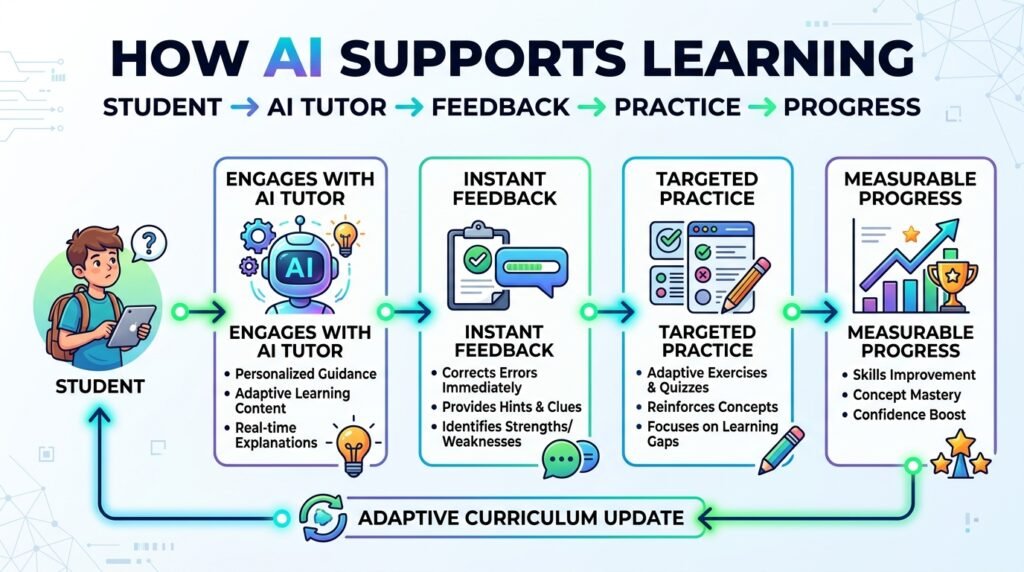
AI-powered educational tools can analyze a student’s learning patterns, identify strengths and weaknesses, recommend personalized study materials, and provide instant feedback. This enables students to learn at their own pace while giving teachers more time to focus on mentoring, classroom engagement, and critical thinking activities.
For example, an AI tutor can explain difficult concepts, generate practice questions, or summarize lengthy chapters in seconds. Similarly, educators can use AI to create lesson plans, draft quizzes, and automate grading for objective assessments, reducing administrative workload and allowing more time for meaningful student interaction.
As educational technology continues to evolve, AI is becoming an increasingly valuable tool for schools, universities, online learning platforms, and workplace training programs.
Continue Learning: New to artificial intelligence? Start with What Is Artificial Intelligence? to understand the core concepts before exploring how AI is applied in education. For a broader overview across industries, read AI Applications: 25 Real-World Uses of Artificial Intelligence.
How AI Is Transforming Education
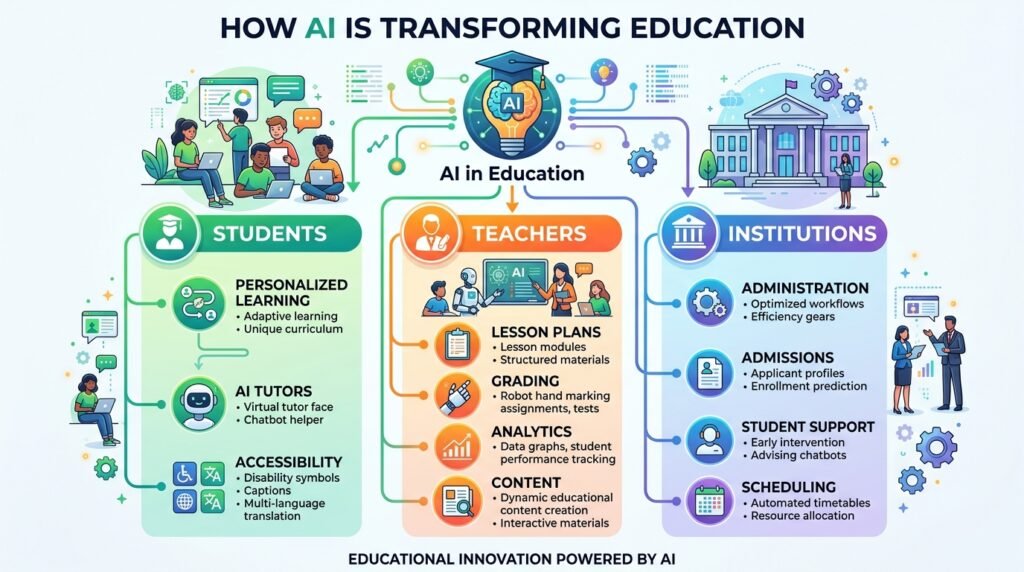
Artificial intelligence is reshaping education by making learning more personalized, efficient, and accessible. Instead of following a one-size-fits-all approach, AI enables educational tools to adapt to individual learning styles, automate routine tasks, and provide real-time insights for both students and educators.
Here are some of the key ways AI is transforming education today.
Personalized Learning
Every student learns differently. Some grasp concepts quickly, while others need additional practice and guidance. AI-powered learning platforms analyze a student’s performance, learning pace, and knowledge gaps to create personalized learning experiences.
For example, if a student consistently struggles with algebra but excels in geometry, an AI-powered platform can recommend additional algebra exercises while allowing the student to move ahead in geometry. This adaptive approach helps learners progress at their own pace and improves overall engagement.
Benefits
- Customized learning paths
- Improved knowledge retention
- Better student engagement
- Self-paced learning
AI Tutors and Virtual Learning Assistants
AI tutors provide students with instant academic support whenever they need it. They can answer questions, explain complex topics, generate practice quizzes, summarize lessons, and offer feedback without waiting for classroom hours.
Unlike traditional tutoring, AI tutors are available 24/7, making learning more flexible for students with different schedules and learning preferences.
Example: A student preparing for a science exam uses ChatGPT to understand difficult concepts and generate practice questions before the test.
Benefits
- Round-the-clock learning support
- Instant explanations
- Interactive learning experience
- Increased learner confidence
Automated Grading and Assessment
Grading assignments, quizzes, and tests can be time-consuming, especially for educators managing large classrooms. AI can automatically evaluate objective assessments, identify common mistakes, and generate performance reports.
While essays and creative work still require human evaluation, AI significantly reduces the time spent grading multiple-choice questions, short-answer quizzes, and standardized assessments.
Benefits
- Faster grading process
- Consistent evaluation
- More time for teaching
- Immediate student feedback
Lesson Planning and Content Creation
Teachers spend considerable time preparing lesson plans, worksheets, presentations, and classroom activities. AI can assist by generating lesson outlines, creating quizzes, simplifying complex topics, and suggesting engaging classroom exercises.
Rather than replacing teachers, AI serves as a productivity tool that allows educators to spend more time interacting with students and less time on administrative preparation.
Benefits
- Reduced preparation time
- More creative teaching materials
- Improved classroom efficiency
- Better curriculum planning
Learning Analytics and Student Progress Tracking
AI helps educators identify learning patterns by analyzing student performance data. It can detect students who may need additional support, monitor progress over time, and provide actionable insights that help teachers make informed instructional decisions.
For example, an AI-powered learning management system can alert a teacher when a student shows declining performance or consistently struggles with specific topics.
Benefits
- Early identification of learning challenges
- Data-driven teaching strategies
- Personalized academic support
- Improved student outcomes
Accessibility and Inclusive Learning
AI is making education more accessible for learners with diverse needs. Features such as speech-to-text, text-to-speech, real-time translation, automatic captions, and personalized reading assistance help create more inclusive learning environments.
These technologies support students with visual, hearing, language, or learning disabilities, ensuring that educational content is accessible to a broader audience.
Benefits
- Greater accessibility
- Inclusive learning environments
- Improved communication
- Enhanced learning opportunities for all students
AI in Educational Administration
Beyond the classroom, educational institutions use AI to streamline administrative tasks such as admissions, scheduling, attendance tracking, and responding to common student inquiries through AI-powered chatbots.
Automating these routine processes allows schools and universities to improve operational efficiency while providing faster support to students and staff.
Benefits
- Reduced administrative workload
- Faster student support
- Improved operational efficiency
- Better resource management
Governments and education systems are increasingly recognizing AI literacy as a core competency. UNESCO has published AI competency frameworks for both students and teachers, while the OECD has introduced an AI literacy framework to help schools prepare learners for an AI-driven future.
Continue Learning: AI in education is just one example of how artificial intelligence is reshaping industries. Explore our AI Applications: 25 Real-World Uses of Artificial Intelligence guide to discover how AI is transforming healthcare, business, finance, transportation, and more.
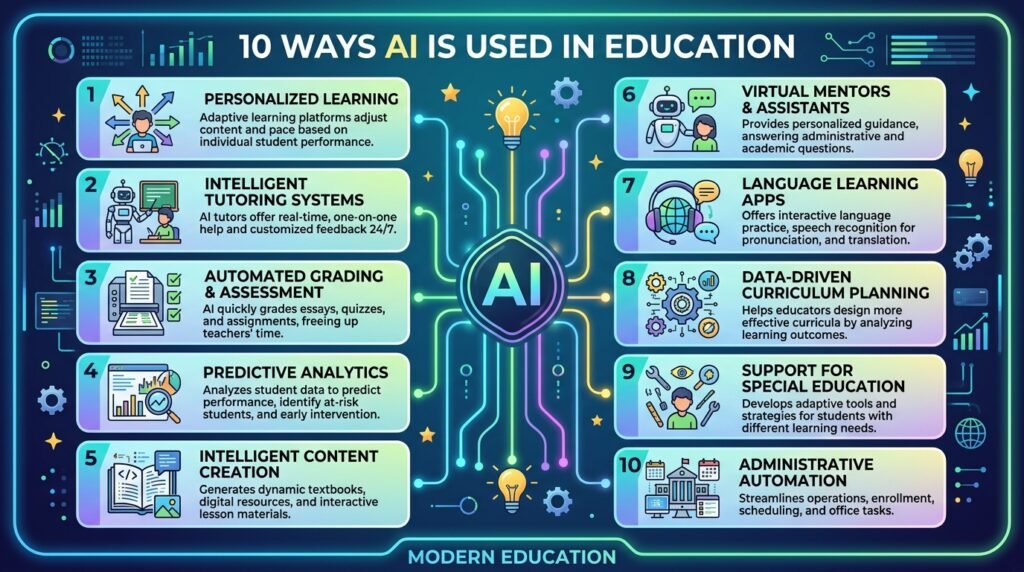
10 Real-World Applications of AI in Education
Artificial intelligence is transforming nearly every aspect of education, from personalized learning experiences to administrative efficiency. Whether you’re a student, teacher, or educational institution, AI offers practical solutions that enhance learning outcomes and streamline everyday tasks.
Below are ten of the most impactful applications of AI in education today.
1. Personalized Learning
Every student has a unique learning style and pace. AI-powered learning platforms analyze a student’s progress, strengths, and areas for improvement to deliver personalized lessons, quizzes, and recommendations.
Instead of following a fixed curriculum, students receive learning experiences tailored to their individual needs.
Example: An online learning platform recommends additional practice questions for algebra after identifying that a student struggles with quadratic equations.
Benefits
- Customized learning paths
- Better knowledge retention
- Increased student engagement
- Self-paced learning
2. AI Tutors and Homework Assistance
AI tutors provide instant academic support by answering questions, explaining difficult concepts, generating examples, and creating practice exercises.
Unlike traditional tutoring, AI is available anytime, allowing students to learn whenever they need help.
Example: A university student uses ChatGPT to understand programming concepts before completing a coding assignment.
Benefits
- 24/7 learning support
- Immediate feedback
- Improved understanding
- Greater learning confidence
3. Automated Grading
AI can automatically grade quizzes, multiple-choice exams, and other objective assessments, significantly reducing the time teachers spend on repetitive evaluation tasks.
Some platforms also provide detailed performance reports that help educators identify learning gaps.
Example: An online classroom automatically grades weekly quizzes and generates progress reports for both students and teachers.
Benefits
- Faster assessment
- Consistent grading
- Reduced administrative workload
- More time for teaching
4. Smart Content Creation
Teachers can use AI to generate lesson plans, quizzes, worksheets, presentations, and classroom activities in minutes. AI also helps simplify complex topics and create learning materials tailored to different age groups.
Example: A teacher uses an AI assistant to generate discussion questions and presentation slides for a history lesson.
Benefits
- Saves preparation time
- Encourages creativity
- Improves lesson quality
- Supports differentiated instruction
5. Language Learning and Translation
AI-powered language learning apps provide pronunciation feedback, conversational practice, grammar corrections, and real-time translation.
These tools help learners improve speaking, listening, reading, and writing skills through interactive exercises.
Example: A student practices Spanish pronunciation with an AI-powered language learning app that provides instant feedback.
Benefits
- Personalized language practice
- Real-time corrections
- Improved communication skills
- Better accessibility for multilingual learners
6. Accessibility for Inclusive Learning
AI makes education more accessible for students with disabilities through features such as text-to-speech, speech-to-text, automatic captions, screen readers, and language translation.
These technologies help ensure that educational content is available to a wider range of learners.
Example: A student with hearing impairment uses AI-generated captions during online lectures.
Benefits
- Greater accessibility
- Inclusive classrooms
- Enhanced learning opportunities
- Improved student participation
7. Academic Research Assistance
AI tools help students and researchers summarize lengthy articles, organize information, brainstorm ideas, and identify relevant resources more efficiently.
While AI can accelerate research, users should always verify information using credible academic and primary sources.
Example: A graduate student uses AI to summarize multiple research papers before conducting a literature review.
Benefits
- Faster information gathering
- Improved productivity
- Better organization
- More efficient research workflows
8. Student Performance Analytics
Educational institutions use AI to analyze attendance, assignment scores, participation, and assessment data to identify students who may need additional support.
This allows teachers to intervene early and provide personalized guidance.
Example: A school identifies students at risk of falling behind and offers targeted academic support based on AI-generated insights.
Benefits
- Early intervention
- Data-driven teaching
- Improved student success
- Better academic planning
9. Exam Preparation
AI helps students prepare for exams by generating mock tests, flashcards, personalized revision plans, and practice questions based on previous performance.
Many AI learning platforms also identify weak areas and recommend additional study materials.
Example: A high school student uses an AI study assistant to create a customized revision schedule before final exams.
Benefits
- More effective revision
- Personalized study plans
- Better time management
- Increased exam confidence
10. Administrative Automation
Schools and universities use AI to automate routine administrative tasks such as admissions processing, attendance tracking, scheduling, student inquiries, and document management.
This allows educational institutions to improve operational efficiency while freeing staff to focus on student support.
Example: A university chatbot answers frequently asked questions about admissions, course registration, and campus services.
Benefits
- Reduced administrative workload
- Faster student support
- Improved operational efficiency
- Better resource allocation
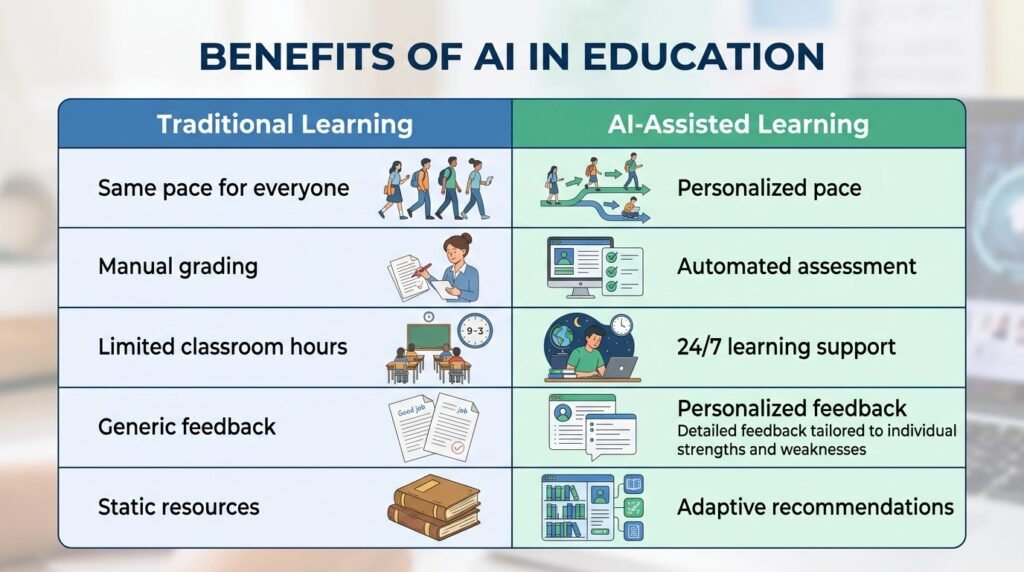
Comparison Table: Traditional Education vs AI-Assisted Education
| Aspect | Traditional Education | AI-Assisted Education |
| Learning Pace | Same pace for most students | Personalized learning paths |
| Feedback | Delayed | Instant, data-driven feedback |
| Assessment | Manual grading | Automated grading for objective tasks |
| Student Support | Limited to classroom hours | 24/7 AI tutoring and assistance |
| Accessibility | Depends on available resources | AI-powered accessibility features |
| Administrative Tasks | Mostly manual | Automated scheduling, attendance, and support |
Did You Know? AI works best in education when it complements—not replaces—teachers. While AI can automate repetitive tasks and personalize learning, educators continue to play an essential role in mentoring, fostering critical thinking, and supporting students’ social and emotional development.
Benefits of AI in Education
Artificial intelligence is transforming education by making learning more personalized, accessible, and efficient. While AI cannot replace teachers, it can enhance the learning experience for students and reduce administrative burdens for educators. When implemented responsibly, AI helps educational institutions deliver better outcomes while preparing learners for an increasingly digital world.
Here are some of the key benefits of AI in education.
Personalized Learning Experiences
One of AI’s greatest strengths is its ability to adapt learning to individual students. AI-powered platforms analyze learning patterns, identify strengths and weaknesses, and recommend personalized lessons and practice exercises.
Instead of moving every student through the same curriculum at the same pace, AI supports individualized learning journeys that help students progress according to their abilities.
Benefits
- Self-paced learning
- Improved engagement
- Better knowledge retention
- Tailored learning recommendations
Increased Teacher Productivity
Teachers spend a significant amount of time on repetitive tasks such as grading assignments, preparing lesson plans, organizing classroom materials, and responding to routine questions.
AI can automate many of these activities, allowing educators to devote more time to teaching, mentoring, and supporting students.
Benefits
- Reduced administrative workload
- Faster lesson preparation
- More time for student interaction
- Improved classroom efficiency
Instant Feedback for Students
Receiving timely feedback helps students identify mistakes, reinforce learning, and improve their understanding of a subject. AI-powered educational tools provide immediate feedback on quizzes, assignments, and practice exercises, enabling students to learn from their mistakes without waiting for teacher evaluations.
Benefits
- Faster learning cycles
- Better understanding of concepts
- Increased student confidence
- Continuous progress monitoring
Greater Accessibility and Inclusion
AI helps make education more inclusive by supporting learners with different abilities and learning needs. Features such as speech-to-text, text-to-speech, automatic captions, language translation, and screen readers improve access to educational content.
These technologies enable more students to participate in learning regardless of physical, language, or learning barriers.
Benefits
- Improved accessibility
- Inclusive learning environments
- Better support for diverse learners
- Equal learning opportunities
Data-Driven Decision Making
AI enables educators and institutions to make informed decisions by analyzing student performance, attendance, participation, and assessment data.
Learning analytics help identify students who may need additional support, allowing teachers to intervene before academic challenges become more serious.
Benefits
- Early identification of learning gaps
- Personalized interventions
- Better academic planning
- Improved student success rates
Enhanced Student Engagement
Interactive AI-powered learning experiences—including virtual tutors, adaptive quizzes, educational games, and simulations—make learning more engaging and enjoyable.
Students receive personalized challenges and instant encouragement, helping them stay motivated throughout their learning journey.
Benefits
- Higher motivation
- Increased participation
- Better learning outcomes
- More interactive classroom experiences
Preparation for an AI-Driven Future
As artificial intelligence becomes increasingly integrated into workplaces, students who learn how to use AI responsibly develop valuable digital literacy and problem-solving skills.
Understanding AI tools prepares learners for future careers where collaboration between humans and AI is expected to become commonplace.
Benefits
- Improved digital literacy
- Future-ready skills
- Greater adaptability
- Better career preparedness
Summary of Benefits
| Benefit | Impact on Education |
| Personalized Learning | Tailors learning to each student’s needs and pace |
| Teacher Productivity | Automates repetitive tasks and saves time |
| Instant Feedback | Helps students learn and improve more quickly |
| Accessibility | Supports inclusive learning for diverse learners |
| Learning Analytics | Identifies learning gaps and tracks progress |
| Student Engagement | Makes learning more interactive and motivating |
| Future Readiness | Builds AI literacy and workplace skills |
Key Insight: The greatest value of AI in education is not replacing teachers—it’s empowering teachers and students with tools that make learning more effective, engaging, and accessible.
Challenges and Limitations of AI in Education
While artificial intelligence offers significant opportunities to improve education, it also presents important challenges that educators, students, and institutions must address. AI should be used as a tool to support learning—not as a substitute for critical thinking, ethical decision-making, or human interaction.
Understanding these limitations helps ensure AI is used responsibly and effectively in educational settings.
Academic Integrity and Cheating
One of the biggest concerns surrounding AI in education is academic integrity. Students can use AI tools to generate essays, solve assignments, or complete homework without fully understanding the material.
While AI can be an excellent learning assistant, relying on it to complete assessed work may violate academic policies and limit the development of critical thinking and problem-solving skills.
Best Practice
Use AI to explain concepts, brainstorm ideas, or review your work—not to replace your own learning or submit AI-generated work as your own.
AI Can Produce Inaccurate Information
AI systems don’t always provide correct or up-to-date information. Sometimes they generate responses that sound convincing but contain factual errors, outdated information, or fabricated references.
For this reason, students and educators should verify important information using trusted sources such as textbooks, peer-reviewed research, or official publications.
Best Practice
Always fact-check AI-generated content before using it in assignments, research projects, or presentations.
Privacy and Data Security
Many AI-powered educational platforms collect user data to personalize learning experiences and improve their services. This may include learning progress, interaction history, or uploaded documents.
Educational institutions should carefully evaluate AI tools to ensure they comply with privacy regulations and protect sensitive student information.
Best Practice
Avoid uploading confidential or personal information to AI platforms unless you understand how the data will be stored and used.
Bias in AI Systems
AI learns from the data it is trained on. If that training data contains biases or lacks diversity, AI systems may produce unfair or inaccurate recommendations.
For example, an AI system trained primarily on one language, region, or educational context may perform less effectively for students from different backgrounds.
Developers and educators should regularly evaluate AI systems for fairness, accuracy, and inclusivity.
The Digital Divide
Not all students have equal access to reliable internet connections, modern devices, or paid AI tools. As AI becomes more integrated into education, unequal access could widen existing educational gaps.
Educational institutions should promote equitable access by providing affordable or institution-supported AI resources whenever possible.
Over-Reliance on AI
AI can make learning faster and more convenient, but depending on it for every task may reduce opportunities to develop essential skills such as critical thinking, creativity, problem-solving, and independent research.
Students should view AI as a learning assistant rather than a replacement for their own effort and understanding.
Teachers Remain Essential
Despite rapid advances in AI, technology cannot replace the human qualities that great educators bring to the classroom. Teachers inspire curiosity, provide emotional support, encourage collaboration, adapt to individual classroom dynamics, and help students develop ethical judgment and social skills.
AI is most effective when it complements teachers by handling repetitive tasks and providing additional learning support, allowing educators to focus on meaningful teaching and student engagement.
Challenges at a Glance
| Challenge | Why It Matters | Best Practice |
| Academic integrity | Students may misuse AI for assignments | Use AI as a learning aid, not a shortcut |
| Inaccurate information | AI can generate incorrect or outdated content | Verify facts with reliable sources |
| Privacy and security | AI tools may collect personal data | Review privacy policies and avoid sharing sensitive information |
| Bias | AI may reflect biases in training data | Cross-check information and use diverse sources |
| Digital divide | Unequal access to AI tools | Promote inclusive access and provide alternatives |
| Over-reliance | Excessive dependence can limit skill development | Balance AI assistance with independent learning |
| Human connection | AI cannot replace mentorship and emotional support | Combine AI with teacher guidance |
Key Insight: AI is most valuable in education when it enhances human learning rather than replaces human thinking. Students and educators who use AI responsibly can benefit from its capabilities while continuing to develop critical skills that technology cannot replicate.
Although many educators recognize AI’s potential, professional development remains a challenge. The Stanford AI Index reports that while 81% of computer science teachers support including AI in foundational education, fewer than half feel equipped to teach it, underscoring the importance of teacher training alongside technology adoption.
Will AI Replace Teachers?
This is one of the most common questions about artificial intelligence in education, and the short answer is no.
AI can automate repetitive tasks, personalize learning, and provide instant assistance, but it cannot replace the uniquely human qualities that teachers bring to education. Effective teaching involves far more than delivering information—it requires empathy, mentorship, motivation, classroom management, and the ability to adapt to students’ emotional and social needs.
Instead of replacing teachers, AI is changing their role. By handling administrative work such as grading objective assessments, generating lesson plans, and organizing learning materials, AI allows educators to spend more time on activities that have the greatest impact on student success.
The future of education is likely to be a partnership between teachers and AI, where technology enhances learning while educators continue to guide, inspire, and support students.
Continue Learning: Curious about how AI is shaping other industries? Explore our AI Applications: 25 Real-World Uses of Artificial Intelligence guide or learn how AI assistants work in our How Does ChatGPT Work? article.
Best AI Tools for Education
Artificial intelligence has made learning more accessible than ever. Whether you’re a student looking for homework assistance, a teacher creating lesson plans, or a researcher organizing information, the right AI tools can help improve productivity and learning outcomes.
Here are some of the most popular AI tools for education.
| AI Tool | Best For | Ideal Users |
| ChatGPT | Explaining concepts, brainstorming, writing assistance, coding help | Students, Teachers, Professionals |
| Google Gemini | Research, Google Workspace integration, study assistance | Students, Researchers |
| Claude | Long-form writing, document analysis, summarizing PDFs | Students, Educators |
| Perplexity AI | AI-powered search with cited sources | Students, Researchers |
| Grammarly | Grammar checking and writing improvement | Students, Writers |
| Canva AI | Presentations, infographics, classroom visuals | Teachers, Students |
| Notion AI | Note-taking, study planning, project organization | Students, Professionals |
While these tools can significantly improve productivity, they should be used to support learning rather than replace independent thinking. Always verify AI-generated information, especially for assignments, research, and academic work.
Recommended Reading: Explore our Recommended AI Tools page for detailed reviews, comparisons, and recommendations to help you choose the right AI tools for your learning needs.
The Future of AI in Education
Artificial intelligence is expected to play an even greater role in education over the next decade. As AI models become more capable, educational experiences will likely become increasingly personalized, interactive, and accessible.
Some of the key trends shaping the future of AI in education include:
Adaptive Learning Platforms
Future AI systems will continuously adjust lessons, assessments, and study materials based on each student’s progress, learning style, and goals.
AI Learning Companions
Instead of simply answering questions, AI assistants will act as long-term learning companions by remembering learning preferences, tracking progress, and recommending personalized study plans.
Immersive Learning Experiences
The combination of AI with technologies such as augmented reality (AR) and virtual reality (VR) could create interactive classrooms where students explore historical events, scientific concepts, and simulations in immersive environments.
Improved Accessibility
AI will continue making education more inclusive through real-time translation, advanced speech recognition, personalized accessibility features, and tools designed for learners with disabilities.
Responsible AI in Education
As AI adoption grows, educational institutions will need clear policies governing privacy, transparency, academic integrity, and ethical AI use. Teaching students how to evaluate AI-generated information critically will become an essential part of digital literacy.
The future of education is unlikely to be fully automated. Instead, AI will serve as a powerful partner that supports teachers, empowers students, and enhances lifelong learning.
Frequently Asked Questions (FAQs)
What is AI in education?
AI in education refers to the use of artificial intelligence technologies to improve teaching, learning, assessment, and educational administration. AI helps personalize learning, automate routine tasks, and provide data-driven insights that support better educational outcomes.
How is AI used in education?
AI is used in many ways, including personalized learning, AI tutoring, automated grading, lesson planning, language learning, student performance analytics, accessibility tools, and administrative automation.
What are the benefits of AI in education?
Some of the main benefits include:
- Personalized learning experiences
- Faster feedback
- Increased teacher productivity
- Improved accessibility
- Better student engagement
- Data-driven decision-making
- Preparation for future careers
Can AI replace teachers?
No. AI can automate repetitive tasks and support learning, but it cannot replace the empathy, mentorship, creativity, classroom management, and critical thinking guidance that teachers provide.
Is using AI for homework considered cheating?
It depends on your school’s or institution’s policies. Using AI to understand concepts, brainstorm ideas, or review your work is often acceptable, but submitting AI-generated work as your own may violate academic integrity guidelines. Always follow your institution’s rules.
Which AI tools are best for students?
Popular AI tools for students include ChatGPT, Gemini, Claude, Perplexity AI, Grammarly, Canva AI, and Notion AI. The best choice depends on your learning goals and the type of tasks you need help with.
Continue Learning
Expand your AI knowledge with these beginner-friendly guides:
- What Is Artificial Intelligence? — Understand the fundamentals of AI.
- AI Applications: 25 Real-World Uses of Artificial Intelligence — Explore how AI is transforming industries.
- What Is Generative AI? — Learn how AI creates text, images, code, and more.
- How Does ChatGPT Work? — Discover how conversational AI generates responses.
- AI Skills Development — Build the skills needed to thrive in an AI-driven world.
Related Articles
You may also find these guides helpful:
- 25 Best AI Tools for Beginners
- What Is Prompt Engineering?
- How to Write Better AI Prompts
- Prompt Engineering Techniques
- Zero-Shot vs Few-Shot Prompting
Conclusion
Artificial intelligence is reshaping education by making learning more personalized, accessible, and efficient for students, teachers, and educational institutions. From AI tutors and adaptive learning platforms to automated grading and accessibility tools, AI is helping create richer learning experiences while reducing administrative workloads.
At the same time, responsible AI adoption requires thoughtful consideration of privacy, academic integrity, fairness, and human oversight. The most effective educational environments will combine the strengths of AI with the expertise, empathy, and guidance that teachers provide.
Whether you’re a student looking to learn more effectively, an educator exploring new teaching strategies, or simply curious about the future of learning, understanding AI in education is an important step toward building the skills needed in an increasingly AI-powered world.
As AI continues to evolve, those who learn to use it responsibly and critically will be better prepared for the opportunities and challenges of tomorrow.
Leave a Reply