🕒 10-12 min read • Updated: July 2026
Table of Contents
Introduction
Creating high-quality content consistently can be challenging, whether you’re writing blog posts, designing social media graphics, producing videos, or managing marketing campaigns. Artificial intelligence (AI) is making these tasks faster and more efficient by helping creators brainstorm ideas, generate drafts, edit content, and automate repetitive work.
But what exactly is AI in content creation, and how can beginners use it effectively without sacrificing quality or creativity?
In this beginner-friendly guide, you’ll learn what AI in content creation is, how it works, its key benefits and limitations, popular AI tools, practical real-world examples, and best practices for using AI responsibly. By the end, you’ll have a clear understanding of how AI can support your content creation process while keeping your work original and engaging.
Key Takeaways
- AI helps create written, visual, audio, and video content more efficiently.
- It speeds up brainstorming, drafting, editing, and optimization.
- Human creativity and fact-checking remain essential.
- Beginners can start with free AI tools before upgrading.
- Responsible AI use improves productivity without replacing originality.
What Is AI in Content Creation?
AI in content creation refers to the use of artificial intelligence to assist in planning, creating, editing, optimizing, and repurposing digital content. Instead of starting every project from scratch, creators can use AI-powered tools to speed up repetitive tasks while maintaining a consistent workflow.
These tools are powered by machine learning and generative AI models that have been trained on vast amounts of text, images, audio, or video data. By analyzing patterns in this data, AI can generate new content based on user instructions, commonly known as prompts.
For example, a blogger can ask an AI assistant to generate article ideas, create an outline, or draft an introduction. A graphic designer can use AI to create illustrations or remove image backgrounds, while a video creator can automatically generate captions, summaries, or voiceovers.
AI doesn’t “think” or create ideas in the same way humans do. Instead, it predicts and generates content based on patterns learned during training. This is why human creativity, judgment, and editing are still essential for producing accurate, engaging, and trustworthy content.
If you’re new to AI, it helps to first understand what artificial intelligence is and how generative AI enables computers to create original text, images, and other forms of content. These concepts provide the foundation for understanding how AI-powered content creation tools work.
Why AI Is Becoming Essential for Content Creators
The demand for digital content continues to grow across websites, social media platforms, podcasts, newsletters, and video-sharing platforms. At the same time, creators are expected to publish consistently while maintaining quality and originality.
AI helps solve this challenge by reducing the time spent on repetitive tasks such as:
- Brainstorming content ideas
- Conducting preliminary research
- Creating outlines
- Drafting articles and emails
- Writing social media captions
- Editing grammar and tone
- Designing graphics
- Generating video subtitles
- Repurposing content for multiple platforms
Rather than replacing the creative process, AI allows creators to spend more time on strategy, storytelling, audience engagement, and adding personal insights that technology cannot replicate.
How AI Helps Create Content
Creating high-quality content traditionally involves multiple steps, from researching a topic to publishing and promoting the final piece. AI can support creators at nearly every stage of this workflow, making the process faster and more efficient.
It’s important to remember that AI works best as a collaborative assistant. While it can automate repetitive tasks and generate ideas, human creativity, expertise, and judgment are still essential for producing content that is accurate, engaging, and valuable.
A Typical AI-Assisted Content Creation Workflow
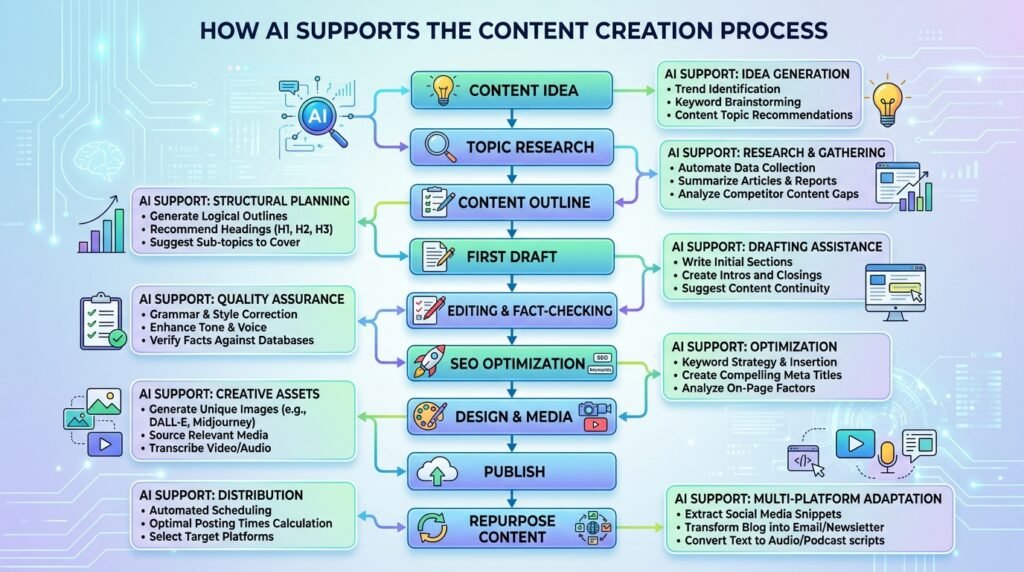
Let’s look at how AI contributes at each stage.
1. Idea Generation
One of the biggest challenges for creators is deciding what to create next. AI tools can analyze trends, answer common audience questions, and suggest content ideas based on your niche.
For example, if you run a fitness blog, you can ask an AI assistant to generate blog topics for beginners, seasonal workout ideas, or frequently asked questions about nutrition.
Instead of staring at a blank page, creators can quickly build a list of relevant ideas and focus on choosing the most valuable ones.
2. Research and Information Gathering
AI can help summarize lengthy articles, organize information, explain complex concepts, and identify important points to cover.
This significantly reduces the time spent gathering background information. However, AI-generated information should always be verified using reliable and authoritative sources, especially for topics involving health, finance, or legal advice.
3. Creating an Outline
A well-structured outline makes writing easier.
AI can generate logical headings, organize ideas into sections, and recommend a flow that improves readability.
For example, instead of manually planning every section of a blog post, you can ask AI to create an outline that covers the topic comprehensively while matching the reader’s search intent.
4. Writing the First Draft
Perhaps the most popular use of AI is generating first drafts.
Whether you’re writing a blog post, email newsletter, product description, or social media caption, AI can produce a starting point within seconds.
Rather than copying the output directly, successful creators use AI-generated drafts as a foundation and then refine them by adding original insights, personal experience, examples, and accurate information.
5. Editing and Improving Content
AI can also act as an editing assistant by helping improve grammar, spelling, sentence structure, clarity, and tone.
Many tools can simplify complex sentences, remove repetition, and make content easier to read without changing the original message.
This allows creators to spend less time on basic editing and more time improving the overall quality of their work.
6. SEO Optimization
Publishing great content is only part of the process—it also needs to be discoverable.
AI-powered SEO tools can help creators:
- Suggest relevant keywords
- Improve headings and structure
- Generate meta titles and descriptions
- Optimize readability
- Identify content gaps
- Recommend internal linking opportunities
These suggestions can improve search visibility while ensuring the content remains helpful and user-focused.
7. Creating Images, Videos, and Other Media
Modern AI tools are no longer limited to text.
Today, creators can use AI to:
- Generate original images and illustrations
- Design presentations
- Edit videos automatically
- Create subtitles and captions
- Produce voiceovers
- Remove image backgrounds
- Enhance audio quality
This allows individuals and small teams to create professional-looking multimedia content without advanced technical skills.
8. Repurposing Content for Multiple Platforms
One of AI’s most valuable capabilities is helping creators maximize the value of a single piece of content.
For example, an AI tool can transform:
- A blog post into a LinkedIn article
- A YouTube video into a blog summary
- A podcast into show notes
- A webinar into an email newsletter
- A long article into multiple social media posts
Repurposing content helps creators reach different audiences while saving significant time and effort.
Key Takeaway
AI can support almost every stage of the content creation process—from brainstorming ideas to publishing across multiple platforms. However, the best results come from combining AI’s speed with human creativity, critical thinking, and subject expertise. By using AI as a productivity partner rather than a replacement, creators can produce higher-quality content more efficiently while maintaining authenticity and trust.
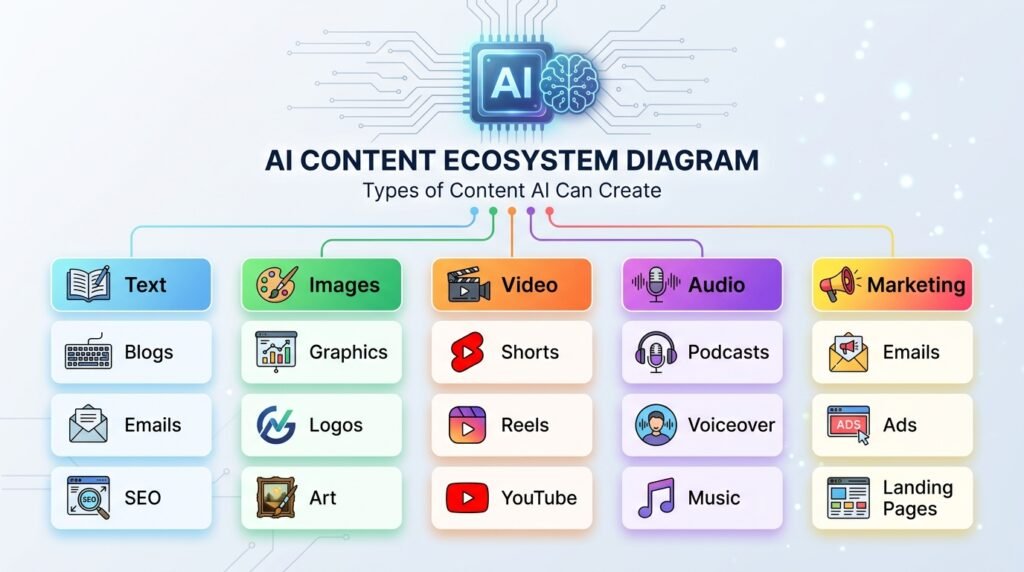
Types of Content AI Can Create
Artificial intelligence has evolved far beyond simple text generation. Today, AI-powered tools can assist creators with producing a wide variety of content across different formats, making it easier to maintain a consistent online presence.
Whether you’re a blogger, marketer, educator, entrepreneur, or content creator, AI can help automate repetitive tasks while supporting the creative process.
Here are some of the most common types of content AI can create.
1. Blog Posts and Articles
Writing long-form content is one of the most popular uses of AI.
AI can help with:
- Generating article ideas
- Creating outlines
- Writing introductions
- Drafting sections
- Suggesting headings
- Improving readability
- Optimizing content for SEO
For example, a travel blogger can use AI to brainstorm destination guides, while a technology website can use it to create the first draft of educational articles before adding expert insights and fact-checking.
Best AI tools: ChatGPT, Claude, Gemini
2. Social Media Content
Creating engaging posts for multiple platforms every day can be time-consuming.
AI can generate:
- Instagram captions
- LinkedIn posts
- Facebook updates
- X (formerly Twitter) posts
- Pinterest descriptions
- Hashtag suggestions
- Content calendars
Instead of creating every post from scratch, creators can use AI to adapt their message for different audiences and platforms.
3. Images and Graphics
Modern AI image generators can create original visuals from simple text descriptions.
Common uses include:
- Blog featured images
- Social media graphics
- Marketing banners
- Product mockups
- Concept art
- Illustrations
- Presentation visuals
While AI-generated images are impressive, they often benefit from human editing to match a brand’s visual identity.
Best AI tools: Midjourney, Canva AI, Adobe Firefly
4. Videos
Video production traditionally requires scripting, editing, subtitles, voiceovers, and visual effects. AI can simplify many of these tasks.
AI can help creators:
- Generate video scripts
- Create subtitles automatically
- Remove background noise
- Produce AI voiceovers
- Translate videos into multiple languages
- Edit clips more efficiently
These capabilities allow creators to produce videos faster while maintaining professional quality.
5. Audio and Podcasts
AI is increasingly being used to improve audio production.
Examples include:
- Podcast editing
- Noise reduction
- Voice enhancement
- AI-generated narration
- Audio transcription
- Show note generation
These features reduce editing time and improve overall production quality.
6. Email Newsletters
Email marketing remains one of the most effective ways to build relationships with an audience.
AI can assist with:
- Writing subject lines
- Drafting newsletters
- Personalizing email content
- Improving clarity and tone
- Creating follow-up email sequences
This helps businesses communicate more consistently while saving valuable time.
7. Marketing Copy
Businesses frequently use AI to create persuasive marketing content such as:
- Product descriptions
- Landing pages
- Google Ads
- Facebook Ads
- Call-to-action buttons
- Sales emails
Although AI can generate compelling copy quickly, reviewing and refining the content ensures it accurately reflects your brand voice and messaging.
8. Educational Content
Teachers, trainers, and educational creators are increasingly using AI to produce learning materials.
Examples include:
- Lesson plans
- Study guides
- Practice quizzes
- Flashcards
- Presentation slides
- Course outlines
- Learning summaries
By automating repetitive preparation tasks, educators can spend more time engaging with learners and improving the learning experience.
AI Content Creation at a Glance
| Content Type | How AI Helps | Popular AI Tools |
| Blog Posts | Drafting, outlining, editing | ChatGPT, Claude, Gemini |
| Social Media | Captions, post ideas, hashtags | ChatGPT, Canva AI |
| Images | Generate illustrations and graphics | Midjourney, Canva AI, Adobe Firefly |
| Videos | Scripts, captions, editing | Runway, Descript |
| Podcasts | Editing, transcription, voice enhancement | Descript, Adobe Podcast |
| Emails | Subject lines, newsletters, automation | ChatGPT, Gemini |
| Marketing Copy | Ads, product descriptions, landing pages | ChatGPT, Claude |
| Educational Content | Lesson plans, quizzes, summaries | ChatGPT, Gemini |
Key Takeaway
AI has become a versatile creative assistant capable of supporting nearly every type of digital content. From writing articles and designing graphics to producing videos and educational resources, AI helps creators work more efficiently and scale their content production. However, the highest-quality content still combines AI’s speed with human creativity, expertise, and editorial judgment to deliver information that is original, accurate, and genuinely valuable.
Benefits of AI in Content Creation
Artificial intelligence is changing how individuals and organizations create content by making the process faster, more efficient, and easier to scale. While AI cannot replace human creativity or expertise, it can significantly reduce the time spent on repetitive tasks, allowing creators to focus on strategy, storytelling, and audience engagement.
Whether you’re managing a personal blog, running a business, or creating content for social media, AI offers several practical advantages.
1. Saves Time
Creating content from scratch often involves brainstorming ideas, conducting research, writing, editing, and optimizing before publishing. These tasks can take several hours—or even days—for a single piece of content.
AI helps speed up many of these steps by generating outlines, drafting content, suggesting headlines, and assisting with editing. This allows creators to spend less time on repetitive work and more time refining their ideas.
For example, instead of spending an hour creating a blog outline, AI can generate one in seconds, giving you more time to focus on adding original insights and expertise.
2. Increases Productivity
One of AI’s greatest strengths is helping creators produce more content without sacrificing quality.
For example, after completing a blog post, AI can quickly help you:
- Create social media captions
- Write an email newsletter
- Generate video scripts
- Draft LinkedIn posts
- Prepare presentation summaries
Repurposing content across multiple platforms helps creators reach wider audiences while reducing duplicate effort.
3. Helps Overcome Writer’s Block
Every creator experiences moments when ideas simply don’t come.
AI can help overcome creative blocks by suggesting:
- Content ideas
- Blog titles
- Article outlines
- Opening paragraphs
- Questions readers might ask
- Alternative ways to explain complex topics
Even if you don’t use AI-generated content directly, it can provide inspiration and help you move forward more quickly.
4. Improves Content Quality
Many AI tools include built-in editing features that improve readability, grammar, spelling, sentence structure, and tone.
Some tools can also identify repetitive language, simplify complex sentences, and suggest clearer ways to communicate ideas.
These improvements make content easier to read while helping creators maintain a consistent writing style.
5. Makes Content Creation More Accessible
AI has lowered the barrier to creating digital content.
Today, someone with little experience in writing, graphic design, or video editing can use AI tools to create professional-looking content with minimal technical knowledge.
This empowers students, educators, entrepreneurs, freelancers, and small businesses to compete more effectively without needing large teams or expensive software.
6. Supports Better SEO
Creating valuable content is only part of the process—it also needs to be discoverable.
AI-powered SEO tools can assist with:
- Keyword research
- Content organization
- Heading suggestions
- Meta titles and descriptions
- Readability improvements
- Internal linking recommendations
While these suggestions are helpful, successful SEO still depends on creating original, useful content that satisfies user intent.
7. Helps Maintain Consistency
Building an online audience often requires publishing content regularly.
AI can help creators maintain a consistent publishing schedule by streamlining repetitive tasks and reducing production time.
Whether you’re managing a blog, YouTube channel, podcast, or business website, AI makes it easier to produce content consistently without compromising quality.
8. Encourages Creative Experimentation
AI makes it easier to test different ideas and creative approaches.
For example, creators can quickly experiment with:
- Multiple blog titles
- Alternative headlines
- Different writing styles
- New content formats
- Image concepts
- Video scripts
This flexibility encourages experimentation while helping creators identify what resonates most with their audience.
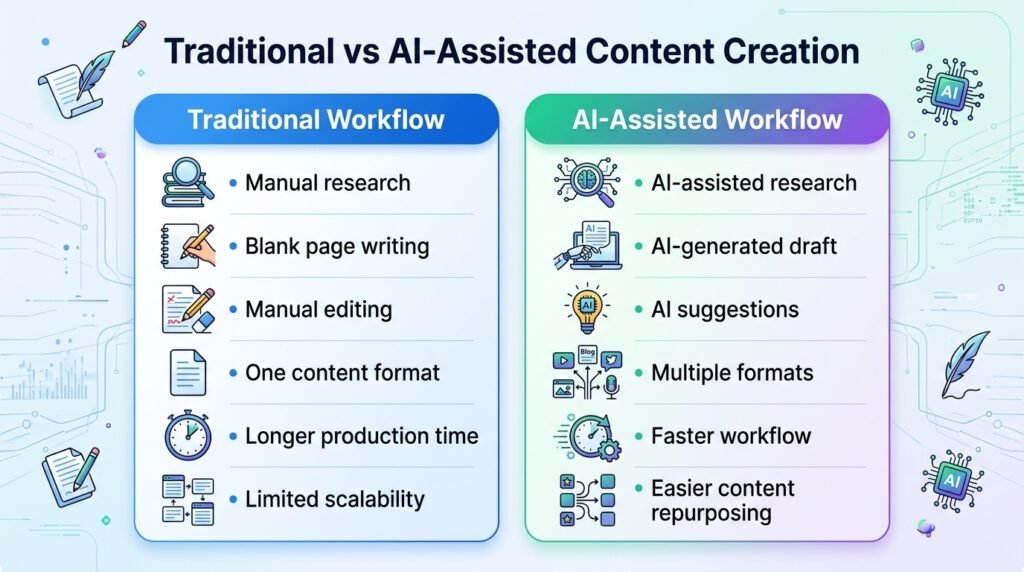
Traditional Content Creation vs AI-Assisted Content Creation
| Traditional Content Creation | AI-Assisted Content Creation |
| Research is mostly manual | AI helps summarize and organize information |
| Ideas often come from brainstorming alone | AI can generate topic ideas and outlines |
| Writing starts from a blank page | AI provides a structured first draft |
| Editing is completely manual | AI assists with grammar, readability, and tone |
| Creating multiple content formats takes significant time | AI helps repurpose content for blogs, videos, emails, and social media |
| Publishing consistently can be challenging | AI speeds up workflows and improves efficiency |
Important: AI improves productivity, but it doesn’t replace human creativity, experience, or critical thinking. The best content combines AI’s efficiency with human expertise, fact-checking, and original insights.
Real-World Example
Imagine you’re launching a new blog post about sustainable travel.
Without AI, you might spend several hours researching the topic, creating an outline, writing the article, editing it, designing graphics, and preparing social media posts.
With AI, you can use different tools to:
- Brainstorm article ideas
- Generate a structured outline
- Draft the first version
- Check grammar and readability
- Design a featured image
- Write social media captions
- Create an email announcing the article
Instead of replacing your work, AI reduces the time spent on repetitive tasks so you can focus on improving the content and adding your unique perspective.
Key Takeaway
AI offers numerous benefits for content creators, from saving time and improving productivity to enhancing creativity and simplifying complex workflows. However, the most successful creators use AI as a collaborative tool rather than relying on it to produce finished work. By combining AI’s speed with human expertise, creators can produce content that is accurate, engaging, and genuinely valuable to their audience.
Real-World Applications of AI in Content Creation
Artificial intelligence is no longer limited to technology companies or large enterprises. Today, creators across industries use AI to streamline workflows, improve efficiency, and produce engaging content at scale.
Let’s explore how AI is being used in different fields.
1. Blogging and Content Marketing
Bloggers and content marketers use AI to speed up the content creation process without sacrificing quality.
Common applications include:
- Brainstorming article ideas
- Creating detailed outlines
- Drafting blog posts
- Improving grammar and readability
- Optimizing content for SEO
- Generating meta titles and descriptions
For example, a travel blogger can use AI to generate destination ideas and create a first draft, then add personal experiences, photographs, and practical tips to make the article unique and valuable.
2. Social Media Content Creation
Managing multiple social media platforms requires a constant flow of fresh content.
AI helps creators:
- Generate captions
- Suggest hashtags
- Create post variations
- Develop monthly content calendars
- Repurpose long-form content into short posts
- Analyze audience engagement
This allows businesses and creators to maintain a consistent posting schedule while spending less time creating content manually.
3. YouTube and Video Production
Video creators use AI throughout the production process.
AI can assist with:
- Script writing
- Video outlines
- Thumbnail ideas
- Subtitle generation
- Voiceovers
- Video editing
- Content summaries
For example, a YouTuber can upload a video transcript and use AI to generate a blog post, newsletter, and several social media posts from the same content.
4. E-commerce and Online Stores
Online businesses often manage hundreds or even thousands of products.
AI helps automate content such as:
- Product descriptions
- Category pages
- Email campaigns
- Promotional copy
- Customer FAQs
- Product recommendations
This improves efficiency while ensuring product information remains clear and consistent across the website.
5. Digital Marketing
Marketing teams use AI to create and optimize campaigns more effectively.
Popular applications include:
- Ad copy generation
- Landing page content
- Email marketing
- Keyword research
- SEO optimization
- Campaign performance analysis
Rather than replacing marketers, AI enables them to test ideas more quickly and focus on strategic decision-making.
6. Education and Online Learning
Educators and course creators use AI to simplify lesson planning and improve the learning experience.
AI can help create:
- Lesson plans
- Course outlines
- Study guides
- Practice quizzes
- Presentation slides
- Learning summaries
This allows teachers to spend more time interacting with students while reducing administrative work.
7. Business Communication
Businesses increasingly rely on AI to improve internal and external communication.
Examples include:
- Business reports
- Meeting summaries
- Email responses
- Training materials
- Company newsletters
- Knowledge base articles
These applications help organizations communicate more efficiently while maintaining consistency across teams.
Real-World Examples at a Glance
| Industry | How AI Is Used |
| Blogging | Article ideas, outlines, SEO optimization, editing |
| Social Media | Captions, content calendars, hashtag suggestions |
| YouTube | Scripts, subtitles, voiceovers, video summaries |
| E-commerce | Product descriptions, email campaigns, FAQs |
| Marketing | Ad copy, landing pages, SEO content, emails |
| Education | Lesson plans, quizzes, presentations, summaries |
| Business | Reports, documentation, newsletters, internal communication |
Can AI Replace Human Content Creators?
Despite its impressive capabilities, AI is not a replacement for human creativity.
AI excels at recognizing patterns, organizing information, and generating first drafts, but it cannot replicate qualities such as:
- Personal experiences
- Original ideas
- Emotional storytelling
- Cultural understanding
- Ethical judgment
- Critical thinking
- Genuine creativity
For example, AI can help draft a travel article, but it cannot describe how it felt to watch the sunrise over the Himalayas or share lessons learned from a personal journey. Those authentic experiences are what make content memorable and trustworthy.
The most successful creators use AI as a creative partner rather than a substitute. They combine AI’s speed and efficiency with their own expertise, unique perspective, and editorial judgment to produce content that informs, inspires, and connects with readers.
Key Takeaway
AI is transforming content creation across industries, helping bloggers, businesses, educators, marketers, and creators work more efficiently. However, the highest-quality content still depends on human creativity, expertise, and authenticity. AI should be viewed as a productivity tool that enhances the creative process—not as a replacement for the people behind it.
Limitations of AI in Content Creation
While AI has made content creation faster and more accessible, it is not without limitations. Understanding these challenges is essential for using AI responsibly and producing content that is accurate, trustworthy, and genuinely valuable.
AI is most effective when it supports human creativity—not when it replaces it.
1. AI Can Generate Incorrect Information
One of the biggest limitations of AI is that it can sometimes produce information that sounds convincing but is factually incorrect or outdated. This is often referred to as an AI hallucination.
For example, an AI tool might:
- Cite a non-existent research paper
- Misinterpret statistics
- Provide outdated facts
- Invent references or quotations
For this reason, it’s important to verify AI-generated information using reliable and authoritative sources before publishing.
2. Limited Original Thinking
AI generates content by identifying patterns in the data it was trained on. While it can create new combinations of ideas, it doesn’t think, reason, or develop original opinions in the way humans do.
As a result, AI-generated content may:
- Lack unique perspectives
- Repeat common ideas
- Miss creative insights
- Struggle with nuanced topics
Adding personal experiences, industry knowledge, and expert insights makes content more original and valuable.
3. Lack of Human Emotion and Experience
Great content often connects with readers through storytelling, empathy, humor, and lived experiences.
AI can imitate different writing styles, but it cannot genuinely experience emotions or personal events.
For example, AI can describe what it’s like to start a business, but it cannot share the lessons learned from building one.
This human element is what builds trust and creates memorable content.
4. Requires Human Editing
Although AI can generate complete drafts within seconds, the output usually requires careful review before publication.
Creators should check for:
- Factual accuracy
- Grammar and clarity
- Logical flow
- Brand voice
- Consistency
- Missing context
Publishing AI-generated content without editing may reduce quality and affect reader trust.
5. Generic or Repetitive Content
Because many people use similar prompts and AI models, the generated content can sometimes feel generic or repetitive.
To stand out, creators should:
- Add original examples
- Include case studies
- Share personal experiences
- Use unique visuals
- Offer practical insights
These additions make content more engaging and difficult to replicate.
6. Privacy and Data Security Concerns
Many AI tools process user inputs on cloud-based servers. Sharing confidential or sensitive information without understanding a platform’s privacy policies could expose important business or personal data.
As a best practice, avoid entering:
- Confidential business information
- Customer data
- Passwords
- Financial records
- Personal identification details
Always review the privacy policy and data handling practices of any AI tool before using it.
7. Copyright and Ethical Considerations
The rapid growth of generative AI has raised important questions about copyright, ownership, and responsible use.
Depending on the tool and the content it generates, creators should consider:
- Copyright laws in their country
- Licensing terms of AI-generated content
- Attribution requirements
- Ethical use of AI-generated images and text
Using AI responsibly helps protect both creators and audiences while maintaining trust.
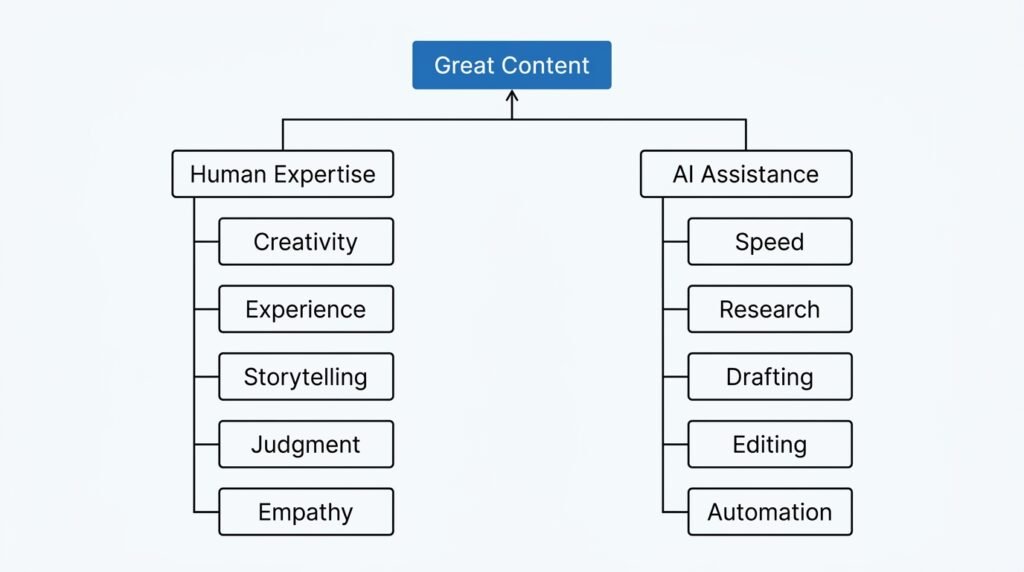
AI Works Best as a Creative Assistant
The table below summarizes where AI performs well and where human expertise remains essential.
| AI Is Good At | Humans Are Better At |
| Brainstorming ideas | Original thinking and creativity |
| Drafting content | Personal storytelling |
| Grammar and editing | Critical thinking and judgment |
| Summarizing information | Fact-checking and verification |
| Repurposing content | Understanding emotions and context |
| Automating repetitive tasks | Building trust and authentic connections |
Key Takeaway
AI is a powerful productivity tool, but it has clear limitations. It cannot replace human creativity, critical thinking, or lived experience. The most effective content combines AI’s speed and efficiency with human expertise, careful editing, and a genuine understanding of the audience.
Creators who treat AI as a collaborative assistant—not a substitute for quality—are more likely to produce content that is informative, engaging, and trustworthy.
Best Practices for Using AI in Content Creation
Using AI effectively isn’t about generating as much content as possible—it’s about creating better content more efficiently. Following a few best practices can help you maximize AI’s benefits while avoiding common pitfalls.
1. Use AI as a Starting Point
Treat AI-generated content as a first draft rather than a finished product. Let AI help with brainstorming, outlining, or drafting, then refine the content with your own expertise and insights.
2. Always Fact-Check Important Information
Before publishing, verify statistics, quotations, research findings, and factual claims using trusted sources. This is especially important for topics related to health, finance, law, and technology.
3. Add Your Own Expertise
Readers value original perspectives and practical experience. Improve AI-generated drafts by including:
- Personal experiences
- Case studies
- Industry examples
- Expert opinions
- Actionable tips
These additions make your content more unique and trustworthy.
4. Maintain Your Brand Voice
AI can adapt to different writing styles, but it may not consistently reflect your brand’s personality.
Review and edit the content to ensure it matches your tone, whether it’s professional, educational, conversational, or technical.
5. Be Transparent When Appropriate
If AI plays a significant role in your workflow, consider being transparent about how you use it—particularly in educational or professional contexts. Transparency can help build trust with your audience.
6. Continue Learning About AI
AI tools evolve rapidly, with new features and capabilities released regularly. Staying informed about these developments will help you choose the right tools and use them more effectively.
Key Takeaway
The most successful content creators don’t rely entirely on AI or avoid it altogether. Instead, they combine AI’s efficiency with human creativity, expertise, and editorial judgment. By using AI responsibly, you can create content faster while maintaining the quality, originality, and trust that readers expect.
The Future of AI in Content Creation
Artificial intelligence is evolving rapidly, and its role in content creation is expected to expand significantly in the coming years. While today’s AI tools primarily assist with writing, designing, editing, and research, future AI systems are likely to become more collaborative, personalized, and capable of handling complex creative workflows.
Rather than replacing human creators, AI will increasingly serve as a creative partner that helps individuals and teams produce higher-quality content more efficiently.
Here are some of the key trends shaping the future of AI in content creation.
1. Multimodal AI Will Become the Standard
Modern AI models are already capable of understanding and generating multiple types of content, including text, images, audio, and video.
In the future, creators will be able to produce an entire content campaign from a single prompt. For example, an AI assistant could generate:
- A blog article
- Social media posts
- Marketing emails
- Images and graphics
- Video scripts
- Podcast summaries
- Presentation slides
This unified workflow will save time and create greater consistency across platforms.
2. AI Agents Will Automate Entire Workflows
The next generation of AI is moving beyond simple chatbots toward AI agents that can complete multi-step tasks with minimal human supervision.
Instead of asking AI to perform one task at a time, creators may assign broader goals such as:
- Research a topic
- Create an article outline
- Write a first draft
- Optimize it for SEO
- Suggest images
- Schedule publication
- Repurpose it for social media
While human review will still be essential, AI agents could significantly reduce repetitive work.
3. More Personalized Content
Future AI systems will be better at adapting content to individual users based on their interests, preferences, learning styles, and behavior.
For example, educational platforms could automatically adjust lessons to match a student’s progress, while businesses could deliver personalized emails or product recommendations tailored to each customer.
This level of personalization has the potential to improve engagement and create more meaningful user experiences.
4. Better Collaboration Between Humans and AI
The future of content creation is unlikely to be AI versus humans. Instead, it will focus on AI working alongside humans.
Creators will continue to provide:
- Creativity
- Strategy
- Subject expertise
- Ethical judgment
- Personal experiences
- Emotional storytelling
AI will support them by handling repetitive tasks, organizing information, generating drafts, and improving productivity.
This collaboration allows creators to spend more time on high-value work that requires human insight.
5. Greater Focus on Responsible AI
As AI adoption grows, responsible and ethical use will become increasingly important.
Content creators should expect greater attention on:
- Transparency in AI-generated content
- Copyright and intellectual property
- Data privacy
- Bias and fairness
- Fact-checking and accuracy
Organizations that use AI responsibly are more likely to build long-term trust with their audiences.
The Future at a Glance
| Emerging Trend | What It Means for Creators |
| Multimodal AI | Create text, images, audio, and video from a single workflow |
| AI Agents | Automate complex, multi-step content creation tasks |
| Personalized Content | Deliver more relevant experiences for different audiences |
| Human-AI Collaboration | Combine AI efficiency with human creativity and expertise |
| Responsible AI | Focus on transparency, ethics, and trustworthy content |
Key Takeaway
AI will continue to reshape content creation, making it faster, more efficient, and more accessible. However, the qualities that define exceptional content—creativity, originality, expertise, empathy, and authenticity—will remain uniquely human.
Creators who embrace AI as a collaborative tool while maintaining high editorial standards will be well positioned to adapt to the evolving digital landscape.
Frequently Asked Questions (FAQs)
Can AI replace human content creators?
No. AI can automate repetitive tasks such as brainstorming, drafting, editing, and repurposing content, but it cannot replace human creativity, critical thinking, lived experience, or emotional storytelling. The best results come from combining AI with human expertise.
Is AI-generated content good for SEO?
AI-generated content can perform well in search engines if it is accurate, original, helpful, and satisfies user intent. Simply publishing unedited AI-generated text is unlikely to produce the best results. Always review, fact-check, and add unique insights before publishing.
What are the best AI tools for content creation?
The right tool depends on your needs. Popular options include:
- ChatGPT for writing and brainstorming
- Claude for long-form content
- Gemini for research and productivity
- Canva AI for graphics and presentations
- Midjourney for AI-generated images
- Grammarly for editing and proofreading
If you’re just getting started, explore our Recommended AI Tools page to compare features and choose the right tools for your workflow.
Is AI-generated content plagiarism-free?
AI-generated content is generally created from learned patterns rather than copied verbatim. However, it may sometimes produce text that is similar to existing content or include inaccurate information. Reviewing originality and verifying sources before publishing is always recommended.
Should beginners use AI for content creation?
Yes. AI can help beginners overcome writer’s block, organize ideas, and learn more efficient workflows. However, it should be viewed as a learning and productivity tool rather than a substitute for developing writing, research, and communication skills.
Continue Your AI Journey
Keep building your AI knowledge with these beginner-friendly guides.
-

10 Best AI Chatbots in 2026: Tested & Ranked for Every Use Case
Learn more : 10 Best AI Chatbots in 2026: Tested & Ranked for Every Use Case🕒 10-12 min read • Updated: July 2026 introduction Artificial intelligence has made chatbots far more capable than…
-
Claude vs ChatGPT for Coding (2026): Tested & Benchmarked for Developers
Learn more : Claude vs ChatGPT for Coding (2026): Tested & Benchmarked for Developers🕒 12-15 min read • Updated: July 2026 Introduction Whether you’re learning your first programming language, debugging a…
-

ChatGPT vs Microsoft Copilot (2026): Tested, Pricing & Workflow Comparison
Learn more : ChatGPT vs Microsoft Copilot (2026): Tested, Pricing & Workflow Comparison🕒 10-12 min read • Updated: July 2026 Introduction Choosing between ChatGPT and Microsoft Copilot can be challenging,…
-
Perplexity AI vs ChatGPT (2026): Features, Pricing & Accuracy Tested
Learn more : Perplexity AI vs ChatGPT (2026): Features, Pricing & Accuracy Tested🕒 15 min read • Updated: July 2026 Introduction Choosing between Perplexity AI and ChatGPT can be surprisingly…
-

Claude vs Gemini (2026): Tested & Compared for Coding, Writing, & Search
Learn more : Claude vs Gemini (2026): Tested & Compared for Coding, Writing, & Search🕒 15 min read • Updated: July 2026 Introduction Choosing the right AI assistant can significantly improve how…
-

ChatGPT vs Claude (2026): Tested Head-to-Head for Coding, Writing & Workflows
Learn more : ChatGPT vs Claude (2026): Tested Head-to-Head for Coding, Writing & Workflows🕒 10-12 min read • Updated: July 2026 Introduction Artificial intelligence assistants have become essential tools for students,…
Related Articles
Explore more guides and resources related to this topic.
-

ChatGPT Complete Guide for Beginners (2026): Master AI Step-by-Step
Learn more : ChatGPT Complete Guide for Beginners (2026): Master AI Step-by-Step🕒 20-25 min read • Updated: Aug 2026 Introduction Introduction Artificial intelligence is changing how people learn, work,…
-

Master Prompt Engineering in 2026: A Step-by-Step Beginner’s Guide
Learn more : Master Prompt Engineering in 2026: A Step-by-Step Beginner’s Guide🕒 18-20 min read • Updated: Aug 2026 Introduction Artificial intelligence (AI) tools like ChatGPT, Claude, Gemini, and…
-

Large Language Models (LLMs) Explained: The Complete 2026 Beginner’s Guide
Learn more : Large Language Models (LLMs) Explained: The Complete 2026 Beginner’s Guide🕒 14-16 min read • Updated: Aug 2026 Introduction Artificial Intelligence has become part of everyday life. Whether…
-

Best AI Image Generators in 2026: 10 Free & Paid Tools Tested
Learn more : Best AI Image Generators in 2026: 10 Free & Paid Tools Tested🕒 15 min read • Updated: July 2026 introduction Creating stunning images no longer requires years of design…
-
10 Best AI Chatbots in 2026: Tested & Ranked for Every Use Case
Learn more : 10 Best AI Chatbots in 2026: Tested & Ranked for Every Use Case🕒 10-12 min read • Updated: July 2026 introduction Artificial intelligence has made chatbots far more capable than…
-
ChatGPT vs Microsoft Copilot (2026): Tested, Pricing & Workflow Comparison
Learn more : ChatGPT vs Microsoft Copilot (2026): Tested, Pricing & Workflow Comparison🕒 10-12 min read • Updated: July 2026 Introduction Choosing between ChatGPT and Microsoft Copilot can be challenging,…
Recommended AI Tools
If you’re ready to start creating content with AI, explore our curated collection of beginner-friendly tools. We compare their features, strengths, and ideal use cases to help you choose the right solution for writing, design, research, and productivity.
Conclusion
Artificial intelligence is transforming the way content is planned, created, and shared. From generating ideas and writing first drafts to designing visuals and optimizing content for search engines, AI enables creators to work more efficiently and focus on producing high-value content.
However, AI is most effective when used as a creative assistant rather than a replacement for human expertise. Original thinking, storytelling, critical judgment, and personal experience remain essential for creating content that informs, engages, and builds trust.
As AI technology continues to evolve, creators who combine these human strengths with AI-powered workflows will be better equipped to produce high-quality content and adapt to the changing digital landscape.
Whether you’re a blogger, marketer, educator, business owner, or aspiring creator, learning how to use AI responsibly is becoming an increasingly valuable skill. By understanding both its capabilities and its limitations, you can leverage AI to create content that is not only more efficient but also more meaningful and impactful.
References
- Google Search Central – Creating Helpful, Reliable, People-First Content
- https://developers.google.com/search/docs/fundamentals/creating-helpful-content
- Supports your discussion on creating valuable, high-quality content.
- OpenAI – ChatGPT
- https://openai.com/chatgpt
- Useful reference when discussing AI-assisted writing and generative AI capabilities.
- Anthropic – Claude
- https://www.anthropic.com/claude
- Supports mentions of Claude as an AI writing assistant.
- Google AI – Gemini
- https://gemini.google.com/
- Reference for Google’s multimodal AI model.
- Canva – Magic Studio
- https://www.canva.com/magic-studio/
- Relevant for the section on AI-assisted design and image creation.
- Adobe Firefly
- https://www.adobe.com/products/firefly.html
- Reference for AI-generated images and creative workflows.
- Microsoft AI
- https://www.microsoft.com/ai
- Provides broader context on enterprise AI and responsible AI initiatives.
- NIST AI Risk Management Framework
- https://www.nist.gov/itl/ai-risk-management-framework
- Excellent source for your sections on responsible AI, limitations, and ethics.
Leave a Reply