
🕒 10-12 min read • Updated: July 2026
Table of Contents
Introduction
Every time you receive a fraud alert from your bank, get personalized investment recommendations, or use a chatbot for customer support, there’s a good chance artificial intelligence is working behind the scenes. AI is rapidly reshaping the financial industry by helping banks, insurers, investment firms, and fintech companies make faster decisions, reduce risk, and deliver better customer experiences.
In this beginner-friendly guide, you’ll learn what AI in finance is, why it matters, and explore 10 real-world applications used across banking, investing, fraud detection, lending, and more. We’ll also cover the key benefits, challenges, and future trends so you can understand how AI is changing the way financial services operate.
Key Takeaways
- AI is transforming banking, investing, lending, insurance, and fraud detection.
- Financial institutions use AI to automate tasks, reduce risk, and improve customer experiences.
- While AI offers major benefits, challenges like privacy, bias, and regulation remain important.
- Understanding AI in finance helps individuals and businesses prepare for the future of financial services.
| Traditional Finance | AI-Powered Finance |
|---|---|
| Manual fraud reviews | Real-time fraud detection |
| Human investment analysis | AI-assisted portfolio recommendations |
| Rule-based lending | AI credit risk models |
| Limited personalization | Personalized financial services |
| Slower customer support | AI chatbots and virtual assistants |
What Is AI in Finance?
Artificial intelligence in finance refers to the use of AI technologies to automate financial processes, analyze large volumes of data, detect patterns, and support better decision-making across banking, investing, insurance, and financial services.
Unlike traditional software that follows fixed rules, AI systems can learn from historical data, recognize patterns, and improve their performance over time. This allows financial organizations to respond more quickly to changing market conditions, customer behavior, and potential risks.
For example, when a customer makes an unusually large purchase in another country, an AI-powered fraud detection system can instantly compare the transaction with previous spending patterns. If the activity appears suspicious, the system may temporarily block the transaction and notify the customer within seconds.
Similarly, investment platforms use AI to analyze market trends, economic indicators, and historical performance to help investors make more informed decisions.
💡 Did You Know?
Every time your bank alerts you about a suspicious transaction or your budgeting app automatically categorizes your expenses, artificial intelligence is likely working behind the scenes. Many people use AI-powered financial services every day without realizing it.
Simple Example
Imagine applying for a personal loan.
Instead of manually reviewing hundreds of financial records, an AI system can quickly analyze your income, repayment history, credit score, spending habits, and other relevant factors. Within minutes, it provides the lender with a recommendation, making the loan approval process faster and more efficient while still allowing human experts to make the final decision.
Continue Learning: If you’re new to artificial intelligence, start with our What Is Artificial Intelligence? guide before exploring industry-specific applications.
How Does AI Work in Finance?
Artificial intelligence works by collecting and analyzing large amounts of financial data to identify patterns, make predictions, automate routine tasks, and support decision-making. Instead of relying solely on fixed rules, AI systems learn from historical data and continuously improve their performance as they process more information.
Financial institutions generate enormous volumes of data every day, including transactions, customer profiles, loan applications, investment records, insurance claims, and market movements. AI can process this information much faster than humans, helping organizations make quicker and more accurate decisions.
The AI Workflow in Finance
Financial Data Collection
AI begins by gathering data from multiple sources, such as:
- Bank transactions
- Credit histories
- Stock market data
- Customer interactions
- Spending patterns
- Economic indicators
- Financial statements
The more accurate and relevant the data, the better the AI system can perform.
Pattern Recognition
Machine learning algorithms analyze historical data to identify trends and relationships that might not be obvious to humans.
For example, an AI system can learn that customers who suddenly make several high-value international purchases within a short period may have experienced credit card fraud.
Similarly, AI can recognize spending habits to recommend personalized financial products or identify businesses that may face cash flow challenges.
Prediction and Risk Assessment
After identifying patterns, AI predicts future outcomes based on similar historical situations.
For example, AI can estimate:
- Whether a loan applicant is likely to repay a loan.
- Which transactions are potentially fraudulent.
- How financial markets may react to economic events.
- Which customers may require additional financial support.
These predictions help financial professionals make faster and more informed decisions.
Automation
AI also automates repetitive financial tasks that previously required significant manual effort.
Examples include:
- Processing invoices
- Reviewing insurance claims
- Categorizing business expenses
- Generating financial reports
- Responding to customer inquiries through AI chatbots
Automation reduces operational costs while allowing employees to focus on more strategic and customer-focused work.
Continuous Learning
Unlike traditional software, many AI systems continue improving over time. As they process more financial data and receive feedback on previous decisions, their models become more accurate and effective.
For example, a fraud detection system learns from newly identified fraud cases, making it better at detecting similar suspicious activities in the future.
How AI Processes Financial Data
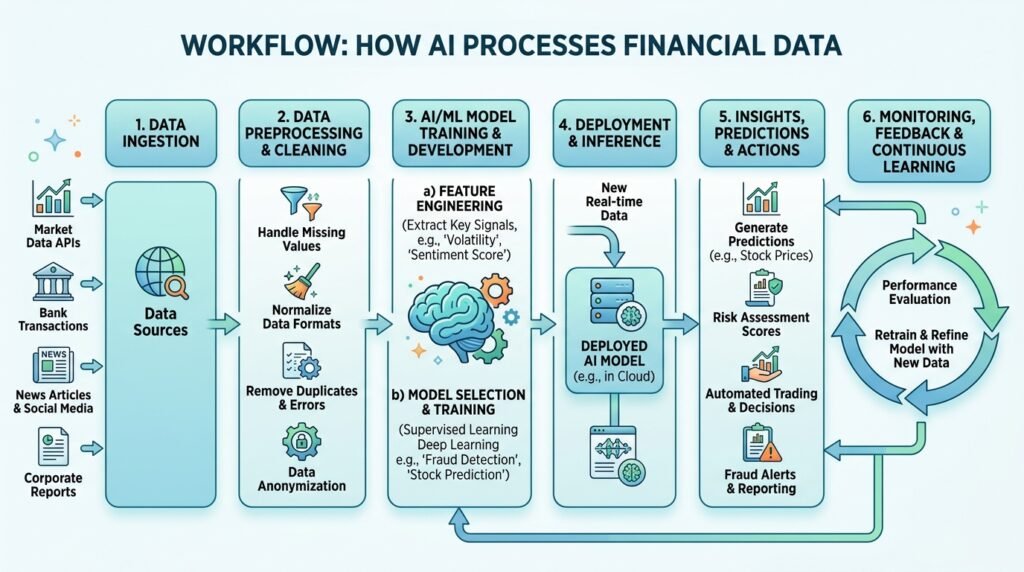
This workflow illustrates how AI transforms raw financial data into meaningful insights that help banks, insurance companies, investment firms, and businesses make faster and more reliable decisions.
Related Reading: Want to understand the technology behind these systems? Explore our guides on AI vs Machine Learning vs Deep Learning and What Is Generative AI? before learning about specific AI applications in finance.
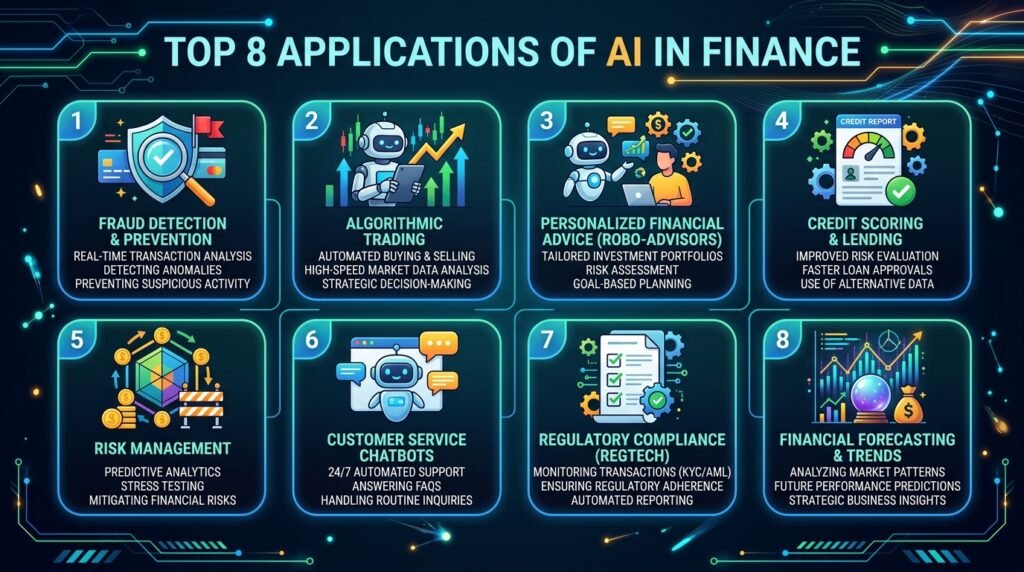
Top Applications of AI in Finance
Artificial intelligence is transforming nearly every area of the financial industry. Banks, insurance companies, investment firms, fintech startups, and businesses use AI to improve efficiency, reduce risks, and deliver better customer experiences.
Here are some of the most important real-world applications of AI in finance.
1. Fraud Detection and Prevention
One of the most common uses of AI in finance is detecting fraudulent transactions before they cause financial losses.
Traditional fraud detection systems rely on predefined rules, which can struggle to identify new or sophisticated fraud techniques. AI, however, continuously learns from millions of transactions and identifies unusual patterns in real time.
For example, if your credit card is suddenly used in another country just minutes after being used locally, an AI system may recognize the unusual behavior, temporarily block the transaction, and notify you immediately.
Benefits include:
- Real-time fraud detection
- Reduced financial losses
- Faster response to suspicious activities
- Improved customer security
2. Credit Scoring and Loan Approvals
Financial institutions use AI to evaluate loan applications more efficiently and accurately.
Instead of reviewing only a few financial factors, AI can analyze a broader range of information, including:
- Credit history
- Income
- Spending behavior
- Existing debts
- Repayment history
- Employment details
This allows lenders to assess risk more quickly while reducing manual paperwork and processing time.
Example: Many digital lending platforms can approve personal loans within minutes using AI-assisted risk assessment.
3. Algorithmic Trading
Investment firms use AI-powered algorithms to analyze vast amounts of financial data and execute trades at high speed.
AI can monitor:
- Market trends
- Stock prices
- Economic news
- Trading volumes
- Historical price movements
By processing this information in real time, AI helps traders identify potential opportunities and respond to market changes more quickly.
It’s important to note that while AI can support investment decisions, financial markets remain unpredictable, and no AI system can guarantee investment returns.
4. Personalized Banking
AI enables banks to provide more personalized services by understanding each customer’s financial behavior and preferences.
Instead of offering the same products to everyone, AI can recommend services based on individual needs.
Examples include:
- Personalized savings plans
- Credit card recommendations
- Budgeting suggestions
- Investment opportunities
- Loan offers
This creates a more relevant and convenient banking experience for customers.
5. AI-Powered Customer Support
Many banks now use AI chatbots and virtual assistants to provide instant customer support.
These systems can answer common questions, help customers check account balances, explain banking services, and assist with simple transactions 24/7.
For more complex issues, AI can transfer customers to human representatives while providing them with relevant account information, reducing waiting times and improving service quality.
6. Risk Management
Managing financial risk is one of the most important responsibilities of banks and financial institutions.
AI helps organizations identify potential risks by analyzing historical data, market conditions, and customer behavior.
For example, AI can predict:
- Loan defaults
- Market volatility
- Insurance risks
- Credit risks
- Business cash flow issues
This enables organizations to make better-informed decisions while minimizing potential losses.
7. Insurance Claims Processing
Insurance companies use AI to simplify and speed up claims processing.
AI systems can review submitted documents, detect inconsistencies, estimate damages, and identify potentially fraudulent claims.
This helps insurers process legitimate claims more quickly while reducing administrative costs.
8. Financial Forecasting and Planning
Businesses and financial professionals use AI to forecast future financial performance based on historical data and current market trends.
AI can assist with:
- Revenue forecasting
- Expense prediction
- Budget planning
- Cash flow analysis
- Business growth projections
While these predictions are valuable, they should support—not replace—human judgment, especially when making significant financial decisions.
🔑 Key Insight
AI doesn’t replace financial professionals—it enhances their ability to make faster, more accurate decisions. While AI excels at analyzing massive amounts of data, humans remain essential for strategic planning, ethical judgment, and building customer trust.
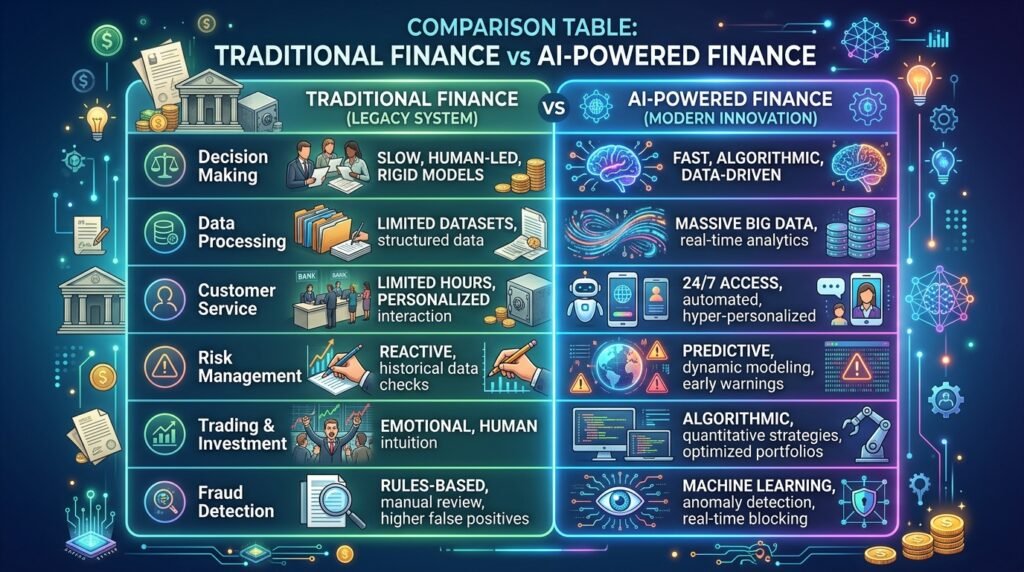
Comparison Table: Traditional Finance vs AI-Powered Finance
| Aspect | Traditional Finance | AI-Powered Finance |
| Fraud Detection | Manual reviews and rule-based systems | Real-time pattern recognition and anomaly detection |
| Loan Approval | Manual evaluation | AI-assisted credit assessment |
| Customer Support | Business hours, human agents | 24/7 AI chatbots with human escalation |
| Investment Analysis | Human research and analysis | AI-assisted market insights and data analysis |
| Risk Management | Historical reports | Predictive analytics using real-time data |
| Financial Forecasting | Spreadsheet-based estimates | AI-powered predictive models |
This comparison highlights how AI enhances traditional financial processes by improving speed, scalability, and data-driven decision-making while still relying on human expertise for oversight and strategic decisions.
Continue Learning: Many of these applications are powered by machine learning. Learn how these technologies relate in our AI vs Machine Learning vs Deep Learning guide.
Real-World Examples of AI in Finance
Artificial intelligence is no longer an experimental technology in the financial sector. Today, banks, payment providers, insurance companies, and investment firms use AI to improve efficiency, enhance security, and deliver better customer experiences. Here are some practical examples of how leading financial organizations apply AI.
JPMorgan Chase: Document Analysis
JPMorgan Chase uses AI to review complex legal documents and financial contracts. Tasks that once required many hours of manual review can now be completed much more quickly with AI-assisted document analysis.
This allows employees to spend less time on repetitive paperwork and more time on strategic decision-making and customer service.
Visa and Mastercard: Fraud Detection
Every day, Visa and Mastercard process millions of payment transactions worldwide. AI continuously monitors these transactions to identify unusual spending patterns that may indicate fraud.
For example, if a credit card is suddenly used in two different countries within a short period, AI can detect the anomaly and alert the cardholder or temporarily block the transaction until it is verified.
PayPal: Risk Analysis
PayPal uses AI to analyze user behavior and transaction patterns to reduce fraud while ensuring legitimate payments are processed smoothly.
Instead of relying only on fixed security rules, AI evaluates multiple factors—such as device information, location, purchasing history, and account activity—to assess the risk level of each transaction.
Banks Using AI Chatbots
Many banks now offer AI-powered virtual assistants that help customers perform everyday banking tasks without waiting for a human representative.
These chatbots can:
- Check account balances
- Answer frequently asked questions
- Explain banking products
- Help users reset passwords
- Guide customers through basic transactions
By handling routine inquiries, AI allows customer support teams to focus on more complex issues.
Robo-Advisors for Investment Management
AI-powered robo-advisors help individuals invest based on their financial goals, risk tolerance, and investment preferences.
After analyzing a user’s profile, these platforms can recommend diversified investment portfolios and automatically rebalance them as market conditions change.
While robo-advisors make investing more accessible, investors should still review recommendations carefully and seek professional financial advice when making significant investment decisions.
Benefits of AI in Finance
Artificial intelligence offers significant advantages for financial institutions, businesses, and consumers. By automating repetitive tasks and analyzing large volumes of data, AI enables organizations to improve efficiency while making faster and more informed decisions.
Faster Decision-Making
AI can process thousands of financial records within seconds, helping banks approve loans, assess risks, and detect fraud much faster than traditional manual methods.
Improved Fraud Detection
By continuously monitoring transactions, AI identifies suspicious activities in real time and helps reduce financial losses caused by fraud.
Better Customer Experience
AI-powered chatbots and personalized recommendations allow financial institutions to provide faster support and more relevant financial products based on individual customer needs.
Increased Efficiency
Automation reduces the time spent on repetitive administrative tasks such as document processing, invoice management, claims handling, and report generation.
This enables finance professionals to focus on higher-value activities like financial planning and strategic analysis.
More Accurate Financial Forecasting
AI analyzes historical financial data alongside current market trends to generate forecasts that support budgeting, investment planning, and business decision-making.
Although these predictions are valuable, they should complement human expertise rather than replace it.
Cost Savings
Automating routine processes helps financial institutions reduce operational costs while improving productivity and service quality.
Benefits at a Glance
| Benefit | How AI Helps |
| Faster Decisions | Processes large amounts of financial data in seconds |
| Better Security | Detects fraudulent activities in real time |
| Improved Customer Service | Provides 24/7 AI-powered assistance |
| Higher Efficiency | Automates repetitive financial tasks |
| Better Forecasting | Supports data-driven financial planning |
| Lower Costs | Reduces manual work and operational expenses |
The widespread adoption of AI is helping financial organizations become more efficient, secure, and customer-focused. However, despite these advantages, AI also introduces important challenges that businesses must address responsibly.
Challenges and Limitations of AI in Finance
While AI offers many benefits, it also presents challenges that financial institutions cannot ignore. Issues related to privacy, security, fairness, and regulatory compliance require careful planning and ongoing human oversight.
Data Privacy and Security
Financial organizations handle highly sensitive personal and financial information. AI systems must be designed with strong security measures to protect customer data from cyberattacks and unauthorized access.
Algorithmic Bias
AI models learn from historical data. If that data contains biases or inaccuracies, the AI may produce unfair or inconsistent decisions, particularly in areas such as lending or credit assessments.
Regular testing and monitoring help reduce the risk of biased outcomes.
Regulatory Compliance
Financial services operate under strict regulations that vary across countries and regions. Organizations must ensure their AI systems comply with legal requirements related to transparency, privacy, and consumer protection.
Lack of Transparency
Some advanced AI models can be difficult to interpret, making it challenging to explain why a particular decision was made.
This is especially important when AI assists with high-impact decisions such as loan approvals or insurance claims, where customers may expect clear explanations.
Human Oversight Remains Essential
AI is a powerful decision-support tool, but it should not replace human judgment in critical financial situations.
Experienced professionals are still needed to:
- Review complex cases
- Interpret AI-generated insights
- Ensure ethical decision-making
- Manage regulatory compliance
- Handle exceptional situations
The most effective financial organizations combine AI’s speed and analytical capabilities with human expertise to achieve better outcomes.
📝 Example
Imagine an AI system incorrectly flags a legitimate credit card purchase as fraudulent because it differs from your usual spending habits. While AI can detect suspicious activity quickly, human review is often needed to confirm the decision and prevent unnecessary inconvenience.
Will AI Replace Finance Jobs?
As artificial intelligence becomes more capable, many people wonder whether it will replace accountants, financial analysts, bankers, and other finance professionals. The short answer is AI is more likely to transform finance jobs than eliminate them entirely.
AI excels at automating repetitive, data-intensive tasks such as processing transactions, detecting fraud, generating reports, and analyzing large datasets. These capabilities help finance professionals work more efficiently and make faster, data-driven decisions.
However, AI cannot replace many of the uniquely human skills that are essential in finance, including:
- Strategic decision-making
- Critical thinking and problem-solving
- Building client relationships
- Negotiation and communication
- Ethical judgment
- Regulatory interpretation
- Understanding complex business contexts
For example, while AI can identify a potential investment opportunity by analyzing market data, a financial advisor must still consider a client’s goals, risk tolerance, and personal circumstances before making a recommendation.
Similarly, AI can assist accountants by automating bookkeeping and expense categorization, but accountants remain responsible for interpreting financial statements, ensuring compliance, and advising businesses on financial strategy.
Jobs Most Likely to Be Enhanced by AI
Rather than replacing professionals, AI is becoming a valuable assistant in roles such as:
- Accountants
- Financial Analysts
- Investment Advisors
- Bank Managers
- Loan Officers
- Auditors
- Risk Managers
- Insurance Professionals
Professionals who understand how to use AI effectively will likely have a competitive advantage as the finance industry continues to evolve.
Best Practices for Using AI in Finance
Organizations can gain significant benefits from AI, but successful adoption requires responsible implementation. Following these best practices helps maximize value while minimizing potential risks.
1. Use AI to Support Human Decision-Making
AI should assist professionals by providing insights and recommendations rather than making important financial decisions independently. Human expertise remains essential for interpreting results and considering broader business and ethical factors.
2. Protect Sensitive Financial Data
Financial information is highly confidential. Organizations should implement strong cybersecurity measures, encrypt sensitive data, and comply with relevant privacy regulations to protect customer information.
3. Monitor AI Systems Regularly
AI models should be reviewed and updated regularly to ensure they remain accurate, fair, and effective. Continuous monitoring also helps identify potential biases or unexpected outcomes.
4. Ensure Regulatory Compliance
Financial institutions must ensure their AI systems comply with applicable laws and industry regulations related to consumer protection, transparency, and data privacy.
5. Invest in Employee Training
As AI becomes more integrated into financial services, employees should receive training to understand AI capabilities, limitations, and responsible usage. Combining technical knowledge with financial expertise enables organizations to make better use of AI technologies.
6. Be Transparent with Customers
When AI assists with financial decisions or customer interactions, organizations should clearly communicate how AI is being used and provide opportunities for customers to speak with human representatives when necessary.
Frequently Asked Questions (FAQs)
What is AI in finance?
AI in finance refers to the use of artificial intelligence technologies to analyze financial data, automate routine tasks, detect fraud, assess risks, improve customer service, and support better financial decision-making.
How do banks use artificial intelligence?
Banks use AI for fraud detection, credit scoring, loan approvals, customer support, personalized banking, risk management, regulatory compliance, and financial forecasting.
Is AI safe to use in finance?
AI can improve security by detecting fraudulent activities and identifying potential risks more quickly than traditional methods. However, organizations must also address challenges such as data privacy, cybersecurity, and algorithmic bias through proper governance and human oversight.
Can AI predict stock market movements?
AI can analyze historical market data, news, and financial indicators to identify trends and generate forecasts. However, financial markets are influenced by many unpredictable factors, so AI cannot accurately predict stock prices with certainty.
What are the biggest benefits of AI in finance?
Some of the main benefits include:
- Faster decision-making
- Improved fraud detection
- Better customer service
- Increased operational efficiency
- More accurate financial forecasting
- Lower operational costs
Will AI replace accountants and financial analysts?
AI is expected to automate repetitive and data-driven tasks, but professionals will continue to play a critical role in strategic planning, regulatory compliance, client relationships, and complex financial decision-making.
Continue Your AI Journey
Keep building your AI knowledge with these beginner-friendly guides.
-

AI Glossary: 100+ Artificial Intelligence Terms Explained
Learn more : AI Glossary: 100+ Artificial Intelligence Terms Explained🕒 25-35 min read • Updated: Aug 2026 Introduction Artificial Intelligence (AI) is changing how we learn, work,…
-

Large Language Models (LLMs) Explained: The Complete 2026 Beginner’s Guide
Learn more : Large Language Models (LLMs) Explained: The Complete 2026 Beginner’s Guide🕒 14-16 min read • Updated: Aug 2026 Introduction Artificial Intelligence has become part of everyday life. Whether…
-

How Artificial Intelligence Works: 5 Core Concepts Explained Simply (2026 Guide)
Learn more : How Artificial Intelligence Works: 5 Core Concepts Explained Simply (2026 Guide)🕒 14-16 min read • Updated: Aug 2026 Introduction What Is Machine Learning? If Artificial Intelligence is the…
-

Artificial Intelligence Explained: The Complete Beginner’s Guide (2026)
Learn more : Artificial Intelligence Explained: The Complete Beginner’s Guide (2026)🕒 14-18 min read • Updated: Aug 2026 introduction Artificial intelligence (AI) has quickly become one of the…
-

How to Use AI in Content Creation: The Complete 2026 Blueprint
Learn more : How to Use AI in Content Creation: The Complete 2026 Blueprint🕒 10-12 min read • Updated: July 2026 Introduction Creating high-quality content consistently can be challenging, whether you’re…
-

7 Ways AI Is Transforming Software Development in 2026 (Real Workflows & Case Studies)
Learn more : 7 Ways AI Is Transforming Software Development in 2026 (Real Workflows & Case Studies)🕒 12-15 min read • Updated: July 2026 Introduction Artificial intelligence (AI) is transforming software development by helping…
Recommended AI Tools
Want to explore AI tools that can improve productivity and financial workflows? Visit our Recommended AI Tools page to discover beginner-friendly AI assistants for research, writing, data analysis, and business productivity.
Related Articles
Explore more guides and resources related to this topic.
-

ChatGPT Complete Guide for Beginners (2026): Master AI Step-by-Step
Learn more : ChatGPT Complete Guide for Beginners (2026): Master AI Step-by-Step🕒 20-25 min read • Updated: Aug 2026 Introduction Introduction Artificial intelligence is changing how people learn, work,…
-

Master Prompt Engineering in 2026: A Step-by-Step Beginner’s Guide
Learn more : Master Prompt Engineering in 2026: A Step-by-Step Beginner’s Guide🕒 18-20 min read • Updated: Aug 2026 Introduction Artificial intelligence (AI) tools like ChatGPT, Claude, Gemini, and…
-
Large Language Models (LLMs) Explained: The Complete 2026 Beginner’s Guide
Learn more : Large Language Models (LLMs) Explained: The Complete 2026 Beginner’s Guide🕒 14-16 min read • Updated: Aug 2026 Introduction Artificial Intelligence has become part of everyday life. Whether…
-

Best AI Image Generators in 2026: 10 Free & Paid Tools Tested
Learn more : Best AI Image Generators in 2026: 10 Free & Paid Tools Tested🕒 15 min read • Updated: July 2026 introduction Creating stunning images no longer requires years of design…
-

10 Best AI Chatbots in 2026: Tested & Ranked for Every Use Case
Learn more : 10 Best AI Chatbots in 2026: Tested & Ranked for Every Use Case🕒 10-12 min read • Updated: July 2026 introduction Artificial intelligence has made chatbots far more capable than…
-

ChatGPT vs Microsoft Copilot (2026): Tested, Pricing & Workflow Comparison
Learn more : ChatGPT vs Microsoft Copilot (2026): Tested, Pricing & Workflow Comparison🕒 10-12 min read • Updated: July 2026 Introduction Choosing between ChatGPT and Microsoft Copilot can be challenging,…
Conclusion
Artificial intelligence is reshaping the financial industry by helping organizations analyze data, automate routine processes, strengthen fraud detection, and deliver more personalized financial services. From banking and insurance to investment management and financial planning, AI is becoming an essential tool for improving efficiency and supporting better decision-making.
At the same time, AI is not a replacement for human expertise. Finance professionals remain indispensable for interpreting complex situations, maintaining ethical standards, ensuring regulatory compliance, and building trusted relationships with clients. The most successful organizations will be those that combine AI’s speed and analytical capabilities with human judgment and experience.
As AI technology continues to evolve, understanding how it works and where it can be applied will become an increasingly valuable skill for students, professionals, business leaders, and anyone interested in the future of finance.
References
- National Institute of Standards and Technology (NIST) – AI Risk Management Framework
- International Monetary Fund (IMF) – Artificial Intelligence and the Future of Work
- World Economic Forum (WEF) – Artificial Intelligence
- Bank for International Settlements (BIS) – AI and Machine Learning in Financial Services
- McKinsey & Company – The State of AI
Leave a Reply