
🕒 10-12 min read • Updated: July 2026
Table of Contents
Introduction
Every day, hospitals generate enormous amounts of medical data—from patient records and lab reports to medical scans and treatment histories. Analyzing all this information quickly and accurately is one of healthcare’s biggest challenges. That’s where Artificial Intelligence (AI) is making a real difference.
AI is helping doctors detect diseases earlier, personalize treatments, speed up medical research, and improve hospital operations. From identifying cancer in medical images to supporting virtual health assistants, AI is becoming an important tool across modern healthcare.
In this beginner-friendly guide, you’ll learn what AI in healthcare is, how it works, its biggest benefits and challenges, real-world applications, and why it is shaping the future of medicine.
Quick Take: AI helps healthcare professionals diagnose diseases faster, personalize treatments, automate routine tasks, and improve patient outcomes. While it won’t replace doctors, it’s becoming an essential tool that supports better medical decisions.
Key Takeaways
- AI helps healthcare professionals analyze medical data and support clinical decision-making.
- Common applications include medical imaging, disease diagnosis, personalized medicine, drug discovery, and hospital management.
- AI improves efficiency but does not replace healthcare professionals.
- Human expertise, ethics, and patient privacy remain essential for responsible AI adoption.
What Is AI in Healthcare?
AI in healthcare refers to the use of artificial intelligence technologies to assist healthcare professionals in diagnosing diseases, analyzing medical information, improving patient care, conducting research, and managing healthcare operations.
Instead of replacing doctors, AI acts as a powerful assistant that can process enormous amounts of medical information much faster than humans. It identifies patterns, highlights potential concerns, and provides insights that healthcare professionals can use alongside their own clinical expertise.
For example, when a patient undergoes an X-ray or MRI scan, AI software can analyze the image and identify areas that may require closer examination. The doctor then reviews these findings, considers the patient’s symptoms and medical history, and makes the final diagnosis.
Think of AI as a highly skilled assistant that helps healthcare teams work more efficiently—not as a substitute for medical judgment.
Continue Learning: If you’re new to AI, start with our What Is Artificial Intelligence? guide to understand the fundamentals before exploring industry-specific applications.
Why Healthcare Is a Good Fit for AI
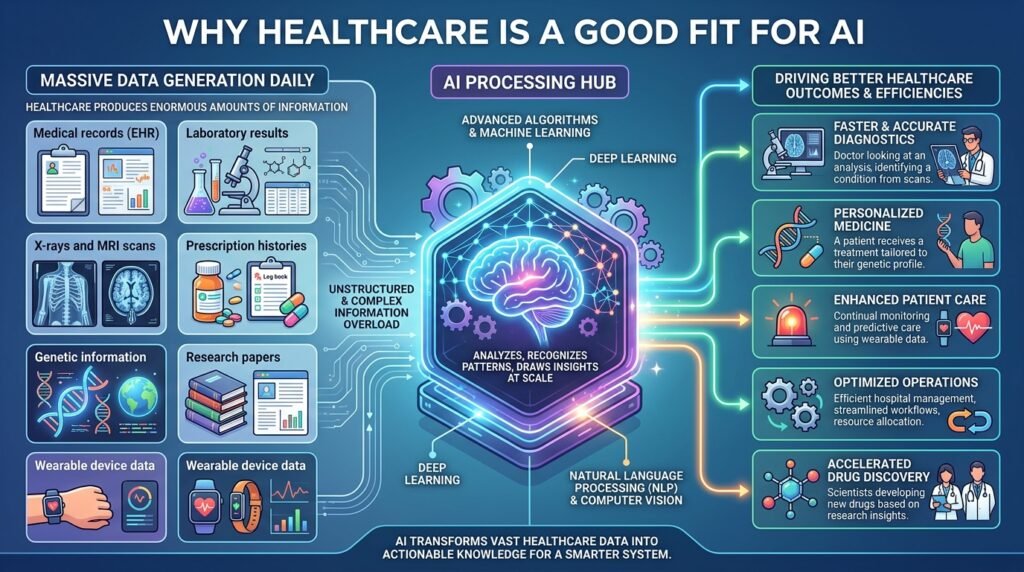
Healthcare generates enormous amounts of information every day, including:
- Medical records
- Laboratory results
- X-rays and MRI scans
- Prescription histories
- Genetic information
- Research papers
- Wearable device data
Analyzing all this information manually can be time-consuming and challenging.
AI excels at identifying patterns in large datasets, making it particularly valuable for supporting healthcare professionals in areas where speed and accuracy matter.
Instead of spending hours reviewing data, doctors can use AI-powered tools to quickly identify important information and focus more time on patient care.
How AI Is Transforming Healthcare
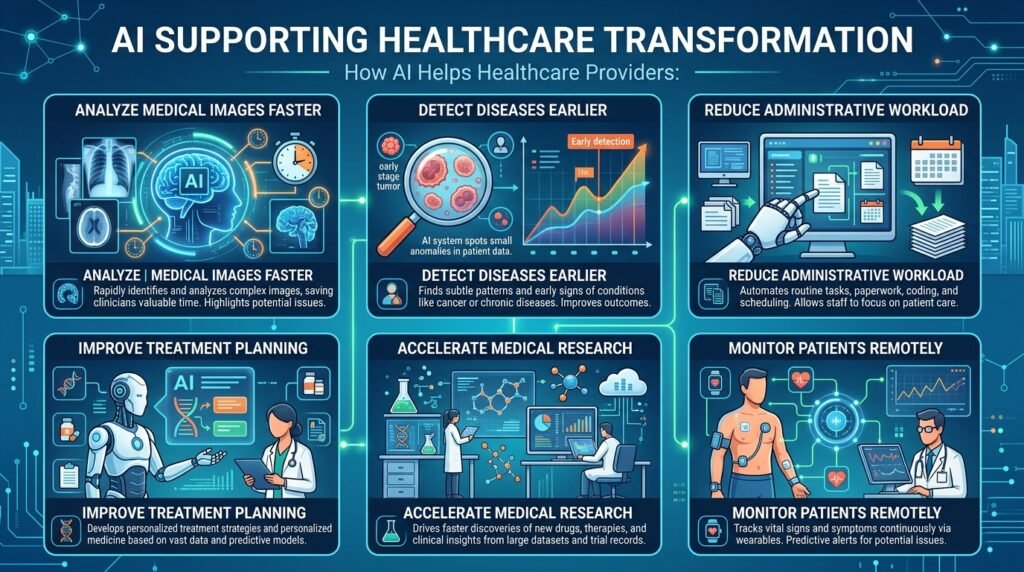
Healthcare is evolving from a reactive model—treating illnesses after they occur—to a more proactive approach that focuses on early detection, prevention, and personalized treatment.
AI supports this transformation by helping healthcare providers:
- Analyze medical images faster
- Detect diseases earlier
- Reduce administrative workload
- Improve treatment planning
- Accelerate medical research
- Monitor patients remotely
Rather than replacing healthcare professionals, AI allows them to make more informed decisions by providing data-driven insights.
Top Applications of AI in Healthcare
1. Medical Imaging
One of the most well-known applications of AI in healthcare is medical imaging.
AI systems can analyze:
- X-rays
- CT scans
- MRI scans
- Mammograms
- Ultrasound images
These systems help identify patterns that may indicate medical conditions, allowing radiologists to review images more efficiently.
For example, AI may highlight areas in an X-ray that deserve closer examination, helping specialists prioritize their review. The final interpretation and diagnosis remain the responsibility of qualified healthcare professionals.
2. Disease Diagnosis
Diagnosing diseases often requires healthcare professionals to evaluate symptoms, medical history, laboratory tests, and imaging results.
AI can assist by analyzing large amounts of clinical data and identifying patterns that may not be immediately obvious.
Examples include supporting the detection of:
- Certain cancers
- Diabetic eye disease
- Heart conditions
- Lung diseases
- Neurological disorders
These tools provide decision support, but they are used alongside—not instead of—clinical expertise.
3. Personalized Medicine
Every patient is different.
Factors such as age, genetics, lifestyle, medical history, and existing conditions can influence which treatments are most appropriate.
AI helps healthcare professionals analyze these factors to support more personalized treatment plans.
Potential applications include:
- Recommending suitable treatment options
- Predicting how patients may respond to certain therapies
- Identifying patients who may need closer monitoring
This approach aims to improve outcomes while reducing unnecessary treatments.
4. Drug Discovery and Medical Research
Developing new medicines is a complex process that can take many years.
AI is helping researchers by:
- Analyzing scientific literature
- Identifying promising drug candidates
- Predicting molecular interactions
- Prioritizing compounds for further study
While AI cannot replace laboratory research or clinical trials, it can help researchers focus their efforts more efficiently and accelerate parts of the discovery process.
AI is helping researchers analyze large datasets and identify promising drug candidates more efficiently. The National Institutes of Health (NIH) supports a wide range of research initiatives exploring AI’s role in advancing medicine.
5. Virtual Health Assistants
Many healthcare organizations now use AI-powered virtual assistants to improve patient communication.
These assistants can help with tasks such as:
- Scheduling appointments
- Sending medication reminders
- Answering common questions
- Providing educational resources
- Assisting with basic administrative requests
For complex medical concerns, patients should always consult qualified healthcare professionals.
6. Remote Patient Monitoring
Wearable devices and connected health technologies allow healthcare providers to monitor certain health indicators outside of traditional clinical settings.
AI can help analyze data collected from these devices, such as:
- Heart rate
- Physical activity
- Sleep patterns
- Blood glucose readings (where applicable)
- Other health metrics, depending on the device
By identifying unusual patterns, AI may help healthcare teams determine when a patient might benefit from further evaluation.
7. Hospital Operations and Administration
Healthcare professionals spend significant time on administrative tasks.
AI can help improve operational efficiency by assisting with:
- Appointment scheduling
- Patient triage support
- Medical documentation
- Resource allocation
- Inventory management
- Hospital workflow optimization
Reducing administrative burdens allows healthcare providers to dedicate more time to patient care.
AI in Healthcare Workflow
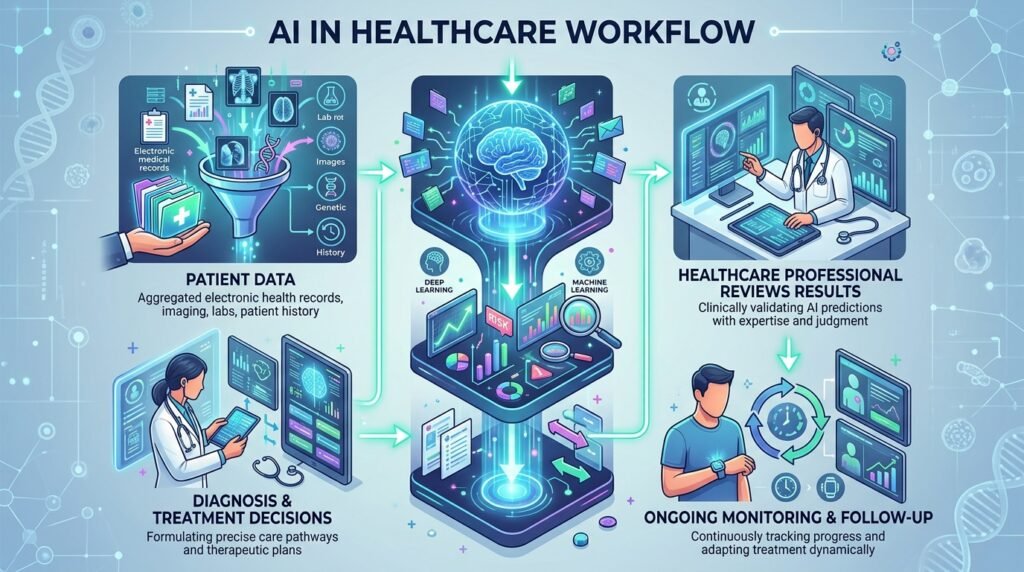
This workflow illustrates an important principle: AI supports healthcare professionals—it does not replace them.
Benefits of AI in Healthcare
Artificial intelligence is helping healthcare organizations improve efficiency, support medical professionals, and enhance patient care. While AI is not a replacement for human expertise, it offers several advantages when used responsibly alongside healthcare professionals.
1. Faster Disease Detection
AI can analyze large volumes of medical data in seconds, helping healthcare professionals identify patterns more quickly. This can support earlier detection of certain conditions and reduce the time needed to review medical images or laboratory results.
For example, AI-assisted imaging tools can help radiologists prioritize scans that may require immediate attention.
2. Improved Diagnostic Support
AI systems can compare patient information with large datasets to identify patterns that may otherwise be difficult to recognize. These insights can help doctors make more informed decisions while considering the patient’s medical history and symptoms.
It’s important to remember that AI provides decision support, not a final diagnosis.
3. Personalized Patient Care
Every patient has unique medical needs. AI can help healthcare professionals analyze factors such as medical history, lifestyle, genetics, and previous treatments to support more personalized care plans.
This can lead to treatments that are better suited to an individual’s specific circumstances.
4. Greater Efficiency
Healthcare professionals often spend a significant portion of their time on administrative work.
AI can automate repetitive tasks such as:
- Appointment scheduling
- Medical documentation
- Billing assistance
- Record organization
- Workflow management
Reducing administrative workload allows doctors and nurses to spend more time caring for patients.
5. Accelerated Medical Research
Researchers use AI to analyze scientific literature, identify trends, and prioritize promising drug candidates for further investigation.
Although laboratory testing and clinical trials remain essential, AI can help speed up parts of the research process.
6. Better Patient Monitoring
AI-powered monitoring systems can analyze data from wearable devices and remote health technologies, helping healthcare teams detect unusual changes that may require further evaluation.
This is especially useful for managing chronic conditions and supporting patients outside traditional clinical settings.
Traditional Healthcare vs AI-Assisted Healthcare
| Feature | Traditional Healthcare | AI-Assisted Healthcare |
| Data Analysis | Manual review of records | Rapid analysis of large datasets |
| Medical Imaging | Reviewed entirely by specialists | AI highlights areas for review before specialist evaluation |
| Diagnosis | Based on clinical expertise | AI provides additional decision support |
| Administrative Tasks | Mostly manual | Many repetitive tasks can be automated |
| Treatment Planning | Based on physician assessment | AI offers data-driven insights alongside physician judgment |
| Patient Monitoring | Periodic hospital visits | Continuous monitoring through connected devices (where available) |
Important: AI supports healthcare professionals by providing additional insights. Final medical decisions should always be made by qualified healthcare providers.
Challenges and Limitations of AI in Healthcare
Despite its benefits, AI also presents several challenges that healthcare organizations must address before widespread adoption.
Data Privacy and Security
Healthcare data is among the most sensitive personal information.
Organizations using AI must protect patient information through strong security measures and comply with applicable privacy regulations.
Bias in AI Systems
AI systems learn from the data used to train them.
If training data lacks diversity or contains biases, AI models may perform less accurately for certain populations.
Developing fair and representative AI systems remains an important area of ongoing research.
Lack of Human Judgment
AI can recognize patterns, but it cannot fully understand a patient’s emotions, values, personal preferences, or unique circumstances.
Doctors combine medical knowledge with empathy, communication, and clinical judgment—qualities that AI cannot replace.
Regulatory and Ethical Challenges
Healthcare AI must undergo careful evaluation before being used in clinical settings.
Governments and regulatory organizations continue developing frameworks to ensure AI systems are safe, reliable, and transparent.
Implementation Costs
Introducing AI into hospitals often requires investment in technology, staff training, cybersecurity, and ongoing maintenance.
For smaller healthcare organizations, these costs can be a significant challenge.
The responsible adoption of AI in healthcare requires strong data governance, transparency, human oversight, and regulatory compliance. Organizations such as the World Health Organization (WHO) and the U.S. Food and Drug Administration (FDA) have published guidance on the safe and ethical use of AI in healthcare.
Real-World Examples of AI in Healthcare
AI is already supporting healthcare professionals in many practical ways.
Medical Imaging
AI assists radiologists by identifying areas in X-rays, CT scans, and MRI images that may need closer examination.
Clinical Documentation
Some healthcare organizations use AI to help summarize clinical notes, reducing administrative workload while allowing clinicians to review and edit the final documentation.
Drug Discovery
Researchers use AI to analyze large biological datasets and identify promising compounds for further laboratory testing.
Remote Health Monitoring
Wearable devices can collect health information such as heart rate and activity levels. AI helps analyze these data to identify patterns that may warrant further medical review.
Hospital Operations
Healthcare facilities use AI to improve appointment scheduling, optimize staffing, and manage resources more efficiently.
Healthcare organizations are also exploring AI to improve diagnostics, streamline workflows, and enhance patient care. For example, the Mayo Clinic Center for Digital Health conducts research into practical AI applications in healthcare.
The Future of AI in Healthcare
Artificial intelligence is expected to become an increasingly important tool across healthcare, supporting professionals rather than replacing them.
Future developments may include:
- More personalized treatment recommendations
- Faster medical research
- Improved early disease detection
- Better integration of patient data
- More efficient hospital operations
- Expanded use of remote healthcare technologies
At the same time, responsible AI development will require continued attention to privacy, transparency, fairness, and human oversight.
The future of healthcare is likely to be one where AI and healthcare professionals work together, combining technological capabilities with human expertise and compassion.
Frequently Asked Questions
What is AI in healthcare?
AI in healthcare refers to the use of artificial intelligence technologies to assist healthcare professionals with tasks such as analyzing medical data, supporting diagnosis, improving workflows, and advancing medical research.
How is AI used in hospitals?
Hospitals use AI for medical imaging support, appointment scheduling, clinical documentation, patient monitoring, resource management, and decision support.
Can AI replace doctors?
No. AI is designed to assist healthcare professionals by providing insights and improving efficiency. Final medical decisions require the expertise, judgment, and communication skills of qualified healthcare providers.
What are the benefits of AI in medicine?
Some key benefits include faster data analysis, improved diagnostic support, personalized treatment planning, administrative automation, and accelerated medical research.
What are the risks of AI in healthcare?
Challenges include data privacy concerns, algorithmic bias, implementation costs, regulatory requirements, and the need for ongoing human oversight.
Conclusion
Artificial intelligence is transforming healthcare by helping professionals analyze information more efficiently, improve clinical workflows, and support medical research. From assisting with medical imaging to streamlining hospital operations, AI is becoming an important tool across many areas of healthcare.
However, AI works best when combined with the knowledge, experience, and compassion of healthcare professionals. Responsible use requires careful attention to privacy, ethics, fairness, and patient safety.
As AI technology continues to evolve, understanding its capabilities and limitations will become increasingly important for healthcare providers, patients, students, and anyone interested in the future of medicine.
Continue Learning
Expand your AI knowledge with these beginner-friendly guides:
- What Is Artificial Intelligence?
- What Is Generative AI?
- AI vs Machine Learning vs Deep Learning
- Types of Artificial Intelligence
- AI Applications: Real-World Uses of Artificial Intelligence
Recommended AI Tools
If you’d like to explore AI beyond healthcare, these beginner-friendly tools are a great place to start:
You can also explore our Recommended AI Tools page for in-depth reviews, comparisons, and beginner guides.
Related Articles
- AI in Education
- AI in Business (upcoming)
- AI Skills Development
- 25 Best AI Tools for Beginners
- How Does ChatGPT Work?
Disclaimer: This article is for educational purposes only and should not be considered medical advice. Always consult a qualified healthcare professional for diagnosis, treatment, or medical decisions.
References
- World Health Organization (WHO): Ethics and Governance of AI for Health
- U.S. Food and Drug Administration (FDA): AI/ML-Enabled Medical Devices
- National Institutes of Health (NIH): Artificial Intelligence Research
- Mayo Clinic Center for Digital Health: Artificial Intelligence
- Nature Portfolio: Artificial Intelligence Collection
Leave a Reply