
🕒 10-12 min read • Updated: July 2026
Table of Contents

Prompt engineering is one of the most valuable skills for working effectively with AI tools like ChatGPT, Claude, Gemini, and many others. However, even powerful AI models can produce poor results if the prompts they receive are unclear or incomplete.
Many beginners assume that AI “just knows” what they mean. In reality, AI models respond based on the information and instructions you provide. Small mistakes in a prompt can lead to inaccurate, generic, or inconsistent responses.
The good news is that most prompt engineering mistakes are easy to fix once you understand why they happen.
In this guide, you’ll learn the most common prompt engineering mistakes, see practical examples of each, and discover simple techniques to write better prompts that consistently produce higher-quality AI responses.
Key Takeaways
- Clear and specific prompts produce better AI responses than vague instructions.
- Providing context helps AI understand your goals and audience.
- Breaking complex tasks into smaller steps often improves accuracy.
- Reviewing and refining prompts is an essential part of prompt engineering.
- Avoiding common mistakes can significantly improve the quality of AI-generated content.
What Are Prompt Engineering Mistakes?
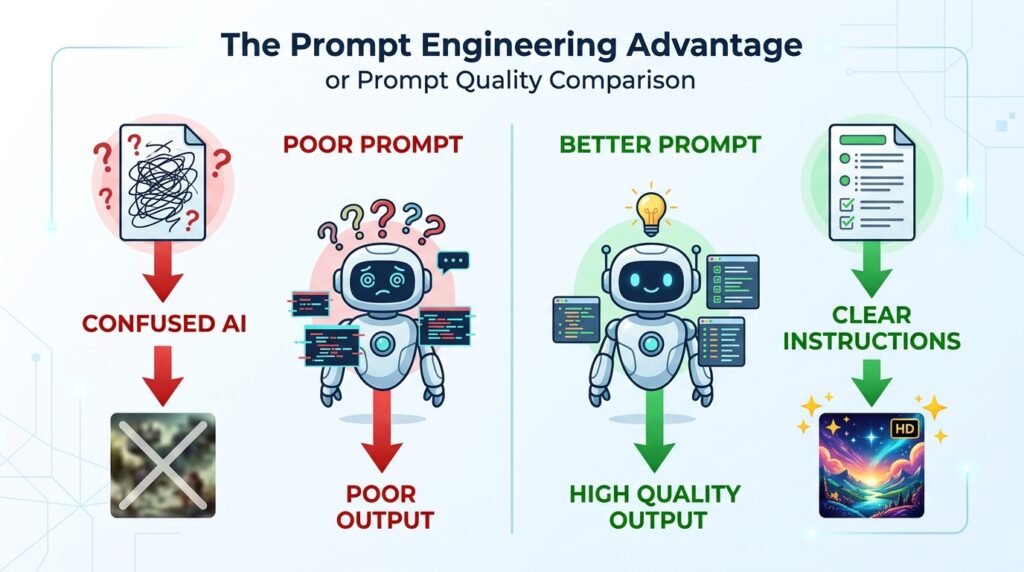
Prompt engineering mistakes are common errors people make when writing instructions for AI systems. These mistakes often confuse the model or leave too much room for interpretation, resulting in responses that don’t meet the user’s expectations.
Think of AI as an incredibly knowledgeable assistant that follows instructions literally. If your instructions are incomplete, the results will likely be incomplete as well.
For example:
Weak Prompt
Explain marketing.
The AI has no idea:
- Which type of marketing?
- Who is the audience?
- How detailed should the explanation be?
- What format is expected?
A better prompt provides this missing information.
Improved Prompt
Explain digital marketing to a complete beginner using simple language and include three real-world examples.
Notice how the second prompt gives the AI much more direction.
Why Do Prompt Engineering Mistakes Matter?
Poor prompts don’t necessarily mean the AI is performing poorly. In many cases, the issue lies in the instructions provided.
Common consequences include:
- Generic responses
- Missing information
- Incorrect assumptions
- Hallucinated details
- Inconsistent formatting
- Wasted time rewriting prompts
Learning to recognize these mistakes helps you work more efficiently with AI.
Mistake #1: Being Too Vague
The most common beginner mistake is writing prompts that are too broad.
Example
❌
Tell me about AI.
This could produce hundreds of different answers.
Better:
✅
Explain artificial intelligence to a high school student in less than 500 words with three everyday examples.
The improved version clearly defines:
- Audience
- Length
- Topic
- Style
Learn more: How to Write Better AI Prompts: 15 Practical Tips for Better Results (2026)
Mistake #2: Not Providing Context
AI performs much better when it understands why you’re asking.
Imagine asking a colleague:
Write an email.
They would immediately ask:
- To whom?
- About what?
- Formal or informal?
- What’s the goal?
AI needs the same context.
Example
Poor prompt:
Write a product description.
Better prompt:
Write a friendly product description for a reusable stainless-steel water bottle aimed at college students. Highlight durability, portability, and sustainability in about 150 words.
Adding context significantly improves relevance and usefulness.
Mistake #3: Trying to Do Everything in One Prompt
Many beginners ask AI to complete multiple complex tasks at once.
Example:
Write a blog post, create social media captions, design an email campaign, generate keywords, create FAQs, and write ad copy.
Although AI may attempt this, the quality often decreases because the request is too broad.
Instead, break the task into manageable steps.
Better Workflow
- Create the blog post.
- Review and refine it.
- Generate social media captions.
- Create an email.
- Develop SEO metadata.
Smaller, focused prompts usually produce better results.
Mistake #4: Ignoring the Target Audience
One of the biggest advantages of AI is its ability to adapt its writing style for different audiences. However, AI can only do this if you tell it who the content is for.
Without an audience, AI often produces responses that are too general or use the wrong level of complexity.
Example
Poor Prompt
Explain prompt engineering.
This response could be written for a child, a college student, or an AI researcher.
Better Prompt
Explain prompt engineering to someone with no technical background using simple language and everyday examples.
Now the AI knows:
- Who it’s writing for
- How simple the explanation should be
- What style to use
Tip: Always specify your audience whenever possible.
Examples:
- Beginner
- Student
- Business owner
- Software developer
- Marketing professional
- Teacher
Mistake #5: Not Specifying the Desired Output Format
AI can generate information in many different formats, including:
- Articles
- Bullet lists
- Tables
- Emails
- Step-by-step guides
- JSON
- Code
- FAQs
If you don’t specify the format, AI chooses one on its own—which may not be what you need.
Example
Poor Prompt
Explain the benefits of AI.
Better Prompt
Explain the benefits of AI using a markdown table with three columns:
- Benefit
- Description
- Real-world Example
Or:
Summarize the benefits of AI in five concise bullet points.
Specifying the format saves editing time and produces more consistent results.
Mistake #6: Forgetting Important Constraints
AI performs better when you define boundaries.
Examples of useful constraints include:
- Maximum word count
- Tone of voice
- Reading level
- Language
- Number of examples
- Output structure
Example
Instead of:
Write a blog introduction.
Try:
Write a 120-word introduction for a beginner-friendly AI blog using a professional but conversational tone. End with a sentence explaining what readers will learn.
This gives the AI a much clearer target.
Mistake #7: Using Contradictory Instructions
Sometimes prompts accidentally include instructions that conflict with one another.
Example
Write a detailed guide in under 100 words.
or
Keep the explanation simple but include every technical detail.
These instructions pull the AI in different directions, often leading to inconsistent responses.
Better Prompt
Write a concise beginner-friendly overview in approximately 300 words. Focus only on the most important concepts.
Clear, consistent instructions produce more reliable outputs.
Mistake #8: Assuming AI Knows Everything
AI models are powerful, but they are not all-knowing.
Depending on the model, they may:
- Have knowledge cutoffs
- Lack access to live internet data
- Misinterpret ambiguous requests
- Generate incorrect information confidently
For example:
Poor Prompt
What happened in AI yesterday?
Some models may not have access to recent news.
A better approach is:
Summarize the latest AI news based on current web information.
If your AI tool supports web browsing, enable it when researching recent events. For important topics such as legal, medical, financial, or scientific information, always verify the output using authoritative sources.
Mistake #9: Accepting the First Response Without Refining It
Prompt engineering is an iterative process.
Professional users rarely stop after the first response. Instead, they improve the conversation by asking follow-up questions or requesting revisions.
Example
Initial Prompt:
Explain machine learning.
Follow-up prompts:
- Add two real-world examples.
- Simplify the explanation.
- Compare it with deep learning.
- Create a comparison table.
- Rewrite it for business owners.
Each refinement helps the AI produce an output that better matches your needs.
Think of AI prompting as a conversation rather than a one-time command.
Mistake #10: Not Verifying AI-Generated Information
AI can occasionally produce incorrect, outdated, or fabricated information—a phenomenon often referred to as AI hallucination.
This is why human review remains essential.
Before relying on AI-generated content:
- Check important facts.
- Verify statistics.
- Confirm names, dates, and technical details.
- Review citations if provided.
- Compare information with trusted sources.
For everyday brainstorming, minor inaccuracies may not matter. However, for educational, professional, medical, legal, or financial content, verification is critical.
Mistake #11: Overcomplicating the Prompt
Some beginners assume that longer prompts are always better.
In reality, adding unnecessary complexity can make the prompt harder for the AI to interpret.
Example
Instead of writing a lengthy paragraph filled with repeated instructions, focus on the essentials:
- Goal
- Audience
- Context
- Output format
- Constraints
A clear, well-organized prompt is usually more effective than an overly detailed one.
Mistake #12: Never Experimenting
Prompt engineering is a skill that improves with practice.
There is rarely a single “perfect” prompt.
Experiment with:
- Different wording
- Different roles (“Act as a teacher…”)
- Different output formats
- Step-by-step instructions
- Follow-up refinements
Small changes can produce noticeably different results.
The more you experiment, the better you’ll understand how AI interprets instructions.
Comparison Table: Poor Prompt vs Improved Prompt
| Common Mistake | Poor Prompt | Improved Prompt |
| Too vague | Explain AI. | Explain AI to a beginner using simple language and three examples. |
| No audience | Write an article. | Write a 600-word article for small business owners. |
| No context | Create a presentation. | Create a presentation introducing AI automation for HR managers. |
| No format | Summarize this. | Summarize this in five bullet points. |
| No constraints | Write a guide. | Write a beginner-friendly guide in under 800 words using H2 headings. |
| Too many tasks | Write, edit, optimize, translate, and summarize. | Complete one task at a time for better quality. |
Best Practices for Writing Better AI Prompts
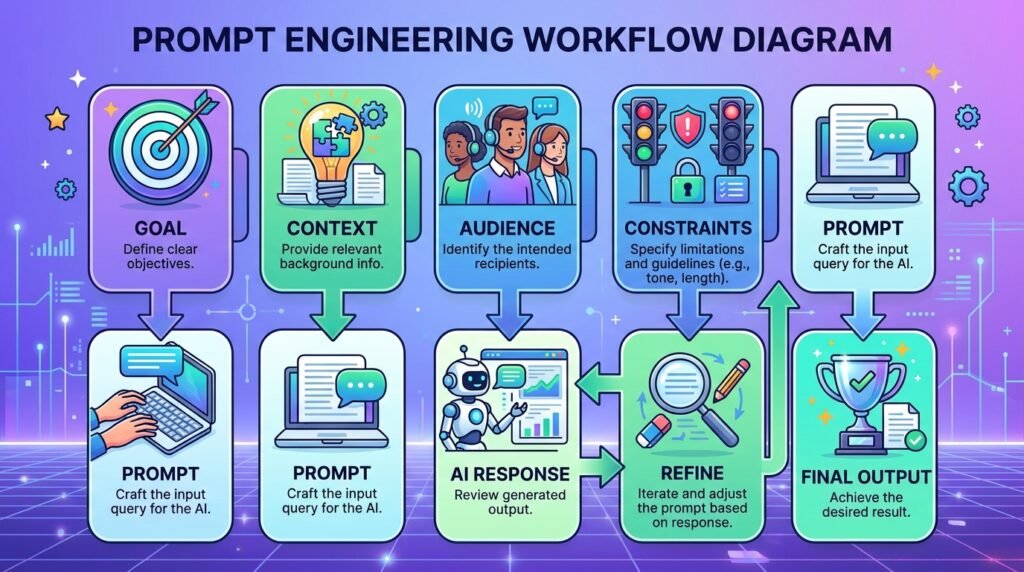
Following a few simple habits can dramatically improve your results:
- Be specific about your goal.
- Provide relevant context.
- Identify the intended audience.
- Request a preferred output format.
- Include constraints such as length or tone.
- Break complex tasks into smaller prompts. Learn more here
- Refine responses through follow-up prompts.
- Verify important information before using it.
A practical way to remember this is to think of every prompt as answering five questions:
- What do I want?
- Who is it for?
- What context does the AI need?
- What format should it use?
- Are there any constraints?
Answering these questions before submitting a prompt will help you avoid many of the common mistakes discussed in this article.
Frequently Asked Questions (FAQs)
1. What is the most common mistake in prompt engineering?
The most common mistake is writing prompts that are too vague. Without enough context or clear instructions, AI has to make assumptions, which often leads to generic or inaccurate responses. Being specific about your goal, audience, and desired format usually produces much better results.
2. Why do AI models sometimes give incorrect answers?
AI models generate responses based on patterns learned from large amounts of data. They don’t “understand” information the way humans do and can occasionally produce inaccurate or fabricated content, especially when information is ambiguous or outside their knowledge scope. Always verify important facts using trusted sources.
3. Are longer prompts always better?
No. Longer prompts are not automatically better. A clear, well-structured prompt with relevant context is usually more effective than a long prompt filled with unnecessary details. Focus on clarity rather than length.
4. How can I improve my prompts?
You can improve prompts by:
- Being specific about your objective
- Providing background information
- Identifying the target audience
- Requesting a preferred output format
- Setting constraints such as tone or length
- Refining the response through follow-up prompts
5. Should I always accept AI’s first response?
No. Prompt engineering is an iterative process. Many experienced users improve AI-generated content by asking follow-up questions, requesting revisions, or changing the prompt until the output better matches their needs.
6. Do these mistakes apply to all AI tools?
Yes. While different AI models have unique strengths, these prompt engineering principles apply broadly to tools such as ChatGPT, Claude, Gemini, Perplexity, and many other generative AI systems.
7. Can prompt engineering be learned without programming?
Absolutely. Prompt engineering primarily involves communicating clearly with AI using natural language. While technical knowledge can be helpful for advanced applications, beginners can learn and benefit from prompt engineering without any programming experience.
Conclusion
Prompt engineering isn’t about finding a single perfect prompt—it’s about learning how to communicate effectively with AI.
Many of the mistakes covered in this guide, such as being too vague, ignoring context, or skipping fact-checking, are common among beginners. Fortunately, they’re also some of the easiest to correct.
As you continue practicing, you’ll develop a better understanding of how AI interprets instructions and how small changes in your prompts can produce significantly better results.
The best way to improve is to experiment, refine your prompts, and treat AI as a collaborative assistant rather than a mind reader.
If you’re new to prompt engineering, continue building your skills by learning different prompting methods and practicing with real-world examples.
Further Reading
To deepen your understanding of prompt engineering, explore these official resources:
Leave a Reply