🕒 14-18 min read • Updated: Aug 2026
Table of Contents
introduction
Artificial intelligence (AI) has quickly become one of the most talked-about technologies in the world. From answering questions and writing emails to recommending movies and helping doctors analyze medical images, AI is changing how we live, work, and learn. Yet despite its growing presence, many people still find AI confusing or intimidating.
If you’ve ever wondered what artificial intelligence actually is, how it works, or why everyone is talking about it, you’re in the right place.
This beginner-friendly guide explains AI in simple language without assuming any technical background. Instead of overwhelming you with jargon, we’ll break down complex ideas into easy-to-understand concepts and real-world examples. By the end of this guide, you’ll understand what AI is, how it works, where it’s used, what its limitations are, and how you can start learning more about it.
Whether you’re a student, professional, business owner, or simply curious about the future of technology, this guide will help you build a strong foundation in artificial intelligence.
What Is Artificial Intelligence?
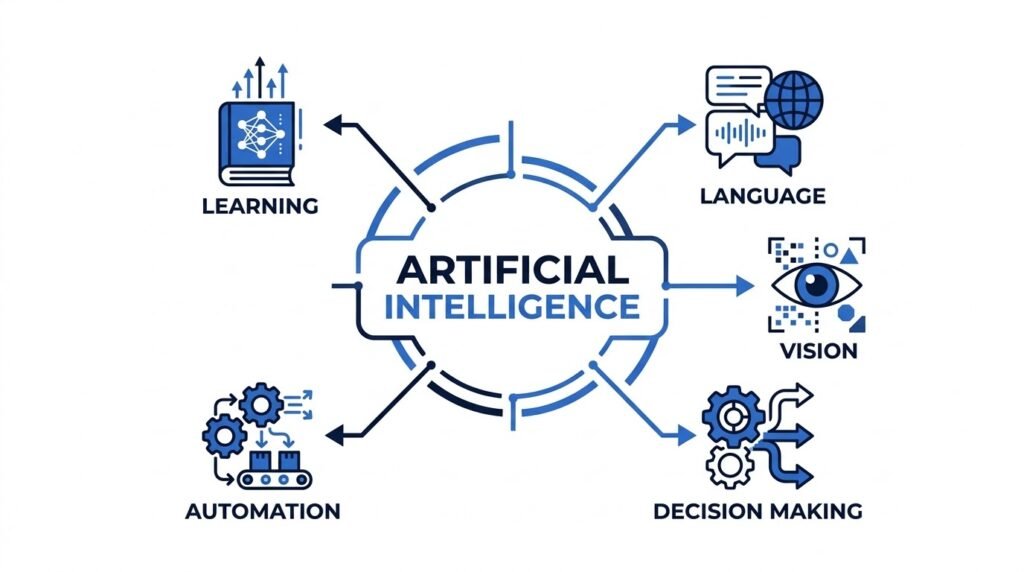
Artificial intelligence, or AI, is a branch of computer science focused on creating systems that can perform tasks that normally require human intelligence.
These tasks include:
- Understanding language
- Recognizing images and objects
- Solving problems
- Learning from data
- Making predictions
- Generating text, images, or code
- Translating languages
- Recommending products or content
Unlike traditional computer programs that follow a fixed set of instructions, many modern AI systems can identify patterns in large amounts of data and use those patterns to make decisions or generate new content.
Think of AI as teaching computers how to recognize patterns and make informed decisions, rather than telling them exactly what to do in every possible situation.
A Simple Analogy
Imagine teaching a child to recognize dogs.
You don’t explain every possible feature of every dog in the world. Instead, you show the child many examples of dogs over time. Eventually, they begin to recognize common patterns—such as fur, four legs, a tail, and a particular shape.
Modern AI learns in a similar way.
Instead of memorizing fixed rules, it analyzes large amounts of data to identify patterns. Once it has learned those patterns, it can make predictions or respond to new situations based on what it has learned.
This ability to learn from data is what makes AI so powerful.
Artificial Intelligence in Everyday Life
Many people think AI is something futuristic, but the reality is that most of us interact with AI multiple times every day—often without realizing it.
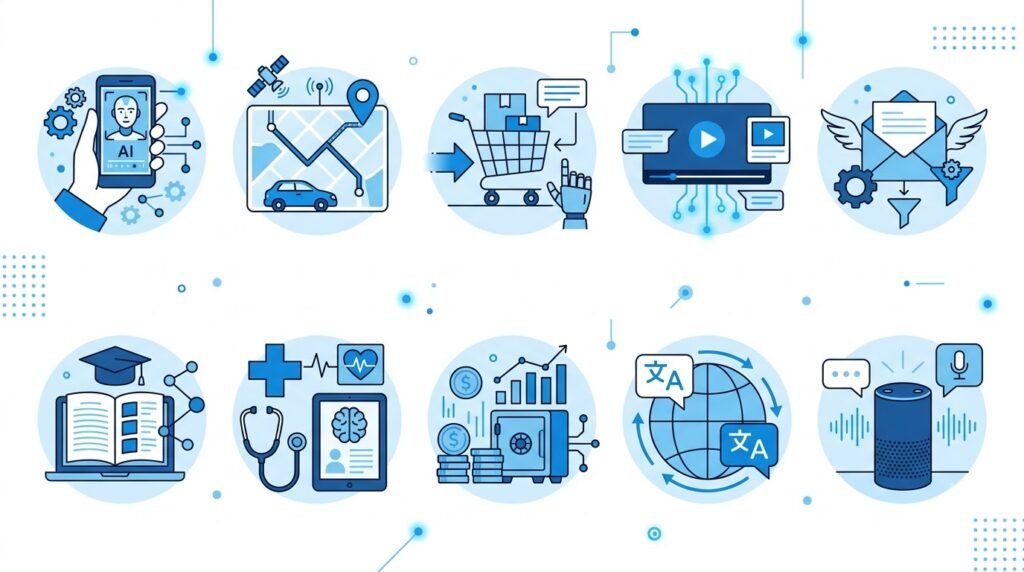
Here are some common examples:
| Everyday Activity | How AI Helps |
| Searching the web | Understands your query and ranks relevant results |
| Streaming movies | Recommends content based on your viewing habits |
| Online shopping | Suggests products you may like |
| Filters spam and prioritizes important messages | |
| Maps and navigation | Predicts traffic and finds faster routes |
| Smartphones | Improves photos, voice recognition, and battery management |
| Language translation | Translates text and speech between languages |
| Customer support | AI chatbots answer common questions instantly |
These applications demonstrate that AI isn’t a single product—it’s a technology that powers many of the digital services we use every day.
Why Is AI Becoming So Important?
Artificial intelligence can process information much faster than humans, making it valuable across many industries. Organizations use AI to automate repetitive tasks, analyze large datasets, improve decision-making, and deliver more personalized experiences.
For individuals, AI can help save time, improve productivity, spark creativity, and simplify everyday tasks.
Some of the reasons AI has become so important include:
- Growing availability of digital data
- More powerful computers and cloud computing
- Advances in machine learning and deep learning
- Better algorithms for recognizing patterns
- Increased demand for automation and efficiency
Together, these factors have accelerated AI development and made advanced tools accessible to millions of people around the world.
What Makes Artificial Intelligence Different from Traditional Software?
Traditional software follows explicit instructions written by programmers.
For example, imagine creating a calculator. Every operation—addition, subtraction, multiplication, and division—is programmed using precise rules. The software doesn’t learn anything new after it’s built.
AI works differently.
Instead of relying only on fixed rules, AI systems can learn from examples. By analyzing large datasets, they identify relationships and patterns that help them make predictions or generate responses.
Consider email spam detection.
A traditional program might block emails containing specific words. Spammers can easily work around these rules.
An AI-powered spam filter, however, analyzes thousands or even millions of emails. Over time, it learns what spam typically looks like and becomes better at identifying unwanted messages—even when the wording changes.
This ability to improve through learning makes AI more flexible than traditional software in many situations.
How Does Artificial Intelligence Work?
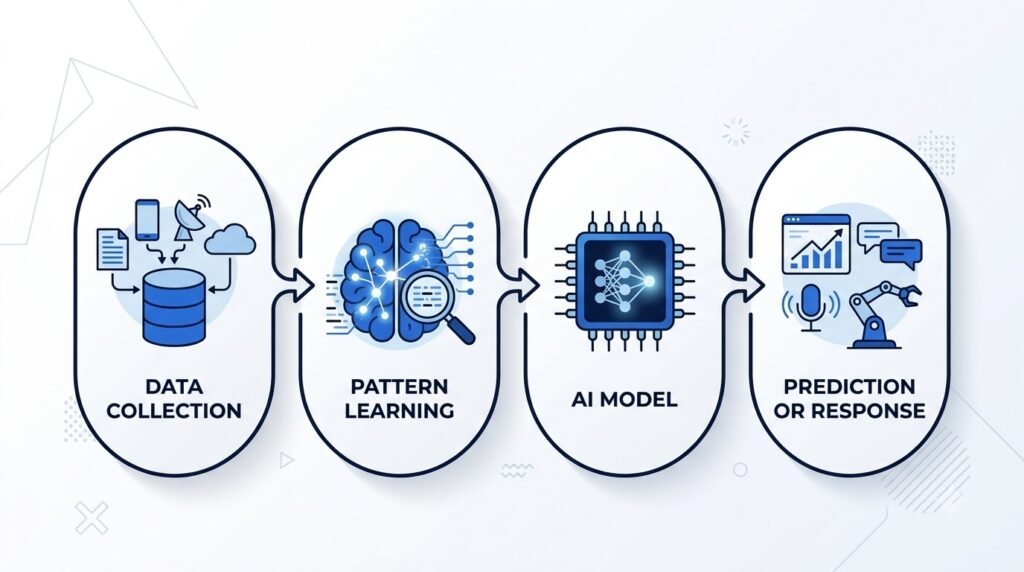
Although AI can seem mysterious, its basic process is surprisingly straightforward.
Most AI systems follow four main steps:
1. Collect Data
AI learns from data. This data can include:
- Text
- Images
- Audio
- Videos
- Numbers
- User interactions
- Sensor readings
The quality and diversity of this data play a major role in how well an AI system performs.
2. Learn Patterns
The AI analyzes the data to identify relationships, similarities, and recurring patterns.
For example, if an AI is trained to recognize cats, it studies thousands of labeled images until it learns which visual features commonly appear in pictures of cats.
3. Build a Model
The learned patterns are stored in a mathematical model. This model allows the AI to make predictions or generate responses when it encounters new information.
The model isn’t memorizing every example—it learns general patterns that can be applied to unfamiliar situations.
4. Make Predictions or Generate Responses
Once trained, the AI uses its model to analyze new inputs.
For example, it might:
- Identify an object in a photo
- Recommend a movie
- Translate a sentence
- Answer a question
- Generate an image from a text prompt
- Suggest the next word while you’re typing
As new data becomes available, some AI systems can be updated or retrained to improve their performance over time.
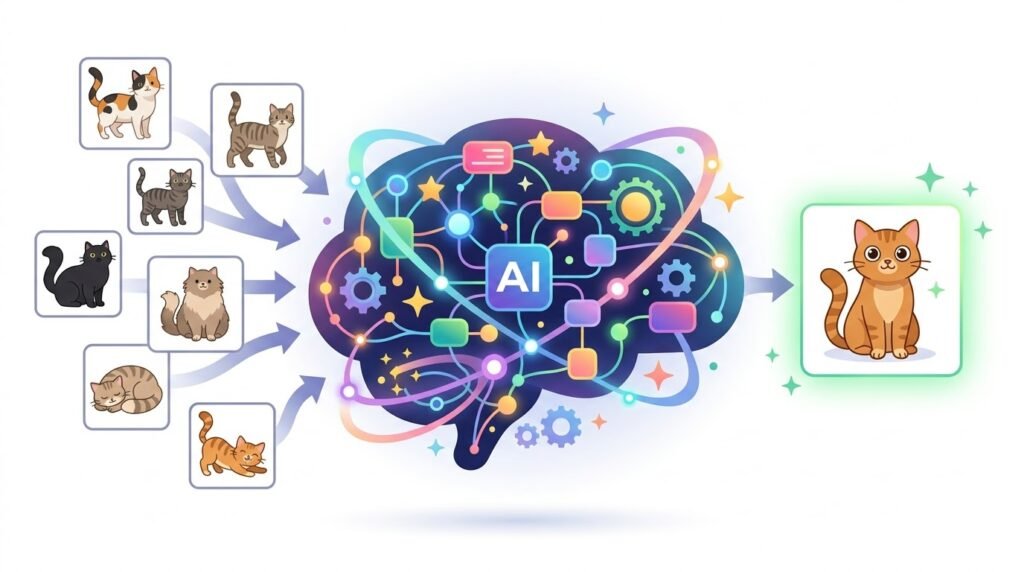
A Real-World Example: How AI Recognizes a Cat
Imagine you want to build an AI that can identify cats in photos.
The training process might look like this:
- Gather thousands of images labeled as “cat” or “not cat.”
- The AI studies these images to find patterns.
- It learns common characteristics such as ears, whiskers, eye shape, body proportions, and fur texture.
- After training, you show it a photo it has never seen before.
- Based on the patterns it learned, the AI predicts whether the image contains a cat.
Notice that the AI doesn’t “understand” what a cat is in the way humans do. It identifies statistical patterns that have proven useful during training.
This distinction is important because AI excels at pattern recognition but does not possess human understanding, emotions, or consciousness.
Key Components of Modern AI
While AI systems vary widely, many modern applications are built using several core technologies:
Machine Learning
Machine learning enables computers to improve their performance by learning from data rather than relying entirely on manually programmed rules.
It powers recommendation systems, fraud detection, predictive analytics, and much more.
Deep Learning
Deep learning is a specialized form of machine learning that uses artificial neural networks with many layers to solve complex problems.
It is especially effective for image recognition, speech recognition, natural language processing, and generative AI.
Natural Language Processing (NLP)
NLP allows computers to understand, interpret, and generate human language.
Applications include chatbots, translation tools, virtual assistants, grammar checkers, and AI writing assistants.
Computer Vision
Computer vision enables AI systems to interpret and analyze images and videos.
It is widely used in healthcare, manufacturing, autonomous vehicles, security systems, and facial recognition.
Generative AI
Generative AI creates new content rather than simply analyzing existing information.
It can generate:
- Articles
- Images
- Music
- Computer code
- Videos
- Voice recordings
Popular tools like ChatGPT, Claude, Gemini, Midjourney, and image generation models are examples of generative AI applications.
Types of Artificial Intelligence
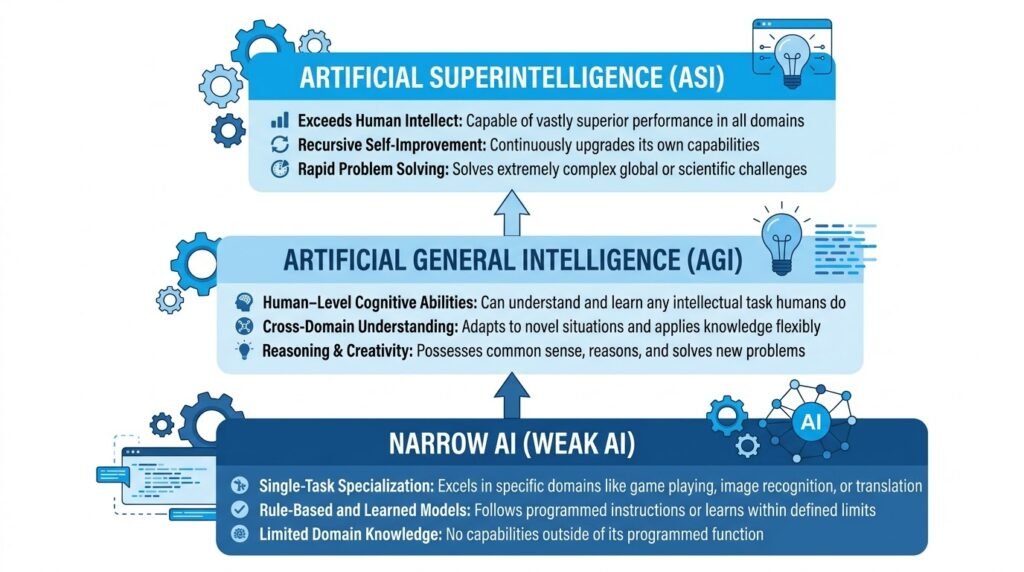
Artificial intelligence isn’t a single technology or system. It includes different categories based on what an AI system can do and how capable it is.
The two most common ways to classify AI are:
- By capabilities (what level of intelligence it has)
- By functionality (how it operates)
Understanding these classifications helps explain why today’s AI is impressive in some areas but still far from human-level intelligence.
AI Types Based on Capabilities
1. Narrow AI (Weak AI)
Narrow AI is designed to perform one specific task—or a small group of related tasks—extremely well. It cannot think beyond the purpose it was created for.
Almost every AI application you use today falls into this category.
Examples of Narrow AI
- ChatGPT answering questions
- Google Translate translating languages
- Netflix recommending movies
- Spotify suggesting playlists
- Gmail detecting spam
- Siri and Google Assistant responding to voice commands
- Face ID recognizing your face
- Chess-playing AI defeating world champions
Although these systems may appear intelligent, they don’t truly understand the world. They excel because they have been trained for specific tasks using large amounts of data.
Key Point: Today’s AI—including the most advanced chatbots and image generators—is still Narrow AI.
2. General AI (AGI)
Artificial General Intelligence (AGI) refers to a theoretical AI system that can perform any intellectual task a human can do.
Unlike Narrow AI, AGI would be able to:
- Learn new skills independently
- Solve unfamiliar problems
- Transfer knowledge between different subjects
- Reason across multiple domains
- Adapt to changing environments without retraining
For example, an AGI could write a research paper in the morning, diagnose a medical condition in the afternoon, and design a new engineering solution in the evening—all without being specifically trained for each task.
Does AGI Exist Today?
No.
Despite rapid advances in AI, there is no confirmed Artificial General Intelligence today. Current AI models can perform a wide range of tasks, but they still rely on patterns learned during training and lack true human-like reasoning, self-awareness, and understanding.
AGI remains an active area of research and debate.
3. Artificial Superintelligence (ASI)
Artificial Superintelligence (ASI) is a hypothetical stage where AI surpasses human intelligence in virtually every field.
An ASI could potentially outperform humans in:
- Scientific research
- Medical discoveries
- Engineering
- Creativity
- Strategic planning
- Decision-making
- Problem-solving
This concept is common in science fiction and philosophical discussions, but it does not exist today.
While some researchers believe ASI may be possible in the future, others question whether it can ever be achieved.
Comparison: AI by Capabilities
| Type | Exists Today? | Description | Examples |
| Narrow AI | ✅ Yes | Performs specific tasks | ChatGPT, Siri, Netflix Recommendations |
| General AI (AGI) | ❌ No | Human-level intelligence across many tasks | Research goal |
| Superintelligence (ASI) | ❌ No | Exceeds human intelligence | Theoretical concept |
AI Types Based on Functionality
Another way to classify AI is by how it processes information and responds to its environment.
1. Reactive Machines
Reactive AI responds only to the information it currently receives.
It has no memory and cannot learn from previous experiences.
Example
Imagine a chess computer that evaluates the current board position and selects the best move. It doesn’t remember previous games or improve automatically.
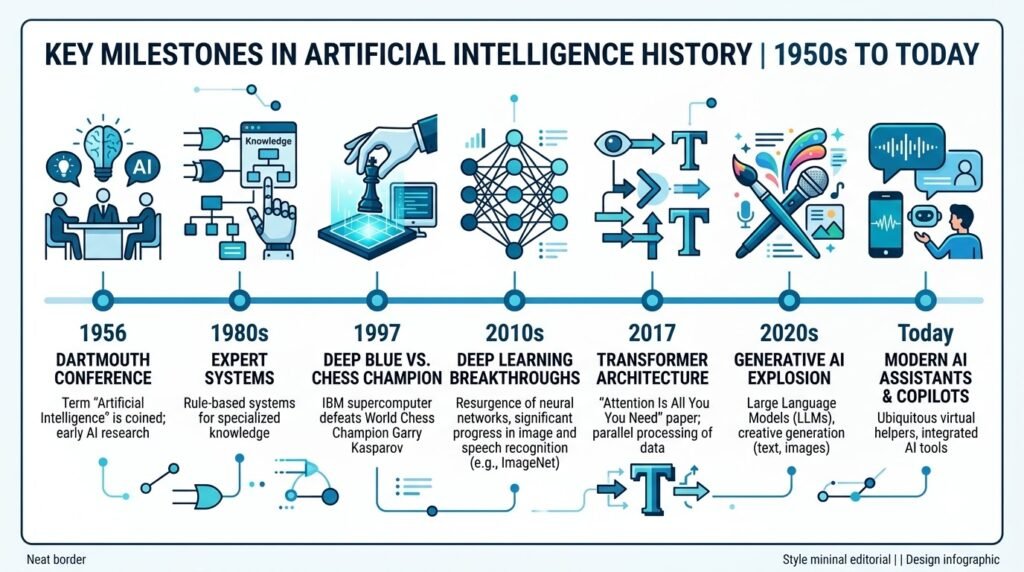
One famous example is IBM’s Deep Blue, which defeated world chess champion Garry Kasparov in 1997.
Reactive AI is excellent at narrowly defined tasks but lacks adaptability.
2. Limited Memory AI
Most modern AI systems belong to this category.
Limited Memory AI can use previous information to make better decisions.
For example:
- Self-driving cars monitor nearby vehicles and road conditions.
- Recommendation systems remember your viewing history.
- AI assistants use previous messages to maintain context during conversations.
- Fraud detection systems analyze historical transaction patterns.
Limited Memory AI can learn from data, but its memory is task-specific rather than human-like.
3. Theory of Mind AI
Theory of Mind AI refers to systems that could understand human emotions, beliefs, intentions, and social interactions.
Such AI would recognize that different people have different thoughts and feelings, allowing it to interact in more natural and empathetic ways.
Although researchers are exploring this area, practical Theory of Mind AI does not yet exist.
4. Self-Aware AI
Self-aware AI represents the idea of machines that possess consciousness, emotions, self-awareness, and subjective experiences.
This is currently a philosophical and theoretical concept rather than an existing technology.
There is no scientific evidence that today’s AI systems are conscious or self-aware.
Comparison: AI by Functionality
| Type | Exists Today? | Description |
| Reactive Machines | Limited | Responds only to current inputs |
| Limited Memory | ✅ Yes | Uses historical information to improve decisions |
| Theory of Mind | ❌ No | Understands emotions and intentions |
| Self-Aware AI | ❌ No | Possesses consciousness and self-awareness |
AI vs Machine Learning vs Deep Learning
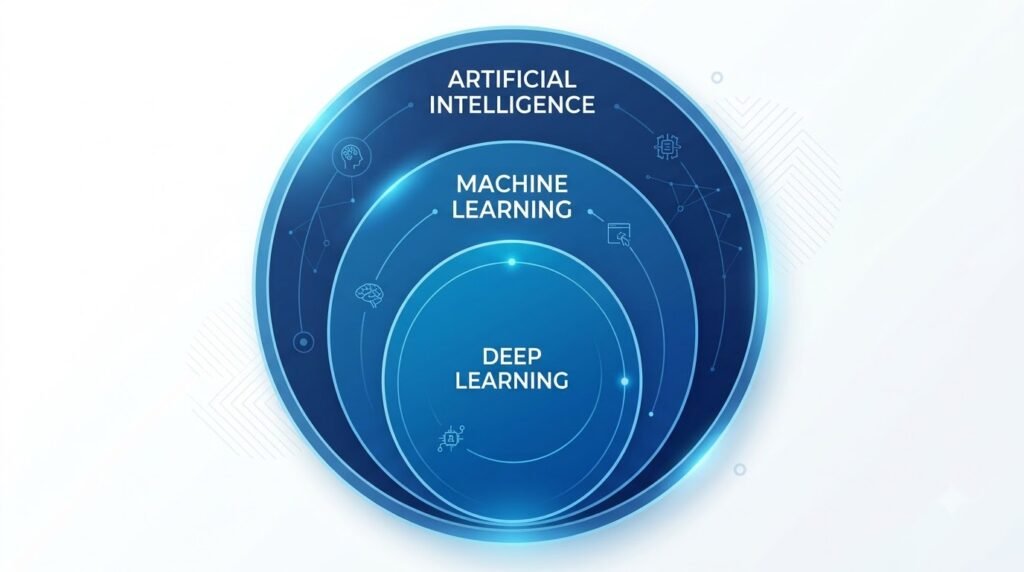
One of the biggest misconceptions about AI is that Artificial Intelligence, Machine Learning, and Deep Learning are the same thing.
They are closely related—but they are not interchangeable.
Think of them as nested layers.
Artificial Intelligence
│
├── Machine Learning
│ │
│ └── Deep Learning
- Artificial Intelligence (AI) is the broad field of creating intelligent systems.
- Machine Learning (ML) is a subset of AI where systems learn from data instead of relying solely on predefined rules.
- Deep Learning (DL) is a subset of Machine Learning that uses neural networks with many layers to solve highly complex tasks.
Simple Analogy
Imagine learning to cook:
- AI is the entire world of cooking.
- Machine Learning is learning recipes by practicing and improving.
- Deep Learning is becoming an expert chef who can recognize complex patterns in flavors and techniques.
Comparison Table
| Feature | Artificial Intelligence | Machine Learning | Deep Learning |
| Scope/image | Broad field | Subset of AI | Subset of ML |
| Learns from data | Sometimes | Yes | Yes |
| Requires training data | Not always | Usually | Usually large datasets |
| Handles complex patterns | Limited | Good | Excellent |
| Common applications | Robotics, planning, search | Recommendations, fraud detection | Image recognition, speech, generative AI |
Where Does Generative AI Fit?
Generative AI is one of the fastest-growing areas of artificial intelligence.
Unlike traditional AI systems that classify or predict information, generative AI creates new content based on patterns learned from large datasets.
It can generate:
- Text
- Images
- Videos
- Music
- Computer code
- Presentations
- Voice recordings
When you ask ChatGPT to explain a topic, Midjourney to create an illustration, or an AI coding assistant to write code, you’re using generative AI.
Most modern generative AI systems are powered by deep learning, particularly large neural networks trained on enormous datasets.
This is why generative AI can produce surprisingly natural and creative outputs—but it can also make mistakes, misunderstand prompts, or generate inaccurate information.
Key Takeaways
- Nearly all AI systems used today are Narrow AI.
- Artificial General Intelligence (AGI) and Superintelligence (ASI) remain theoretical concepts.
- Most practical AI applications use Limited Memory AI.
- Machine Learning is a subset of AI, while Deep Learning is a subset of Machine Learning.
- Generative AI is a modern application of deep learning that creates new content instead of simply analyzing existing information.
Real-World Applications of Artificial Intelligence
Artificial intelligence is no longer limited to research labs or large technology companies. Today, it powers many of the products and services we use every day, often working quietly in the background to improve speed, accuracy, and convenience.
From helping students learn more effectively to assisting doctors with medical diagnoses, AI is transforming nearly every industry.
Let’s explore some of the most common real-world applications of AI and understand how they create value.
AI in Everyday Life
You may not realize it, but you probably interact with AI dozens of times each day.
Here are a few familiar examples:
| Activity | How AI Helps |
| Searching on Google | Understands search intent and ranks relevant results |
| Watching Netflix | Recommends movies and TV shows based on your preferences |
| Shopping online | Suggests products you may be interested in |
| Using Google Maps | Predicts traffic and recommends faster routes |
| Unlocking your phone | Recognizes your face or fingerprint |
| Filters spam and prioritizes important messages | |
| Voice assistants | Answers questions and performs tasks using natural language |
| Social media | Personalizes your feed based on your interests |
These systems use AI to analyze patterns and make predictions that improve your experience.
AI in Education
Artificial intelligence is making learning more personalized and accessible.
Instead of offering the same experience to every student, AI can adapt lessons based on individual progress, learning style, and performance.
Common Applications
- Personalized learning platforms
- AI tutors available 24/7
- Automated quiz generation
- Grammar and writing assistance
- Language learning tools
- Research assistants
- Lecture transcription
- Study planning
Example
A student struggling with algebra can receive additional practice questions and explanations tailored to their skill level, while another student moves on to more advanced topics.
AI helps create a learning experience that adapts to individual needs rather than following a one-size-fits-all approach.
AI in Healthcare
Healthcare professionals use AI to support diagnosis, improve patient care, and accelerate medical research.
Importantly, AI is designed to assist healthcare providers, not replace them.
Common Applications
- Medical image analysis
- Disease prediction
- Drug discovery
- Virtual health assistants
- Patient monitoring
- Hospital workflow optimization
- Clinical documentation
- Personalized treatment recommendations
Example
An AI system can analyze thousands of X-rays or MRI scans to highlight areas that may require closer examination by a radiologist, helping doctors work more efficiently.
AI in Business
Businesses use AI to automate repetitive tasks, improve customer experiences, and make better decisions using data.
Common Applications
- Customer support chatbots
- Sales forecasting
- Inventory management
- Document summarization
- Meeting transcription
- Email drafting
- Workflow automation
- Data analysis
Example
A customer support chatbot can answer frequently asked questions instantly, allowing human agents to focus on more complex issues.
This improves response times while reducing operational costs.
AI in Marketing
Marketing teams increasingly rely on AI to understand customer behavior and create more effective campaigns.
Applications
- Personalized email campaigns
- Content generation
- Keyword research
- Social media scheduling
- Audience segmentation
- Ad optimization
- Customer sentiment analysis
- SEO assistance
Example
An online store can recommend products based on previous purchases, increasing the likelihood that customers will find items they’re interested in.
AI in Finance
Financial institutions process enormous amounts of data every day. AI helps identify patterns that would be difficult for humans to detect quickly.
Applications
- Fraud detection
- Credit risk assessment
- Investment analysis
- Customer service
- Budget planning
- Expense categorization
- Algorithmic trading
- Financial forecasting
Example
If a credit card is suddenly used in another country minutes after being used locally, AI can detect this unusual activity and flag the transaction for review.
AI in Transportation
Transportation companies use AI to improve safety, optimize routes, and reduce delays.
Applications
- Navigation systems
- Traffic prediction
- Route optimization
- Fleet management
- Driver assistance systems
- Autonomous vehicle research
- Predictive maintenance
Example
Navigation apps analyze real-time traffic data from millions of users to recommend the fastest available route.
AI in Manufacturing
Factories use AI to improve quality control and increase efficiency.
Applications
- Predictive equipment maintenance
- Product quality inspection
- Robotics
- Supply chain optimization
- Demand forecasting
- Energy management
Example
Instead of waiting for a machine to fail, AI analyzes sensor data to predict when maintenance is needed, reducing downtime and repair costs.
AI in Cybersecurity
As cyber threats become more sophisticated, AI plays an increasingly important role in protecting digital systems.
Applications
- Detecting unusual network activity
- Identifying malware
- Preventing phishing attacks
- Monitoring user behavior
- Automated threat detection
- Incident response support
Example
AI can recognize login attempts that differ significantly from a user’s normal behavior, helping organizations detect potential security breaches early.
AI in Creative Work
One of the most exciting developments in recent years is the rise of generative AI, which helps people create new content.
Rather than replacing creativity, AI often serves as a collaborative assistant.
Applications
- Writing articles and emails
- Designing graphics
- Generating illustrations
- Editing photos
- Producing music
- Creating videos
- Writing computer code
- Brainstorming ideas
Example
A graphic designer might use AI to generate several concept sketches in minutes, then refine the best ideas using their own creative expertise.
AI in Scientific Research
Researchers use AI to analyze massive datasets and uncover patterns that would take humans much longer to identify.
Applications
- Protein structure prediction
- Climate modeling
- Astronomy
- Genomics
- Drug discovery
- Materials science
- Environmental monitoring
AI accelerates research by helping scientists focus on interpretation and experimentation rather than manual data analysis.
AI in Agriculture
Farmers are increasingly adopting AI to improve crop yields and reduce waste.
Applications
- Crop health monitoring
- Soil analysis
- Weather forecasting
- Pest detection
- Smart irrigation
- Yield prediction
- Livestock monitoring
These technologies help farmers make more informed decisions while using resources more efficiently.
AI in Customer Service
Many businesses now provide instant support through AI-powered assistants.
Applications
- Frequently asked questions
- Order tracking
- Appointment scheduling
- Product recommendations
- Technical support
- Multilingual communication
When a request becomes more complex, the conversation can be handed over to a human support representative.
This combination of AI and human expertise improves both efficiency and customer satisfaction.
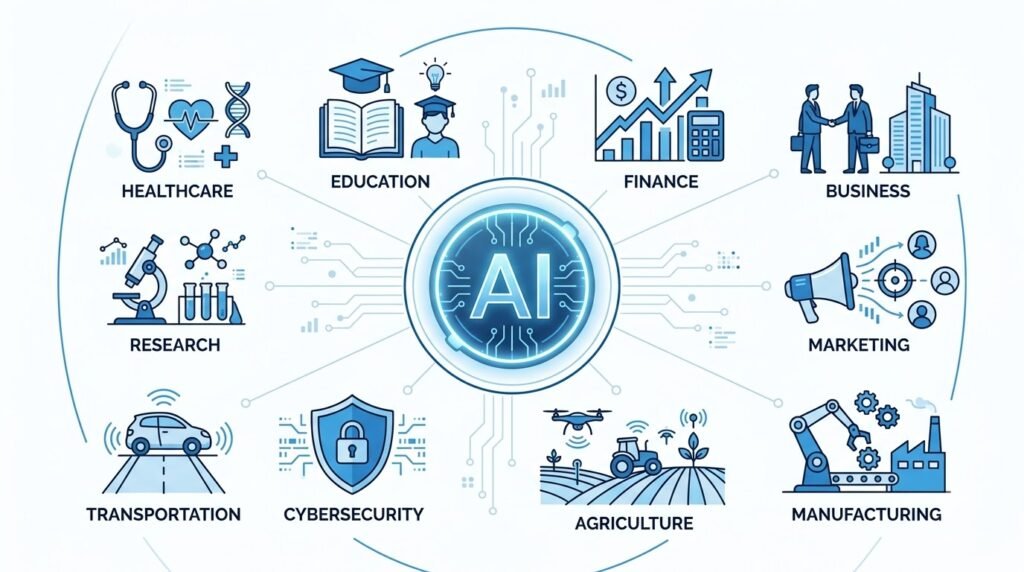
AI Across Industries at a Glance
| Industry | Common AI Applications | Benefits |
| Education | AI tutors, personalized learning | Better learning outcomes |
| Healthcare | Diagnosis support, medical imaging | Faster and more accurate analysis |
| Business | Automation, analytics | Increased productivity |
| Marketing | Content creation, personalization | Improved customer engagement |
| Finance | Fraud detection, forecasting | Better risk management |
| Transportation | Navigation, route optimization | Reduced travel time |
| Manufacturing | Predictive maintenance | Lower costs and downtime |
| Cybersecurity | Threat detection | Enhanced digital security |
| Research | Data analysis, simulations | Faster scientific discoveries |
| Agriculture | Smart farming | Higher efficiency and sustainability |
How AI Is Changing the Workplace
AI is transforming the way people work by automating repetitive tasks and assisting with complex decision-making. Rather than replacing every job, AI is more often changing how work gets done.
For example:
- Writers use AI to brainstorm ideas and draft content.
- Developers use AI coding assistants to speed up programming.
- Teachers create lesson plans with AI support.
- Marketers analyze campaign performance more efficiently.
- Customer service teams handle routine inquiries through AI chatbots.
- Business analysts summarize reports in minutes instead of hours.
As AI takes over repetitive work, human skills such as critical thinking, creativity, communication, ethical judgment, and problem-solving become even more valuable.
Tip for Beginners: Learning how to work with AI is becoming an essential digital skill across many careers.
Best Practices for Using AI Responsibly
AI is a powerful tool, but it’s most effective when used thoughtfully.
Here are a few best practices:
- Verify important information. AI can make mistakes or provide outdated information.
- Protect sensitive data. Avoid sharing confidential, personal, or proprietary information with AI tools unless you understand their privacy policies.
- Use AI as an assistant, not a replacement. Human judgment is still essential for important decisions.
- Write clear prompts. The quality of AI outputs often depends on the clarity of your instructions.
- Review AI-generated content. Check for accuracy, tone, bias, and completeness before publishing or acting on it.
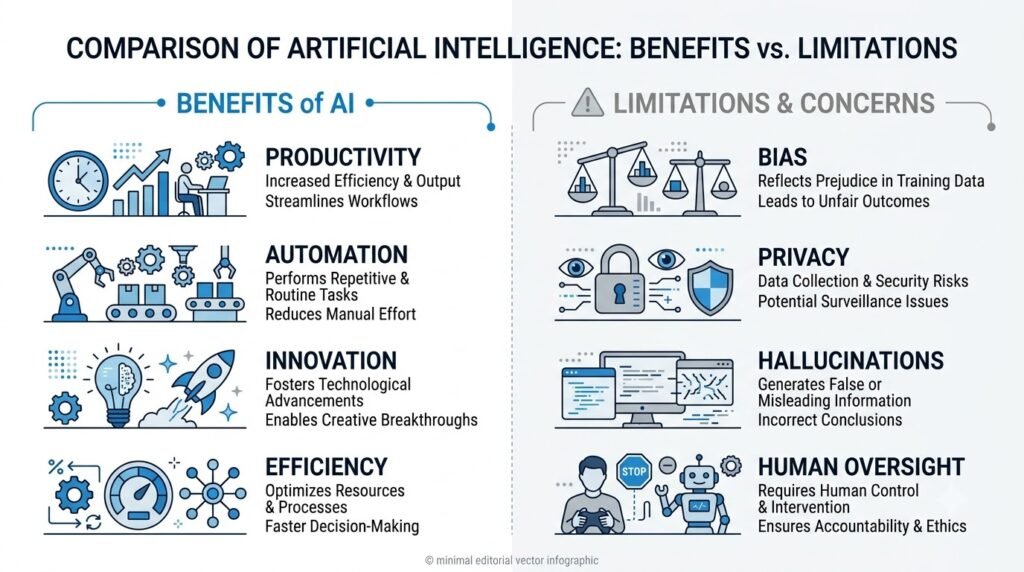
Benefits and Limitations of Artificial Intelligence
Artificial intelligence has the potential to improve productivity, accelerate innovation, and solve problems at a scale that would be difficult for humans alone. However, AI is not a perfect technology.
Like any tool, it has strengths and weaknesses.
Understanding both sides is essential for using AI effectively and responsibly.
Benefits of Artificial Intelligence
1. Automates Repetitive Tasks
One of AI’s biggest advantages is its ability to automate routine and repetitive work.
Tasks that once required hours of manual effort can often be completed in minutes.
Examples
- Sorting emails
- Scheduling appointments
- Organizing documents
- Data entry
- Meeting transcription
- Invoice processing
This allows people to spend more time on creative thinking, strategic planning, and problem-solving.
2. Improves Productivity
AI can assist professionals across almost every industry.
Instead of replacing expertise, it often enhances it.
For example:
- Writers generate outlines faster.
- Developers receive coding suggestions.
- Designers brainstorm visual concepts.
- Researchers summarize lengthy reports.
- Teachers prepare lesson plans more efficiently.
AI reduces repetitive work while helping users accomplish more in less time.
3. Processes Large Amounts of Data Quickly
Humans can only analyze so much information at once.
AI can examine millions of records, identify patterns, and generate insights in a fraction of the time.
This makes AI especially valuable in fields such as:
- Healthcare
- Finance
- Scientific research
- Cybersecurity
- Climate science
- Manufacturing
4. Supports Better Decision-Making
AI helps people make more informed decisions by identifying trends that may not be immediately obvious.
Examples include:
- Predicting customer demand
- Detecting fraudulent transactions
- Forecasting weather
- Optimizing delivery routes
- Recommending medical treatments
It’s important to remember that AI provides recommendations, not guarantees. Human oversight remains essential, especially in high-stakes situations.
5. Personalizes User Experiences
Many digital services use AI to create personalized experiences.
Examples include:
- Movie recommendations
- Music playlists
- Shopping suggestions
- Learning platforms
- News feeds
Personalization helps users discover relevant content more efficiently.
6. Works Continuously
Unlike humans, AI systems can operate around the clock without needing breaks.
This makes AI useful for:
- Customer support
- Security monitoring
- Manufacturing
- Healthcare systems
- Online services
Continuous operation improves responsiveness and efficiency.
7. Accelerates Innovation
AI is helping researchers solve problems faster than ever before.
Applications include:
- Drug discovery
- Climate modeling
- Material science
- Space exploration
- Protein structure prediction
By analyzing enormous datasets, AI allows scientists to focus on experimentation and discovery.
Summary of AI Benefits
| Benefit | Why It Matters |
| Automation | Saves time on repetitive tasks |
| Productivity | Helps people work more efficiently |
| Data Analysis | Finds patterns in large datasets |
| Decision Support | Provides insights for better choices |
| Personalization | Delivers tailored experiences |
| Continuous Operation | Available 24/7 |
| Innovation | Speeds up research and discovery |
Limitations of Artificial Intelligence
Despite its impressive capabilities, AI has significant limitations.
Understanding these limitations helps set realistic expectations and encourages responsible use.
1. AI Doesn’t Truly Understand Information
One of the biggest misconceptions is that AI “understands” information the way humans do.
In reality, modern AI identifies statistical patterns in data.
It predicts the most likely response based on what it learned during training.
This means AI can generate convincing answers without actually understanding concepts, emotions, or experiences.
2. AI Can Make Mistakes
AI systems sometimes produce incorrect or misleading information.
These errors are often called hallucinations in the context of generative AI.
For example, an AI assistant might:
- Invent facts
- Misquote sources
- Generate incorrect statistics
- Cite non-existent research papers
For this reason, it’s important to verify important information using reliable sources.
3. AI Depends on Data Quality
The quality of an AI system depends heavily on the data it was trained on.
Poor-quality or biased data can lead to inaccurate or unfair results.
For example:
- Incomplete medical data may reduce diagnostic accuracy.
- Biased hiring data may lead to unfair recruitment recommendations.
- Poor-quality images may reduce recognition accuracy.
“Garbage in, garbage out” applies to AI just as much as traditional software.
4. AI Lacks Common Sense
Humans naturally use context, experience, and common sense when making decisions.
AI often struggles with situations that fall outside its training or require nuanced reasoning.
For example, a person understands that:
“It’s raining cats and dogs.”
is an idiom meaning heavy rain, not actual animals falling from the sky.
Without sufficient context, AI may misinterpret figurative language or cultural references.
5. AI Cannot Replace Human Judgment
AI can assist with decision-making, but it should not replace human expertise in critical situations.
Examples include:
- Medical diagnosis
- Legal advice
- Financial planning
- Engineering safety
- Public policy
Professionals should use AI as a decision-support tool rather than an unquestionable authority.
6. Privacy and Security Concerns
Many AI tools process user data to generate responses or improve their services.
Users should be cautious when sharing:
- Personal information
- Financial records
- Medical details
- Confidential business information
- Proprietary documents
Always review an AI provider’s privacy policy and data-handling practices before uploading sensitive information.
7. Bias and Fairness Challenges
AI learns from historical data, which may contain existing human biases.
As a result, AI systems can unintentionally produce unfair outcomes if these biases are not identified and addressed.
Developers increasingly use testing, monitoring, and diverse datasets to improve fairness, but eliminating bias entirely remains an ongoing challenge.
8. AI Requires Human Oversight
Even advanced AI systems benefit from human review.
People remain responsible for:
- Verifying facts
- Evaluating ethical implications
- Making final decisions
- Providing context
- Exercising creativity and empathy
The most effective approach is often a collaboration between human expertise and AI capabilities.
Benefits vs Limitations
| Benefits | Limitations |
| Automates repetitive tasks | Can generate incorrect information |
| Improves productivity | Doesn’t truly understand concepts |
| Processes data quickly | Depends on data quality |
| Supports better decisions | Lacks common sense |
| Personalizes experiences | May reflect biases in training data |
| Operates continuously | Raises privacy and security concerns |
| Accelerates innovation | Requires human oversight |
Common Myths About Artificial Intelligence
AI has become a popular topic in movies, social media, and news headlines, leading to several misconceptions.
Let’s separate fact from fiction.
Myth 1: AI Thinks Like Humans
Reality: Today’s AI recognizes patterns and generates predictions. It does not possess consciousness, emotions, or self-awareness.
Myth 2: AI Knows Everything
Reality: AI only works with the information and patterns available during its training or through connected tools. It can make mistakes and should not be treated as an infallible source.
Myth 3: AI Will Replace Every Job
Reality: AI is more likely to automate specific tasks than eliminate all jobs. Many roles will evolve, requiring people to work alongside AI rather than compete against it.
Myth 4: AI Is Always Objective
Reality: AI systems can reflect biases present in their training data. Responsible development and human oversight are essential for fair outcomes.
Myth 5: AI Is Only for Programmers
Reality: Many modern AI tools are designed for everyone. Students, teachers, writers, designers, marketers, entrepreneurs, and professionals across industries can use AI without writing code.
The Future of Artificial Intelligence
AI is advancing rapidly, but its future will likely involve collaboration rather than replacement.
Over the coming years, AI is expected to:
- Become more integrated into everyday software.
- Improve accessibility through natural language interfaces.
- Assist professionals with increasingly complex tasks.
- Enhance scientific research and healthcare.
- Create new career opportunities while changing existing roles.
- Raise important discussions around ethics, regulation, and responsible innovation.
Success in an AI-driven world will depend not only on understanding the technology but also on developing uniquely human skills such as critical thinking, creativity, communication, and ethical decision-making.
How to Start Learning Artificial Intelligence
Getting started with artificial intelligence may seem overwhelming at first. With so many tools, courses, and technical terms, it’s easy to feel unsure about where to begin.
The good news is that you don’t need to be a programmer or a mathematician to understand AI. Many of today’s AI tools are designed for beginners and can be learned through hands-on practice.
The key is to build your knowledge step by step.
Step 1: Learn the Fundamentals
Before exploring advanced AI topics or tools, it’s important to understand the basic concepts.
Start by learning:
- What artificial intelligence is
- How AI works
- The different types of AI
- Machine Learning vs Deep Learning
- Generative AI
- AI Agents
- Prompt Engineering
A strong foundation makes it much easier to understand new developments as AI continues to evolve.
Step 2: Use Popular AI Tools
The best way to learn AI is by using it.
Experiment with beginner-friendly tools for everyday tasks such as writing, brainstorming, researching, and summarizing information.
For example, you can use AI to:
- Explain complex topics
- Generate ideas for projects
- Improve your writing
- Summarize long documents
- Translate languages
- Create presentations
- Analyze data
- Learn new skills
The more you practice, the better you’ll understand both the strengths and limitations of AI.
Step 3: Learn How to Write Better Prompts
AI responds to instructions called prompts. Learning how to write clear, specific prompts is one of the most valuable AI skills you can develop.
Instead of asking:
“Tell me about marketing.”
Try asking:
“Explain digital marketing for a beginner in simple language with three real-world examples.”
The second prompt provides more context, making it easier for the AI to generate a useful response.
As a general rule:
Clearer prompts lead to better results.
Step 4: Practice Critical Thinking
AI is a powerful assistant, but it is not always correct.
Whenever you use AI:
- Verify important facts.
- Compare information from reliable sources.
- Think critically about the response.
- Ask follow-up questions when something isn’t clear.
Learning how to evaluate AI-generated information is just as important as learning how to generate it.
Step 5: Stay Curious and Keep Learning
Artificial intelligence is evolving rapidly.
New tools, models, and applications appear regularly, so continuous learning is essential.
You don’t need to learn everything at once. Instead, focus on building consistent knowledge over time.
Reading quality educational resources, experimenting with AI tools, and following trusted sources will help you stay informed without feeling overwhelmed.
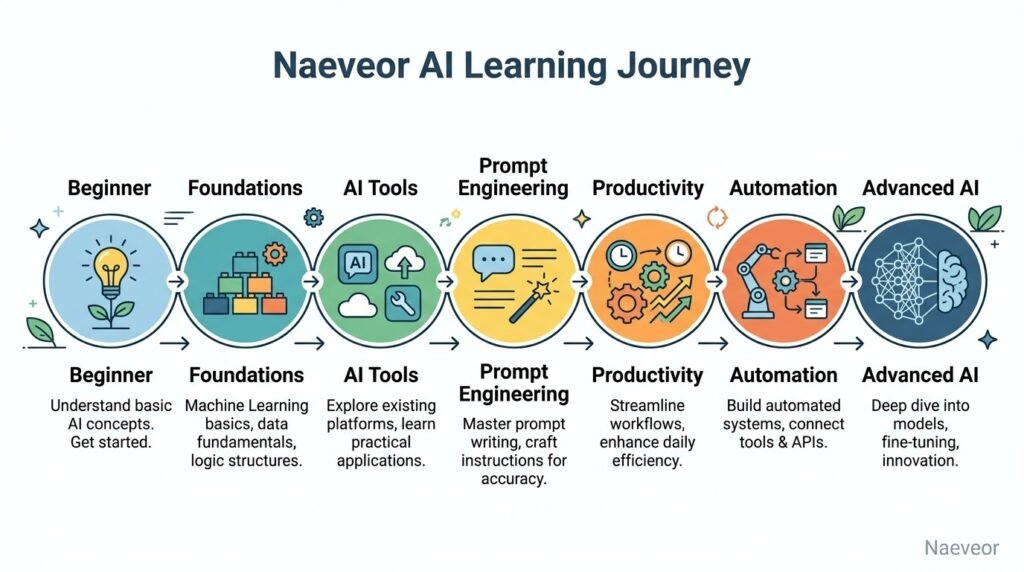
Beginner AI Learning Roadmap
The roadmap below provides a practical sequence for learning AI.
| Stage | Focus | Goal |
| Beginner | AI fundamentals | Understand core concepts and terminology |
| Beginner | Everyday AI tools | Learn practical applications |
| Intermediate | Prompt Engineering | Improve AI outputs through better instructions |
| Intermediate | AI productivity | Use AI effectively at work or school |
| Intermediate | AI ethics and limitations | Understand responsible AI use |
| Advanced | Automation and workflows | Build AI-powered systems |
| Advanced | AI development (optional) | Learn Python, Machine Learning, and model development |
Tip: Most people don’t need to become AI engineers. Learning how to use AI effectively can provide significant value in education, business, and everyday work.
Frequently Asked Questions
What is artificial intelligence in simple words?
Artificial intelligence is technology that enables computers to perform tasks that usually require human intelligence, such as understanding language, recognizing images, solving problems, and making predictions.
Is AI the same as Machine Learning?
No.
Artificial Intelligence is the broader field of creating intelligent systems.
Machine Learning is a subset of AI that enables computers to learn from data instead of relying solely on predefined rules.
Deep Learning is a further subset of Machine Learning that uses neural networks to solve complex problems.
Can AI think like humans?
No.
Today’s AI does not possess consciousness, emotions, self-awareness, or human understanding. It identifies patterns in data and generates responses based on those patterns.
Is ChatGPT artificial intelligence?
Yes.
ChatGPT is a generative AI chatbot built on a large language model (LLM). It uses deep learning to understand prompts and generate human-like text.
Will AI replace jobs?
AI is expected to automate certain tasks rather than replace all jobs.
Many roles will evolve, requiring people to work alongside AI. Skills such as creativity, communication, critical thinking, leadership, and ethical judgment will remain highly valuable.
Do I need coding skills to use AI?
No.
Many AI tools are designed for non-technical users. While programming can be helpful for building AI systems, you can use AI effectively for writing, research, design, education, productivity, and business without learning to code.
Is AI always accurate?
No.
AI can produce incorrect, outdated, or misleading information. Always verify important facts using trusted sources, especially when making decisions related to health, finance, law, or education.
What are the most common uses of AI?
Some of the most common applications include:
- Virtual assistants
- Search engines
- Recommendation systems
- Language translation
- Content creation
- Customer support
- Fraud detection
- Medical diagnosis support
- Image recognition
- Data analysis
Is AI safe to use?
AI can be safe when used responsibly. However, users should avoid sharing sensitive personal or confidential information with AI tools and should always review AI-generated content for accuracy and bias.
Conclusion
Artificial intelligence is no longer a futuristic concept—it’s a practical technology that is already shaping how we learn, work, create, and solve problems.
While AI can seem complex at first, its core idea is surprisingly simple: using computers to recognize patterns, make predictions, and assist with tasks that traditionally required human intelligence.
As you’ve learned throughout this guide, AI is much more than chatbots or image generators. It includes a wide range of technologies that power search engines, recommendation systems, healthcare innovations, business automation, scientific research, and countless everyday applications.
At the same time, AI is not a replacement for human intelligence. It has important limitations, can make mistakes, and requires responsible oversight. The most successful people and organizations will be those who learn to combine AI’s speed and capabilities with human creativity, judgment, and ethical decision-making.
Whether you’re a student, professional, entrepreneur, or simply curious about technology, understanding AI is becoming an essential digital skill. By starting with the fundamentals, experimenting with AI tools, and continuing to learn, you’ll be well prepared to navigate an increasingly AI-powered world.
Continue Your AI Journey
Keep building your AI knowledge with these beginner-friendly guides.
-
AI Glossary: 100+ Artificial Intelligence Terms Explained
Learn more : AI Glossary: 100+ Artificial Intelligence Terms Explained🕒 25-35 min read • Updated: Aug 2026 Introduction Artificial Intelligence (AI) is changing how we learn, work,…
-
Large Language Models (LLMs) Explained: The Complete 2026 Beginner’s Guide
Learn more : Large Language Models (LLMs) Explained: The Complete 2026 Beginner’s Guide🕒 14-16 min read • Updated: Aug 2026 Introduction Artificial Intelligence has become part of everyday life. Whether…
-
How Artificial Intelligence Works: 5 Core Concepts Explained Simply (2026 Guide)
Learn more : How Artificial Intelligence Works: 5 Core Concepts Explained Simply (2026 Guide)🕒 14-16 min read • Updated: Aug 2026 Introduction What Is Machine Learning? If Artificial Intelligence is the…
-
Artificial Intelligence Explained: The Complete Beginner’s Guide (2026)
Learn more : Artificial Intelligence Explained: The Complete Beginner’s Guide (2026)🕒 14-18 min read • Updated: Aug 2026 introduction Artificial intelligence (AI) has quickly become one of the…
-

How to Use AI in Content Creation: The Complete 2026 Blueprint
Learn more : How to Use AI in Content Creation: The Complete 2026 Blueprint🕒 10-12 min read • Updated: July 2026 Introduction Creating high-quality content consistently can be challenging, whether you’re…
-

7 Ways AI Is Transforming Software Development in 2026 (Real Workflows & Case Studies)
Learn more : 7 Ways AI Is Transforming Software Development in 2026 (Real Workflows & Case Studies)🕒 12-15 min read • Updated: July 2026 Introduction Artificial intelligence (AI) is transforming software development by helping…
Related Articles
Explore more guides and resources related to this topic.
-

ChatGPT Complete Guide for Beginners (2026): Master AI Step-by-Step
Learn more : ChatGPT Complete Guide for Beginners (2026): Master AI Step-by-Step🕒 20-25 min read • Updated: Aug 2026 Introduction Introduction Artificial intelligence is changing how people learn, work,…
-

Master Prompt Engineering in 2026: A Step-by-Step Beginner’s Guide
Learn more : Master Prompt Engineering in 2026: A Step-by-Step Beginner’s Guide🕒 18-20 min read • Updated: Aug 2026 Introduction Artificial intelligence (AI) tools like ChatGPT, Claude, Gemini, and…
-
Large Language Models (LLMs) Explained: The Complete 2026 Beginner’s Guide
Learn more : Large Language Models (LLMs) Explained: The Complete 2026 Beginner’s Guide🕒 14-16 min read • Updated: Aug 2026 Introduction Artificial Intelligence has become part of everyday life. Whether…
-

Best AI Image Generators in 2026: 10 Free & Paid Tools Tested
Learn more : Best AI Image Generators in 2026: 10 Free & Paid Tools Tested🕒 15 min read • Updated: July 2026 introduction Creating stunning images no longer requires years of design…
-
10 Best AI Chatbots in 2026: Tested & Ranked for Every Use Case
Learn more : 10 Best AI Chatbots in 2026: Tested & Ranked for Every Use Case🕒 10-12 min read • Updated: July 2026 introduction Artificial intelligence has made chatbots far more capable than…
-

ChatGPT vs Microsoft Copilot (2026): Tested, Pricing & Workflow Comparison
Learn more : ChatGPT vs Microsoft Copilot (2026): Tested, Pricing & Workflow Comparison🕒 10-12 min read • Updated: July 2026 Introduction Choosing between ChatGPT and Microsoft Copilot can be challenging,…
Recommended AI Tools for Beginners
If you’re new to AI, these tools are excellent starting points:
| Tool | Best For |
| ChatGPT | Writing, brainstorming, learning, coding assistance |
| Claude | Long-form writing, document analysis, reasoning |
| Gemini | Research, productivity, Google Workspace integration |
| Perplexity AI | AI-powered search and source-backed answers |
| Canva AI | Design, presentations, and visual content creation |
Editor’s Note: Choose the tool that best fits your workflow. No single AI tool is “best” for every task. Experiment with several options to understand their strengths and limitations.
References
- Stanford Human-Centered AI (HAI): https://hai.stanford.edu/
- Google AI: https://ai.google/
- Microsoft AI Learning Hub: https://learn.microsoft.com/ai/
- Hugging Face Documentation: https://huggingface.co/docs
- TensorFlow Documentation: https://www.tensorflow.org/
- PyTorch Documentation: https://pytorch.org/docs/
Leave a Reply