🕒 12-14 min read • Updated: July 2026
Table of Contents
Introduction
Artificial intelligence tools like ChatGPT, Claude, and Gemini can generate impressive responses from simple instructions. However, the quality of those responses often depends on how you ask your question.
Two of the most widely used prompt engineering techniques are zero-shot prompting and few-shot prompting. While both involve giving instructions to an AI model, they differ in the amount of guidance you provide before asking the model to complete a task.
Understanding when to use each approach can help you write more effective prompts, improve response quality, and save time when working with AI.
In this guide, you’ll learn what zero-shot and few-shot prompting are, how they differ, when to use each, and practical examples you can apply immediately.
Key Takeaways
- Zero-shot prompting gives the AI only a task or instruction.
- Few-shot prompting includes one or more examples before the task.
- Zero-shot prompts are faster and work well for simple tasks.
- Few-shot prompts improve consistency for complex or structured tasks.
- Choosing the right technique depends on the task, desired accuracy, and output format.
What Is Zero-Shot Prompting?
Zero-shot prompting is a technique where you ask an AI model to complete a task without providing any examples. OpenAI’s Prompt Engineering Guide also recommends using examples (few-shot prompting) when you need the model to produce outputs in a consistent style or format.
The model relies entirely on its existing training and your instructions to generate a response.
Example
Instead of showing examples, you simply ask:
Explain quantum computing in simple language.
The AI uses its general knowledge to answer.
Another Example
Write a professional email declining a meeting invitation.
No sample emails are provided.
When to Use Zero-Shot Prompting
Zero-shot prompting works best when:
- Asking general knowledge questions
- Summarizing text
- Brainstorming ideas
- Translating languages
- Writing simple emails
- Creating outlines
- Explaining concepts
It is often the quickest way to interact with AI because it requires minimal preparation. Before exploring advanced prompting strategies, it’s helpful to understand the fundamentals of prompt engineering.
What Is Few-Shot Prompting?
Few-shot prompting provides the AI with a small number of examples before asking it to perform a similar task. Anthropic also highlights the importance of providing examples to guide Claude toward more reliable and consistent responses.
These examples help the model understand the expected style, structure, tone, or format.
Example
Prompt:
Example 1
Customer:
“The product arrived late.”
Response:
“We’re sorry for the delay. We appreciate your patience and are working to improve our delivery experience.”
Example 2
Customer:
“I received the wrong item.”
Response:
“We apologize for the mistake. Please contact our support team so we can arrange a replacement.”
Now respond to:
Customer:
“The package arrived damaged.”
Because the AI has seen examples, it is more likely to produce a consistent customer support response.
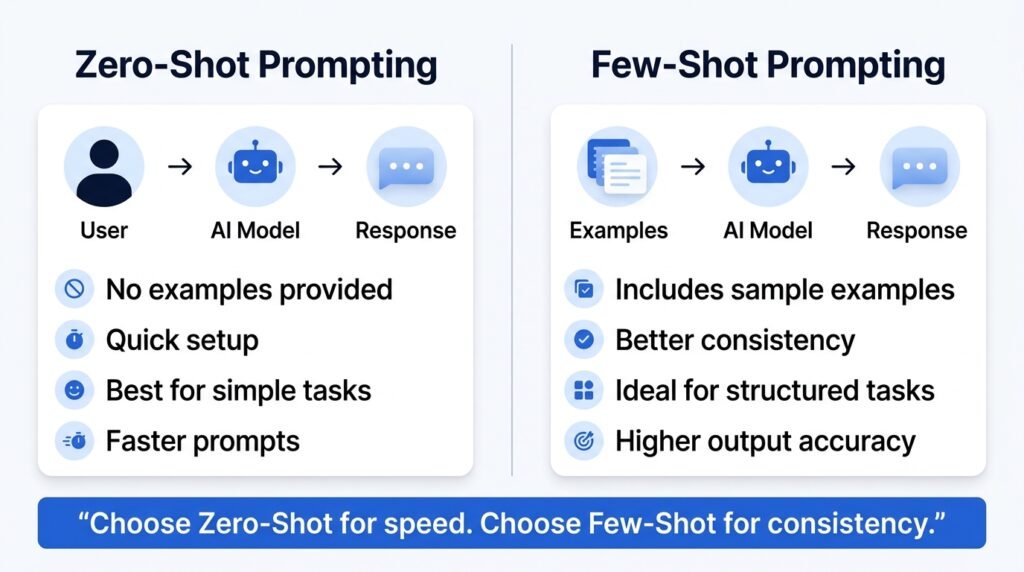
Zero-Shot vs Few-Shot Prompting
| Feature | Zero-Shot | Few-Shot |
|---|---|---|
| Examples Provided | No | Yes |
| Setup Time | Very Low | Moderate |
| Prompt Length | Short | Longer |
| Best For | Simple tasks | Complex or structured tasks |
| Consistency | Moderate | High |
| Learning Style | Uses existing knowledge | Learns from provided examples |
Real-World Examples
Example 1: Writing
Zero-Shot
Write a LinkedIn post about artificial intelligence.
Few-Shot
Example 1
Friendly LinkedIn post…
Example 2
Professional LinkedIn post…
Now write a LinkedIn post about prompt engineering.
The few-shot version is more likely to match the desired tone and structure.
Example 2: Sentiment Classification
Zero-Shot
Is this review positive or negative?
“I absolutely loved this product.”
Few-Shot
Positive:
“I love this.”
Negative:
“This was disappointing.”
Now classify:
“I absolutely loved this product.”
The examples help reduce ambiguity.
Advantages of Zero-Shot Prompting
- Quick and easy
- Requires little preparation
- Works well for everyday AI tasks
- Saves time
- Ideal for beginners
Advantages of Few-Shot Prompting
- Produces more consistent responses
- Better for specialized tasks
- Helps maintain tone and formatting
- Improves accuracy for repetitive workflows
- Useful in business and professional settings
Limitations
Zero-Shot Prompting
- Results may vary
- Less consistent formatting
- May misunderstand complex requirements
Few-Shot Prompting
- Longer prompts
- Requires creating examples
- Consumes more context space in AI models
Which One Should You Use?
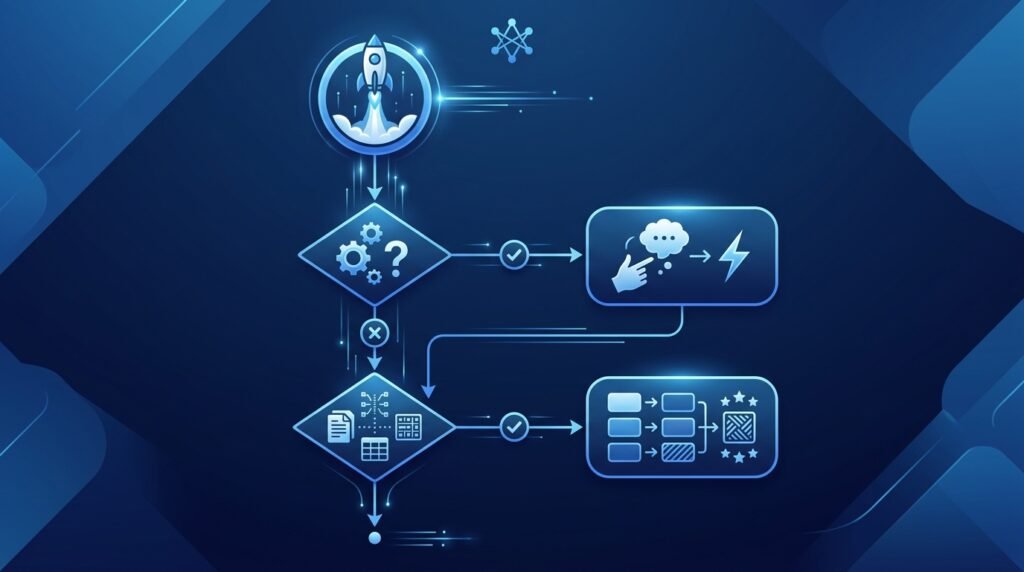
There isn’t a single best approach.
Use zero-shot prompting when you need quick answers, brainstorming, summaries, or simple writing tasks.
Choose few-shot prompting when consistency, formatting, or specialized outputs are important, such as customer support replies, content creation, coding patterns, or classification tasks.
Many experienced prompt engineers start with zero-shot prompting and switch to few-shot prompting if the results need refinement.
Google’s AI documentation similarly emphasizes selecting prompting techniques based on the complexity of the task and the desired output.
Common Mistakes
- Assuming examples are always necessary
- Providing inconsistent examples
- Using too many examples for simple tasks
- Giving vague instructions
- Mixing different writing styles within the same prompt
Frequently Asked Questions
Is few-shot prompting always better than zero-shot prompting?
No. Few-shot prompting is often more consistent, but zero-shot prompting is faster and sufficient for many everyday tasks.
Can ChatGPT use zero-shot prompting?
Yes. Most interactions with ChatGPT are zero-shot prompts unless you include examples. You can explore the latest OpenAI models and capabilities in the official documentation.
How many examples should a few-shot prompt include?
Typically between two and five examples are enough to establish a pattern without making the prompt unnecessarily long.
Does few-shot prompting improve accuracy?
It often improves consistency and helps the model better understand the desired output format, especially for structured tasks.
Conclusion
Zero-shot and few-shot prompting are two essential techniques in prompt engineering. Zero-shot prompting is ideal for simple, everyday requests where speed and convenience matter, while few-shot prompting provides additional guidance through examples, making it better suited for complex or structured tasks.
Learning when to use each technique will help you create more effective prompts, improve the quality of AI-generated responses, and build a stronger foundation in prompt engineering.
As you gain experience, you’ll often combine these approaches with other prompt engineering methods to get even better results from AI systems.
Leave a Reply