
🕒 14-16 min read • Updated: Aug 2026
Table of Contents
Introduction
Artificial Intelligence has become part of everyday life. Whether you’re chatting with ChatGPT, asking Gemini to summarize an article, using Claude to write emails, or searching the web with AI-powered answers, you’re interacting with a technology called a Large Language Model (LLM).
Despite their growing popularity, many people still wonder:
- What exactly is a Large Language Model?
- How does it understand language?
- Is it actually “thinking”?
- Why does it sometimes make mistakes?
- How is it different from traditional software?
The good news is that you don’t need a computer science degree to understand the basics.
This guide explains Large Language Models in simple, everyday language. You’ll learn how they work, what they can and cannot do, where they are used, and why they have become one of the most important technologies in modern AI.
Key Takeaways
- A Large Language Model (LLM) is an AI system trained to understand and generate human language.
- LLMs learn patterns from enormous amounts of text rather than memorizing facts like a database.
- They can write, summarize, translate, answer questions, generate code, and assist with many language-based tasks.
- Popular LLMs include the models behind ChatGPT, Claude, Gemini, and other AI assistants.
- Although powerful, LLMs do not truly “understand” information like humans and can sometimes generate incorrect or misleading responses.
What Is a Large Language Model (LLM)?
A Large Language Model (LLM) is a type of artificial intelligence designed to process, understand, and generate human language.
Instead of following a fixed set of rules, an LLM learns by analyzing massive collections of text, such as books, articles, websites, research papers, and other publicly available written content.
During training, the model learns:
- how words relate to one another,
- how sentences are structured,
- how ideas are connected,
- and how language is commonly used in different contexts.
Once trained, the model can generate new text by predicting what words are most likely to come next based on the input it receives.
Think of an LLM as an extremely advanced language prediction engine. It doesn’t search for a pre-written answer. Instead, it generates a response one token at a time based on patterns it learned during training.
A Simple Analogy
Imagine you’ve spent years reading millions of books, newspapers, websites, and conversations.
Eventually, you become very good at predicting how a sentence is likely to continue.
For example:
“The sun rises in the…”
You would naturally complete the sentence with:
“east.”
You aren’t searching a database. You’re using everything you’ve learned about language and the world to make a highly probable prediction.
Large Language Models work in a similar way—but at a much larger scale and much faster speed.
Why Are They Called “Large Language Models”?
The name can be understood by breaking it into three parts.
| Term | Meaning |
| Large | Trained on enormous amounts of data and containing billions (sometimes trillions) of parameters. |
| Language | Designed to understand and generate human language, including text and, in some cases, code. |
| Model | A machine learning system that has learned patterns from data and can make predictions. |
Together, a Large Language Model is a machine learning model trained on vast amounts of language data to predict and generate human-like text.
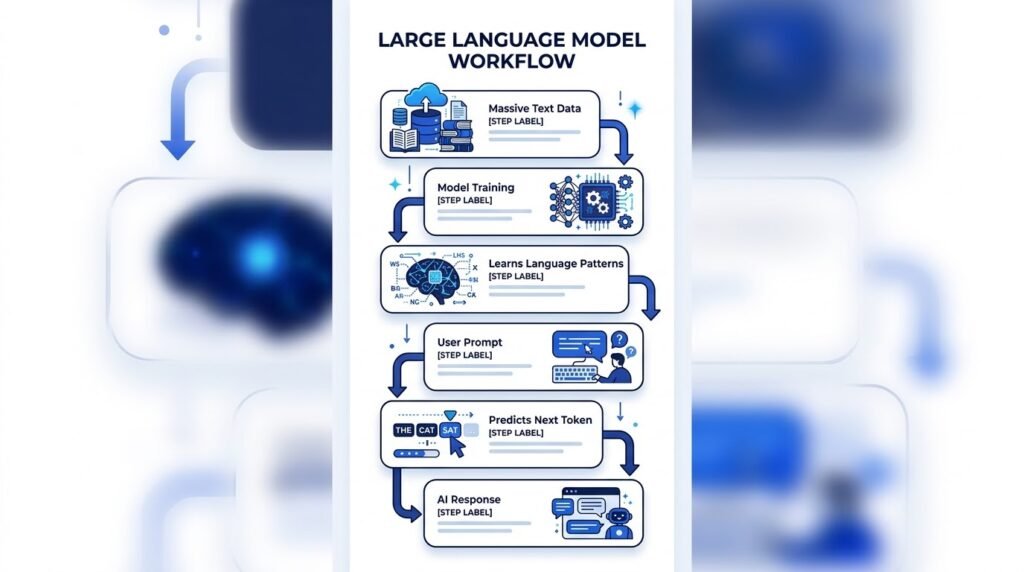
How Do Large Language Models Work?
At a high level, LLMs follow three major steps:
- Learn from huge amounts of text.
- Identify patterns in language.
- Predict the most likely next token when given a prompt.
Although the mathematics behind these models is complex, the overall idea is surprisingly straightforward.
Let’s explore each step.
Step 1: Collecting Training Data
Before an LLM can answer questions, it must first learn from data.
Developers train these models using enormous collections of text from sources such as:
- Books
- Encyclopedias
- Academic papers
- News articles
- Public websites
- Technical documentation
- Programming code
- Educational materials
The goal is not to memorize every document but to learn the statistical patterns of language.
For example, after seeing millions of examples, the model learns that:
- “Good morning” is a common greeting.
- Questions often end with a question mark.
- Recipes typically include ingredients followed by instructions.
- Emails usually begin with a greeting and end with a sign-off.
These patterns help the model generate coherent and contextually appropriate responses.
Step 2: Breaking Text into Tokens
Humans read words.
LLMs read tokens.
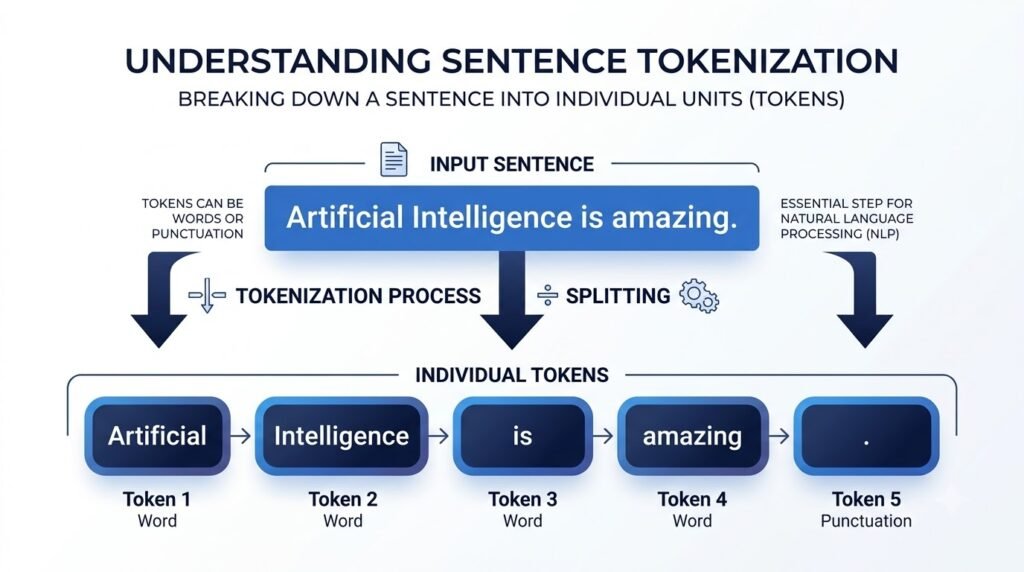
A token is a small unit of text. Depending on the language and tokenizer, a token might be:
- a whole word,
- part of a word,
- punctuation,
- or even a single character.
For example:
Sentence:
Artificial Intelligence is amazing.
A model might process it as tokens similar to:
- Artificial
- Intelligence
- is
- amazing
- .
Working with tokens allows the model to handle different languages, punctuation, and uncommon words more efficiently.
Step 3: Learning Patterns
During training, the model repeatedly performs a simple task:
Predict the next token.
For example:
The Eiffel Tower is located in…
The model learns that “Paris” is a much more likely continuation than unrelated words because it has encountered similar patterns countless times during training.
By repeating this process billions of times, the model gradually becomes better at understanding grammar, style, context, and many factual relationships.
Importantly, it isn’t memorizing every sentence. Instead, it learns the statistical relationships between tokens and concepts.
Step 4: Generating a Response
When you enter a prompt such as:
Explain photosynthesis in simple terms.
The model doesn’t search the internet for an answer (unless it’s connected to external tools).
Instead, it:
- Reads your prompt.
- Analyzes the context.
- Predicts the most likely next token.
- Repeats the process until it forms a complete response.
This happens incredibly quickly, creating the impression of a natural conversation.
The Technology Behind Modern LLMs
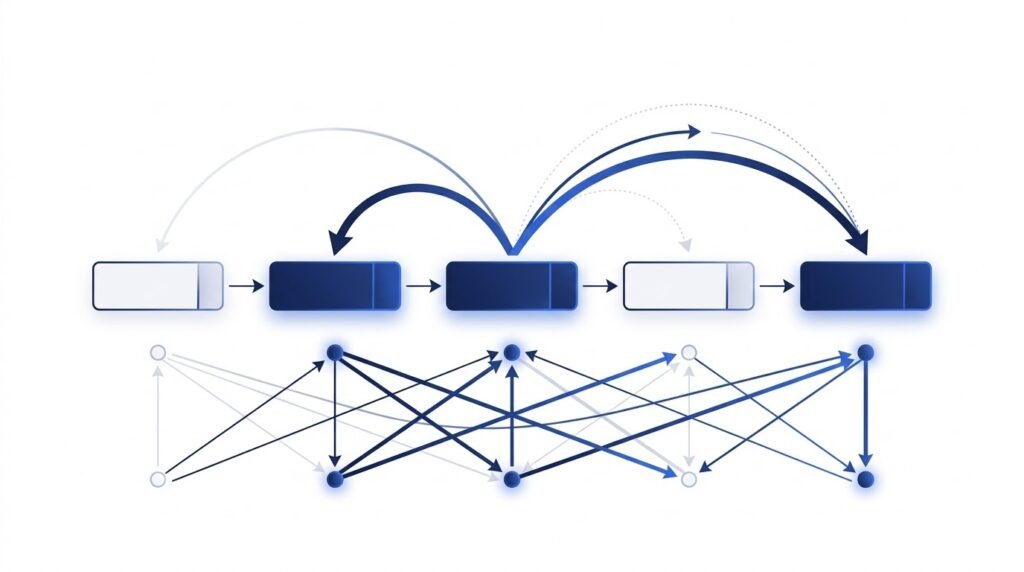
Modern Large Language Models are built using a deep learning architecture known as the Transformer.
Introduced in 2017, the Transformer architecture significantly improved how AI systems process language by enabling them to understand relationships between words across an entire sentence rather than one word at a time.
One of its key innovations is the attention mechanism, which helps the model determine which words in the input are most relevant when generating each part of the response.
For example, in the sentence:
“The scientist thanked the student because she completed the experiment.”
An effective language model uses attention to determine who “she” refers to based on the surrounding context.
This ability to consider context across long passages is one of the reasons modern LLMs can produce more coherent and relevant responses than earlier language models.
Why LLMs Seem So Intelligent
Large Language Models often appear intelligent because they can:
- explain complex ideas,
- answer follow-up questions,
- write in different styles,
- solve many language-related tasks,
- and maintain conversational context.
However, it’s important to understand that this behavior comes from recognizing patterns in data—not from human-like reasoning or consciousness.
An LLM does not have beliefs, emotions, intentions, or self-awareness. It generates responses by predicting likely sequences of tokens based on the input and the patterns it learned during training.
Understanding this distinction helps users make better use of AI while remaining aware of its limitations.

What Can Large Language Models Do?
Large Language Models have transformed how people interact with computers because they can perform a wide variety of language-based tasks using a single model. Instead of creating separate software for writing, translation, coding, or summarization, an LLM can often handle all of these tasks through natural conversation.
Here are some of the most common capabilities of modern LLMs.
Answer Questions
One of the most popular uses of LLMs is answering questions in plain language.
For example, you can ask:
- “Why is the sky blue?”
- “Explain inflation like I’m 12 years old.”
- “What is photosynthesis?”
- “How do electric cars work?”
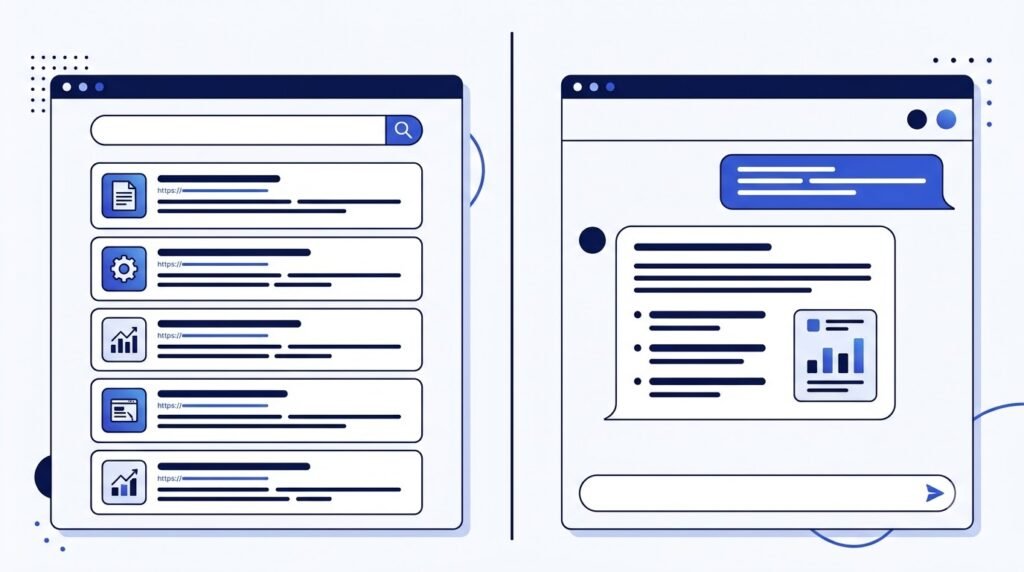
Instead of returning a list of links, the model generates a direct explanation tailored to your request.
Example:
Prompt:
Explain blockchain in simple words.
Response (simplified):
Think of blockchain as a shared digital notebook that everyone can see, but no one can secretly change. Every new page is linked to the previous one, making it very difficult to tamper with past information.
Write Content
LLMs can generate many types of written content, including:
- Emails
- Blog posts
- Reports
- Product descriptions
- Social media captions
- Business proposals
- Marketing copy
- Study notes
They can also adjust their writing style based on your instructions.
For example:
- Formal
- Casual
- Professional
- Friendly
- Technical
- Beginner-friendly
Summarize Information
Reading long documents takes time.
LLMs can summarize:
- Research papers
- News articles
- Meeting notes
- Books
- PDFs
- Reports
For instance, instead of reading a 20-page report, you can ask the model to provide:
- a one-page summary,
- five key points,
- or an explanation suitable for beginners.
Translate Languages
Many LLMs support dozens or even hundreds of languages.
Examples include translating:
- English to Hindi
- Spanish to French
- Japanese to English
- Arabic to German
They can also explain cultural nuances, idioms, and alternative phrasings rather than simply translating word for word.
Help with Programming
Developers use LLMs to:
- write code,
- explain programming concepts,
- debug errors,
- generate documentation,
- convert code between programming languages.
For beginners, an LLM can act like a coding tutor by explaining each step instead of only providing the final solution.
Brainstorm Ideas
LLMs are excellent brainstorming partners.
You can ask them for:
- business ideas,
- article topics,
- YouTube video ideas,
- startup names,
- lesson plans,
- travel itineraries,
- marketing campaigns,
- interview questions.
While not every suggestion will be perfect, they can help overcome creative blocks and generate starting points.
Real-World Applications of Large Language Models
Today, LLMs are being used across many industries.
| Industry | Example Use Cases |
| Education | Tutoring, lesson planning, study guides |
| Healthcare | Drafting clinical notes, summarizing medical literature (with human oversight) |
| Customer Support | AI chatbots and virtual assistants |
| Software Development | Code generation and debugging |
| Marketing | Content creation and campaign planning |
| Finance | Report summarization and document analysis |
| Legal | Reviewing contracts and summarizing legal documents |
| Human Resources | Job descriptions, interview preparation, employee communication |
As the technology improves, new applications continue to emerge.

Popular Large Language Models
Several organizations have developed powerful LLMs, each with different strengths.
| Model | Organization | Common Uses |
| ChatGPT | OpenAI | Writing, coding, research, productivity |
| Claude | Anthropic | Long-form writing, analysis, document processing |
| Gemini | Productivity, multimodal AI, search integration | |
| Llama | Meta | Open-source AI development and research |
| Mistral | Mistral AI | Lightweight and open-weight AI applications |
Although they share similar underlying principles, each model differs in training methods, capabilities, and supported features.
What LLMs Cannot Do
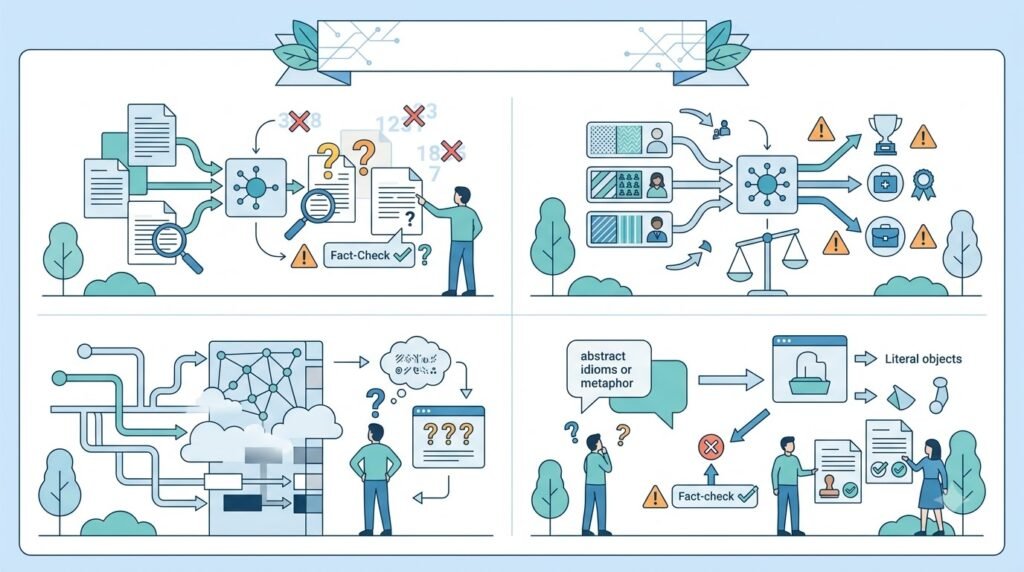
Despite their impressive abilities, Large Language Models have important limitations.
Understanding these limitations is essential for using AI responsibly.
They Don’t Truly Understand Like Humans
An LLM recognizes patterns in language.
It does not possess:
- consciousness,
- emotions,
- personal experiences,
- intentions,
- beliefs,
- or common sense in the human sense.
When it appears to “understand,” it is generating responses based on learned statistical relationships rather than genuine comprehension.
They Can Produce Incorrect Information
One of the biggest challenges with LLMs is that they can confidently generate inaccurate information.
This phenomenon is often called an AI hallucination.
For example, an LLM might:
- invent a research paper,
- create fake statistics,
- misquote a source,
- or provide an incorrect historical fact.
Because the response may sound convincing, it’s important to verify important information using reliable sources.
They May Reflect Bias
LLMs learn from large collections of human-generated text.
Since human-created content can contain biases, models may occasionally reflect or amplify those biases.
AI developers work to reduce harmful outputs through training, testing, and safety measures, but no model is completely free from bias.
They Don’t Always Have Current Information
Some LLMs rely primarily on knowledge learned during training and may not know about events that occurred afterward.
Others can access live information through web browsing or connected tools.
Whether an LLM has up-to-date knowledge depends on how it is designed and the tools available to it.
Common Misconceptions About LLMs
Let’s address a few myths.
| Myth | Reality |
| LLMs think like humans. | They predict language patterns rather than think or reason like people. |
| LLMs know everything. | Their knowledge has limits and can contain inaccuracies. |
| LLMs are always correct. | They can generate incorrect or fabricated information. |
| LLMs search the internet for every answer. | Many responses are generated from learned patterns unless external tools are used. |
| LLMs will replace every job. | They are more likely to automate specific tasks while creating new opportunities alongside humans. |
Best Practices for Using Large Language Models
To get the best results, follow these guidelines.
Be Specific
Instead of asking:
Tell me about climate change.
Try:
Explain climate change to a 10-year-old using simple examples.
Specific prompts usually produce more useful responses.
Provide Context
Rather than asking:
Write an email.
Try:
Write a professional email declining a meeting while suggesting next Tuesday instead.
The more context you provide, the better the output is likely to be.
Verify Important Information
Always fact-check AI-generated content when it relates to:
- health,
- legal matters,
- finance,
- academic work,
- research,
- or major decisions.
LLMs are helpful assistants, but they should not be treated as infallible authorities.
Review Before Publishing
If you use AI to write content, always:
- check facts,
- edit for clarity,
- ensure the tone matches your audience,
- and add your own expertise and insights.
Human review improves both quality and trustworthiness.
Common Mistakes Beginners Make
Many new users expect LLMs to behave like search engines or experts in every subject. Here are a few mistakes to avoid.
- Assuming every answer is accurate without verification.
- Writing vague prompts with little context.
- Expecting AI to read your mind instead of giving clear instructions.
- Sharing sensitive or confidential information unnecessarily.
- Copying AI-generated text without reviewing or editing it.
Using AI effectively is a skill that improves with practice and thoughtful prompting.
Frequently Asked Questions
What is a Large Language Model (LLM) in simple terms?
A Large Language Model (LLM) is an AI system trained on massive amounts of text to understand and generate human language. It predicts the most likely next token (a word or part of a word) based on the context of your input, allowing it to answer questions, write content, summarize information, and perform many other language-related tasks.
Is ChatGPT a Large Language Model?
ChatGPT is an AI assistant powered by one or more Large Language Models developed by OpenAI. The chatbot interface lets users interact with the underlying LLM through natural conversation.
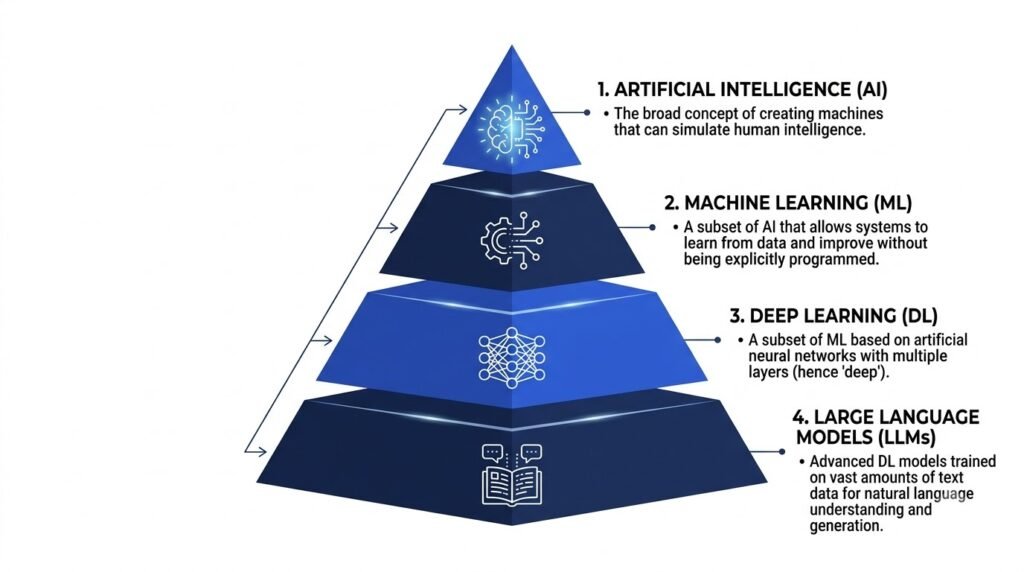
Are LLMs the same as Artificial Intelligence?
No. Artificial Intelligence (AI) is a broad field that includes many technologies such as machine learning, computer vision, robotics, speech recognition, and natural language processing.
Large Language Models are one type of AI specifically designed for understanding and generating language.
Think of it this way:
Artificial Intelligence
│
Machine Learning
│
Deep Learning
│
Large Language Models
Every LLM is AI, but not every AI system is an LLM.
Do LLMs understand what they are saying?
Not in the way humans do.
LLMs recognize patterns in language and generate responses based on probabilities learned during training. They do not have consciousness, emotions, beliefs, or true understanding.
Although their responses can appear thoughtful, they are generated through statistical prediction rather than human-like reasoning.
How are LLMs trained?
Developers train LLMs using enormous collections of text from sources such as books, articles, websites, academic papers, technical documentation, and programming code.
During training, the model repeatedly learns to predict missing or next tokens. Over time, it develops a sophisticated understanding of language patterns, grammar, context, and relationships between words.
Many modern AI assistants also undergo additional fine-tuning and safety training to improve response quality and reduce harmful outputs.
Can Large Language Models access the internet?
It depends on the application.
Some LLM-powered tools work only with the information learned during training. Others can access live information through web browsing, search tools, or connected databases.
Whether an AI assistant has internet access depends on how it has been built and configured.
What are some examples of Large Language Models?
Some well-known examples include:
- GPT models
- Claude
- Gemini
- Llama
- Mistral
Each model has different strengths, capabilities, licensing approaches, and supported features, but they all use similar underlying principles for processing language.
Will LLMs replace human writers?
LLMs are powerful writing assistants, but they are not a replacement for human creativity, expertise, or judgment.
They can help with drafting, brainstorming, editing, and summarizing, while humans remain essential for:
- critical thinking,
- originality,
- fact-checking,
- domain expertise,
- ethical decision-making,
- and understanding audience needs.
For high-quality educational content—such as the articles published on Naeveor—human review and editorial oversight remain indispensable.
Key Concepts at a Glance
| Concept | Simple Explanation |
| Large Language Model (LLM) | AI trained to understand and generate text |
| Training Data | Massive collections of text used for learning |
| Token | A small unit of text processed by the model |
| Transformer | The neural network architecture behind most modern LLMs |
| Attention | A mechanism that helps the model focus on relevant parts of the input |
| Prompt | The instruction or question given to the AI |
| Context Window | The amount of information an LLM can consider at one time |
| Hallucination | When an AI generates incorrect or fabricated information |
The Future of Large Language Models
Large Language Models continue to evolve rapidly. Recent advancements are expanding their capabilities beyond text to include images, audio, video, and interactions with software tools.
In the coming years, LLMs are expected to become:
- more accurate,
- better at reasoning across complex tasks,
- more personalized,
- more efficient,
- and increasingly integrated into everyday applications.
However, the future of AI will also depend on responsible development, including transparency, privacy, fairness, security, and thoughtful human oversight.
Understanding how LLMs work today provides a strong foundation for learning about the next generation of AI technologies.
Conclusion
Large Language Models have fundamentally changed how people interact with technology.
By learning patterns from vast amounts of text, they can answer questions, generate content, summarize information, translate languages, assist with coding, and support countless other language-based tasks.
At the same time, it is important to recognize both their strengths and their limitations. LLMs do not think or understand like humans, and they can sometimes produce inaccurate or misleading information. Using them effectively requires clear instructions, critical thinking, and verification of important facts.
For beginners, understanding the basic principles of Large Language Models is one of the best ways to build AI literacy. Whether you’re a student, professional, educator, or simply curious about artificial intelligence, this knowledge will help you make informed decisions about when and how to use AI tools responsibly.
As AI continues to evolve, Large Language Models are likely to remain at the heart of many digital experiences. Learning how they work today will prepare you to explore more advanced topics, from prompt engineering and AI agents to multimodal AI systems and intelligent automation.
Continue Your AI Journey
Keep building your AI knowledge with these beginner-friendly guides.
-
AI Glossary: 100+ Artificial Intelligence Terms Explained
Learn more : AI Glossary: 100+ Artificial Intelligence Terms Explained🕒 25-35 min read • Updated: Aug 2026 Introduction Artificial Intelligence (AI) is changing how we learn, work,…
-

Large Language Models (LLMs) Explained: The Complete 2026 Beginner’s Guide
Learn more : Large Language Models (LLMs) Explained: The Complete 2026 Beginner’s Guide🕒 14-16 min read • Updated: Aug 2026 Introduction Artificial Intelligence has become part of everyday life. Whether…
-
How Artificial Intelligence Works: 5 Core Concepts Explained Simply (2026 Guide)
Learn more : How Artificial Intelligence Works: 5 Core Concepts Explained Simply (2026 Guide)🕒 14-16 min read • Updated: Aug 2026 Introduction What Is Machine Learning? If Artificial Intelligence is the…
-

Artificial Intelligence Explained: The Complete Beginner’s Guide (2026)
Learn more : Artificial Intelligence Explained: The Complete Beginner’s Guide (2026)🕒 14-18 min read • Updated: Aug 2026 introduction Artificial intelligence (AI) has quickly become one of the…
-

How to Use AI in Content Creation: The Complete 2026 Blueprint
Learn more : How to Use AI in Content Creation: The Complete 2026 Blueprint🕒 10-12 min read • Updated: July 2026 Introduction Creating high-quality content consistently can be challenging, whether you’re…
-

7 Ways AI Is Transforming Software Development in 2026 (Real Workflows & Case Studies)
Learn more : 7 Ways AI Is Transforming Software Development in 2026 (Real Workflows & Case Studies)🕒 12-15 min read • Updated: July 2026 Introduction Artificial intelligence (AI) is transforming software development by helping…
Related Articles
Explore more guides and resources related to this topic.
-

ChatGPT Complete Guide for Beginners (2026): Master AI Step-by-Step
Learn more : ChatGPT Complete Guide for Beginners (2026): Master AI Step-by-Step🕒 20-25 min read • Updated: Aug 2026 Introduction Introduction Artificial intelligence is changing how people learn, work,…
-

Master Prompt Engineering in 2026: A Step-by-Step Beginner’s Guide
Learn more : Master Prompt Engineering in 2026: A Step-by-Step Beginner’s Guide🕒 18-20 min read • Updated: Aug 2026 Introduction Artificial intelligence (AI) tools like ChatGPT, Claude, Gemini, and…
-
Large Language Models (LLMs) Explained: The Complete 2026 Beginner’s Guide
Learn more : Large Language Models (LLMs) Explained: The Complete 2026 Beginner’s Guide🕒 14-16 min read • Updated: Aug 2026 Introduction Artificial Intelligence has become part of everyday life. Whether…
-

Best AI Image Generators in 2026: 10 Free & Paid Tools Tested
Learn more : Best AI Image Generators in 2026: 10 Free & Paid Tools Tested🕒 15 min read • Updated: July 2026 introduction Creating stunning images no longer requires years of design…
-

10 Best AI Chatbots in 2026: Tested & Ranked for Every Use Case
Learn more : 10 Best AI Chatbots in 2026: Tested & Ranked for Every Use Case🕒 10-12 min read • Updated: July 2026 introduction Artificial intelligence has made chatbots far more capable than…
-

ChatGPT vs Microsoft Copilot (2026): Tested, Pricing & Workflow Comparison
Learn more : ChatGPT vs Microsoft Copilot (2026): Tested, Pricing & Workflow Comparison🕒 10-12 min read • Updated: July 2026 Introduction Choosing between ChatGPT and Microsoft Copilot can be challenging,…
Recommended AI Tools
To experience Large Language Models firsthand, consider exploring these AI tools:
| Tool | Best For |
| ChatGPT | Writing, learning, coding, brainstorming |
| Claude | Long-form writing and document analysis |
| Gemini | Productivity, research, and multimodal AI |
| Perplexity AI | AI-powered search and research |
| Microsoft Copilot | Productivity within Microsoft 365 |
References
- Vaswani, A., et al. “Attention Is All You Need.” https://arxiv.org/abs/1706.03762
- OpenAI. “GPT-4 Technical Report.” https://arxiv.org/abs/2303.08774
- Stanford Center for Research on Foundation Models. https://crfm.stanford.edu/
- IBM Think – What Are Large Language Models (LLMs)? https://www.ibm.com/think/topics/large-language-models
- Hugging Face – Transformers Documentation. https://huggingface.co/docs/transformers
- Google DeepMind. https://deepmind.google/
- Anthropic Research. https://www.anthropic.com/research
- NIST AI Risk Management Framework. https://www.nist.gov/itl/ai-risk-management-framework
Leave a Reply