🕒 14-16 min read • Updated: Aug 2026
Table of Contents
Introduction
What Is Machine Learning?
If Artificial Intelligence is the broad field, Machine Learning (ML) is one of the primary ways modern AI systems are built.
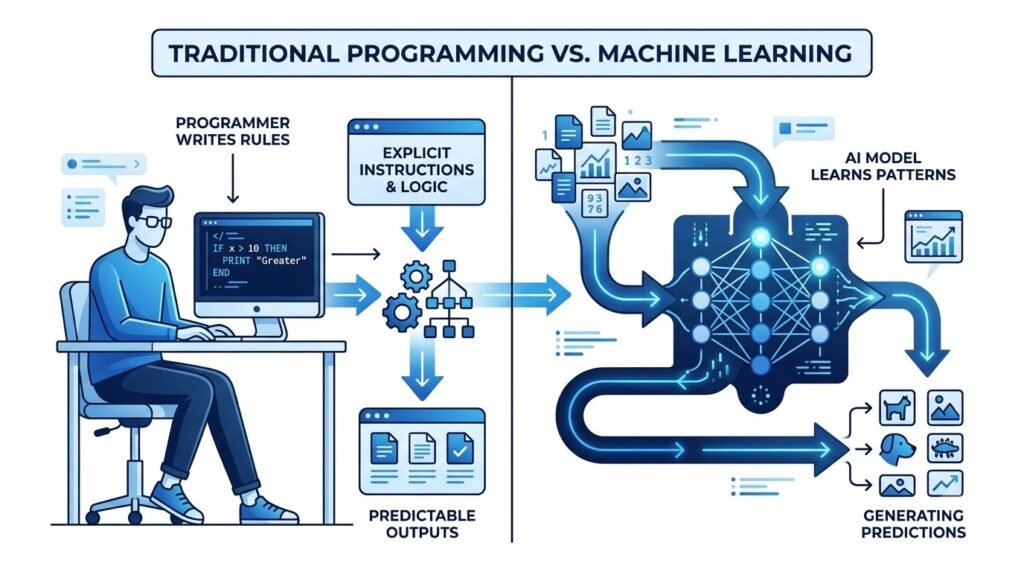
Machine learning enables computers to learn from data instead of relying only on manually programmed rules.
Imagine you’re teaching a child to identify apples and oranges.
You could explain every detail:
- Apples are usually round.
- Apples come in red, green, or yellow.
- Apples have smooth skin.
But this approach becomes difficult when there are thousands of different fruits and countless variations.
A better method is to show the child hundreds of examples. Over time, they naturally recognize the patterns.
Machine learning follows the same principle.
Instead of explicitly programming every rule, developers provide examples, and the AI learns the underlying patterns on its own.
Example
Suppose you want to build an AI that predicts house prices.
You provide data such as:
| House Size | Bedrooms | Location | Price |
| 1,200 sq ft | 2 | City A | $250,000 |
| 2,000 sq ft | 4 | City B | $480,000 |
| 1,600 sq ft | 3 | City A | $340,000 |
After analyzing thousands of similar examples, the AI begins recognizing relationships between features like size, location, and price.
When presented with a new house, it can estimate its value—even if it has never seen that exact house before.
Types of Machine Learning
Although machine learning includes many techniques, beginners should understand three main categories.
1. Supervised Learning
In supervised learning, the AI is trained using labeled data.
Each example already includes the correct answer.
For example:
- Image: Cat → Label: Cat
- Image: Dog → Label: Dog
The AI gradually learns to associate image features with the correct labels.
Common Applications
- Email spam detection
- Medical diagnosis
- Credit scoring
- Image recognition
- Speech recognition
2. Unsupervised Learning
In unsupervised learning, the AI receives data without labels.
Its goal is to discover hidden patterns or group similar items together.
Imagine giving someone thousands of books without telling them the genres.
They may naturally organize them into groups based on similar themes, writing styles, or topics.
That’s essentially what unsupervised learning does.
Common Applications
- Customer segmentation
- Product recommendations
- Fraud detection
- Market analysis
3. Reinforcement Learning
Reinforcement learning teaches AI through trial and error.
The AI interacts with an environment, receives feedback, and gradually learns which actions produce the best outcomes.
Think of teaching a dog a new trick.
- Correct behavior → Reward
- Incorrect behavior → No reward
Over time, the dog learns which actions lead to rewards.
Similarly, reinforcement learning improves through repeated practice.
Common Applications
- Robotics
- Self-driving vehicles
- Game-playing AI
- Warehouse automation
How Neural Networks Work
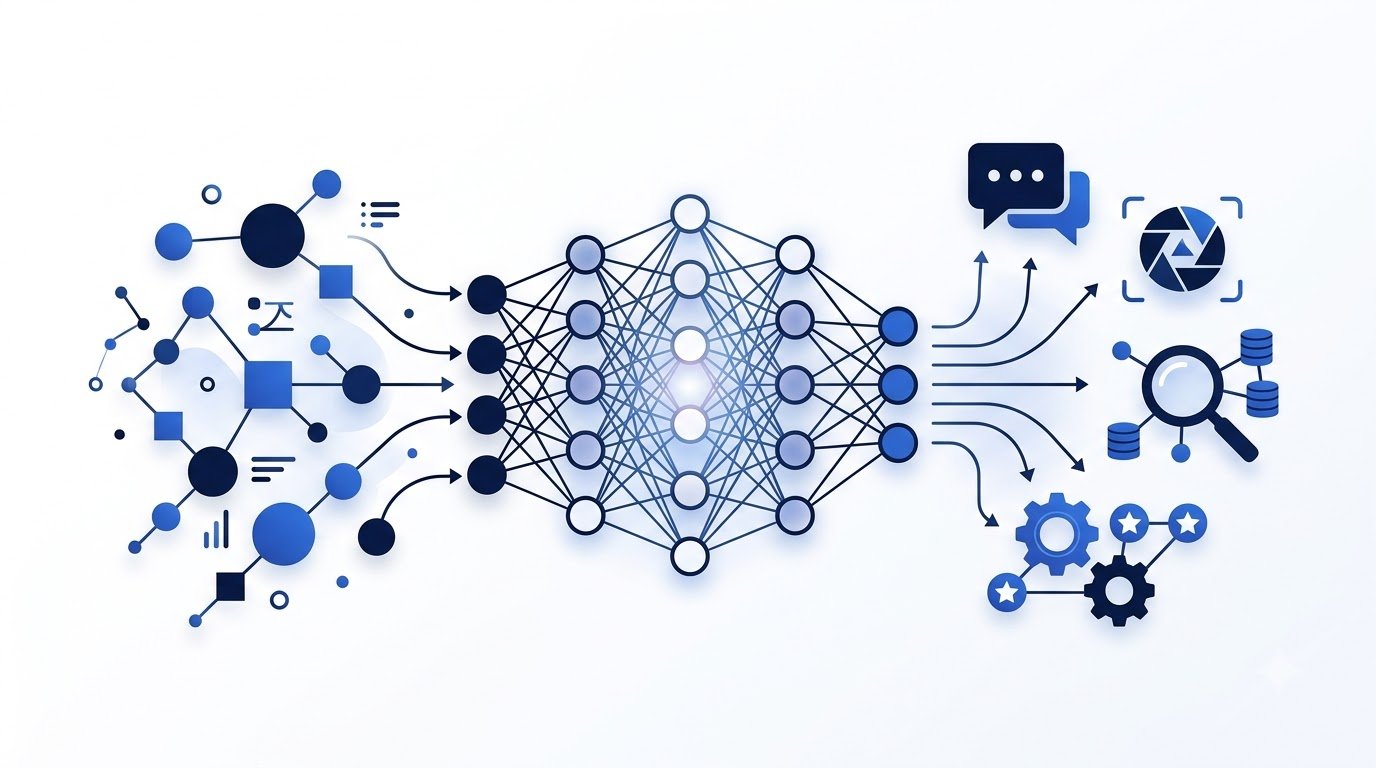
One of the most important breakthroughs in modern AI is the artificial neural network.
Despite the name, neural networks do not function exactly like the human brain. They are mathematical models inspired by how biological neurons communicate.
Their purpose is simple:
Recognize complex patterns that traditional algorithms struggle to identify.
A Simple Analogy
Imagine trying to determine whether an image contains a cat.
Rather than checking a single feature, the AI examines many characteristics simultaneously.
One part of the network might focus on:
- Ear shape
Another might analyze:
- Eye position
Another might detect:
- Fur texture
Another might recognize:
- Body outline
Each layer builds upon the previous one until the AI can confidently identify the object.
This layered approach makes neural networks extremely effective for recognizing images, understanding language, and generating content.
Understanding Layers
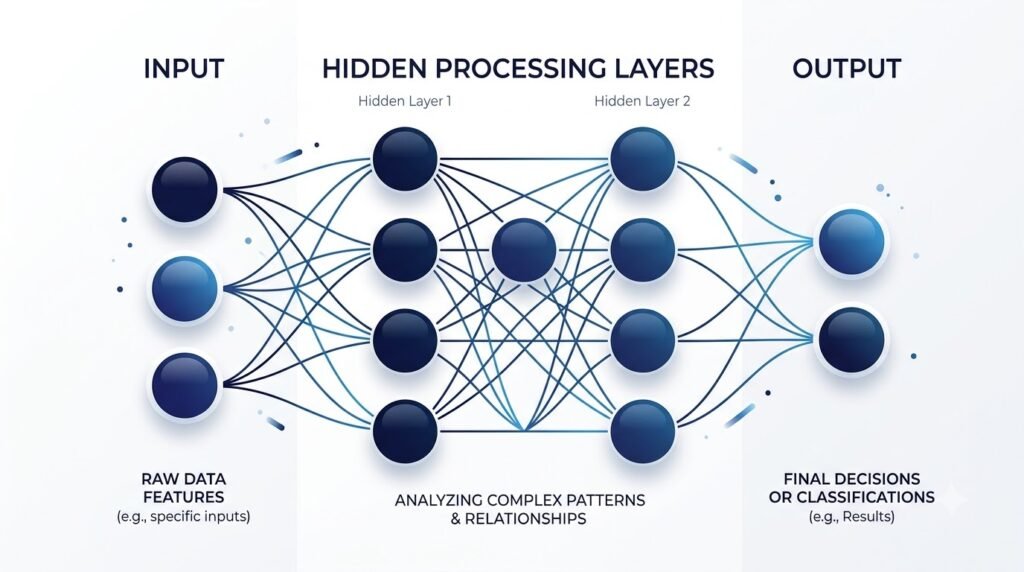
A neural network consists of multiple layers.
Input Layer
This layer receives raw information.
Examples:
- Image pixels
- Written text
- Audio signals
- Sensor readings
Hidden Layers
The hidden layers perform most of the learning.
Each layer extracts increasingly meaningful information.
For example, when analyzing a face:
Layer 1 might detect:
- Lines
- Edges
Layer 2 identifies:
- Eyes
- Nose
- Mouth
Layer 3 recognizes:
- Complete facial structures
As information moves through the network, the AI develops a richer understanding of the data.
Output Layer
The final layer produces the prediction.
For example:
Input:
📷 Photo
Output:
- Cat: 98%
- Dog: 1%
- Rabbit: 1%
The highest probability becomes the AI’s prediction.
What Is Deep Learning?
Deep Learning is a specialized branch of machine learning that uses very large neural networks with many hidden layers.
The word “deep” refers to the number of layers—not the intelligence of the system.
Because deep learning models can process enormous amounts of information, they have enabled many of today’s most impressive AI applications.
Examples include:
- ChatGPT
- Gemini
- Claude
- Midjourney
- Self-driving vehicle perception
- Voice assistants
Without deep learning, modern generative AI would not exist.
Machine Learning vs. Deep Learning
| Machine Learning | Deep Learning |
| Often requires manual feature selection | Learns features automatically |
| Works well with smaller datasets | Performs best with very large datasets |
| Simpler models | Large neural networks |
| Faster to train | More computationally intensive |
| Easier to interpret | Often more difficult to explain |
Deep learning is essentially an advanced form of machine learning designed to solve highly complex problems.
How Large Language Models (LLMs) Work
Large Language Models (LLMs) power conversational AI tools like ChatGPT, Claude, and Gemini.
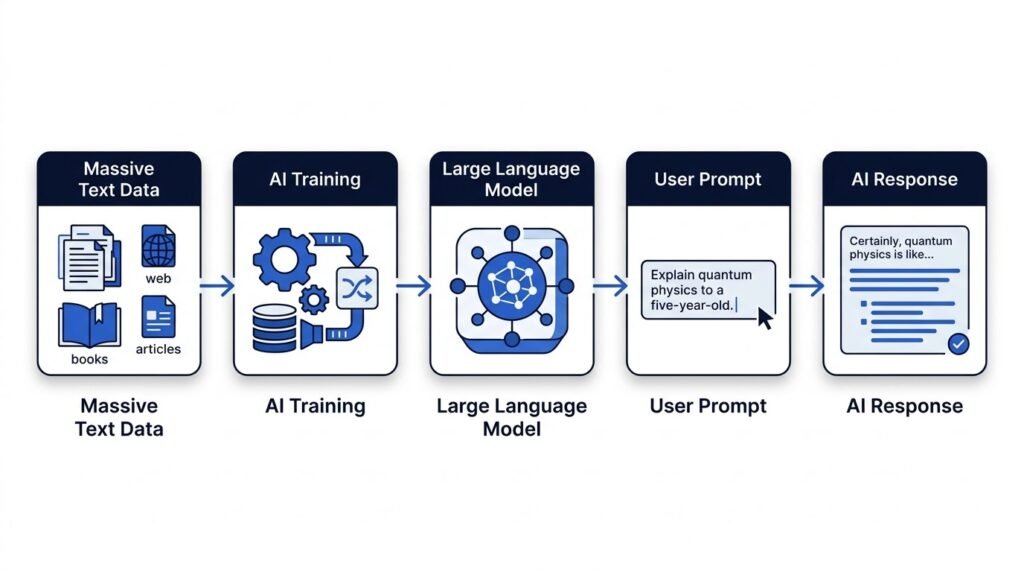
An LLM is trained on vast collections of text to learn how words, sentences, and ideas relate to one another.
During training, the model repeatedly answers a simple question:
“What is the most likely next word?”
It performs this prediction billions of times across books, articles, websites, and other text sources.
Over time, the model develops a statistical understanding of language.
It learns:
- Grammar
- Sentence structure
- Common facts
- Writing styles
- Relationships between concepts
- Patterns in human communication
It’s important to note that an LLM does not memorize every sentence it encounters. Instead, it learns patterns that allow it to generate new, original responses.
How ChatGPT Generates Responses
When you type a prompt into ChatGPT, the system follows a series of steps in just a few seconds.
Step 1: Understand the Prompt
The model analyzes your words and identifies the context and intent.
For example:
“Explain photosynthesis to a 10-year-old.”
The AI recognizes:
- Topic: Photosynthesis
- Audience: Beginner
- Desired style: Simple explanation
Step 2: Predict the Next Word
Rather than writing the entire answer at once, the model predicts one token (a piece of a word or word) at a time.
For example:
Plants
↓
use
↓
sunlight
↓
to
↓
make
↓
their
↓
own
↓
food.
Each prediction is based on all the words that came before it.
This process happens extremely quickly, creating responses that appear natural and coherent.
Step 3: Generate a Complete Response
The model continues predicting tokens until it has produced a complete answer.
Although the response feels conversational, it is fundamentally the result of sophisticated probability calculations based on patterns learned during training.
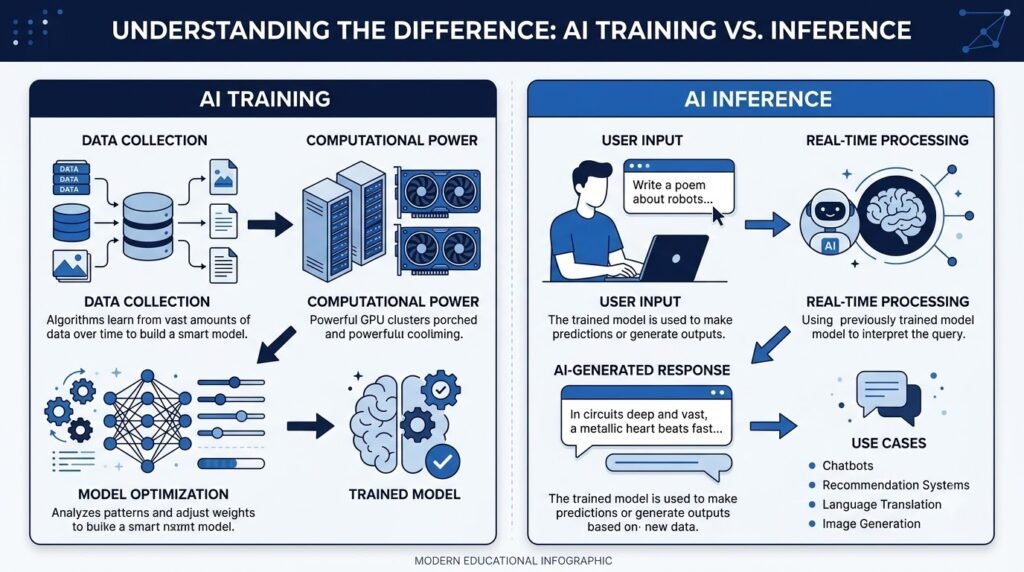
Training vs. Inference
Many beginners assume AI is constantly learning from every conversation. In reality, there are two distinct phases.
| Training | Inference |
| AI learns from data | AI applies what it has learned |
| Requires significant computing resources | Happens in real time |
| Updates the model’s knowledge | Uses the existing model |
| Can take weeks or months | Usually takes seconds |
When you use an AI chatbot, you’re typically interacting with the inference phase—the model is using its existing knowledge to generate responses, not retraining itself on your conversation.
Why Does Artificial Intelligence Sometimes Make Mistakes?
Artificial intelligence has made remarkable progress, but it is not perfect. Even the most advanced AI systems can produce incorrect, misleading, or biased results.
Understanding why AI makes mistakes is an important part of learning how it works.
1. Poor or Incomplete Training Data
AI learns from the data it is trained on. If that data contains errors, outdated information, or lacks diversity, the AI’s predictions can also be inaccurate.
For example, imagine training an AI image recognition system using only pictures of white cats. If it’s later shown a black cat, it may struggle to recognize it because it hasn’t seen enough varied examples.
Key takeaway: Better data usually leads to better AI.
2. AI Predicts—It Doesn’t Think
Unlike humans, AI doesn’t truly understand concepts or reason about the world.
Instead, it predicts the most likely response based on patterns learned during training.
This means AI can sometimes sound confident while providing incorrect information.
This phenomenon is often called an AI hallucination.
Example
If you ask an AI for a source that doesn’t exist, it might generate a realistic-looking citation instead of admitting it doesn’t know.
This is why it’s important to verify AI-generated information, especially for:
- Medical advice
- Financial decisions
- Legal information
- Academic research
- News and current events
3. Bias in Training Data
AI models learn from human-created data, which can contain biases.
If the training data reflects certain stereotypes or lacks representation, the AI may unintentionally reproduce those patterns.
Developers work to reduce bias through:
- Better datasets
- Human review
- Safety testing
- Ongoing model improvements
However, no AI system is completely free from bias.
4. Limited Context
AI performs best when it has enough context.
For example:
Less effective prompt:
“Write about AI.”
More effective prompt:
“Write a 500-word beginner-friendly explanation of how AI works with real-world examples.”
Providing clear instructions helps AI generate more accurate and relevant responses.
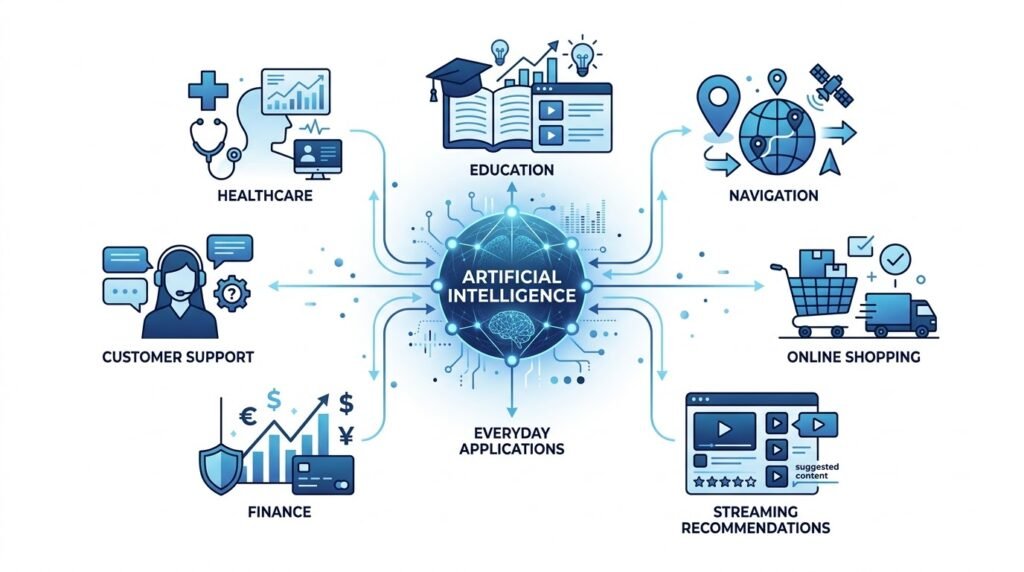
Real-World Examples of How AI Works
Artificial intelligence powers many everyday technologies, often behind the scenes.
Search Engines
When you search for information online, AI helps:
- Understand your query
- Rank relevant web pages
- Suggest related searches
- Detect spam
- Improve search results over time
Streaming Services
Platforms like Netflix and Spotify use AI to recommend content based on your viewing or listening habits.
The AI analyzes patterns such as:
- Previous activity
- Similar users
- Genres
- Ratings
- Time of day
This helps create personalized recommendations.
Online Shopping
E-commerce websites use AI to:
- Recommend products
- Predict customer preferences
- Detect fraudulent transactions
- Optimize pricing
- Improve search results
Navigation Apps
Applications such as Google Maps use AI to analyze:
- Traffic conditions
- Road closures
- Historical travel patterns
- Estimated arrival times
The AI then suggests the fastest or most efficient route.
Healthcare
Healthcare organizations increasingly use AI to assist professionals by:
- Analyzing medical images
- Supporting disease detection
- Predicting health risks
- Organizing patient records
- Accelerating medical research
It’s important to note that AI is designed to assist healthcare professionals, not replace their expertise.
Customer Support
Many businesses use AI chatbots to:
- Answer common questions
- Guide customers through processes
- Recommend products
- Provide support around the clock
For complex issues, conversations are often transferred to human representatives.
Benefits of Artificial Intelligence
AI offers numerous advantages when used responsibly.
Improves Efficiency
AI can process large amounts of information much faster than humans.
Automates Repetitive Tasks
Routine work such as data entry, scheduling, and document classification can often be automated.
Supports Better Decisions
By identifying patterns in data, AI can help people make more informed decisions.
Personalizes Experiences
AI tailors recommendations, search results, and learning experiences based on user preferences.
Accelerates Innovation
Researchers use AI to analyze complex problems in fields such as medicine, engineering, climate science, and education.
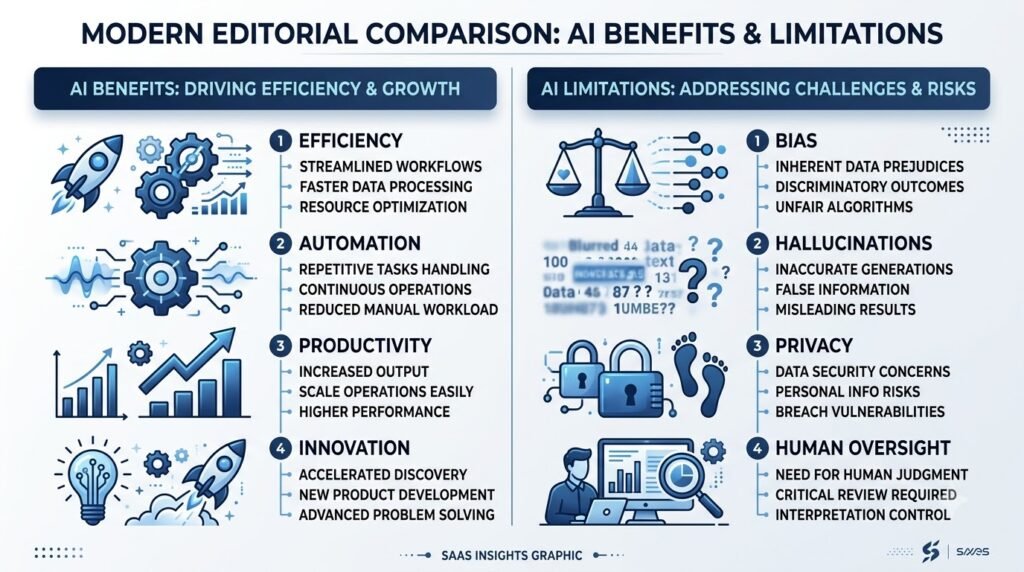
Limitations of Artificial Intelligence
Despite its capabilities, AI also has important limitations.
It Doesn’t Truly Understand
AI recognizes patterns but doesn’t possess human consciousness, emotions, or common sense.
It Can Be Wrong
AI-generated content may include factual errors or outdated information.
It Depends on Data
The quality of AI outputs is closely tied to the quality of the training data.
It Requires Human Oversight
People should review important AI-generated outputs, especially in high-stakes situations.
It Raises Ethical Questions
Responsible AI development involves addressing issues such as:
- Privacy
- Fairness
- Transparency
- Accountability
- Security
Common Misconceptions About AI
| Myth | Reality |
| AI thinks like humans. | AI identifies patterns and predicts outputs based on data. |
| AI knows everything. | AI has limitations and can make mistakes. |
| AI will replace every job. | AI is more likely to automate specific tasks while creating new opportunities. |
| AI is always objective. | AI can reflect biases present in its training data. |
| AI continuously learns from every conversation. | Most AI systems use trained models during inference and are not retrained with each interaction. |
Best Practices for Using AI
To get the most value from AI tools:
- Be specific when writing prompts.
- Verify important facts using reliable sources.
- Use AI as a productivity assistant, not as the sole decision-maker.
- Protect sensitive or confidential information.
- Continue developing your own critical thinking and subject knowledge.
AI works best when combined with human judgment.
Frequently Asked Questions
Can artificial intelligence think like humans?
No. Current AI systems recognize patterns and generate predictions, but they do not possess human consciousness, emotions, or genuine understanding.
Does AI learn every time I use it?
Typically, no. Most AI applications use a trained model to generate responses. Updating the model usually requires a separate training process conducted by developers.
What is the difference between AI and machine learning?
Artificial Intelligence is the broader field focused on creating intelligent systems.
Machine Learning is a subset of AI that enables systems to learn from data rather than relying solely on programmed rules.
What is a neural network?
A neural network is a mathematical model inspired by the structure of the human brain. It helps AI identify complex patterns in text, images, audio, and other forms of data.
Is ChatGPT an example of artificial intelligence?
Yes. ChatGPT is an AI application powered by a Large Language Model (LLM) that generates human-like text by predicting the most likely sequence of words based on patterns learned during training.
Will AI replace human jobs?
AI is expected to automate certain tasks, particularly repetitive or data-intensive work. At the same time, it is creating demand for new roles in AI development, oversight, education, and human-AI collaboration.
Conclusion
Artificial intelligence may seem complex at first, but its core idea is surprisingly straightforward.
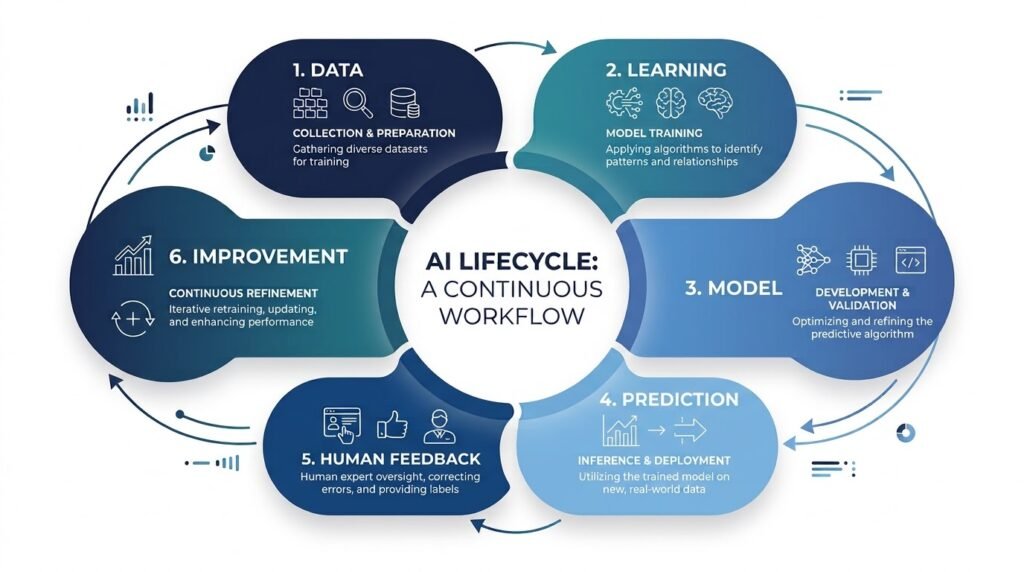
Modern AI systems learn patterns from data, build mathematical models, and use those models to make predictions or generate content. Technologies such as machine learning, neural networks, and deep learning have enabled AI to solve problems that were once considered impossible for computers.
While AI can recognize images, understand language, recommend products, and generate text, it is important to remember that it does not think or reason like a human. It relies on probabilities, patterns, and the quality of the data it has learned from.
As AI becomes increasingly integrated into education, business, healthcare, and everyday life, understanding how it works is becoming a valuable digital skill. You don’t need to become a data scientist to benefit from AI—but having a solid understanding of its fundamentals will help you use these technologies more effectively and responsibly.
Whether you’re a student, professional, business owner, or simply curious about technology, learning the basics of AI is an investment in your future.
Key Terms
| Term | Definition |
| Artificial Intelligence (AI) | Computer systems designed to perform tasks that typically require human intelligence. |
| Machine Learning (ML) | A subset of AI where systems learn patterns from data. |
| Neural Network | A layered mathematical model used to recognize complex patterns. |
| Deep Learning | Machine learning using large neural networks with many layers. |
| Model | The result of training that AI uses to make predictions. |
| Training | The process of teaching an AI model using data. |
| Inference | Using a trained model to make predictions or generate outputs. |
| Large Language Model (LLM) | An AI model trained on vast amounts of text to understand and generate language. |
| Hallucination | An AI-generated response that sounds plausible but is inaccurate or fabricated. |
Continue Your AI Journey
Keep building your AI knowledge with these beginner-friendly guides.
-
AI Glossary: 100+ Artificial Intelligence Terms Explained
Learn more : AI Glossary: 100+ Artificial Intelligence Terms Explained🕒 25-35 min read • Updated: Aug 2026 Introduction Artificial Intelligence (AI) is changing how we learn, work,…
-

Large Language Models (LLMs) Explained: The Complete 2026 Beginner’s Guide
Learn more : Large Language Models (LLMs) Explained: The Complete 2026 Beginner’s Guide🕒 14-16 min read • Updated: Aug 2026 Introduction Artificial Intelligence has become part of everyday life. Whether…
-
How Artificial Intelligence Works: 5 Core Concepts Explained Simply (2026 Guide)
Learn more : How Artificial Intelligence Works: 5 Core Concepts Explained Simply (2026 Guide)🕒 14-16 min read • Updated: Aug 2026 Introduction What Is Machine Learning? If Artificial Intelligence is the…
-

Artificial Intelligence Explained: The Complete Beginner’s Guide (2026)
Learn more : Artificial Intelligence Explained: The Complete Beginner’s Guide (2026)🕒 14-18 min read • Updated: Aug 2026 introduction Artificial intelligence (AI) has quickly become one of the…
-

How to Use AI in Content Creation: The Complete 2026 Blueprint
Learn more : How to Use AI in Content Creation: The Complete 2026 Blueprint🕒 10-12 min read • Updated: July 2026 Introduction Creating high-quality content consistently can be challenging, whether you’re…
-

7 Ways AI Is Transforming Software Development in 2026 (Real Workflows & Case Studies)
Learn more : 7 Ways AI Is Transforming Software Development in 2026 (Real Workflows & Case Studies)🕒 12-15 min read • Updated: July 2026 Introduction Artificial intelligence (AI) is transforming software development by helping…
Related Articles
Explore more guides and resources related to this topic.
-

ChatGPT Complete Guide for Beginners (2026): Master AI Step-by-Step
Learn more : ChatGPT Complete Guide for Beginners (2026): Master AI Step-by-Step🕒 20-25 min read • Updated: Aug 2026 Introduction Introduction Artificial intelligence is changing how people learn, work,…
-

Master Prompt Engineering in 2026: A Step-by-Step Beginner’s Guide
Learn more : Master Prompt Engineering in 2026: A Step-by-Step Beginner’s Guide🕒 18-20 min read • Updated: Aug 2026 Introduction Artificial intelligence (AI) tools like ChatGPT, Claude, Gemini, and…
-
Large Language Models (LLMs) Explained: The Complete 2026 Beginner’s Guide
Learn more : Large Language Models (LLMs) Explained: The Complete 2026 Beginner’s Guide🕒 14-16 min read • Updated: Aug 2026 Introduction Artificial Intelligence has become part of everyday life. Whether…
-

Best AI Image Generators in 2026: 10 Free & Paid Tools Tested
Learn more : Best AI Image Generators in 2026: 10 Free & Paid Tools Tested🕒 15 min read • Updated: July 2026 introduction Creating stunning images no longer requires years of design…
-

10 Best AI Chatbots in 2026: Tested & Ranked for Every Use Case
Learn more : 10 Best AI Chatbots in 2026: Tested & Ranked for Every Use Case🕒 10-12 min read • Updated: July 2026 introduction Artificial intelligence has made chatbots far more capable than…
-

ChatGPT vs Microsoft Copilot (2026): Tested, Pricing & Workflow Comparison
Learn more : ChatGPT vs Microsoft Copilot (2026): Tested, Pricing & Workflow Comparison🕒 10-12 min read • Updated: July 2026 Introduction Choosing between ChatGPT and Microsoft Copilot can be challenging,…
Recommended AI Tools
If you’d like to explore AI hands-on, start with these beginner-friendly tools:
- ChatGPT — Conversational AI for writing, brainstorming, coding, and learning.
- Claude — Helpful for long-form writing, analysis, and reasoning.
- Gemini — Google’s AI assistant with strong integration across Google services.
- Perplexity AI — AI-powered search with cited sources.
- Canva AI — Create presentations, graphics, and social media content using AI.
Leave a Reply