
🕒 14-16 min read • Updated: July 2026
Table of Contents
AI Interview Preparation: How to Use AI Tools to Ace Your Next Interview
Introduction
Preparing for a job interview has always required research, practice, and confidence.
But the way people prepare for interviews is changing.
Artificial intelligence now allows candidates to practice realistic interviews, improve their answers, research companies faster, and receive instant feedback on their communication.
Instead of preparing alone with a list of common interview questions, candidates can use AI as a personal interview coach.
AI can help you:
- Generate role-specific interview questions
- Practice realistic mock interviews
- Improve weak answers
- Structure responses professionally
- Identify gaps in your preparation
- Build confidence before the actual interview
However, AI is not a replacement for authentic preparation.
The strongest candidates do not use AI to create fake answers. They use AI to organize their experiences, improve their communication, and present their real skills more effectively.
This guide explains how to use AI for interview preparation, the best AI-powered methods, practical prompts, common mistakes to avoid, and a complete workflow to prepare for your next interview.
Key Takeaways
- AI can act as a personal interview preparation assistant by creating questions, simulations, and feedback.
- AI mock interviews help candidates practice realistic conversations before the actual interview.
- The STAR method combined with AI feedback can improve behavioral interview answers.
- AI should enhance your personal experiences, not replace them with generic responses.
- A structured AI interview preparation workflow can make your preparation faster and more effective.
What Is AI Interview Preparation?
AI interview preparation means using artificial intelligence tools to improve your readiness for job interviews.
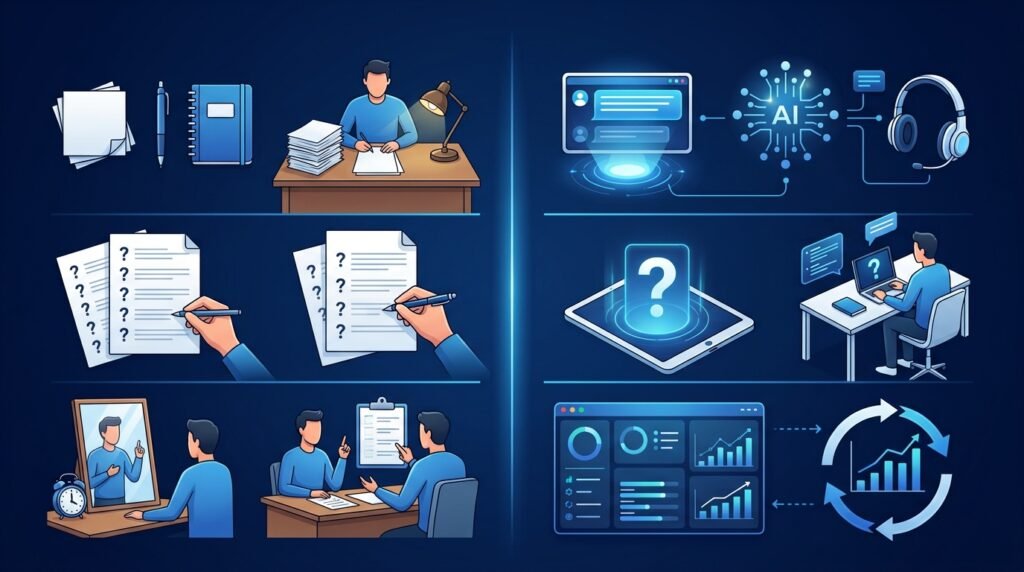
Traditional interview preparation usually involves:
- Searching common interview questions
- Reading sample answers
- Writing notes
- Practicing with friends
- Reviewing company information
While these methods are useful, they often lack personalized feedback.
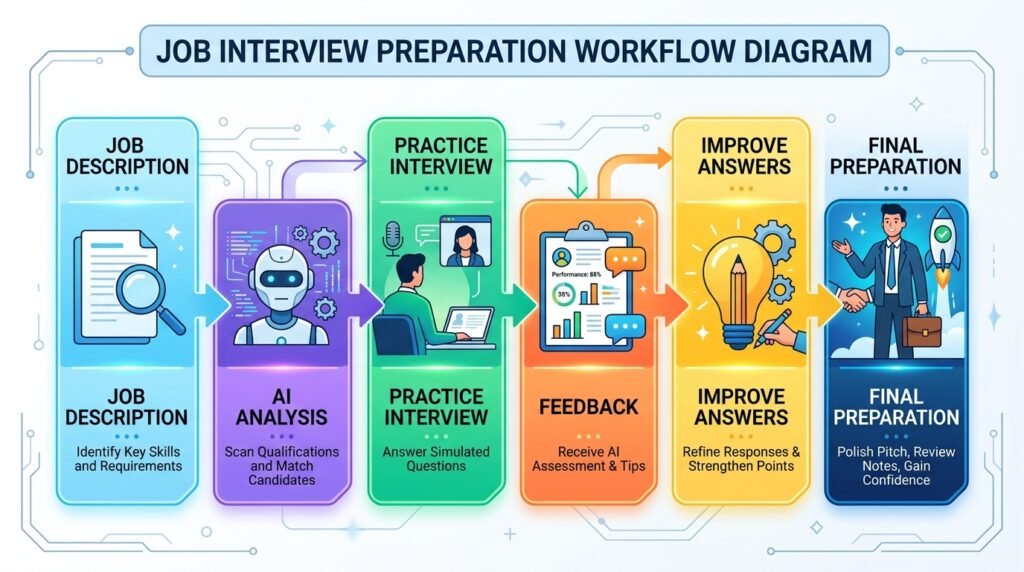
AI changes this by creating a more interactive preparation process.
An AI assistant can analyze your target role, generate relevant questions, review your answers, and suggest improvements.
For example, instead of searching:
“Common marketing manager interview questions”
you can ask AI:
“Act as a senior marketing hiring manager. Create a realistic interview simulation for a marketing manager position at a technology company.”
The result is a more personalized practice experience.
Why AI Is Changing Interview Preparation
The biggest challenge in interview preparation is not finding questions.
It is knowing whether your answers are strong enough.
Many candidates struggle with:
- Giving unclear answers
- Talking too much without structure
- Forgetting important achievements
- Failing to explain their impact
- Becoming nervous during conversations
AI helps create a continuous improvement loop:
Practice → Feedback → Improvement → Repeat
Instead of practicing once and hoping for the best, candidates can improve through multiple simulated interviews.
AI provides several advantages:
1. Personalized Preparation
Every job is different.
A software engineer interview requires different preparation from a sales manager interview.
AI can customize practice based on:
- Job description
- Industry
- Company
- Experience level
- Required skills
2. Faster Research
Before an interview, candidates need to understand:
- Company background
- Products and services
- Industry trends
- Competitors
- Role expectations
AI can help organize this information quickly.
Example prompt:
“Analyze this company website and summarize its business model, products, competitors, and important points I should know before my interview.”
This helps candidates arrive prepared with better questions and stronger answers.
3. Realistic Interview Practice
Reading interview questions is different from answering them under pressure.
AI allows candidates to simulate conversations.
Example:
Prompt:
“Conduct a mock interview for a product manager role. Ask one question at a time. After each answer, provide feedback on clarity, structure, and impact.”
This creates a realistic practice environment.
How to Use AI for Interview Preparation
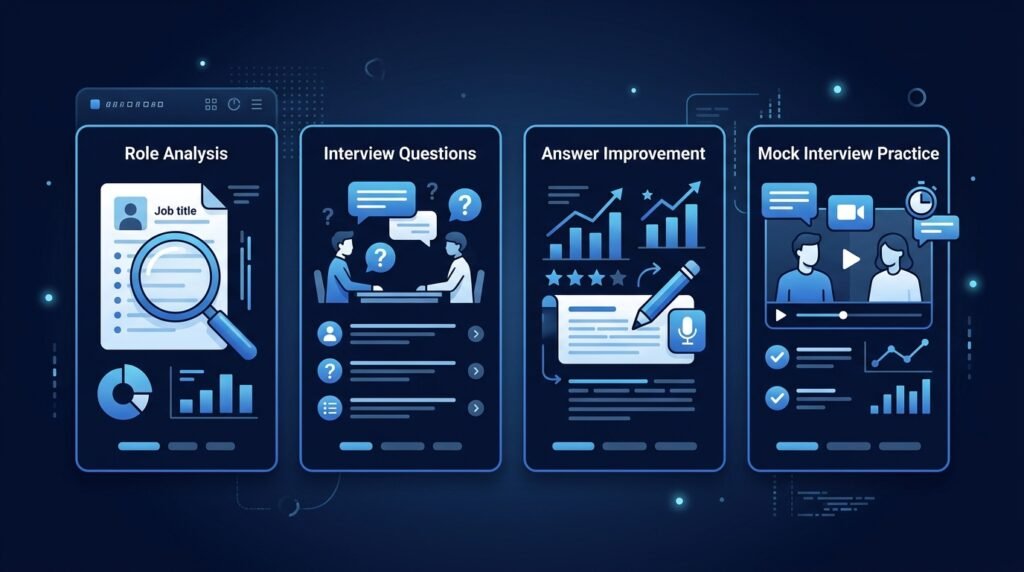
1. Analyze the Job Description
The first step in interview preparation is understanding what the employer is looking for.
Most job descriptions contain hidden signals about:
- Required skills
- Important responsibilities
- Company expectations
- Candidate qualities
AI can help identify these signals.
Example prompt:
“Analyze this job description. Identify the five most important skills the employer is looking for and suggest interview questions based on them.”
AI can transform a long job description into a preparation roadmap.
2. Generate Role-Specific Interview Questions
Generic interview questions are useful, but role-specific questions are more valuable.
For example:
A data analyst may be asked:
- How do you handle missing data?
- Explain a project where your analysis influenced decisions.
A sales professional may be asked:
- How do you handle customer objections?
- Describe your biggest sales achievement.
AI can create questions tailored to your position.
Example prompt:
“Generate 30 interview questions for a junior data analyst role. Include technical, behavioral, and situational questions.”
3. Practice AI Mock Interviews
Mock interviews are one of the most effective ways to use AI.
Instead of simply reviewing questions, you practice answering them.
A good AI mock interview should include:
- One question at a time
- Follow-up questions
- Feedback after answers
- Suggestions for improvement
Example workflow:
Step 1:
Ask AI to act as an interviewer.
Step 2:
Answer naturally.
Step 3:
Ask AI to evaluate your response.
Step 4:
Improve and repeat.
4. Improve Answers Using the STAR Method
Many interview questions focus on past experiences.
Examples:
- Tell me about a challenge you faced.
- Describe a time you solved a problem.
- Give an example of leadership.
The STAR framework helps organize answers.
Situation
Explain the context.
Task
Describe your responsibility.
Action
Explain what you did.
Result
Share the outcome.
Example:
Question:
“Tell me about a difficult project you completed.”
Basic answer:
“I worked on a difficult project and completed it successfully.”
Improved STAR answer:
“During a product launch, our team faced a tight deadline because requirements changed late in the process. I was responsible for coordinating communication between teams. I created a revised timeline, organized weekly progress meetings, and improved task tracking. As a result, we launched successfully while meeting our customer goals.”
AI can help transform simple answers into structured professional responses.
5. Use AI to Improve Communication
A good answer is not only about what you say.
It is also about how clearly you communicate.
AI can review:
- Answer length
- Clarity
- Confidence
- Professional tone
- Missing details
Example prompt:
“Review my interview answer. Identify weaknesses and suggest improvements while keeping my personal experience authentic.”
This helps candidates sound more polished without sounding artificial.
6. Prepare Questions to Ask the Interviewer
Many candidates focus only on answering questions.
But asking thoughtful questions also demonstrates preparation.
AI can help generate questions based on:
- Company goals
- Team structure
- Role expectations
- Industry challenges
Examples:
- What does success look like in this role after six months?
- What are the biggest challenges the team is currently solving?
- How does this company measure performance?
Strong questions can leave a positive impression.
Best AI Tools for Interview Preparation
AI interview preparation becomes much more effective when you use the right tools for the right tasks.
Different AI tools can support different parts of the preparation process:
- Researching companies
- Practicing interviews
- Improving answers
- Writing professional responses
- Organizing preparation notes
Below are some of the most useful categories of AI tools for interview preparation.
1. AI Chat Assistants
General AI assistants can act as interview coaches.
They can help you:
- Generate questions
- Simulate interviews
- Review answers
- Explain technical concepts
- Improve communication
Examples include:
- ChatGPT
- Claude
- Gemini
- Perplexity
A simple workflow:
- Upload the job description.
- Ask AI to identify key skills.
- Generate interview questions.
- Practice answers.
- Request feedback.
2. AI Mock Interview Platforms
Dedicated AI interview platforms are designed specifically for practice.
They often provide:
- Video interview simulations
- Voice-based conversations
- Answer analysis
- Communication feedback
- Performance reports
These tools can help candidates practice realistic interview situations.
3. AI Resume Analysis Tools
Your resume and interview preparation are connected.
Many interview questions come directly from your resume.
AI can help identify:
- Weak descriptions
- Missing achievements
- Unclear responsibilities
- Opportunities to add measurable results
Example prompt:
Review my resume as a hiring manager. Identify areas that may create questions during an interview and suggest improvements.
A Complete AI Interview Preparation Workflow
A structured process helps you prepare faster and more effectively.
Follow this five-step workflow.
Step 1: Understand the Role
Before practicing answers, understand what the company needs.
Analyze:
- Job responsibilities
- Required skills
- Experience expectations
- Company values
Use AI to summarize the role.
Example prompt:
Analyze this job description and explain the top skills, responsibilities, and qualities the ideal candidate should demonstrate.
Output:
- Key competencies
- Likely interview topics
- Important examples to prepare
Step 2: Build Your Personal Answer Library
Do not memorize hundreds of answers.
Instead, create a collection of your own experiences.
Prepare examples related to:
- Leadership
- Problem-solving
- Teamwork
- Conflict resolution
- Failure
- Learning
- Achievement
A useful structure:
| Experience | Skill Demonstrated | Result |
| Product launch | Leadership | Increased adoption |
| Customer issue | Problem-solving | Improved satisfaction |
| Team project | Collaboration | Delivered on deadline |
AI can organize these experiences into interview-ready stories.
Step 3: Practice With AI Mock Interviews
Create realistic interview conditions.
Example prompt:
Act as a senior recruiter interviewing me for a software engineer position. Ask one question at a time. Do not provide answers until I respond. After five questions, give detailed feedback.
During practice, focus on:
- Speaking clearly
- Avoiding unnecessary details
- Providing specific examples
- Explaining your impact

Step 4: Improve Weak Answers
After completing a mock interview, ask AI:
Evaluate my answers as a hiring manager. Score my responses based on clarity, relevance, confidence, and evidence. Suggest improvements.
Pay attention to:
Too General
Weak:
“I improved team performance.”
Better:
“I introduced weekly planning meetings that reduced project delays by 30%.”
No Result
Weak:
“I managed a customer campaign.”
Better:
“I managed a customer campaign that increased qualified leads by 20% over three months.”
Too Long
Many candidates lose impact because they provide unnecessary background.
AI can help shorten answers while keeping important details.
Step 5: Final Interview Simulation
Before the actual interview, conduct a complete simulation.
Ask AI to:
- Act as the interviewer
- Ask realistic questions
- Challenge unclear answers
- Provide final feedback
Example:
Conduct a 30-minute interview simulation for this role. Include behavioral, technical, and situational questions. At the end, provide a hiring recommendation.
This final practice helps reduce uncertainty and improves confidence.
Useful AI Prompts for Interview Preparation
Prompt 1: Generate Interview Questions
Act as an experienced hiring manager.
Based on this job description, create 25 realistic interview questions.
Include:
– Technical questions
– Behavioral questions
– Situational questions
– Follow-up questions
Prompt 2: Improve an Interview Answer
Review my interview answer.
Evaluate:
– Clarity
– Structure
– Confidence
– Specific examples
– Business impact
Suggest improvements while keeping my original experience authentic.
Prompt 3: Practice Behavioral Questions
Act as an interview coach.
Ask me behavioral interview questions one at a time.
After each response:
– Analyze my answer
– Suggest improvements
– Explain how a hiring manager may perceive it.
Prompt 4: Company Research
Help me prepare for an interview at this company.
Analyze:
– Business model
– Products
– Industry position
– Competitors
– Recent developments
– Questions I should ask the interviewer.
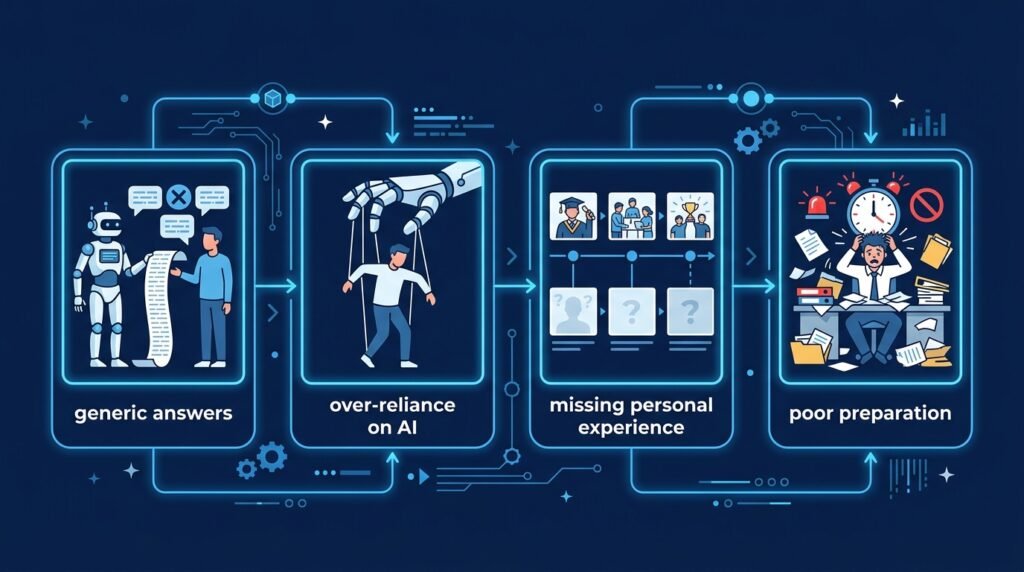
Common Mistakes When Using AI for Interview Preparation
AI is powerful, but using it incorrectly can hurt your performance.
Mistake 1: Memorizing AI-Generated Answers
One of the biggest mistakes candidates make is copying AI responses word-for-word.
Why it fails:
- Answers sound unnatural
- Personal experiences are missing
- Interviewers can notice rehearsed responses
Better approach:
Use AI as an editor, not a scriptwriter.
Your answer should sound like you.
Mistake 2: Giving AI Too Little Context
A vague prompt produces a generic answer.
Poor prompt:
Give me interview answers.
Better prompt:
I have three years of experience as a digital marketer. I am applying for a growth marketing manager role. Help me prepare answers based on my experience.
More context creates better results.
Mistake 3: Ignoring Personal Experience
AI cannot invent your achievements.
Your strongest interview answers come from:
- Real projects
- Real challenges
- Real outcomes
Use AI to organize your experience, not replace it.
Mistake 4: Preparing Only Common Questions
Many candidates prepare:
- Tell me about yourself
- What are your strengths?
- What are your weaknesses?
But interviews often focus on:
- Role-specific challenges
- Decision-making
- Problem-solving
- Past experiences
Use AI to prepare beyond the obvious questions.
Mistake 5: Skipping Human Practice
AI is useful, but human interaction matters.
Practice with:
- Friends
- Mentors
- Colleagues
- Professional coaches
Real conversations improve:
- Body language
- Listening skills
- Confidence
Frequently Asked Questions
Can AI help me pass a job interview?
AI can improve your preparation, but it cannot guarantee a job offer.
Success depends on:
- Your skills
- Experience
- Communication
- Role fit
- Interview performance
AI works best as a preparation assistant.
Is it okay to use AI for interview preparation?
Yes.
Using AI for research, practice, and feedback is similar to using books, courses, or coaching.
However, candidates should avoid using AI to create fake experiences or dishonest answers.
Which AI tool is best for interview preparation?
The best tool depends on your needs.
For general preparation:
- AI chat assistants are useful for questions and feedback.
For realistic simulations:
- Dedicated AI interview platforms may provide stronger practice features.
For research:
- AI search tools can help analyze companies and industries.
Can AI improve my confidence before an interview?
Yes.
Confidence often improves when uncertainty decreases.
AI helps by allowing you to:
- Practice repeatedly
- Prepare examples
- Receive feedback
- Understand expectations
Conclusion: Use AI as Your Personal Interview Coach
AI has transformed interview preparation from a passive activity into an interactive learning process.
Instead of simply reading interview questions, candidates can now practice realistic conversations, receive feedback, improve answers, and prepare strategically.
The best approach is simple:
Use AI to:
- Understand the role
- Practice questions
- Improve communication
- Organize your experiences
- Build confidence
But remember:
AI should enhance your preparation, not replace your authenticity.
Your experiences, skills, and personal stories are what make you valuable.
The candidates who succeed in the AI era will not be those who depend on AI completely.
They will be those who know how to use AI effectively.
Recommended AI Tools for Interview Preparation
Explore AI tools that can help with:
- Research
- Writing
- Productivity
- Career development
- Learning
Recommended categories:
- AI assistants
- AI writing tools
- AI productivity tools
- AI learning platforms
Continue Your AI Journey
Keep building your AI knowledge with these beginner-friendly guides.
-
AI Glossary: 100+ Artificial Intelligence Terms Explained
Learn more : AI Glossary: 100+ Artificial Intelligence Terms Explained🕒 25-35 min read • Updated: Aug 2026 Introduction Artificial Intelligence (AI) is changing how we learn, work,…
-
Large Language Models (LLMs) Explained: The Complete 2026 Beginner’s Guide
Learn more : Large Language Models (LLMs) Explained: The Complete 2026 Beginner’s Guide🕒 14-16 min read • Updated: Aug 2026 Introduction Artificial Intelligence has become part of everyday life. Whether…
-
How Artificial Intelligence Works: 5 Core Concepts Explained Simply (2026 Guide)
Learn more : How Artificial Intelligence Works: 5 Core Concepts Explained Simply (2026 Guide)🕒 14-16 min read • Updated: Aug 2026 Introduction What Is Machine Learning? If Artificial Intelligence is the…
-
Artificial Intelligence Explained: The Complete Beginner’s Guide (2026)
Learn more : Artificial Intelligence Explained: The Complete Beginner’s Guide (2026)🕒 14-18 min read • Updated: Aug 2026 introduction Artificial intelligence (AI) has quickly become one of the…
-
How to Use AI in Content Creation: The Complete 2026 Blueprint
Learn more : How to Use AI in Content Creation: The Complete 2026 Blueprint🕒 10-12 min read • Updated: July 2026 Introduction Creating high-quality content consistently can be challenging, whether you’re…
-

7 Ways AI Is Transforming Software Development in 2026 (Real Workflows & Case Studies)
Learn more : 7 Ways AI Is Transforming Software Development in 2026 (Real Workflows & Case Studies)🕒 12-15 min read • Updated: July 2026 Introduction Artificial intelligence (AI) is transforming software development by helping…
Related Articles
Explore more guides and resources related to this topic.
-

ChatGPT Complete Guide for Beginners (2026): Master AI Step-by-Step
Learn more : ChatGPT Complete Guide for Beginners (2026): Master AI Step-by-Step🕒 20-25 min read • Updated: Aug 2026 Introduction Introduction Artificial intelligence is changing how people learn, work,…
-
Master Prompt Engineering in 2026: A Step-by-Step Beginner’s Guide
Learn more : Master Prompt Engineering in 2026: A Step-by-Step Beginner’s Guide🕒 18-20 min read • Updated: Aug 2026 Introduction Artificial intelligence (AI) tools like ChatGPT, Claude, Gemini, and…
-
Large Language Models (LLMs) Explained: The Complete 2026 Beginner’s Guide
Learn more : Large Language Models (LLMs) Explained: The Complete 2026 Beginner’s Guide🕒 14-16 min read • Updated: Aug 2026 Introduction Artificial Intelligence has become part of everyday life. Whether…
-

Best AI Image Generators in 2026: 10 Free & Paid Tools Tested
Learn more : Best AI Image Generators in 2026: 10 Free & Paid Tools Tested🕒 15 min read • Updated: July 2026 introduction Creating stunning images no longer requires years of design…
-
10 Best AI Chatbots in 2026: Tested & Ranked for Every Use Case
Learn more : 10 Best AI Chatbots in 2026: Tested & Ranked for Every Use Case🕒 10-12 min read • Updated: July 2026 introduction Artificial intelligence has made chatbots far more capable than…
-
ChatGPT vs Microsoft Copilot (2026): Tested, Pricing & Workflow Comparison
Learn more : ChatGPT vs Microsoft Copilot (2026): Tested, Pricing & Workflow Comparison🕒 10-12 min read • Updated: July 2026 Introduction Choosing between ChatGPT and Microsoft Copilot can be challenging,…
References
- OpenAI Prompt Engineering Guide
https://platform.openai.com/docs/guides/prompt-engineering - LinkedIn Career Advice
https://www.linkedin.com/business/talent/blog - Indeed Interview Preparation Guide
https://www.indeed.com/career-advice/interviewing - World Economic Forum — Future of Jobs Report
https://www.weforum.org/publications/ - NACE Career Readiness Competencies
https://www.naceweb.org/career-readiness/competencies/career-readiness-defined/
Leave a Reply