
🕒 15 min read • Updated: July 2026
Table of Contents

Introduction
Every day, new AI tools promise faster answers, better research, and improved productivity. One name that’s quickly gaining attention is Perplexity AI, an AI-powered search assistant that combines conversational responses with real-time web sources.
But what exactly is Perplexity AI, how does it work, and is it a better choice than ChatGPT or traditional search engines?
In this beginner-friendly guide, you’ll learn what Perplexity AI is, how it works, its key features, pricing, advantages, limitations, and practical use cases. We’ll also compare it with ChatGPT and Google AI to help you decide which tool best fits your needs.
Perplexity AI at a Glance
Best for: Research, fact-checking, and finding information with cited sources.
Free Plan: Yes
Paid Plan: Yes (Perplexity Pro)
Strength: AI-powered answers with citations.
Best Alternative: ChatGPT, Claude, Google Gemini
Key Takeaways
- Perplexity AI combines AI-generated answers with live web citations.
- It excels at research, learning, and fact-finding.
- Unlike traditional search engines, it summarizes information conversationally.
- Compared with ChatGPT, it focuses more on source-backed responses.
- It’s suitable for students, professionals, and everyday learners.
What Is Perplexity AI?
Perplexity AI is an AI-powered search and research assistant designed to help users find information through natural conversations.
Instead of typing keywords into a search engine and opening multiple websites, you can ask Perplexity a question in plain language. It searches relevant sources, analyzes the information, and generates a clear answer while providing citations to the websites it used.
For example, instead of searching:
“best programming language for beginners”
you could simply ask:
“I’m new to coding. Which programming language should I learn first, and why?”
Perplexity responds with a concise explanation, compares popular languages, and includes links to the sources supporting its answer.
This conversational approach makes information easier to understand, especially for beginners.
Perplexity AI is an AI-powered search and answer engine that combines large language models with real-time web search to provide conversational responses supported by citations. It helps users research topics, verify information, and explore sources more efficiently than traditional search engines.
Why Is It Called an “Answer Engine”?
Traditional search engines primarily help users discover webpages.
Perplexity takes a different approach.
Rather than showing a long list of links, it aims to answer your question directly using AI while referencing the original sources.
This is why many people describe it as an AI answer engine rather than just another search engine.
Why Perplexity AI Matters
The internet contains an enormous amount of information. While that’s valuable, it also creates challenges.
Many searches require opening several webpages, comparing conflicting information, and deciding which sources are trustworthy.
Perplexity AI helps reduce this effort by combining several steps into one experience.
It saves research time
Instead of reading five or ten articles before finding your answer, Perplexity summarizes the key points and links back to the original sources if you want to explore further.
It encourages source verification
Unlike some AI chatbots that provide answers without references, Perplexity usually includes citations, making it easier to check where information comes from.
It supports natural conversations
You don’t need to know the perfect search keywords. You can ask follow-up questions, clarify your request, or explore a topic step by step.
It makes learning more accessible
Students, professionals, creators, and business owners can use conversational AI to understand unfamiliar concepts more quickly without feeling overwhelmed by technical jargon.
| Feature | Perplexity AI | ChatGPT | Google AI |
|---|---|---|---|
| Live Web Search | ✅ | Limited (depends on plan/model) | ✅ |
| Source Citations | ✅ | Sometimes | Yes |
| Research Focus | ⭐⭐⭐⭐⭐ | ⭐⭐⭐⭐ | ⭐⭐⭐⭐ |
| Creative Writing | ⭐⭐⭐ | ⭐⭐⭐⭐⭐ | ⭐⭐⭐ |
| Best For | Research | Conversations | Search |
How Does Perplexity AI Work?
Although Perplexity AI feels like chatting with a knowledgeable assistant, several technologies work together behind the scenes.
At a high level, the process looks like this:
Question → Web Search → AI Analysis → Source Verification → Answer Generation
Let’s break this down.
1. You Ask a Question
Everything begins with a natural language prompt.
For example:
“What are the benefits of solar energy for homeowners?”
You don’t need to use special keywords or search operators.
2. It Searches Relevant Information
Perplexity retrieves information from the web and other available knowledge sources to find content related to your question.
Unlike a traditional search engine that simply lists webpages, Perplexity identifies information that appears most relevant before generating a response.
3. AI Understands the Context
Perplexity uses large language models (LLMs) to interpret your question, identify its intent, and understand the relationships between different pieces of information.
For example, if you ask:
“Is it better than ChatGPT?”
Perplexity can infer that “it” refers to the topic discussed earlier in the conversation.
This makes follow-up questions feel more natural.
4. It Generates a Response
After analyzing the available information, the AI creates a clear, readable summary instead of copying content from a single webpage.
The goal is to present the information in an organized, conversational format.
5. It Provides Sources
One of Perplexity’s defining features is its use of citations.
Whenever possible, it lists the sources used to generate its response, allowing users to verify facts, explore topics in greater depth, or compare different perspectives.
This transparency is especially valuable for research and learning.
Key Features of Perplexity AI
Perplexity offers more than simple question-and-answer functionality. Several features make it a versatile research assistant.
Conversational Search
You can ask questions naturally and continue the conversation with follow-up prompts without starting over.
For example:
- “Explain quantum computing in simple terms.”
- “Can you give a real-world example?”
- “How is it different from classical computing?”
Perplexity remembers the context, making the interaction feel more like a conversation than a series of isolated searches.
Source Citations
Many responses include references to the websites or publications used.
This helps users evaluate the credibility of the information and explore the original material if they need more detail.
Web Search Integration
Perplexity can retrieve current information from the web, making it useful for topics that change over time, such as technology, business, or recent events.
This distinguishes it from AI systems that rely only on static training data.
Follow-Up Questions
Instead of performing a brand-new search every time, you can build on previous questions.
For example:
“Compare electric cars.”
Then ask:
“Which option is best for city driving?”
The AI understands the context of the ongoing discussion.
File Analysis
Users can upload documents such as PDFs and ask questions about their contents.
This feature is helpful for reviewing research papers, reports, manuals, or study materials.
Collections and Organization
Perplexity allows users to organize conversations into collections, making it easier to revisit research projects and keep related discussions together.
Real-World Uses of Perplexity AI
One of Perplexity AI’s biggest strengths is its versatility. Whether you’re learning something new, conducting research, or making decisions, it can help you gather and understand information more efficiently.
Below are some practical ways different people use Perplexity AI.
For Students
Students often spend hours searching through websites to understand a topic or prepare for exams.
Perplexity can help by:
- Explaining complex concepts in simple language
- Summarizing long articles or research papers
- Comparing theories or historical events
- Answering follow-up questions during study sessions
Example
Instead of searching:
“Photosynthesis definition”
You could ask:
“Explain photosynthesis like I’m a high school student, then give a real-world example.”
The response is more conversational and easier to understand than reading multiple webpages.
For Professionals
Professionals need reliable information quickly.
Perplexity can help with:
- Industry research
- Market trends
- Understanding new technologies
- Summarizing reports
- Learning unfamiliar concepts
Example
A project manager researching artificial intelligence could ask:
“What are the latest AI trends affecting small businesses?”
Perplexity summarizes recent developments and provides links to supporting sources.
For Content Creators
Writers, bloggers, YouTubers, and marketers can use Perplexity during the research phase.
Common tasks include:
- Gathering background information
- Finding statistics (which should always be verified)
- Discovering different viewpoints
- Creating outlines
- Exploring related questions audiences ask
Best practice: Use Perplexity for research and inspiration, but create original content in your own words.
For Business Owners
Entrepreneurs can use Perplexity to:
- Research competitors
- Understand industry terminology
- Explore software solutions
- Learn about marketing strategies
- Analyze customer trends
Instead of reading dozens of articles, they can begin with a summarized overview and then dive deeper into the cited sources.
For Developers
Developers often use Perplexity to:
- Understand programming concepts
- Compare frameworks
- Learn APIs
- Troubleshoot coding issues
- Explore technical documentation
For code generation and debugging, however, dedicated coding assistants or AI chatbots may offer more specialized support.
Perplexity AI vs ChatGPT
Although both tools use large language models and conversational interfaces, they are designed with different primary goals.
| Feature | Perplexity AI | ChatGPT |
| Primary purpose | AI-powered search and research | General-purpose AI assistant |
| Internet access | Built around web search | Depends on the model and settings |
| Source citations | Usually included | May or may not include sources |
| Research | Excellent | Very good |
| Brainstorming | Good | Excellent |
| Creative writing | Good | Excellent |
| Coding | Good | Excellent |
| Follow-up conversations | Yes | Yes |
| Real-time information | Strong | Depends on configuration |
| Best for | Research and factual exploration | Writing, coding, reasoning, brainstorming |
If your goal is researching topics with cited sources, Perplexity AI is often the better choice. If you need help writing, brainstorming, coding, or creating content, ChatGPT offers broader capabilities.
When Should You Use Perplexity AI?
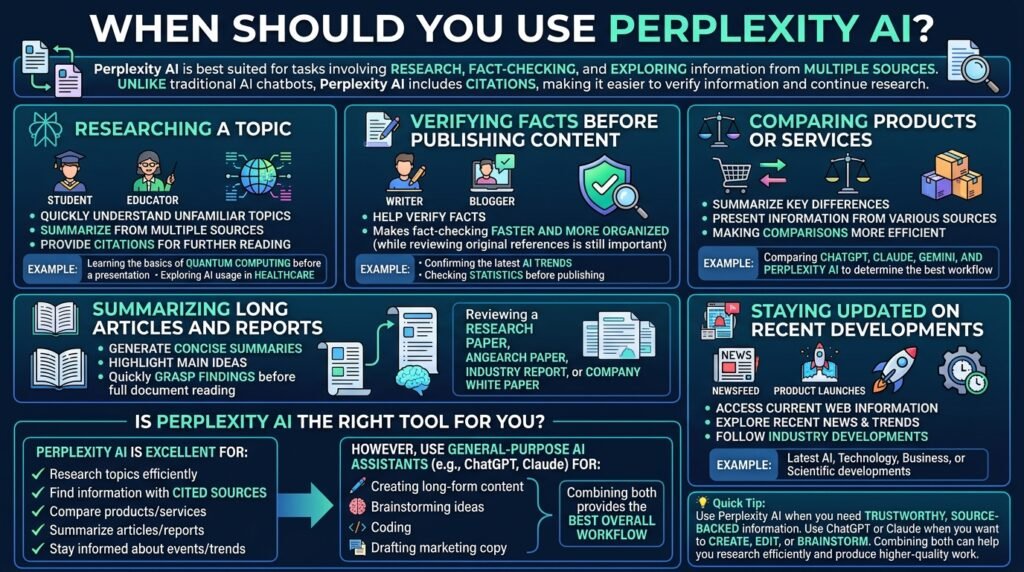
Perplexity AI is best suited for tasks that involve research, fact-checking, and exploring information from multiple sources. Unlike traditional AI chatbots that may provide answers without references, Perplexity AI includes citations, making it easier to verify information and continue your research.
Here are some situations where Perplexity AI can be especially helpful.
Researching a Topic
Whether you’re a student, educator, or professional, Perplexity AI can help you quickly understand unfamiliar topics by summarizing information from multiple sources and providing citations for further reading.
Example: Learning the basics of quantum computing before a class presentation or exploring how artificial intelligence is used in healthcare.
Verifying Facts Before Publishing Content
If you’re writing a blog post, preparing a report, or creating educational content, Perplexity AI can help you verify facts and locate supporting sources.
While it’s still important to review the original references, Perplexity AI makes the fact-checking process faster and more organized.
Example: Confirming the latest AI trends or checking statistics before publishing an article.
Comparing Products or Services
Choosing between software, AI tools, or online services often requires reading multiple reviews. Perplexity AI can summarize key differences and present information from various sources, making comparisons more efficient.
Example: Comparing ChatGPT, Claude, Gemini, and Perplexity AI to determine which assistant best suits your workflow.
Summarizing Long Articles and Reports
Reading lengthy documents can be time-consuming. Perplexity AI can generate concise summaries that highlight the main ideas, helping you understand key points before deciding whether to read the full document.
Example: Reviewing a research paper, industry report, or company white paper to quickly grasp its main findings.
Staying Updated on Recent Developments
Because Perplexity AI can access current web information, it’s useful for exploring recent news, product launches, and emerging trends.
Example: Following the latest developments in artificial intelligence, technology, business, or scientific research.
Is Perplexity AI the Right Tool for You?
Perplexity AI is an excellent choice if your primary goal is to:
- Research topics efficiently
- Find information with cited sources
- Compare products or services
- Summarize articles and reports
- Stay informed about current events and industry trends
However, if your focus is creating long-form content, brainstorming ideas, coding, or drafting marketing copy, a general-purpose AI assistant such as ChatGPT or Claude may be a better fit. Many users find that using Perplexity AI alongside other AI tools provides the best overall workflow.
💡 Quick Tip
Use Perplexity AI when you need trustworthy, source-backed information. Use ChatGPT or Claude when you want to create, edit, or brainstorm content. Combining both can help you research efficiently and produce higher-quality work.
When to Choose Perplexity
Perplexity is often the better choice when you need:
- Current information
- Source citations
- Research support
- Fact checking
- Learning about unfamiliar topics
When to Choose ChatGPT
ChatGPT is often better for:
- Writing articles
- Brainstorming ideas
- Programming assistance
- Creating emails or reports
- Creative projects
- Long-form explanations
Can You Use Both Together?
Absolutely.
Many professionals research a topic using Perplexity, verify the sources, and then use ChatGPT to organize ideas, draft content, or refine their work.
These tools complement each other rather than replace one another.
Perplexity AI vs Google Search
Google and Perplexity both help users find information, but they take different approaches.
| Feature | Perplexity AI | Google Search |
| Results | AI-generated answers | List of webpages |
| Conversation | Yes | Limited |
| Citations | Included in responses | Individual links |
| Ads | Minimal within answers | Ads may appear |
| Learning experience | Guided and conversational | Self-directed |
| Research speed | Often faster | Depends on browsing |
| Best for | Understanding topics | Discovering websites |
Which One Is Better?
There isn’t a universal winner.
Choose Perplexity when:
- You want quick summaries.
- You need conversational explanations.
- You’re researching unfamiliar topics.
- You want source-backed answers.
Choose Google when:
- You need official websites.
- You’re shopping.
- You’re looking for local businesses.
- You want multiple independent viewpoints.
- You need highly specialized information.
Many users combine both tools depending on the task.
Is Perplexity AI Accurate?
Perplexity is generally accurate for many everyday questions, especially because it references sources. However, no AI system is perfect.
Its responses depend on:
- The quality of available sources
- How clearly the question is asked
- The complexity of the topic
- The capabilities of the underlying AI model
Strengths
- Explains information clearly
- Provides supporting references
- Summarizes multiple sources
- Handles follow-up questions well
Limitations
It can still:
- Misinterpret questions
- Oversimplify complex topics
- Miss important context
- Present outdated information if sources are outdated
- Occasionally generate incorrect conclusions
For important decisions involving health, finance, legal matters, or safety, always verify information using authoritative sources.
Benefits of Perplexity AI
Faster Research
Instead of opening ten browser tabs, users receive a summarized answer with links for further reading.
Better Learning Experience
Natural conversations make it easier to understand complex subjects.
Source Transparency
Citations help users verify information rather than accepting AI-generated answers blindly.
Time Savings
Research tasks that once took an hour can often be completed in a fraction of the time.
Continuous Conversations
Users can ask follow-up questions without repeating the entire context.
Beginner-Friendly
People unfamiliar with technical search techniques can simply ask questions in everyday language.
Limitations of Perplexity AI
Despite its strengths, Perplexity is not a replacement for critical thinking.
AI Can Make Mistakes
Like other AI systems, it can occasionally produce inaccurate or misleading information.
Sources May Vary
Not every cited source has the same level of credibility. Users should evaluate the quality of the references provided.
Limited Deep Expertise
For highly specialized fields, expert textbooks, peer-reviewed research, or official documentation may provide more comprehensive information.
Privacy Considerations
Avoid sharing confidential, personal, or sensitive information in AI conversations unless you understand the platform’s privacy policies.
Perplexity AI Pricing
Perplexity offers multiple plans designed for different types of users.
| Plan | Best For | Typical Features |
| Free | Casual users | AI search, conversational answers, citations |
| Pro | Professionals and researchers | More advanced models, higher usage limits, additional research capabilities |
| Enterprise | Organizations | Team features, collaboration, administrative controls, enhanced security |
The available features and pricing may change over time, so always check the official Perplexity website before making a decision.
Best Practices for Using Perplexity AI
To get the most value from Perplexity, follow these practical guidelines.
Ask Specific Questions
Instead of:
“Tell me about AI.”
Try:
“Explain how generative AI differs from traditional AI with simple examples.”
Specific prompts usually produce more useful responses.
Read the Source Citations
Don’t stop at the AI-generated answer.
Open the cited sources when accuracy is important or when you want a deeper understanding.
Ask Follow-Up Questions
One of Perplexity’s strengths is maintaining conversational context.
Keep refining your questions rather than starting a new search each time.
Compare Multiple Sources
Even with citations, it’s good practice to compare information from more than one authoritative source, especially for research or decision-making.
Verify Critical Information
Always verify information related to:
- Health
- Finance
- Legal matters
- Safety
- Academic research
AI should support your research—not replace careful judgment.
Common Mistakes Beginners Make
Assuming Every Answer Is Correct
AI can make mistakes. Treat responses as a helpful starting point rather than unquestionable facts.
Ignoring the Sources
Many users read only the summary without checking where the information came from.
Reading the original sources often provides important context.
Asking Questions That Are Too Broad
Broad questions usually produce broad answers.
Break large topics into smaller, more focused questions.
Using AI as the Only Research Tool
AI is excellent for learning and summarizing, but official documentation, books, and expert publications remain valuable sources.
Sharing Sensitive Information
Avoid uploading confidential business documents, passwords, personal identification details, or private data unless you’re confident about the platform’s privacy and security practices.
Frequently Asked Questions (FAQs)
1. Is Perplexity AI free to use?
Yes. Perplexity AI offers a free plan that allows users to ask questions, search the web, and receive AI-generated answers with citations. It also offers paid plans with additional features, higher usage limits, and access to more advanced AI models.
2. Is Perplexity AI better than ChatGPT?
It depends on your goal.
- Choose Perplexity AI if you want current information, source-backed research, and quick summaries.
- Choose ChatGPT if you need help with writing, brainstorming, coding, or long-form explanations.
Many people use both tools together because they complement each other.
3. Can I trust the information provided by Perplexity AI?
Perplexity AI often provides citations, making it easier to verify information. However, like any AI tool, it can make mistakes or rely on imperfect sources. Always verify important information using authoritative references, especially for medical, legal, financial, or safety-related topics.
4. Does Perplexity AI use real-time information?
Perplexity AI is designed to retrieve information from the web, making it useful for topics that change frequently, such as technology, business, and current events. The availability and freshness of information may depend on the search results and the AI model being used.
5. Is Perplexity AI good for students?
Yes. Students can use Perplexity AI to understand difficult concepts, summarize articles, compare ideas, and explore new topics. It can be a valuable learning aid, but it should not replace textbooks, lectures, or critical thinking.
6. Can Perplexity AI replace Google Search?
Not entirely.
Perplexity AI excels at answering questions and summarizing information, while Google Search remains better for finding official websites, local businesses, shopping results, images, videos, and a wide variety of independent sources. Many users benefit from using both tools together.
7. What types of questions work best with Perplexity AI?
Perplexity AI performs particularly well with:
- Research questions
- Explanations of complex topics
- Comparisons
- Product research
- Learning new skills
- Technology-related questions
- Summaries of information
Clear and specific prompts generally produce better results than broad or vague questions.
8. Is Perplexity AI suitable for professional research?
It can significantly speed up the research process by providing summaries and linking to relevant sources. However, for academic papers, legal documents, scientific research, or business decisions, it’s important to review the original sources and verify the information independently.
Conclusion
If your priority is research, learning, and finding trustworthy information with cited sources, Perplexity AI is one of the best AI assistants available today.
If you’re comparing multiple AI tools before deciding, continue with our guides on ChatGPT, Claude, Gemini, and our roundup of the 25 Best AI Tools for Beginners to find the option that best fits your needs.
For beginners, it offers an accessible way to explore new topics without feeling overwhelmed by dozens of webpages. For professionals and researchers, it can streamline the process of gathering information and identifying reliable sources.
However, like all AI tools, Perplexity AI has limitations. While it can save time and improve productivity, it should complement—not replace—critical thinking and careful verification.
As AI-powered search continues to evolve, learning how to use tools like Perplexity effectively will become an increasingly valuable digital skill.
Whether you’re researching a project, learning a new concept, or exploring the latest developments in artificial intelligence, Perplexity AI can be a helpful companion when used thoughtfully and responsibly.
Leave a Reply