📖 12-14 min read • Updated July 2026 • AI Basics
Table of Contents
Introduction
Artificial Intelligence (AI) is no longer a futuristic concept—it powers many of the tools and services we use every day, from virtual assistants and recommendation systems to AI chatbots and image generators. However, not all AI is the same.
When people talk about AI, they are often referring to different types of Artificial Intelligence, each with its own capabilities, limitations, and real-world applications. Some AI systems are designed to perform a single task exceptionally well, while others represent theoretical concepts that researchers are still working toward.
Understanding these different types of AI helps you better evaluate today’s technology, follow industry developments, and build a stronger foundation for learning artificial intelligence. If you’re new to AI, start with What Is Artificial Intelligence? before exploring the different AI classifications.
Naeveor Insight
One of the biggest misconceptions about AI is that all AI systems are equally intelligent. In reality, nearly every AI tool available today—including chatbots, recommendation systems, and image generators—is a form of Artificial Narrow Intelligence (ANI). Understanding this distinction makes it easier to interpret AI news and evaluate claims about future technologies.
In this guide, you’ll learn:
- The two main ways AI is classified
- The capabilities of Narrow AI, General AI, and Super AI
- The functional categories of AI systems
- Real-world examples of each type
- Which types exist today—and which remain theoretical
Key Takeaways
- Artificial Intelligence can be classified by capability and functionality.
- Most AI available today is Artificial Narrow Intelligence (ANI).
- Artificial General Intelligence (AGI) aims to perform any intellectual task a human can.
- Artificial Superintelligence (ASI) is a hypothetical form of AI that surpasses human intelligence.
- Functional AI categories include Reactive Machines, Limited Memory, Theory of Mind, and Self-Aware AI.
- Understanding these classifications helps explain both today’s AI systems and future developments.
What Are the Types of Artificial Intelligence?
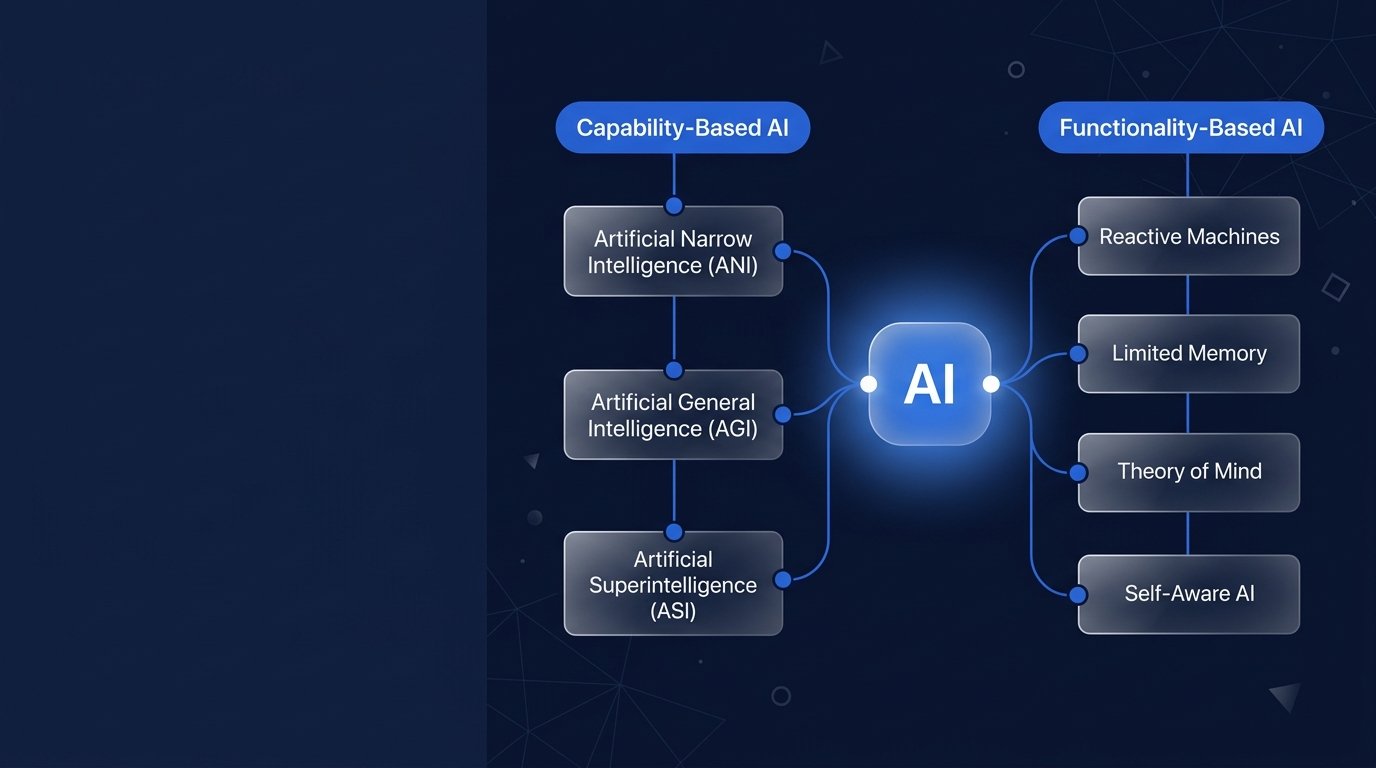
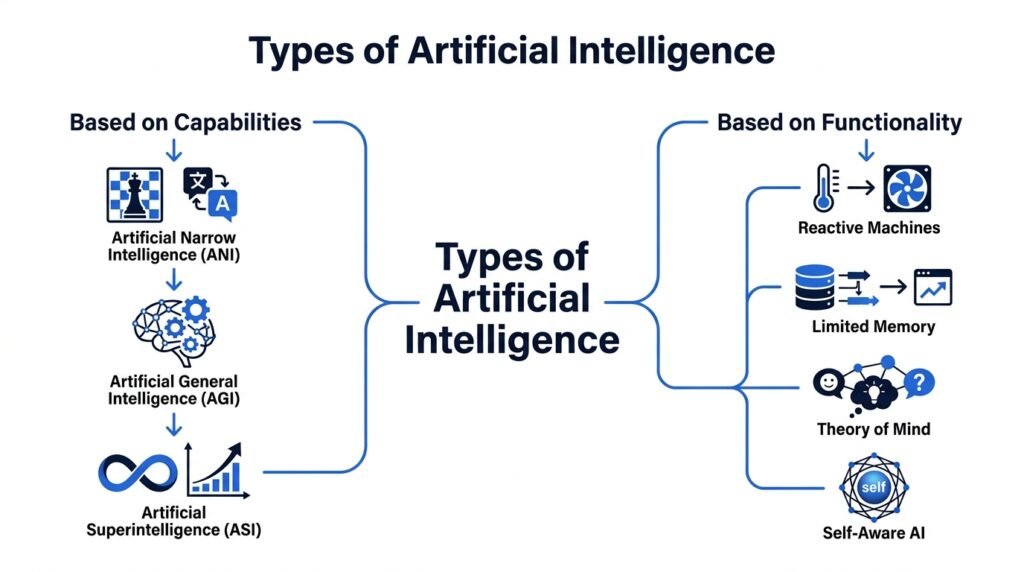
Artificial Intelligence can be categorized in two common ways:
1. Based on Capabilities
This classification focuses on how intelligent an AI system is compared to humans.
The three capability-based categories are:
- Artificial Narrow Intelligence (ANI)
- Artificial General Intelligence (AGI)
- Artificial Superintelligence (ASI)
2. Based on Functionality
This classification focuses on how AI processes information and interacts with its environment.
The four functional categories are:
- Reactive Machines
- Limited Memory
- Theory of Mind
- Self-Aware AI
Both classification systems describe AI from different perspectives and complement each other.
Types of AI Based on Capabilities
Artificial Narrow Intelligence (ANI)
Artificial Narrow Intelligence, also known as Weak AI, is designed to perform specific tasks within a limited domain.
Rather than thinking like humans, ANI excels at solving well-defined problems using trained data and algorithms.
Examples
- ChatGPT
- Google Search
- Spam filters
- Netflix recommendations
- Face recognition
- Voice assistants
Advantages
- Highly efficient
- Fast decision-making
- Excellent accuracy for specialized tasks
- Widely available
Limitations
- Cannot perform tasks outside its training
- Lacks common sense reasoning
- Does not possess consciousness
Today, Most modern AI systems—including generative AI tools—used by consumers and businesses falls into this category.
Artificial General Intelligence (AGI)
Artificial General Intelligence refers to AI capable of understanding, learning, and performing any intellectual task that a human can.
Unlike Narrow AI, AGI would transfer knowledge across different domains, solve unfamiliar problems, and adapt independently. To understand why AGI differs from today’s systems, read AI vs Machine Learning vs Deep Learning.
Potential characteristics include:
- Human-level reasoning
- Learning without extensive retraining
- Adaptability across disciplines
- Independent decision-making
Current Status
AGI has not yet been achieved. It remains an active area of research and debate.
Artificial Superintelligence (ASI)
Artificial Superintelligence is a theoretical form of AI that would exceed human intelligence in virtually every field.
If developed, ASI could potentially outperform humans in:
- Scientific research
- Creativity
- Strategic planning
- Medical discoveries
- Engineering
- Problem-solving
Current Status
ASI remains hypothetical. There is currently no real-world example of Artificial Superintelligence.
Comparison Table
| Type | Exists Today? | Intelligence Level | Examples |
| ANI | ✅ Yes | Task-specific | ChatGPT, Siri, Google Search |
| AGI | ❌ No | Human-level | None |
| ASI | ❌ No | Beyond human | None |
Types of AI Based on Functionality
Reactive Machines
Reactive Machines are the simplest form of AI. They respond only to current inputs and do not retain memories of past interactions.
Characteristics
- No memory
- No learning
- Task-specific responses
Example: IBM Deep Blue, the chess-playing computer that defeated Garry Kasparov.
Limited Memory AI
Limited Memory AI can use past information to improve future decisions. This is the most common functional type of AI today.
Examples include:
- Self-driving vehicle systems
- Fraud detection
- Recommendation engines
- Modern AI chatbots
Theory of Mind AI
Theory of Mind AI is a proposed category of AI that would understand emotions, intentions, beliefs, and social interactions.
Researchers continue to explore this concept, but such systems do not yet exist.
Self-Aware AI
Self-Aware AI represents the most advanced theoretical stage of AI.
Such systems would possess:
- Self-awareness
- Consciousness
- Emotions
- Independent understanding of themselves
At present, Self-Aware AI exists only as a theoretical concept and in science fiction.
Capability vs Functionality
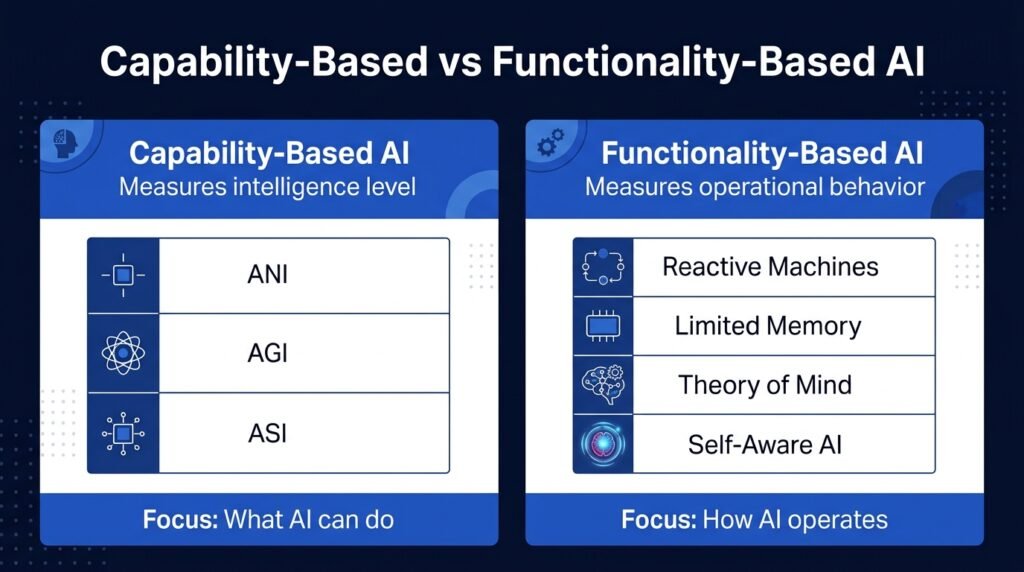
These two classifications answer different questions:
| Capability-Based | Functionality-Based |
| Measures intelligence level | Measures operational behavior |
| ANI, AGI, ASI | Reactive, Limited Memory, Theory of Mind, Self-Aware |
| Focuses on potential | Focuses on design and operation |
Why Understanding AI Types Matters
Knowing the different types of AI helps you:
- Better understand AI news and research
- Evaluate AI tools realistically
- Avoid misconceptions about current AI capabilities
- Build a strong foundation for advanced AI topics
- Follow discussions about the future of AI
Frequently Asked Questions
What type of AI is ChatGPT?
ChatGPT is considered Artificial Narrow Intelligence (ANI) because it performs specialized language-related tasks rather than possessing general human intelligence.
Is AGI available today?
No. Artificial General Intelligence remains a research goal and has not been achieved.
What is the difference between ANI and AGI?
ANI specializes in specific tasks, while AGI would be capable of learning and performing a wide range of intellectual tasks similar to a human.
Is Self-Aware AI real?
No. Self-Aware AI is currently a theoretical concept without real-world implementation.
Which type of AI is most common?
Artificial Narrow Intelligence (ANI) is the most common and is used in nearly all current AI applications.
Conclusion
Artificial Intelligence is not a single technology but a broad field encompassing different types of systems with varying capabilities and functions. Today’s AI applications—from chatbots to recommendation engines—are examples of Artificial Narrow Intelligence, while Artificial General Intelligence and Artificial Superintelligence remain future possibilities.
By understanding both capability-based and functionality-based classifications, you’ll be better equipped to interpret AI developments, evaluate emerging technologies, and continue building your knowledge of artificial intelligence.
Suggested reading:
- What Is Artificial Intelligence?
- What Is Generative AI?
- AI vs Machine Learning vs Deep Learning
- How Does ChatGPT Work?
- What Is Prompt Engineering?
References
- Stanford Human-Centered AI (HAI) — Research and educational resources on artificial intelligence.
- NIST AI Resource Center — AI terminology, governance, and trustworthy AI resources.
- Google AI — Educational material and AI research.
- IBM Think: Artificial Intelligence — Foundational AI explanations and industry examples.
Leave a Reply