🕒 15-18 min read • Updated: Aug 2026
Table of Contents
Introduction
Artificial Intelligence (AI) is changing the way people work, learn, create, and solve problems. From virtual assistants like ChatGPT to recommendation systems on Netflix and fraud detection in banking, AI has become a part of everyday life.
As interest in AI continues to grow, many beginners ask the same question:
“Where do I start learning Artificial Intelligence?”
The sheer number of courses, tutorials, programming languages, and AI tools can make the learning process feel overwhelming. Some resources dive into advanced mathematics too early, while others focus only on using AI tools without explaining how they work.
The good news is that you don’t need to learn everything at once.
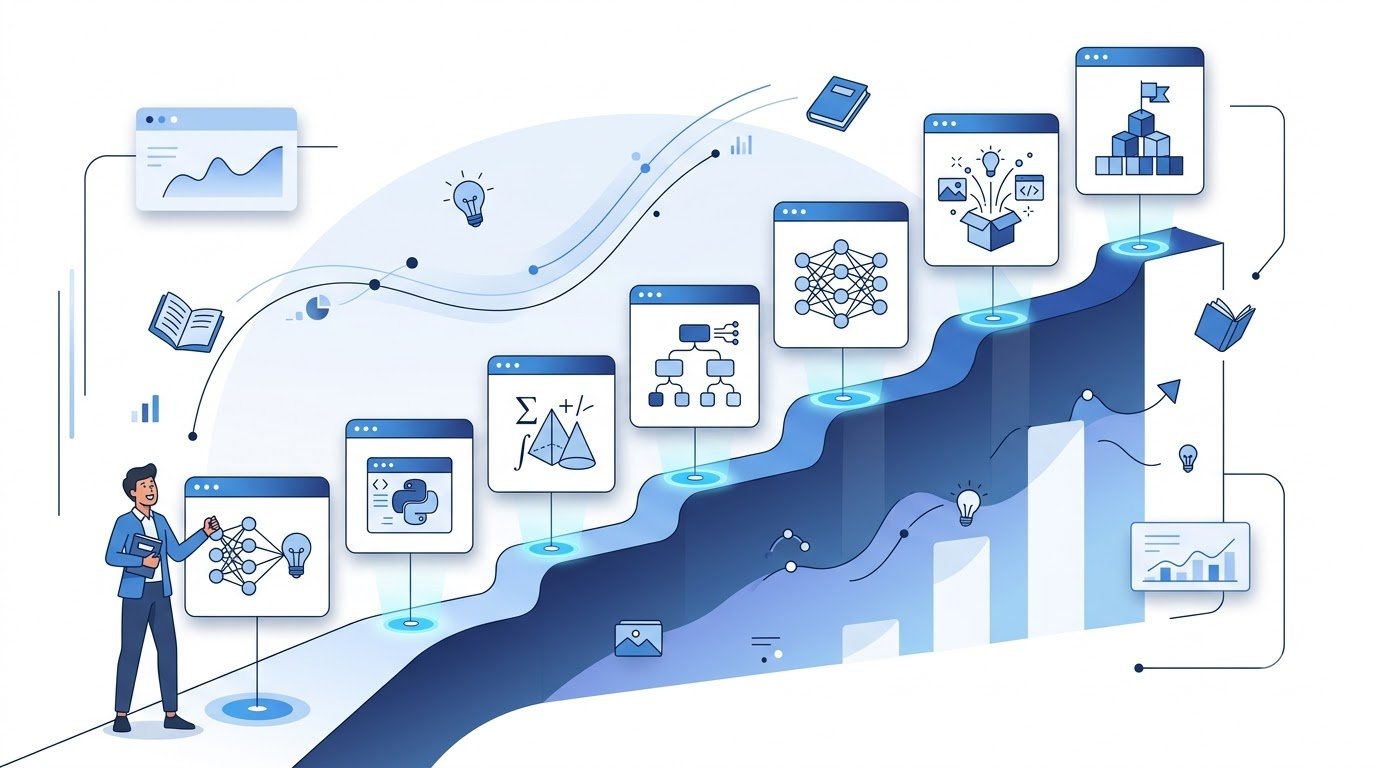
With a structured roadmap, you can build your knowledge step by step, developing a strong foundation before moving on to more advanced topics.
This AI Learning Roadmap is designed specifically for beginners. Whether you’re a student, professional, entrepreneur, or simply curious about AI, this guide will help you understand what to learn, when to learn it, and how each skill connects to the next.
By following this roadmap, you’ll gain both practical AI skills and a deeper understanding of the technology behind today’s most powerful AI systems.
Key Takeaways
- AI is best learned gradually through structured stages rather than trying to master everything at once.
- Start with AI fundamentals before exploring Machine Learning, Deep Learning, and Generative AI.
- Basic programming skills, especially Python, make learning AI much easier but are not required to understand AI concepts.
- Practical projects reinforce your knowledge better than passive learning.
- Consistency is more important than speed. Even 30–60 minutes of daily practice can lead to significant progress over time.
- Learning AI is an ongoing journey, as the field continues to evolve rapidly.
Why You Need an AI Learning Roadmap
Imagine trying to build a house without a blueprint. You might have the right materials, but without a clear plan, the process becomes inefficient and confusing.
Learning AI works the same way.
Many beginners make the mistake of jumping straight into advanced topics like neural networks or large language models without first understanding the fundamentals. This often leads to frustration because each advanced concept builds upon earlier knowledge.
A structured roadmap helps you:
- Learn concepts in the right order
- Focus on the most important skills first
- Avoid information overload
- Track your progress
- Build confidence through achievable milestones
Instead of asking, “What should I learn next?”, you’ll always know your next step.
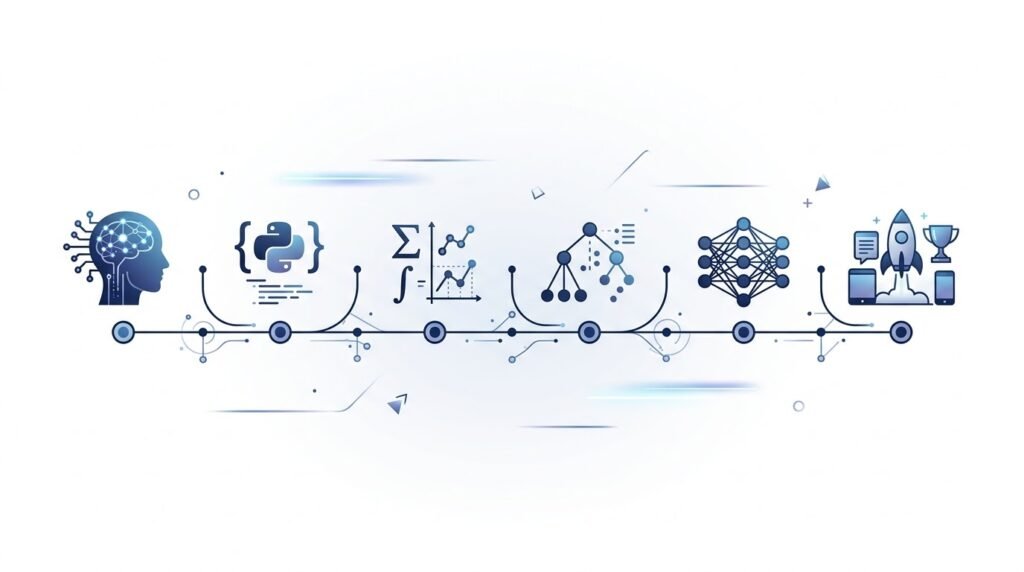
The AI Learning Roadmap at a Glance
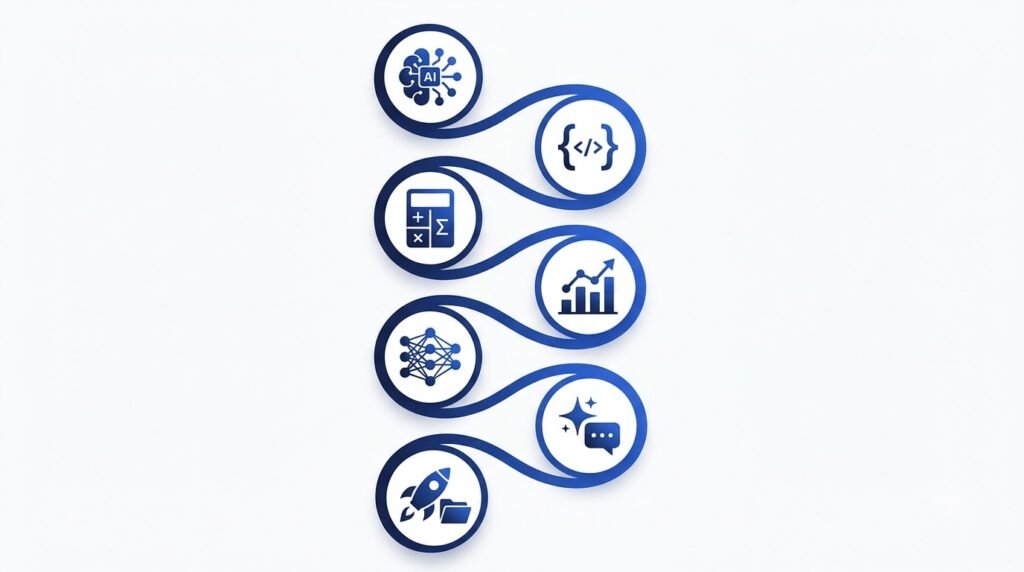
| Stage | Focus | Goal |
| Stage 1 | AI Fundamentals | Understand what AI is and how it works |
| Stage 2 | Programming Basics | Learn Python and essential programming concepts |
| Stage 3 | Mathematics for AI | Build a basic understanding of the math behind AI |
| Stage 4 | Machine Learning | Train models using data |
| Stage 5 | Deep Learning | Explore neural networks and modern AI systems |
| Stage 6 | Generative AI & AI Tools | Learn how to use and build with modern AI applications |
| Stage 7 | Build Projects & Continue Learning | Apply your knowledge through real-world projects |
Think of these stages as building blocks. Each one prepares you for the next.
Stage 1: Build a Strong Foundation in AI
Before learning algorithms or writing code, it’s important to understand what Artificial Intelligence actually is.
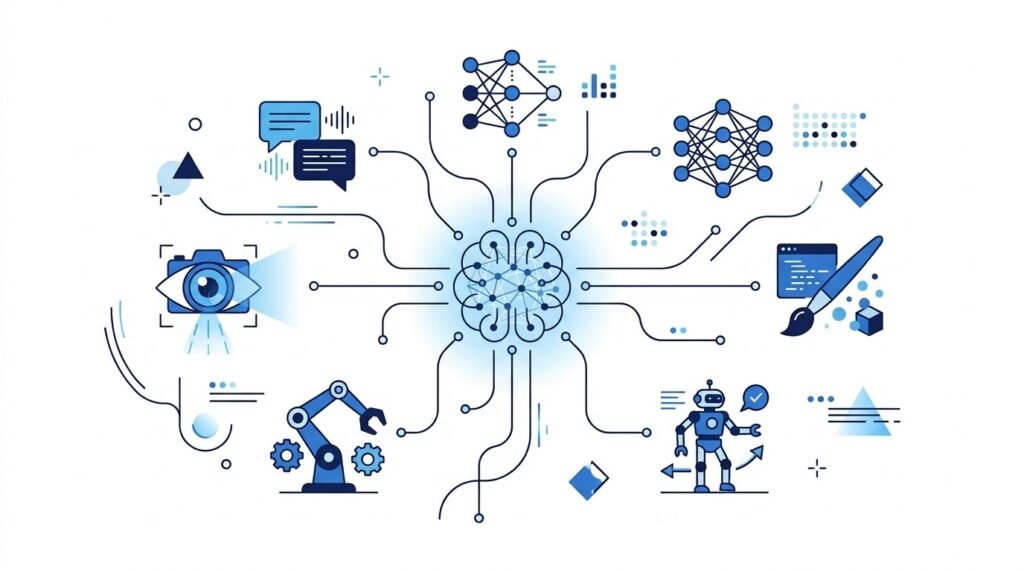
Many people assume AI is simply ChatGPT or robots. In reality, AI is a broad field of computer science focused on creating systems that can perform tasks that typically require human intelligence.
Examples include:
- Recognizing speech
- Understanding language
- Identifying objects in images
- Making recommendations
- Detecting fraud
- Playing strategic games
- Generating text and images
At this stage, your goal is not to build AI systems but to understand the concepts behind them.
Topics to Learn
- What is Artificial Intelligence?
- Types of AI
- Narrow AI vs General AI
- AI vs Machine Learning vs Deep Learning
- What is Generative AI?
- How ChatGPT works
- What are AI Agents?
- Real-world applications of AI
- Benefits and limitations of AI
- Responsible and ethical AI
By the end of this stage, you should understand the language of AI and feel comfortable discussing its core concepts.
Beginner Tip
Avoid trying to memorize technical definitions. Instead, focus on understanding how AI solves real-world problems.
For example, rather than remembering the exact definition of machine learning, think of it as teaching computers to identify patterns from data instead of following fixed instructions.
Stage 2: Learn Basic Programming (Python)
While you can use many AI tools without programming, coding becomes increasingly valuable as you progress.
Python is the most widely used programming language in AI because it is beginner-friendly and supported by a rich ecosystem of AI libraries.
Learning Python enables you to:
- Automate repetitive tasks
- Analyze data
- Build machine learning models
- Experiment with AI frameworks
- Create AI-powered applications
Core Python Concepts
- Variables
- Data types
- Lists
- Dictionaries
- Loops
- Functions
- Conditional statements
- File handling
- Basic object-oriented programming
You don’t need to become an expert programmer before moving on. Aim to become comfortable reading and writing simple Python programs.
Example
Instead of manually organizing thousands of customer records in a spreadsheet, a short Python program can automatically categorize and process the data in seconds.
This illustrates one of the biggest advantages of programming: automation.
Recommended Beginner Projects
- Simple calculator
- To-do list application
- Password generator
- Number guessing game
- Weather information app
- Basic chatbot
These small projects build confidence while reinforcing programming concepts.

Stage 3: Learn the Mathematics Behind AI
Mathematics often intimidates beginners, but you don’t need a PhD to understand AI.
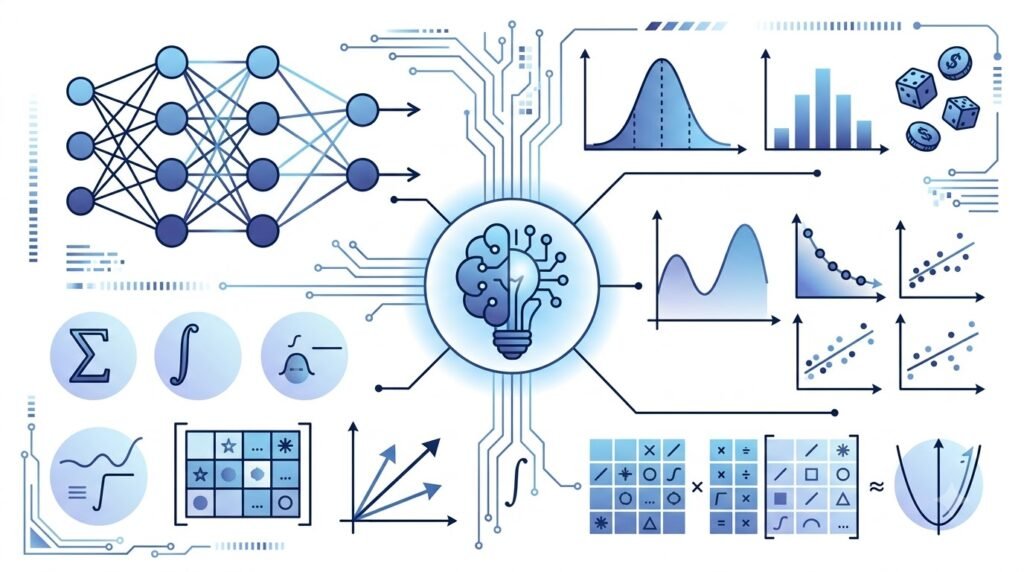
The goal is to develop an intuitive understanding of the mathematical ideas that power AI systems.
Many successful AI practitioners gradually learn the required math as they progress.
Important Areas
Linear Algebra
Helps computers represent and manipulate data.
Topics include:
- Vectors
- Matrices
- Matrix multiplication
These concepts are widely used in neural networks.
Probability and Statistics
AI systems often make predictions under uncertainty.
Important topics include:
- Probability
- Mean
- Median
- Standard deviation
- Distributions
- Correlation
These concepts help AI models make informed decisions based on data.
Calculus (Basic Understanding)
Calculus is used during model training, particularly when optimizing neural networks.
Focus on understanding concepts such as:
- Functions
- Derivatives
- Gradients
Rather than mastering complex equations, aim to understand why optimization matters.
Why Mathematics Matters
Imagine teaching an AI model to distinguish between cats and dogs.
The model starts with random guesses. Using mathematics, it measures how wrong those guesses are and gradually adjusts itself to become more accurate.
This process of learning from mistakes relies heavily on mathematical optimization.
Don’t Let Math Stop You
Many beginners postpone learning AI because they believe they must first master advanced mathematics.
In reality, understanding concepts is far more important than memorizing formulas in the early stages.
As your projects become more advanced, your mathematical knowledge will naturally deepen.
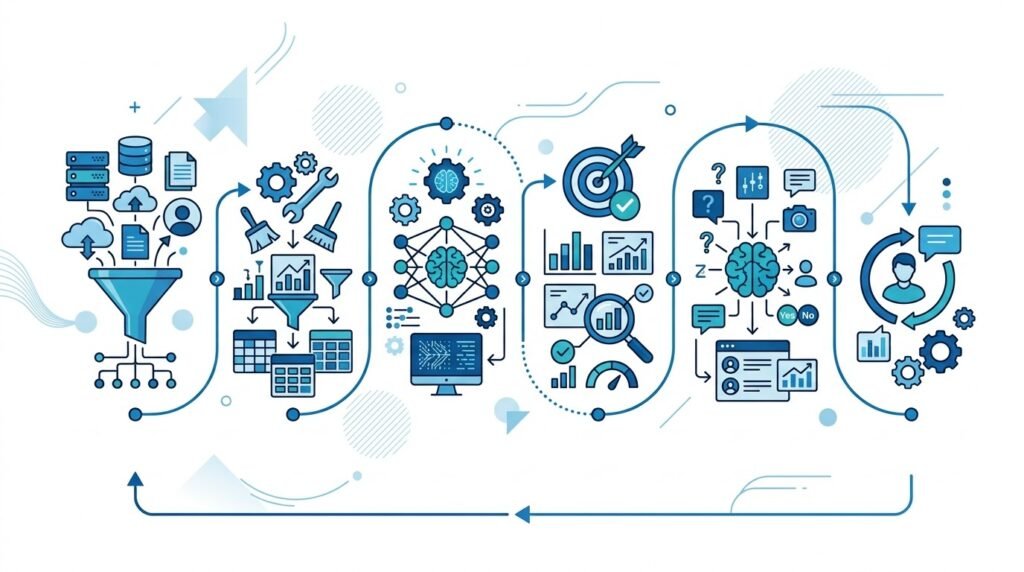
Stage 4: Learn Machine Learning
Once you have a basic understanding of AI concepts, Python, and foundational mathematics, the next step is to learn Machine Learning (ML).
Machine Learning is a subset of Artificial Intelligence that enables computers to learn patterns from data instead of relying solely on explicitly programmed rules.
For example, instead of writing thousands of rules to identify spam emails, a machine learning model can analyze examples of spam and legitimate emails, recognize patterns, and make predictions on new messages.
This ability to improve performance through experience makes Machine Learning one of the most powerful areas of AI.
Core Machine Learning Concepts
As a beginner, focus on understanding the ideas behind machine learning before diving into complex algorithms.
Key concepts include:
- Datasets
- Features and labels
- Training and testing data
- Predictions
- Accuracy
- Overfitting
- Underfitting
- Model evaluation
Understanding these concepts will make advanced topics much easier later.
Types of Machine Learning
Supervised Learning
In supervised learning, models are trained using labeled data where the correct answers are already known.
Examples include:
- Email spam detection
- House price prediction
- Customer churn prediction
- Disease diagnosis
Think of it like learning with a teacher who provides both questions and correct answers.
Unsupervised Learning
In unsupervised learning, the model works with unlabeled data and discovers hidden patterns or groups on its own.
Examples include:
- Customer segmentation
- Product recommendations
- Market basket analysis
- Fraud detection
This is similar to sorting books into categories without knowing the genres beforehand.
Reinforcement Learning
Reinforcement learning involves learning through trial and error by receiving rewards or penalties.
Examples include:
- Self-driving cars
- Robotics
- Game-playing AI
- Warehouse automation
Imagine teaching a robot to walk. Every successful step earns a reward, encouraging better decisions over time.
Beginner-Friendly Machine Learning Algorithms
You don’t need to master dozens of algorithms immediately.
Start with these foundational ones:
| Algorithm | Common Use Case |
| Linear Regression | Predicting prices or sales |
| Logistic Regression | Classification tasks |
| Decision Trees | Decision-making models |
| Random Forest | Improved classification and prediction |
| K-Means Clustering | Grouping similar data |
| Naive Bayes | Spam detection and text classification |
Focus on understanding when each algorithm is useful rather than memorizing mathematical formulas.
Hands-On Projects
Learning machine learning becomes much more effective when you build projects.
Beginner project ideas include:
- Predict house prices
- Classify handwritten digits
- Detect spam emails
- Predict customer churn
- Movie recommendation system
- Analyze sentiment in product reviews
Each project reinforces concepts while helping you build a portfolio.
Stage 5: Explore Deep Learning
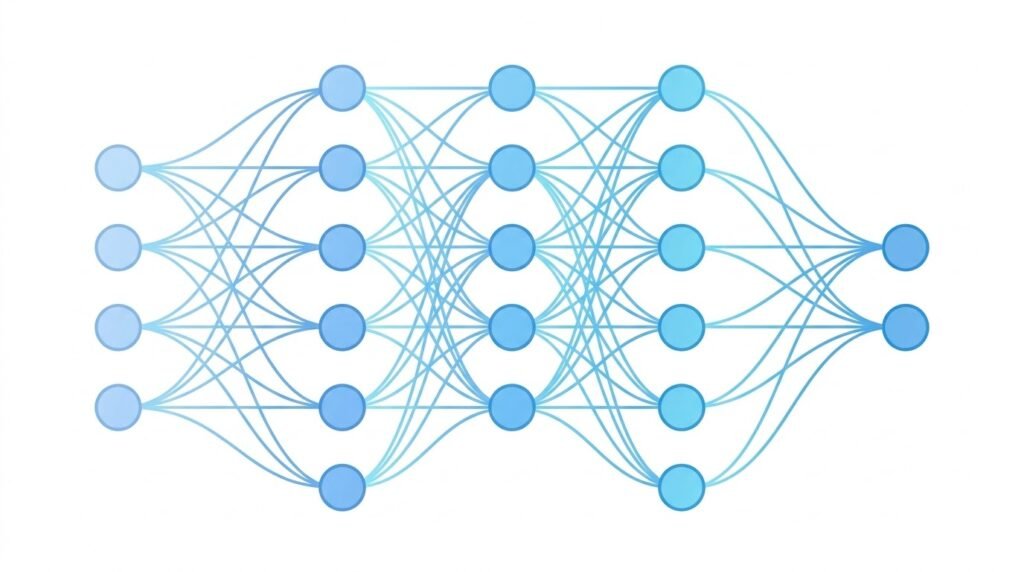
Deep Learning is a specialized branch of Machine Learning that uses artificial neural networks inspired by the human brain.
Deep learning powers many of today’s most impressive AI applications, including:
- ChatGPT
- Image recognition
- Voice assistants
- Language translation
- Autonomous vehicles
- Medical image analysis
Unlike traditional machine learning, deep learning models automatically learn complex patterns from massive amounts of data.
Topics to Learn
As a beginner, focus on understanding:
- Neural Networks
- Input, hidden, and output layers
- Activation functions
- Loss functions
- Backpropagation (conceptually)
- Training epochs
- Model optimization
You don’t need to understand every mathematical detail initially. Concentrate on how these components work together.
Common Deep Learning Applications
Deep learning is widely used in:
Computer Vision
Examples:
- Face recognition
- Medical imaging
- Object detection
- Self-driving vehicles
Natural Language Processing (NLP)
Examples:
- Chatbots
- Translation
- Text summarization
- Search engines
- Content generation
Speech Recognition
Examples:
- Voice assistants
- Speech-to-text software
- Real-time translation
Recommendation Systems
Examples:
- Netflix
- Spotify
- Amazon
- YouTube
These systems analyze user behavior to recommend relevant content or products.
Stage 6: Learn Generative AI and Modern AI Tools
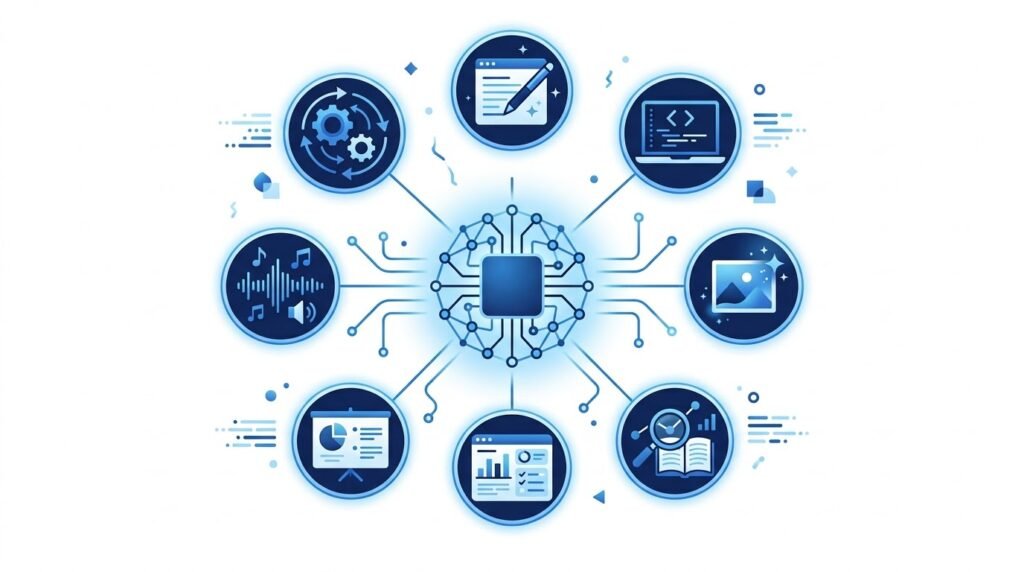
Generative AI has transformed the AI landscape by enabling machines to create original content such as text, images, code, music, and videos.
This stage focuses on using AI effectively rather than building models from scratch.
For many professionals, mastering AI tools provides immediate productivity benefits.
Essential AI Tools to Learn
Start with tools that cover different use cases.
AI Assistants
Useful for:
- Brainstorming
- Research
- Writing
- Coding
- Learning
Examples include conversational AI platforms that answer questions and generate content.
AI Image Generators
Used for:
- Marketing graphics
- Illustrations
- Concept art
- Social media visuals
Understanding prompt writing significantly improves image quality.
AI Coding Assistants
Helpful for:
- Explaining code
- Debugging
- Writing functions
- Learning programming
Even beginners can accelerate learning with responsible use of coding assistants.
AI Productivity Tools
Common applications include:
- Meeting summaries
- Note-taking
- Email drafting
- Presentation creation
- Task management
These tools demonstrate how AI can enhance everyday workflows.
Learn Prompt Engineering
Modern AI systems respond based on the instructions you provide.
Prompt Engineering teaches you how to communicate effectively with AI.
Important skills include:
- Writing clear prompts
- Providing context
- Breaking down complex tasks
- Using examples
- Refining outputs
Prompt engineering is valuable regardless of whether you pursue a technical or non-technical AI career.
Stage 7: Build Real-World AI Projects
Knowledge alone isn’t enough.
Employers, clients, and collaborators value demonstrated skills.
Projects help you:
- Apply concepts
- Solve practical problems
- Build confidence
- Showcase your abilities
- Create a professional portfolio
Beginner Projects
- AI-powered chatbot
- Resume analyzer
- Personal finance assistant
- Study planner
- Document summarizer
- Image classifier
- Language translator
- AI research assistant
Intermediate Projects
As your skills grow, consider building:
- Customer support chatbot
- AI recommendation engine
- Content generation assistant
- AI-powered search application
- Voice-controlled assistant
- Predictive analytics dashboard
Each project teaches new skills while expanding your portfolio.
Learn Version Control with Git
As you begin building projects, learn the basics of Git and GitHub.
These tools help you:
- Track code changes
- Collaborate with others
- Showcase projects publicly
- Build a professional portfolio
Even basic familiarity with version control is valuable for aspiring AI practitioners.
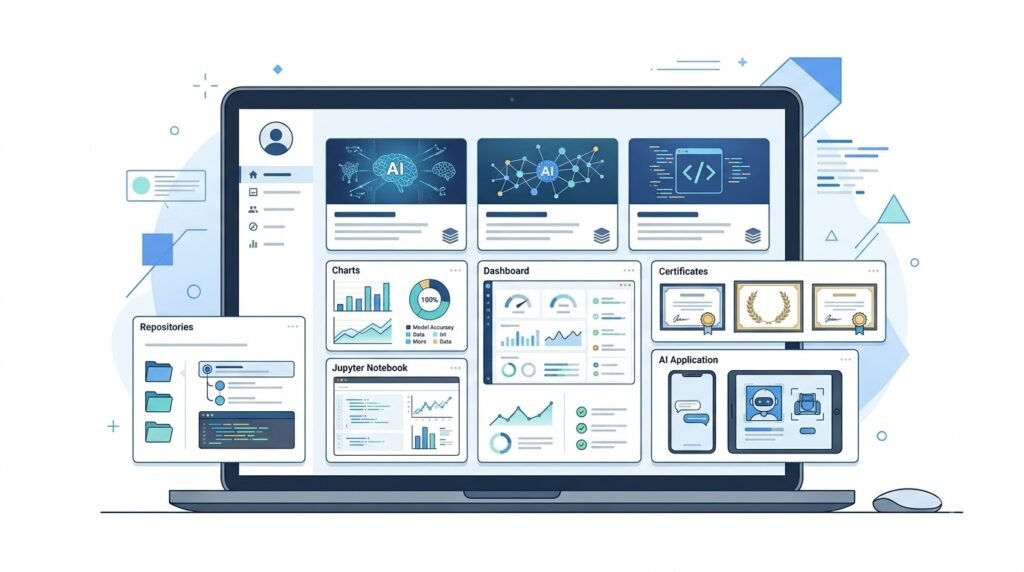
Create an AI Portfolio
Document your learning journey.
Your portfolio can include:
- Python exercises
- Machine learning notebooks
- AI projects
- Case studies
- Blog posts
- Prompt collections
- Research summaries
A strong portfolio often demonstrates practical ability more effectively than certificates alone.
Learn Continuously
Artificial Intelligence evolves rapidly.
Successful learners develop the habit of continuous improvement.
Stay current by:
- Reading trusted AI publications
- Following official documentation
- Experimenting with new tools
- Participating in AI communities
- Revisiting older projects with improved skills
Remember, AI learning is a marathon—not a sprint.
AI Learning Milestones
| Stage | Outcome |
| AI Fundamentals | Understand core AI concepts and terminology |
| Python Programming | Write basic programs and automate simple tasks |
| Mathematics | Understand the principles behind AI models |
| Machine Learning | Build and evaluate predictive models |
| Deep Learning | Understand neural networks and advanced AI techniques |
| Generative AI | Use modern AI tools effectively and write better prompts |
| Projects | Demonstrate practical skills through a portfolio |
A Practical 6-Month AI Learning Plan
Everyone learns at a different pace, but having a structured timeline helps you stay focused and measure your progress. The roadmap below assumes you can dedicate 5–10 hours per week. If you have more or less time available, simply adjust the pace while maintaining the same learning sequence.
| Month | Focus | Goal |
| Month 1 | AI Fundamentals | Understand AI concepts, terminology, and real-world applications |
| Month 2 | Python Programming | Learn programming basics and build small projects |
| Month 3 | Mathematics & Data | Develop an intuitive understanding of AI-related math and data handling |
| Month 4 | Machine Learning | Train and evaluate your first machine learning models |
| Month 5 | Deep Learning & Generative AI | Explore neural networks and modern AI tools |
| Month 6 | Projects & Portfolio | Build practical AI projects and create a professional portfolio |
Weekly Learning Routine
A simple weekly routine can help you make steady progress without feeling overwhelmed.
- Monday: Learn a new concept
- Tuesday: Watch tutorials or read documentation
- Wednesday: Practice coding or prompting
- Thursday: Build a mini-project
- Friday: Review what you’ve learned
- Saturday: Experiment with AI tools
- Sunday: Reflect, revise, and plan the next week
Even 30–60 minutes of focused learning each day can produce significant results over several months.
Recommended Learning Resources
You don’t need dozens of courses to learn AI effectively. Choose a few high-quality resources and focus on completing them.
Official Documentation
Official documentation is often the most accurate and up-to-date source of information for AI tools and frameworks.
Consider exploring documentation for:
- Python
- TensorFlow
- PyTorch
- Hugging Face
- OpenAI APIs
- Google AI
Documentation teaches you how tools are intended to be used and helps build long-term learning habits.
Online Courses
Choose beginner-friendly courses that explain concepts before introducing advanced mathematics or programming.
Look for courses that include:
- Practical exercises
- Real-world projects
- Quizzes
- Community support
- Updated AI content
Completing one comprehensive course is generally more beneficial than starting several without finishing them.
Books
Books provide structured learning and often explain concepts more thoroughly than short online tutorials.
Topics worth exploring include:
- Artificial Intelligence
- Python Programming
- Machine Learning
- Deep Learning
- Prompt Engineering
- Data Science
Combine books with hands-on practice for the best learning experience.
Practice Platforms
The best way to learn AI is by applying what you’ve learned.
Practice by:
- Solving coding exercises
- Participating in AI competitions
- Building personal projects
- Exploring public datasets
- Experimenting with AI models
Practical experience reinforces theoretical knowledge and helps identify areas that need improvement.
AI Career Paths
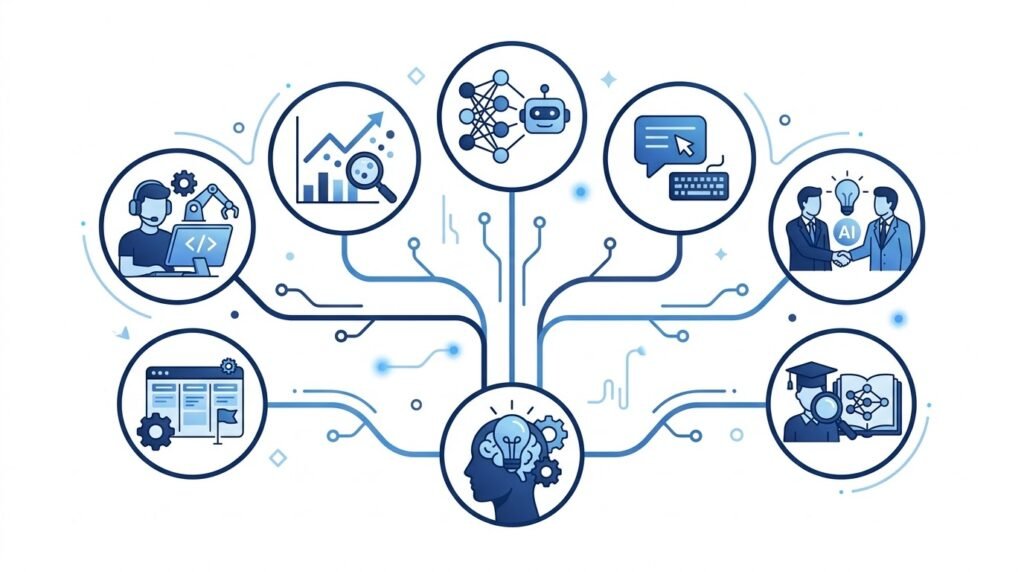
One of the advantages of learning AI is that it opens doors to a wide range of careers. Your learning path may vary depending on your goals.
| Career Path | Skills to Focus On |
| AI Engineer | Python, Machine Learning, Deep Learning, AI Frameworks |
| Machine Learning Engineer | Data Processing, Model Training, Deployment |
| Data Scientist | Statistics, Data Analysis, Machine Learning |
| Prompt Engineer | Prompt Design, Generative AI Tools, Workflow Optimization |
| AI Product Manager | AI Concepts, Business Strategy, Product Development |
| AI Researcher | Mathematics, Research Methods, Advanced AI |
| AI Consultant | AI Strategy, Business Applications, Communication |
If you’re not interested in programming, you can still build valuable skills by learning how to use AI tools effectively in areas such as marketing, education, design, writing, customer support, or business operations.
Common Mistakes Beginners Make
Learning AI can be exciting, but it’s easy to lose direction without a clear plan.
Here are some common mistakes to avoid.
Trying to Learn Everything at Once
Artificial Intelligence is a vast field.
Instead of jumping between dozens of topics, focus on mastering one stage before moving to the next.
Ignoring the Fundamentals
Many beginners rush into advanced topics without understanding the basics.
A strong foundation in AI concepts, Python, and data will make future learning much easier.
Watching Tutorials Without Practicing
Watching videos alone doesn’t build skills.
Apply every new concept by writing code, creating prompts, or building projects.
Learning happens through doing.
Building No Portfolio
Employers and clients often care more about what you’ve built than which courses you’ve completed.
Document your projects and publish them whenever possible.
Comparing Yourself to Others
AI is evolving rapidly, and everyone learns at a different pace.
Focus on consistent improvement rather than trying to keep up with every new AI tool or trend.
Best Practices for Learning AI
To make steady progress, consider these best practices:
- Learn one concept at a time.
- Practice regularly instead of studying for long sessions infrequently.
- Build small projects after completing each major topic.
- Review previous concepts to strengthen your understanding.
- Follow trusted educational resources.
- Stay curious and experiment with new AI tools.
- Keep notes or a learning journal.
- Join AI communities to ask questions and share ideas.
Consistency is one of the most important factors in becoming proficient in AI.
Frequently Asked Questions
Can I learn AI without programming?
Yes. You can begin by understanding AI concepts and using AI tools without writing code. However, learning Python will significantly expand your opportunities and enable you to build AI applications.
How long does it take to learn Artificial Intelligence?
The timeline depends on your goals and the time you can dedicate to learning.
Most beginners can develop a solid understanding of AI fundamentals within a few months. Becoming proficient in building AI systems typically requires continuous learning and practical experience over a longer period.
Is mathematics required for AI?
Basic mathematical concepts are helpful, particularly for machine learning and deep learning. However, you don’t need advanced mathematical expertise to start learning AI or using modern AI tools.
Which programming language is best for AI?
Python is the most widely used programming language for Artificial Intelligence due to its simplicity and extensive ecosystem of AI libraries and frameworks.
Should I learn Machine Learning before Generative AI?
Understanding the basics of Machine Learning provides valuable context for how many Generative AI systems work. However, if your goal is to improve productivity with AI tools, you can begin using Generative AI while gradually learning the underlying concepts.
Do I need a computer science degree to learn AI?
No. Many successful AI practitioners come from diverse educational and professional backgrounds. Curiosity, consistent practice, and project-based learning are often more important than a specific degree.
Conclusion
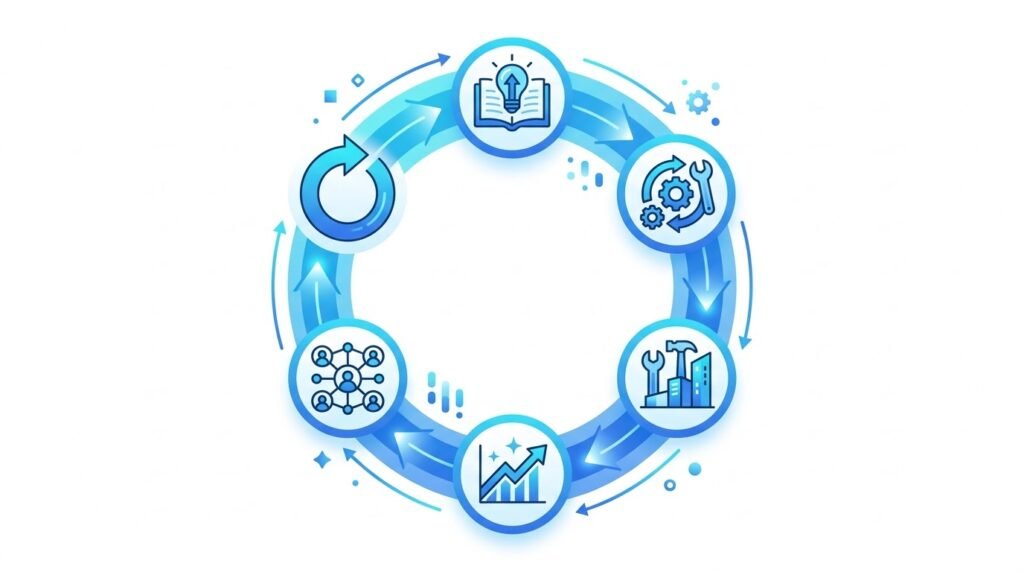
Learning Artificial Intelligence may seem challenging at first, but breaking it into manageable stages makes the journey far more approachable.
Instead of trying to master every AI topic immediately, focus on building a strong foundation, practicing consistently, and applying what you learn through real-world projects.
Remember that AI is not a destination—it’s an evolving field. New tools, techniques, and applications continue to emerge, making continuous learning an essential part of your journey.
Whether your goal is to improve productivity, transition into an AI-related career, build innovative applications, or simply understand one of today’s most transformative technologies, following a structured AI learning roadmap will help you progress with confidence.
Start with the fundamentals, stay consistent, and celebrate each milestone along the way. Over time, your knowledge will compound into valuable skills that can benefit both your personal and professional growth.
Continue Your AI Journey
Keep building your AI knowledge with these beginner-friendly guides.
-
AI Skills Roadmap 2026: 7 Essential Skills
Learn more : AI Skills Roadmap 2026: 7 Essential Skills🕒 14-16 min read • Updated: Aug 2026 Introduction Artificial intelligence (AI) is rapidly changing how people work,…
-
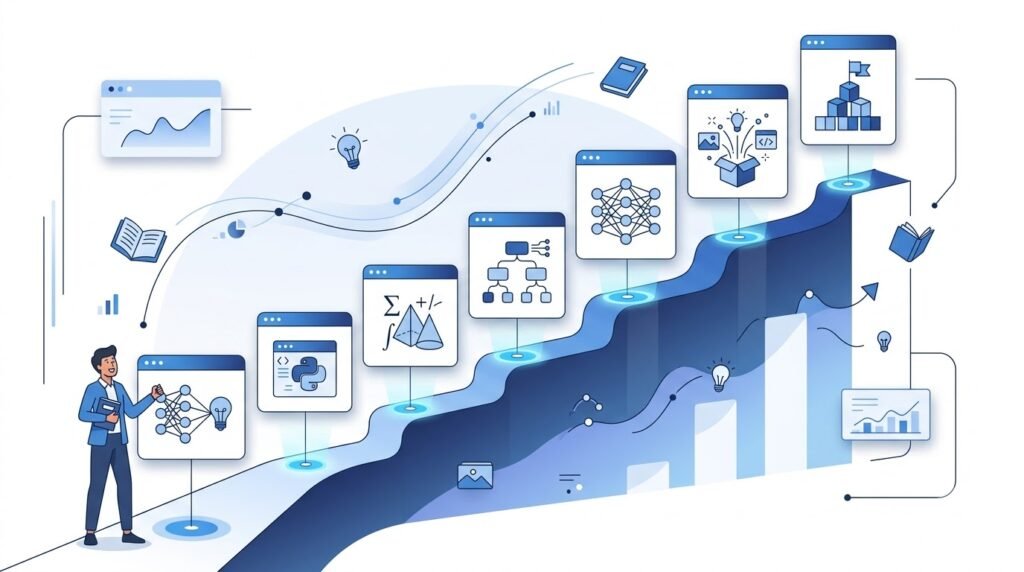
AI Learning Roadmap (2026): Step-by-Step Guide for Beginners
Learn more : AI Learning Roadmap (2026): Step-by-Step Guide for Beginners🕒 15-18 min read • Updated: Aug 2026 Introduction Artificial Intelligence (AI) is changing the way people work,…
Related Articles
Explore more guides and resources related to this topic.
-

ChatGPT Complete Guide for Beginners (2026): Master AI Step-by-Step
Learn more : ChatGPT Complete Guide for Beginners (2026): Master AI Step-by-Step🕒 20-25 min read • Updated: Aug 2026 Introduction Introduction Artificial intelligence is changing how people learn, work,…
-

Master Prompt Engineering in 2026: A Step-by-Step Beginner’s Guide
Learn more : Master Prompt Engineering in 2026: A Step-by-Step Beginner’s Guide🕒 18-20 min read • Updated: Aug 2026 Introduction Artificial intelligence (AI) tools like ChatGPT, Claude, Gemini, and…
-
Large Language Models (LLMs) Explained: The Complete 2026 Beginner’s Guide
Learn more : Large Language Models (LLMs) Explained: The Complete 2026 Beginner’s Guide🕒 14-16 min read • Updated: Aug 2026 Introduction Artificial Intelligence has become part of everyday life. Whether…
-

Best AI Image Generators in 2026: 10 Free & Paid Tools Tested
Learn more : Best AI Image Generators in 2026: 10 Free & Paid Tools Tested🕒 15 min read • Updated: July 2026 introduction Creating stunning images no longer requires years of design…
-
10 Best AI Chatbots in 2026: Tested & Ranked for Every Use Case
Learn more : 10 Best AI Chatbots in 2026: Tested & Ranked for Every Use Case🕒 10-12 min read • Updated: July 2026 introduction Artificial intelligence has made chatbots far more capable than…
-
ChatGPT vs Microsoft Copilot (2026): Tested, Pricing & Workflow Comparison
Learn more : ChatGPT vs Microsoft Copilot (2026): Tested, Pricing & Workflow Comparison🕒 10-12 min read • Updated: July 2026 Introduction Choosing between ChatGPT and Microsoft Copilot can be challenging,…
Recommended AI Tools
As you progress through your AI learning journey, these categories of tools can help you practice and apply your knowledge:
- Conversational AI assistants for learning and research
- AI writing tools for drafting and editing
- AI coding assistants for programming support
- AI image generators for creative projects
- AI productivity tools for task automation
- AI note-taking and organization tools
Create accounts with a few trusted tools and experiment regularly to reinforce what you’ve learned.
References
- Python Software Foundation. Python Documentation. https://docs.python.org/3/
- TensorFlow. TensorFlow Documentation. https://www.tensorflow.org/learn
- PyTorch. PyTorch Documentation. https://pytorch.org/docs/stable/index.html
- Hugging Face. Hugging Face Documentation. https://huggingface.co/docs
- OpenAI. OpenAI API Documentation. https://platform.openai.com/docs
- Google AI. Google AI Resources. https://ai.google/
- Google for Developers. Machine Learning Crash Course. https://developers.google.com/machine-learning/crash-course
Leave a Reply