🕒 15-18 min read • Updated: July 2026
Table of Contents
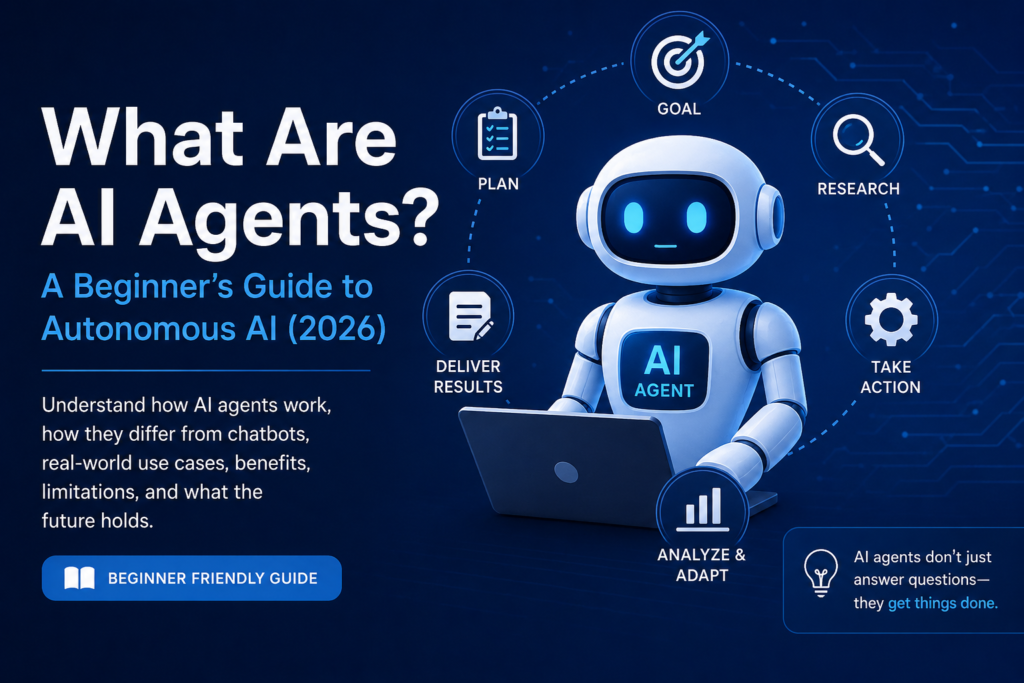
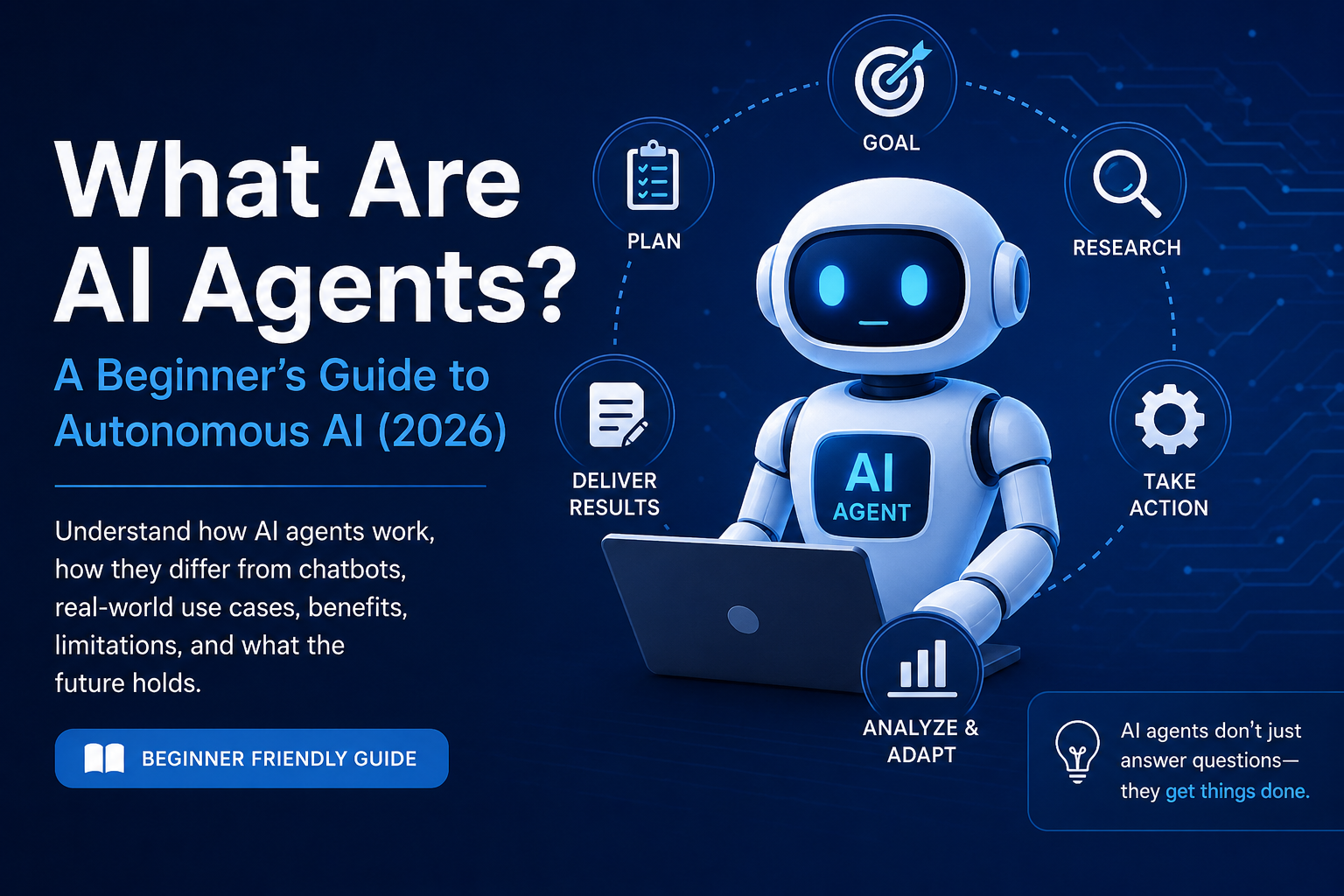
Artificial intelligence has rapidly evolved from answering questions to helping people write content, generate images, analyze data, and even write computer code. The next major step in this evolution is the rise of AI agents—systems designed not only to respond to instructions but also to plan, make decisions, and complete tasks with minimal human guidance.
Unlike traditional AI chatbots that wait for each new prompt, AI agents can work toward a goal by breaking it into smaller steps, using available tools, and adapting their actions based on the results they receive. This ability makes them one of the most exciting developments in modern AI.
For example, instead of asking an AI to write a single email, you could ask an AI agent to organize your inbox, draft replies, schedule meetings, and remind you about important follow-ups. Rather than requiring constant instructions, the agent works through the task step by step until the objective is complete.
Although AI agents are becoming increasingly capable, they’re not independent replacements for human decision-making. They still rely on human guidance, accurate information, and careful oversight, especially for important or sensitive tasks.
In this guide, you’ll learn what AI agents are, how they work, how they differ from chatbots like ChatGPT, where they’re used today, and why they’re expected to play an important role in the future of artificial intelligence.
Key Takeaways
Before exploring AI agents in detail, here are the main ideas you’ll learn from this guide:
- AI agents are AI systems designed to pursue a goal by planning and carrying out multiple steps.
- Unlike traditional chatbots, AI agents can make decisions about the next action based on the information available to them.
- Many AI agents can use external tools, such as web browsers, calendars, databases, or software applications, to complete tasks.
- AI agents are increasingly being used to automate repetitive work, assist with research, improve productivity, and support business operations.
- Although AI agents are becoming more capable, they still require human oversight and should not be trusted to make important decisions without verification.
Whether you’re new to artificial intelligence or already familiar with AI tools like ChatGPT, understanding AI agents will help you better understand where AI technology is heading.
What Are AI Agents?
An AI agent is an artificial intelligence system that is designed to achieve a specific goal by making decisions and taking actions over multiple steps. Instead of simply answering a question, an AI agent works toward completing a task, adapting its actions as new information becomes available.
Think of an AI agent as a digital assistant that can plan its work rather than waiting for instructions after every step.
For example, imagine you’re planning a weekend trip.
A traditional AI chatbot might help you by answering individual questions such as:
- “What’s the weather forecast?”
- “Recommend hotels.”
- “Suggest places to visit.”
After each answer, you decide what to ask next.
An AI agent approaches the same goal differently. You might simply say:
“Plan a three-day trip to Jaipur within a budget of ₹20,000.”
The AI agent could then:
- Research transportation options.
- Compare hotel prices.
- Create a travel itinerary.
- Suggest restaurants and attractions.
- Organize the information into a day-by-day schedule.
Instead of waiting for a new instruction after each step, the agent works toward completing the overall objective.
It’s important to understand that not every AI application is an AI agent. Many popular AI chatbots are primarily designed to generate responses to user prompts. AI agents go a step further by combining reasoning, planning, and action to accomplish a broader goal.
A Simple Definition
An AI agent is an AI system that can plan, make decisions, use available information or tools, and perform multiple actions to achieve a defined objective.
This doesn’t mean AI agents think like humans or possess independent consciousness. They operate according to their programming, available tools, and the goals provided by users, making them powerful assistants rather than autonomous decision-makers.
How Do AI Agents Work?
Although AI agents can vary in their design and capabilities, most follow a similar process when working toward a goal. Instead of responding to a single request, they repeatedly evaluate what needs to be done next until the task is complete or requires human input.
You can think of an AI agent as a project coordinator. Rather than waiting for instructions after every action, it works through a series of logical steps while checking its progress along the way.
Step 1: Understand the Goal
Every AI agent starts with an objective provided by the user.
For example:
“Research the best laptops for graphic design under ₹1,00,000 and summarize the top five options.”
Instead of treating this as one large request, the AI agent first identifies the overall goal and determines what information it needs to complete the task.
Step 2: Create a Plan
After understanding the objective, the AI agent breaks the task into smaller, manageable steps.
For the laptop research example, it might decide to:
- Search for available models.
- Compare hardware specifications.
- Review prices.
- Analyze customer feedback.
- Organize the findings into a comparison table.
Planning helps the AI approach complex tasks more efficiently instead of trying to solve everything at once.
Step 3: Gather Information and Use Available Tools
Many AI agents can work with external tools or data sources to complete their tasks.
Depending on how they’re designed, an AI agent may be able to:
- Search the web for current information.
- Read documents or spreadsheets.
- Access a calendar or email account (with permission).
- Perform calculations.
- Generate images or code.
- Interact with business software through approved integrations.
The exact capabilities depend on the AI system and the permissions granted by the user.
Step 4: Take Action and Evaluate the Results
Once enough information has been collected, the AI agent begins completing the task.
Rather than assuming every action is correct, many AI agents evaluate the results before deciding what to do next.
For example, if an AI agent is searching for hotel options and discovers that all recommended hotels exceed the budget, it may automatically adjust its search criteria and try again instead of immediately presenting unsuitable recommendations.
This ability to adapt makes AI agents more flexible than systems that simply generate a single response.
Step 5: Deliver the Final Outcome
After completing the necessary steps, the AI agent presents the results to the user.
Depending on the task, the final output might include:
- A written report.
- A travel itinerary.
- A project plan.
- A summarized research document.
- A draft email.
- A completed checklist.
- A recommendation based on the available information.
Some AI agents can also continue working after delivering an initial result, allowing users to request revisions, add new goals, or refine the outcome through follow-up instructions.
A Simple Workflow
Most AI agents follow a process similar to this:
Goal → Plan → Gather Information → Take Action → Review Results → Deliver Outcome
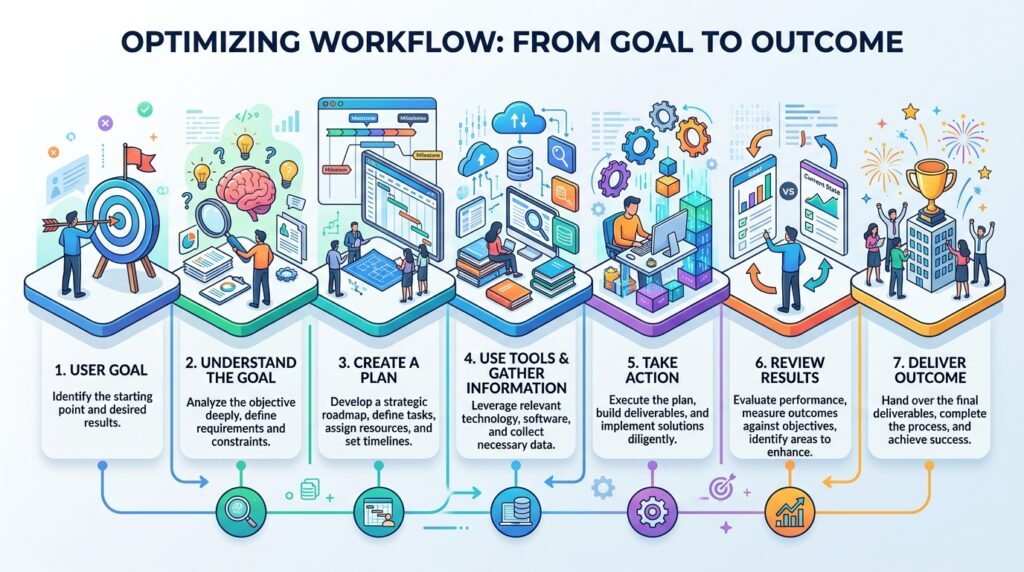
Although the technology behind AI agents can be sophisticated, the basic idea is straightforward: they work toward completing a goal by performing a series of connected actions rather than responding to just one prompt.
AI Agents vs AI Chatbots: What’s the Difference?
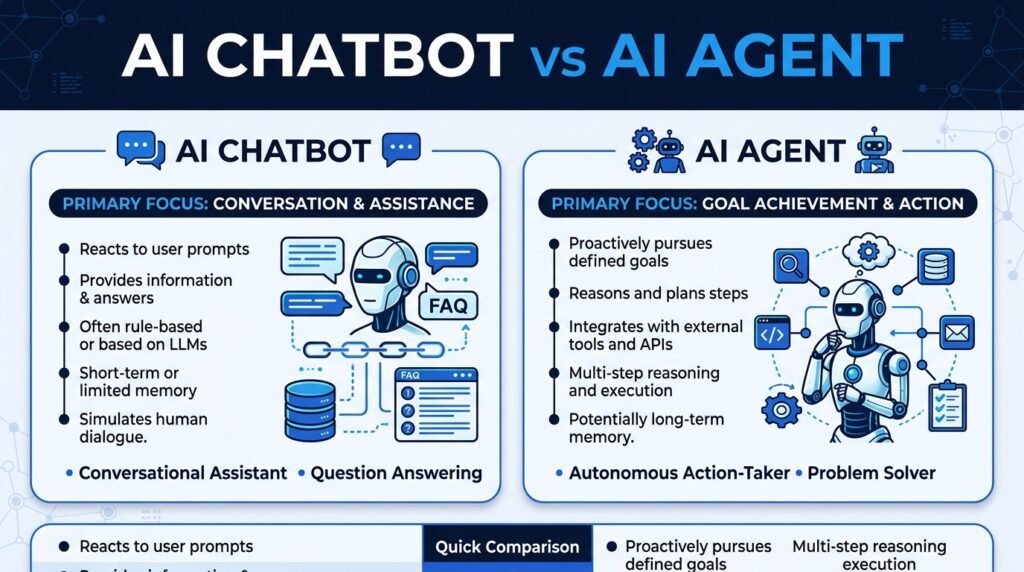
The terms AI agent and AI chatbot are often used interchangeably, but they don’t mean the same thing. While both use artificial intelligence to help users, they are designed for different types of tasks.
An AI chatbot is primarily built to respond to prompts and answer questions during a conversation. It waits for user input before generating each response.
An AI agent, on the other hand, is designed to work toward a goal by planning, making decisions, and carrying out multiple actions. Instead of waiting for instructions after every step, it can determine what to do next based on the objective and available information.
If you’re unfamiliar with conversational AI, read our guide on How Does ChatGPT Work.
Think of it this way:
- An AI chatbot is like a knowledgeable assistant who answers your questions.
- An AI agent is like a project coordinator who helps complete an entire task from start to finish.
Neither approach is better in every situation. The right choice depends on what you’re trying to accomplish.
AI Agents vs AI Chatbots: Comparison Table
| Feature | AI Chatbot | AI Agent |
| Primary Purpose | Answer questions and generate responses | Complete goals through multiple steps |
| Interaction Style | Waits for each user prompt | Can plan and perform connected actions |
| Decision Making | Limited to the current conversation | Evaluates progress and decides the next step |
| Task Complexity | Best for individual requests | Better suited for multi-step workflows |
| Tool Usage | May use tools when available | Often combines multiple tools to complete tasks |
| Human Input | Usually required throughout the conversation | Can complete several actions before requesting further input |
| Typical Use Cases | Writing, brainstorming, explanations, summaries | Research, scheduling, workflow automation, task management |
A Real-World Example
Imagine you’re organizing a company meeting.
Using an AI Chatbot
You might ask:
- Write an invitation email.
- Suggest a meeting agenda.
- Summarize the discussion afterward.
The chatbot helps with each request individually, but you guide every step of the process.
Using an AI Agent
You provide one objective:
“Help me organize next week’s project meeting.”
Depending on its capabilities and permissions, the AI agent could:
- Check participants’ calendars.
- Suggest a suitable meeting time.
- Draft invitation emails.
- Prepare a meeting agenda.
- Create reminder notifications.
- Organize follow-up tasks after the meeting.
Instead of completing isolated requests, the agent works toward achieving the overall objective.
Can Chatbots Become AI Agents?
The distinction between chatbots and AI agents is becoming less clear as AI technology continues to evolve.
Many modern AI assistants now combine conversational abilities with features such as memory, planning, and access to external tools. As a result, some systems can behave like traditional chatbots in one situation and more like AI agents in another.
Rather than thinking of chatbots and AI agents as completely separate technologies, it’s helpful to view them as part of a spectrum. Some AI systems focus mainly on conversation, while others are designed to carry out increasingly complex tasks with greater autonomy.
For most users, the important difference is simple:
- If you want answers, explanations, or creative ideas, an AI chatbot is often enough.
- If you want AI to help manage and complete a series of connected tasks, an AI agent may be the better choice.
Real-World Applications of AI Agents
AI agents are no longer just experimental technology. They are increasingly being used to automate repetitive tasks, support decision-making, and improve productivity across many industries.
While the capabilities of AI agents vary depending on the system, their common goal is to reduce manual effort by handling tasks that involve planning, organizing, and taking multiple actions.
Here are some of the most common ways AI agents are being used today.
Personal Productivity
AI agents can help individuals manage everyday tasks more efficiently.
For example, an AI agent may be able to:
- Organize your daily schedule.
- Prioritize your to-do list.
- Draft emails based on recent conversations.
- Summarize lengthy documents.
- Create reminders for upcoming deadlines.
Instead of switching between multiple apps, users can delegate routine tasks to an AI agent and focus on higher-value work.
Customer Support
Many businesses use AI-powered agents to improve customer service by handling routine inquiries around the clock.
These agents can:
- Answer frequently asked questions.
- Help customers track orders.
- Assist with account-related requests.
- Direct complex issues to human support teams.
By automating repetitive conversations, businesses can respond more quickly while allowing human representatives to focus on cases that require personal attention.
Research and Information Gathering
Finding reliable information often involves searching multiple sources, comparing findings, and organizing the results.
AI agents can assist by:
- Collecting information from approved sources.
- Summarizing key points.
- Comparing products or services.
- Identifying patterns within large amounts of data.
- Preparing research summaries for review.
Although these capabilities can save time, it’s still important to verify important information using trusted and up-to-date sources.
Software Development
AI agents are increasingly being used to support software development by assisting with tasks such as:
- Explaining existing code.
- Generating code snippets.
- Identifying potential bugs.
- Suggesting improvements.
- Creating technical documentation.
Rather than replacing software developers, these tools help automate repetitive tasks and accelerate parts of the development process.
Business Operations
Organizations are exploring AI agents to streamline internal workflows and improve operational efficiency.
Examples include:
- Preparing meeting summaries.
- Organizing project updates.
- Creating reports.
- Managing internal documentation.
- Monitoring routine business processes.
By reducing the time spent on repetitive administrative work, employees can dedicate more attention to strategic and creative responsibilities.
Education and Learning
AI agents can support both students and educators by providing personalized learning assistance.
Possible applications include:
- Creating study plans.
- Explaining difficult concepts.
- Generating practice questions.
- Summarizing learning materials.
- Tracking study progress.
When used responsibly, AI can complement traditional learning methods, but it should not replace critical thinking or independent study.
Healthcare Support
In healthcare, AI agents are being explored for tasks such as:
- Organizing patient records.
- Assisting with appointment scheduling.
- Summarizing clinical documentation.
- Supporting administrative workflows.
These systems are designed to assist healthcare professionals rather than replace their expertise. Medical decisions should always be made by qualified healthcare providers.
Financial Services
Financial organizations are also adopting AI agents to improve efficiency and customer experience.
Potential applications include:
- Detecting unusual account activity.
- Organizing financial reports.
- Assisting customers with routine banking questions.
- Automating repetitive administrative tasks.
As with other industries, human oversight remains essential, especially when financial decisions affect individuals or businesses.
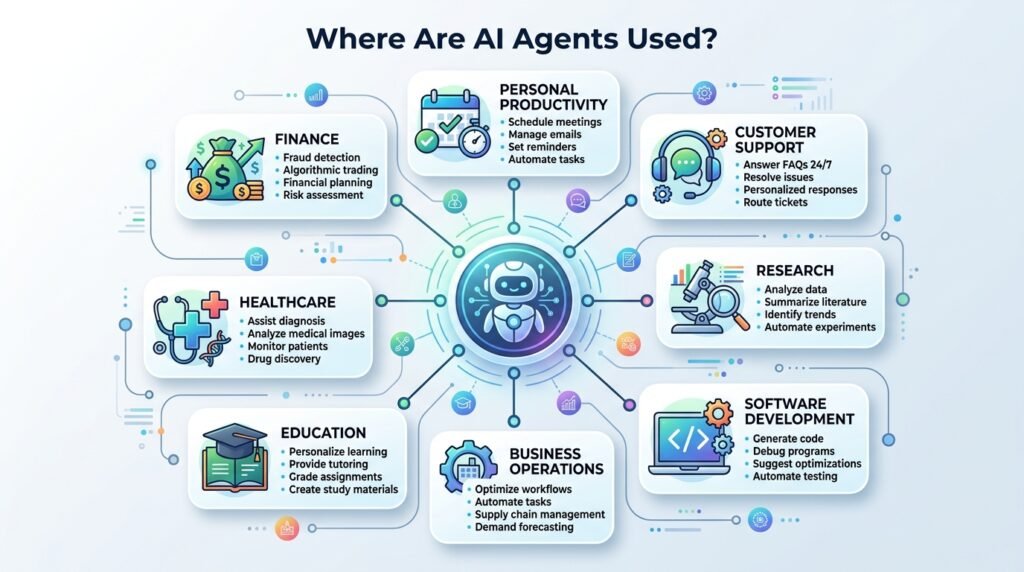
The Common Thread
Although AI agents are being applied in many different fields, they all share one key characteristic:
They help people complete multi-step tasks more efficiently by combining planning, reasoning, and action.
Rather than replacing human expertise, today’s AI agents are most effective when they work alongside people—handling repetitive work while leaving important decisions, creativity, and judgment to humans.
Benefits and Limitations of AI Agents
AI agents have the potential to transform how people work, learn, and solve problems. They can automate repetitive tasks, assist with complex workflows, and help users become more productive.
At the same time, AI agents are not perfect. Like other AI systems, they have limitations that users should understand before relying on them for important tasks.
Knowing both the advantages and the challenges will help you use AI agents more effectively and responsibly.
Benefits of AI Agents
1. Save Time on Repetitive Tasks
Many daily activities involve routine work, such as organizing emails, scheduling meetings, summarizing documents, or preparing reports.
AI agents can automate many of these repetitive tasks, allowing people to spend more time on work that requires creativity, critical thinking, or decision-making.
2. Improve Productivity
Instead of switching between multiple applications, AI agents can often complete several related tasks as part of a single workflow.
For example, an AI agent may help you:
- Research a topic.
- Organize the findings.
- Draft a report.
- Create a presentation outline.
This streamlined approach can improve efficiency for individuals and teams.
3. Handle Complex Workflows
Unlike traditional chatbots that typically respond to one request at a time, AI agents are designed to work through multi-step objectives.
This makes them useful for projects that involve planning, organizing, and coordinating several connected actions.
4. Available Around the Clock
AI agents can perform many tasks whenever they are needed, making them valuable for businesses that operate across different time zones or require continuous support.
For example, they can assist with customer inquiries, monitor routine processes, or prepare reports outside normal working hours.
5. Adapt to Different Use Cases
Modern AI agents can support a wide variety of activities, including writing, research, education, programming, business operations, and personal productivity.
As AI technology continues to evolve, new applications are likely to emerge across many industries.
Limitations of AI Agents
While AI agents offer many benefits, it’s equally important to understand their current limitations.
1. They Can Make Mistakes
AI agents can misunderstand instructions, generate inaccurate information, or make incorrect assumptions.
For this reason, important work should always be reviewed by a human before it is shared or acted upon.
2. They Depend on Available Data and Tools
An AI agent can only work with the information, tools, and permissions it has access to.
If important information is missing or a required system isn’t available, the agent may not be able to complete the task successfully.
3. Human Oversight Is Still Essential
Although AI agents can automate parts of a workflow, they are not substitutes for human judgment.
Decisions involving health, finance, legal matters, safety, or other high-impact areas should always involve qualified professionals and appropriate human review.
4. Privacy and Security Require Care
Some AI agents interact with emails, documents, calendars, or business systems.
Before granting access, it’s important to understand:
- What information the AI can access.
- How your data is stored.
- What permissions have been granted.
- Whether the service follows appropriate security and privacy practices.
Users should avoid sharing sensitive or confidential information unless they fully understand how it will be handled.
5. They Are Still Evolving
AI agents are developing rapidly, but they are not yet capable of independently handling every situation.
Unexpected inputs, changing circumstances, or ambiguous instructions can still produce unreliable results.
For the foreseeable future, the most effective approach is to treat AI agents as collaborative assistants that enhance human capabilities rather than replace them.
Finding the Right Balance
AI agents are most valuable when they combine the speed of automation with human experience, judgment, and accountability.
Think of an AI agent as a capable teammate rather than an independent decision-maker. It can help gather information, organize work, and complete repetitive tasks, but people remain responsible for setting goals, reviewing outcomes, and making important decisions.
Understanding both the strengths and limitations of AI agents will help you use them more confidently, responsibly, and effectively as the technology continues to evolve.
The Future of AI Agents
AI agents are still in the early stages of development, but they are already changing how people interact with technology. As AI models become more capable and better integrated with software and digital services, AI agents are expected to take on a wider range of tasks across both personal and professional environments.
Rather than replacing people, the more likely future is one where AI agents become collaborative assistants that help individuals work more efficiently, stay organized, and make better use of their time. Effective prompting remains an important skill when working with many AI systems.
Here are a few trends that are likely to shape the future of AI agents. Explore UNESCO Recommendation on the Ethics of AI
Smarter Task Automation
Today’s AI agents can already assist with planning, research, writing, and organization. In the future, they are expected to handle increasingly complex workflows by coordinating multiple tasks while requiring less manual input.
For example, an AI agent might help organize a business trip by comparing travel options, creating an itinerary, scheduling meetings, and preparing relevant documents—all while allowing the user to review and approve important decisions.
Better Integration with Everyday Tools
AI agents are likely to become more deeply integrated into the software people already use every day.
This may include:
- Email applications
- Calendars
- Project management platforms
- Productivity software
- Customer support systems
- Business applications
Instead of switching between multiple tools, users may increasingly rely on AI agents to help connect information and streamline routine work.
More Personalized Assistance
Future AI agents may become better at understanding a user’s preferences, work habits, and recurring tasks—provided users choose to enable these features.
For example, an AI agent might learn your preferred writing style, meeting schedule, or reporting format and use that information to provide more tailored assistance over time.
Personalization also makes privacy and transparency increasingly important, giving users greater reason to understand how their data is collected, stored, and used.
Collaboration Between Humans and AI
One of the most important trends is likely to be greater collaboration rather than full automation.
In many situations, AI agents will help people by:
- Gathering information.
- Organizing ideas.
- Completing repetitive tasks.
- Preparing first drafts.
- Suggesting possible solutions.
Humans will continue to play a critical role by providing creativity, ethical judgment, domain expertise, and final decision-making.
The most effective results often come from combining the speed of AI with the experience and critical thinking of people.
Frequently Asked Questions
Are AI agents the same as ChatGPT?
Not exactly. ChatGPT is primarily designed for conversation and generating responses to prompts. AI agents are designed to work toward a goal by planning tasks, making decisions, and carrying out multiple actions. Some modern AI systems combine conversational abilities with agent-like features, but the two terms are not interchangeable.
Can AI agents work without human supervision?
Some AI agents can perform several tasks with minimal input, but they still require human oversight, especially for decisions involving health, finance, law, safety, or other high-impact areas.
Do I need programming skills to use AI agents?
No. Many AI tools and AI agents are designed for everyday users and provide simple interfaces that do not require coding knowledge. However, technical skills can be helpful for creating more advanced workflows or custom automations.
Are AI agents safe to use?
AI agents can be useful when used responsibly, but users should always review important outputs, understand the permissions they grant, and avoid sharing sensitive information unless they trust the platform and its privacy practices.
Will AI agents replace human jobs?
AI agents are expected to automate some repetitive tasks, but many jobs involve creativity, communication, critical thinking, and human judgment that AI cannot fully replace. In many workplaces, AI is more likely to assist people than replace them entirely.
How can I start learning about AI agents?
A good starting point is to understand the fundamentals of artificial intelligence, prompt engineering, and AI tools before exploring AI agents. Building this foundation makes it easier to understand how modern AI systems plan, reason, and complete tasks.
Conclusion
AI agents represent an important step forward in the evolution of artificial intelligence. Unlike traditional AI chatbots that primarily respond to individual prompts, AI agents are designed to pursue goals, plan multiple steps, and carry out connected tasks with varying degrees of autonomy.
As the technology continues to develop, AI agents are likely to become valuable assistants for individuals, businesses, educators, and developers alike. They can help automate routine work, improve productivity, and support better decision-making, while still relying on human guidance for oversight and accountability.
Whether you’re just beginning your AI journey or exploring more advanced concepts, understanding AI agents will help you make better use of the technologies shaping the future of work and everyday life.
To continue learning, explore our related guides on What Is Artificial Intelligence?, How Does ChatGPT Work?, and What Is Prompt Engineering? Together, these articles provide a strong foundation for understanding how today’s AI systems work and how to use them effectively.
Leave a Reply