
🕒 12 min read • Updated: July 2026
Table of Contents
Introduction
Artificial Intelligence (AI) is no longer a futuristic idea—it’s already part of our daily lives. From ChatGPT helping people write emails to Netflix recommending movies and Google Maps finding the fastest route, AI is quietly powering many of the tools we use every day.
But what exactly is artificial intelligence, and how does it work?
In this beginner-friendly guide, you’ll learn what AI is, how it differs from machine learning and deep learning, the different types of AI, real-world applications, common misconceptions, and why understanding AI is becoming one of the most valuable skills in today’s digital world.
Whether you’re a student, professional, entrepreneur, or simply curious about technology, this guide will help you build a strong foundation in artificial intelligence—without requiring a technical background.
What You’ll Learn
In this guide, you’ll discover:
- What artificial intelligence actually means
- How AI works in simple terms
- The different types of AI
- Everyday examples of AI
- The benefits and limitations of AI
- The difference between AI, Machine Learning, and Generative AI
- How to start learning AI
Let’s begin with the basics.
What Is Artificial Intelligence?
Artificial Intelligence (AI) is a branch of computer science focused on creating systems that can perform tasks that normally require human intelligence.
These tasks include:
- Understanding language
- Recognizing images and objects
- Learning from data
- Solving problems
- Making recommendations
- Predicting outcomes
- Generating text, images, music, and code
Unlike traditional computer programs that simply follow fixed instructions, many AI systems can learn from data, identify patterns, and improve their performance over time.
A Simple Definition
Imagine teaching a child to recognize a cat.
Instead of giving them a list of hundreds of rules, you simply show them many pictures of cats. Over time, they begin to recognize common features such as ears, whiskers, and body shape.
Many AI systems learn in a similar way. Rather than being programmed with every possible rule, they analyze large amounts of data to identify patterns and make predictions.
This ability to learn from data is what makes AI so powerful. Artificial Intelligence is becoming part of our daily lives, powering everything from virtual assistants to modern Generative AI tools that can create text, images, and code.
Why Is AI So Important?
Artificial intelligence is becoming one of the most influential technologies of our time because it helps people and organizations make better decisions, automate repetitive work, and unlock new possibilities.
Today, AI is used to:
- AI-powered chatbots like ChatGPT can answer questions, generate content, and assist with everyday tasks. Learn more in our guide on How Does ChatGPT Work?
- Translate languages instantly
- Detect fraud in banking
- Recommend movies and music
- Assist doctors in analyzing medical images
- Help students learn more effectively
- Generate written content, images, videos, and software code
- Improve business productivity
Rather than replacing every human job, AI is increasingly becoming a tool that works alongside people, helping them complete tasks faster and more efficiently.
AI Is Already Part of Your Daily Life
Many people believe they rarely use AI.
In reality, you probably interact with it dozens of times every day.
Here are a few common examples:
| Activity | How AI Helps |
| Searching the web | Understands your query and ranks relevant results |
| Filters spam and suggests replies | |
| Navigation apps | Predicts traffic and finds faster routes |
| Streaming platforms | Recommends movies, music, and shows |
| Online shopping | Suggests products based on your interests |
| Banking | Detects suspicious transactions |
| Smartphones | Improves photos, voice recognition, and predictive typing |
AI has quietly become an invisible assistant that powers many of the digital services we rely on every day.
Common Myths About Artificial Intelligence
As AI becomes more popular, so do misconceptions. Let’s clear up a few of the most common myths.
Myth 1: AI Is the Same as a Robot
Reality: AI is software. While robots can use AI, most AI exists behind the scenes in apps, websites, and cloud services.
Myth 2: AI Thinks Like Humans
Reality: AI doesn’t have emotions, consciousness, or personal opinions. It analyzes patterns in data to produce useful outputs.
Myth 3: AI Knows Everything
Reality: AI systems can make mistakes, generate inaccurate information, or misunderstand context. Human judgment remains essential.
Myth 4: AI Will Replace Every Job
Reality: AI is more likely to transform jobs than eliminate all of them. People who learn to work effectively with AI are likely to gain a significant advantage.
Key Takeaways So Far
If you remember only a few things from this section, make them these:
- Artificial intelligence enables computers to perform tasks that typically require human intelligence.
- AI learns from data and patterns rather than following only fixed rules.
- AI is already part of many everyday technologies.
- AI is a tool that helps people make better decisions and work more efficiently.
- Understanding AI is becoming an important digital skill for the future.
A Brief History of Artificial Intelligence
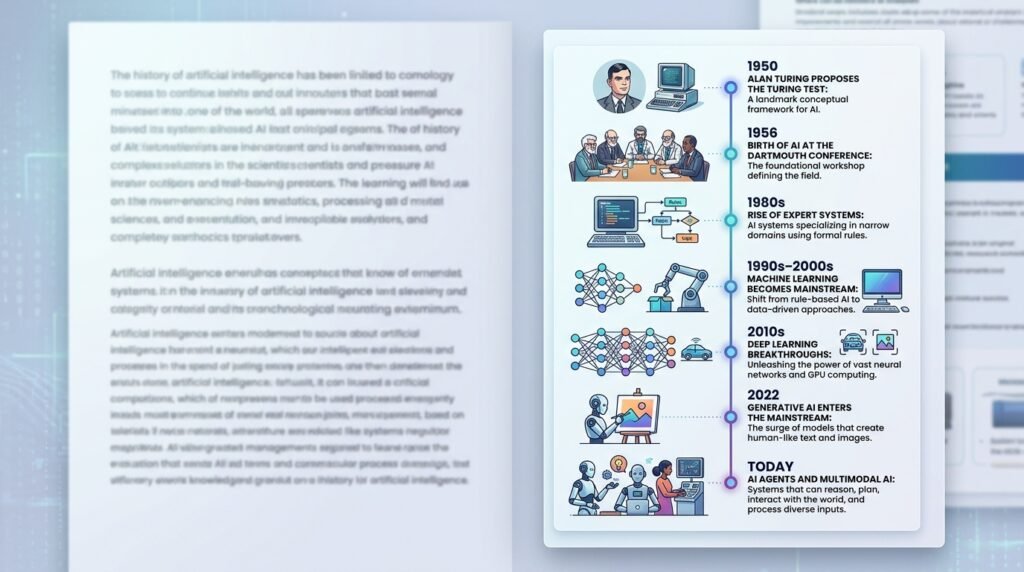
Artificial intelligence has evolved over several decades, driven by advances in computing power, data availability, and research. While AI often seems like a recent breakthrough, its foundations were established long before tools like ChatGPT became popular.
1950: The Idea of Intelligent Machines
The modern history of AI began in 1950 when British mathematician Alan Turing published the paper Computing Machinery and Intelligence. In it, he introduced the famous Turing Test, a way to evaluate whether a machine could imitate human conversation well enough to be considered intelligent. This work laid the foundation for modern AI research.
Visual Suggestion: Insert the AI Timeline Graphic here.
1956: The Dartmouth Conference
In 1956, a group of researchers gathered at the Dartmouth Summer Research Project on Artificial Intelligence in the United States. This event is widely regarded as the birth of AI as an academic field. It was here that the term “Artificial Intelligence” was officially coined, inspiring decades of research into building machines capable of solving problems, learning, and reasoning.
1980s: The Rise of Expert Systems
During the 1980s, AI gained commercial interest through expert systems—computer programs designed to mimic the decision-making abilities of human specialists. These systems were used in industries such as healthcare, manufacturing, and finance. Although they performed well in specific tasks, they relied on manually created rules and lacked the ability to learn from new data.
1990s–2010s: Machine Learning and Deep Learning
As computers became more powerful and large datasets became available, researchers shifted toward machine learning, where algorithms learn patterns directly from data instead of relying on fixed rules. This approach significantly improved AI’s ability to make predictions and recognize patterns.
Later, deep learning, a subset of machine learning inspired by the structure of the human brain, enabled breakthroughs in image recognition, speech recognition, language translation, and many other complex tasks.
Continue learning: If you’re unsure how these concepts differ, read our AI vs Machine Learning vs Deep Learning guide.
2022: The Rise of Generative AI
The release of powerful generative AI tools such as ChatGPT brought artificial intelligence into everyday life. Unlike earlier AI systems that primarily analyzed information, generative AI can create original text, images, code, music, and other content from simple prompts. This made AI accessible to millions of people, businesses, educators, and creators.
Today and Beyond: AI Agents
The latest evolution is AI agents—AI systems that can reason, plan, remember information, and complete multi-step tasks with minimal human intervention. Instead of responding to a single prompt, AI agents can perform more autonomous workflows, making them an exciting area of development for the future of artificial intelligence.
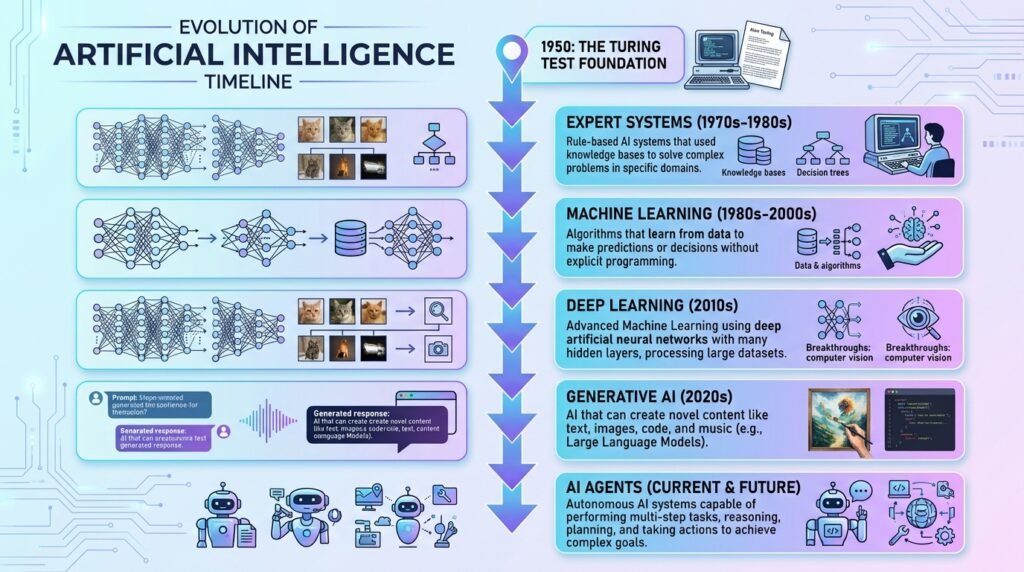
How Does Artificial Intelligence Work?
At first glance, artificial intelligence may seem like magic. You ask a chatbot a question, upload a photo for analysis, or request an image from a text prompt, and within seconds you receive a useful response.
Many modern AI systems rely on Machine Learning and Deep Learning to recognize patterns, learn from data, and improve over time. If you’re unsure how these concepts differ, read our guide on AI vs Machine Learning vs Deep Learning.
Behind the scenes, however, AI follows a structured process. While different AI systems work in different ways, most modern AI applications rely on four essential components:
- Data
- Algorithms
- Training
- Predictions
Let’s explore each one.
Step 1: Data — The Foundation of AI
Every AI system starts with data.
Data is simply information that a computer can process. It can include:
- Text documents
- Images
- Videos
- Audio recordings
- Numbers
- User interactions
- Sensor readings
Think of data as the “experience” AI learns from.
For example, if you wanted to build an AI system that recognizes cats, you would train it using thousands—or even millions—of images of cats and other animals. Over time, the AI begins identifying patterns that distinguish cats from dogs, rabbits, or other objects.
The quality of an AI system depends heavily on the quality of the data it learns from.
Good data leads to better AI. Poor or biased data can lead to inaccurate or unfair results.
Step 2: Algorithms — The Learning Rules
Once the AI has data, it needs a method to learn from it.
This method is called an algorithm.
An algorithm is a set of instructions that tells the computer how to identify patterns and make decisions.
Imagine teaching someone to identify apples.
You might say:
- Apples are usually round.
- They often have a stem.
- They can be red, green, or yellow.
An AI algorithm doesn’t receive these exact rules. Instead, it analyzes thousands of examples and discovers these patterns by itself.
This ability to learn from examples is what makes AI far more flexible than traditional software.
Step 3: Training — Learning from Examples
Training is the process where AI studies large amounts of data and improves its performance.
During training, the AI repeatedly makes predictions, compares them with the correct answers, identifies mistakes, and adjusts itself to improve future predictions.
This cycle may happen millions—or even billions—of times.
For example:
An AI designed to recognize handwritten numbers might initially confuse a “3” with an “8.” After seeing enough examples and correcting its mistakes repeatedly, it becomes much more accurate.
The more relevant, diverse, and high-quality training data an AI receives, the better it generally performs.
Step 4: Predictions — Putting Knowledge into Action
After training, the AI is ready to make predictions.
When you ask an AI chatbot a question, upload a photo, or request a recommendation, the AI analyzes the new information and uses what it learned during training to generate the most likely response.
For example:
- An email service predicts whether a message is spam.
- A streaming platform predicts which movie you might enjoy next.
- A navigation app predicts the fastest route based on current traffic.
- A chatbot predicts the most appropriate next word in its response.
Although these outputs often feel intelligent, AI is fundamentally making highly sophisticated predictions based on patterns it has learned.
AI vs Human Intelligence
| Feature | Artificial Intelligence | Human Intelligence |
|---|---|---|
| Learns from | Data and algorithms | Experience and reasoning |
| Speed | Very fast calculations | Slower but contextual |
| Creativity | Limited to training | Original thinking |
| Emotions | None | Yes |
| Decision Making | Pattern-based | Context and judgment |
| Adaptability | Requires retraining | Naturally adapts |
| Memory | Large data storage | Limited but flexible |
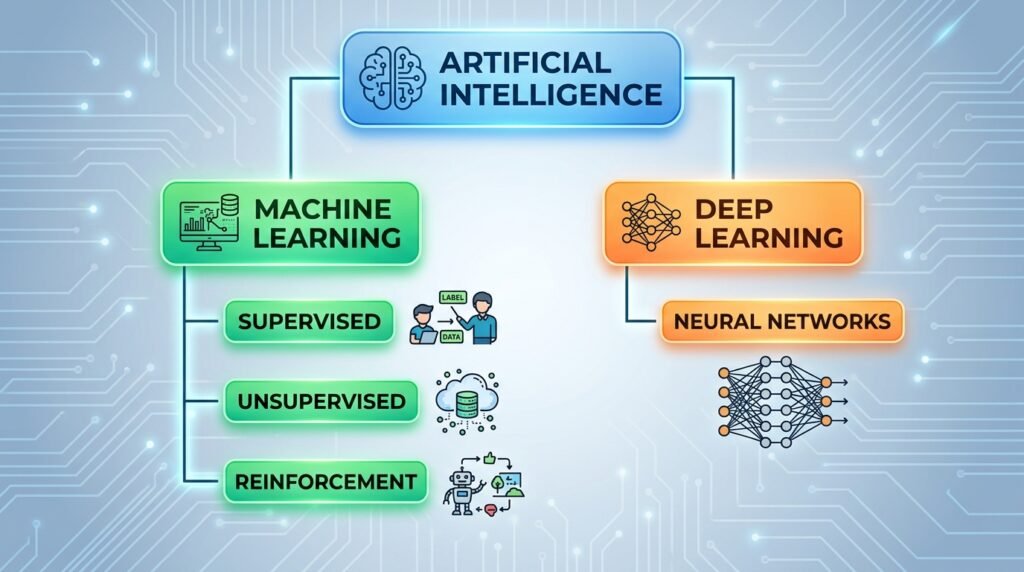
The diagram above shows how machine learning and deep learning are subsets of artificial intelligence. While AI is the broad field, machine learning enables systems to learn from data, and deep learning uses neural networks to solve more complex tasks.
A Simple Analogy
Imagine teaching a child to identify different fruits.
Instead of giving them a detailed instruction manual, you show them hundreds of examples of apples, bananas, oranges, and grapes.
Over time, they naturally recognize the differences.
AI learns in a similar way.
The main difference is that modern AI systems can study millions—or even billions—of examples far faster than any human.
What Is Machine Learning?
Machine Learning (ML) is a branch of artificial intelligence that enables computers to learn from data instead of relying only on fixed programming.
Traditional software follows explicit instructions.
For example:
If the password is correct, allow access. Otherwise, deny access.
Machine learning works differently.
Instead of following only predefined rules, it identifies patterns in historical data and uses those patterns to make future predictions.
For example, an online store doesn’t manually decide which products to recommend to every customer. A machine learning model analyzes browsing history, purchases, and customer behavior to suggest products that each individual is more likely to buy.
Machine learning powers many of the AI features we use every day, including recommendation systems, spam filters, fraud detection, and voice assistants.
What Is Deep Learning?
Deep Learning is a more advanced type of machine learning.
It uses structures called neural networks, which are loosely inspired by how neurons in the human brain are connected.
Despite the name, these neural networks do not think like humans.
Instead, they process information through multiple layers, allowing them to recognize increasingly complex patterns.
For example:
- The first layer of an image-recognition model might detect simple edges.
- The next layer identifies shapes.
- Another layer recognizes facial features.
- The final layer determines whose face appears in the image.
This layered approach is one reason deep learning has dramatically improved image recognition, speech recognition, language translation, and many other AI capabilities.
What Are Large Language Models (LLMs)?
Large Language Models (LLMs) are a type of AI designed to understand and generate human language.
They are trained on enormous collections of books, articles, websites, and other publicly available text to learn grammar, context, writing styles, and relationships between words.
When you type a question into an AI assistant, an LLM analyzes your prompt and predicts the most appropriate sequence of words to generate a helpful response.
Popular examples include conversational AI assistants and coding assistants that can explain concepts, summarize information, write drafts, or help solve problems.
It’s important to remember that LLMs do not “know” facts in the same way humans do. Instead, they generate responses based on patterns learned during training, which is why human verification remains important—especially for critical decisions.
What Is Generative AI?
Generative AI is a category of artificial intelligence that creates new content instead of simply analyzing existing information.
Depending on the model, Generative AI can produce:
- Articles
- Emails
- Images
- Videos
- Music
- Computer code
- Presentations
- Product descriptions
- Business ideas
You provide a prompt, and the AI generates original content based on what it learned during training.
This is one of the fastest-growing areas of AI because it enables individuals and businesses to create high-quality content, automate repetitive tasks, and explore ideas much more quickly than before.
However, generated content should always be reviewed for accuracy, originality, and suitability before being used in professional or important contexts.
Key Takeaways
- AI learns from data rather than following only fixed rules.
- Algorithms help AI identify patterns and make predictions.
- Machine Learning allows computers to improve through experience.
- Deep Learning uses multi-layered neural networks to solve more complex problems.
- Large Language Models specialize in understanding and generating human language.
- Generative AI creates new content such as text, images, audio, and code based on user prompts.
Types of Artificial Intelligence
Artificial intelligence can be classified in different ways. One common approach is to categorize AI based on its capabilities. While some of these categories already exist today, others remain theoretical and are the subject of ongoing research.
Understanding these types helps explain both what AI can do now and what it may be capable of in the future.
1. Reactive Machines
Reactive Machines are the simplest form of AI.
They do not remember past experiences or learn from previous interactions. Instead, they analyze the current situation and respond based only on the information available at that moment.
Characteristics
- No memory
- No learning from past experiences
- Designed for specific tasks
Example
An AI chess program that evaluates the current board position and calculates the best possible move is a classic example of a reactive machine.
Although highly effective for specific tasks, this type of AI cannot improve itself through experience.
2. Limited Memory AI
Most modern AI systems belong to this category.
Limited Memory AI can use historical information to make better decisions. It learns from data collected during training and, in some cases, uses recent information while performing tasks.
Examples
- Self-driving vehicle systems
- Fraud detection software
- Recommendation engines
- Virtual assistants
- Email spam filters
When a navigation app recommends a faster route based on current traffic conditions, it is using information beyond the immediate moment to improve its decision.
3. Theory of Mind AI (Future Technology)
Theory of Mind AI refers to systems that could understand human emotions, beliefs, intentions, and social interactions.
Such AI would be able to interpret not only what people say but also why they say it, taking emotions and context into account.
At present, this type of AI remains a research goal rather than a commercial reality.
4. Self-Aware AI (Hypothetical)
Self-Aware AI represents the idea of machines possessing consciousness and self-awareness.
A truly self-aware AI would understand its own existence, thoughts, and emotions.
Today, no such system exists.
It is a concept frequently explored in science fiction, philosophy, and academic discussions, but it remains far beyond current technological capabilities.
Real-World Applications of Artificial Intelligence
One of the reasons AI has become so influential is its ability to solve practical problems across nearly every industry.
Let’s look at some of the most common applications.
Healthcare
Healthcare professionals use AI to assist with:
- Analyzing medical images
- Supporting disease detection
- Predicting patient risks
- Organizing healthcare records
- Accelerating drug research
AI supports medical professionals by providing additional insights, but important medical decisions still rely on qualified healthcare providers.
Education
AI is making learning more personalized and accessible.
Examples include:
- Personalized learning recommendations
- Language translation
- AI tutoring
- Automated feedback
- Study assistance
Students can receive explanations tailored to their level of understanding, helping them learn more efficiently.
Finance
Banks and financial institutions use AI to:
- Detect fraudulent transactions
- Assess financial risk
- Improve customer support
- Analyze spending patterns
- Automate repetitive processes
Many online banking security systems rely on AI to identify unusual account activity within seconds.
Business
Businesses use AI to improve efficiency and decision-making.
Common applications include:
- Customer service chatbots
- Market research
- Sales forecasting
- Document summarization
- Content creation
- Workflow automation
By automating repetitive work, employees can spend more time on strategic and creative tasks.
Software Development
Developers increasingly use AI to:
- Generate code
- Explain programming concepts
- Find software bugs
- Write documentation
- Improve productivity
AI is becoming a valuable assistant rather than a replacement for software developers.
Entertainment
Many digital entertainment platforms use AI to personalize user experiences.
Examples include:
- Movie recommendations
- Music suggestions
- Video recommendations
- Personalized playlists
- Content moderation
These systems analyze user preferences to recommend content that is more likely to match individual interests.
Manufacturing
Manufacturers use AI to:
- Monitor production lines
- Predict equipment failures
- Improve quality control
- Optimize supply chains
- Reduce operational costs
Predictive maintenance helps businesses repair equipment before major failures occur, reducing downtime and expenses.
Benefits of Artificial Intelligence
AI offers numerous advantages when implemented responsibly.
Increased Productivity
AI automates repetitive tasks, allowing people to focus on higher-value work.
Better Decision-Making
AI can analyze large amounts of information much faster than humans, helping organizations identify useful insights.
Improved Accuracy
In many specialized tasks, AI can reduce human error and improve consistency.
Examples include image analysis, document processing, and quality inspection.
Personalization
AI helps deliver personalized experiences by adapting recommendations, learning paths, and digital services to individual users.
Accessibility
AI-powered tools such as speech recognition, language translation, and text-to-speech technology improve accessibility for millions of people around the world.
Limitations and Risks of AI
Despite its remarkable capabilities, AI is not perfect.
Understanding its limitations is just as important as appreciating its strengths.
AI Can Make Mistakes
AI generates predictions based on patterns, not true understanding.
As a result, it may occasionally produce inaccurate or misleading information.
This is why important decisions should always involve human review.
Bias
If an AI system is trained using biased or incomplete data, its outputs may also contain bias.
Developers work continuously to reduce these issues, but they remain an important challenge.
Privacy Concerns
Many AI applications process user information.
Organizations must handle personal data responsibly and comply with privacy regulations while protecting user information.
Overdependence
Relying too heavily on AI without critical thinking can lead to poor decisions.
AI should support human judgment rather than replace it.
Job Transformation
AI is changing how many jobs are performed.
While some repetitive tasks are becoming automated, new roles are emerging that require people to work effectively alongside AI technologies.
Developing AI literacy and digital skills will become increasingly valuable in the coming years.
AI vs Machine Learning vs Generative AI
These terms are often used interchangeably, but they have different meanings.
| Artificial Intelligence | Machine Learning | Generative AI |
| Broad field focused on creating intelligent systems | A subset of AI that learns from data | A subset of AI that creates new content |
| Covers many technologies | Focuses on prediction and pattern recognition | Focuses on generating text, images, audio, code, and more |
| Includes machine learning, robotics, planning, and reasoning | Uses training data to improve performance | Uses advanced models to produce original outputs |
Think of the relationship like this:
- Artificial Intelligence is the umbrella field.
- Machine Learning is one branch within AI.
- Generative AI is a specialized area that creates new content.
Understanding this distinction helps you navigate AI discussions more confidently.
Final Thoughts
Artificial intelligence is no longer a technology of the future—it is already part of our daily lives.
From helping doctors analyze medical images to enabling students to learn more effectively, from improving business productivity to assisting software developers, AI is transforming the way we work and solve problems.
The most important skill isn’t simply using AI—it’s understanding what AI can do, where its limitations lie, and how to apply it responsibly.
Whether you’re a student, professional, entrepreneur, or lifelong learner, building a strong foundation in AI today will prepare you for the opportunities of tomorrow.
As AI continues to evolve, those who combine curiosity, critical thinking, and practical skills will be best positioned to thrive in an AI-powered world.
Frequently Asked Questions (FAQs)
1. What is artificial intelligence in simple words?
Artificial intelligence is technology that enables computers to perform tasks that usually require human intelligence, such as understanding language, recognizing images, solving problems, and making predictions.
2. Is AI the same as Machine Learning?
No. Machine Learning is a branch of Artificial Intelligence. AI is the broader field, while Machine Learning focuses on learning from data.
3. What is Generative AI?
Generative AI is a type of AI that creates original content, including text, images, music, videos, and computer code, based on user prompts.
4. Do I need coding skills to use AI?
No. Many modern AI tools are designed for beginners and require little or no programming knowledge. However, learning basic technical concepts can help you use AI more effectively.
5. Will AI replace human jobs?
AI is changing many jobs by automating repetitive tasks, but it is also creating new opportunities. People who learn to work alongside AI are likely to benefit the most from these changes.
6. How can beginners start learning AI?
Start by understanding the fundamentals, exploring beginner-friendly AI tools, practicing with real-world use cases, and gradually learning concepts such as Machine Learning, prompt engineering, and automation. One of the best ways to learn AI is through hands-on practice. Explore our curated list of the Best AI Tools for Beginners to discover platforms for writing, research, coding, image generation, and productivity.
Recommended AI Tools
If you’d like to experience AI firsthand, start with these beginner-friendly tools:
- ChatGPT — conversational AI for writing, brainstorming, and learning.
- Gemini — Google’s AI assistant for research and productivity.
- Claude — ideal for long-form writing and document analysis.
- Perplexity AI — combines AI with web-based research.
- Canva AI — create presentations, social media graphics, and designs using AI.
👉 Explore our complete Recommended AI Tools collection for detailed reviews and beginner-friendly recommendations.
Conclusion
Artificial intelligence is one of the most significant technological developments of our time. While it can seem complex at first, its core ideas are accessible to anyone willing to learn.
By understanding how AI works, where it is used, and how to use it responsibly, you are taking the first step toward developing an essential skill for the future.
This guide is just the beginning. As you continue your AI journey, learning prompt engineering—the skill of giving AI clear and effective instructions—can help you get better results from modern AI tools.
Related Articles
- What Is Prompt Engineering?
- How to Write Better AI Prompts
- 25 Best AI Tools for Beginners
- AI Learning Roadmap
- AI Skills Development Guide
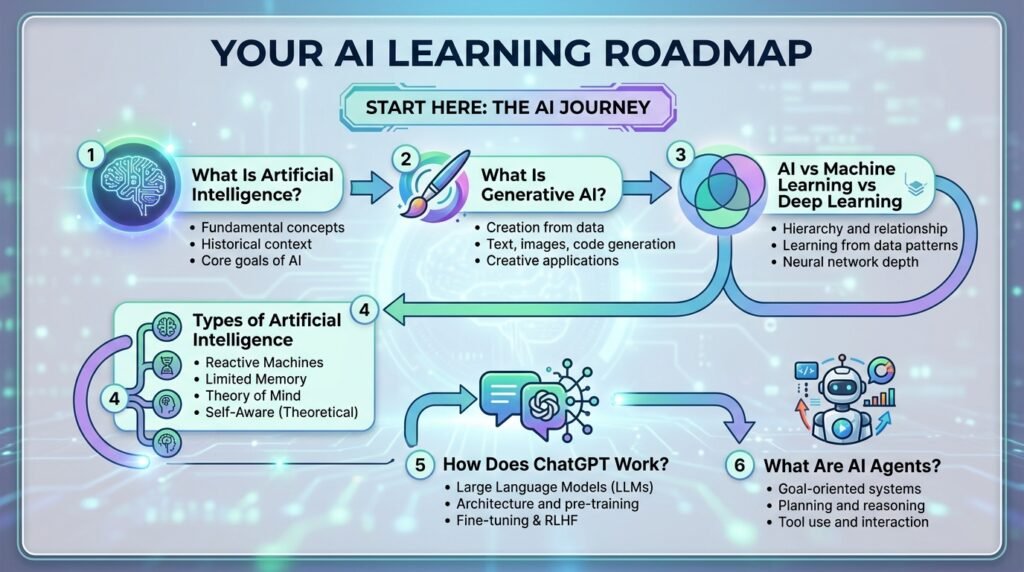
Your AI Learning Roadmap.
Further Reading
National Institute of Standards and Technology (AI terminology and AI risk resources)
Association for Computing Machinery (AI and computing articles)
Stanford University (AI research and reports)
Leave a Reply